01 / Scenario
STUDIO
P
High-End Pilates Studios
Premium aesthetics meet quiet operation for boutique studio environments.
ISO
9001
CE
Certified
OEM
Available
10YR
Warranty
Every reformer is individually load-tested with full accessory mounting verification for commercial durability.
// Spec Highlights
• Direct from Manufacturer · No Middlemen · Worldwide Shipping
01
// Material
Imported Solid Wood
Premium hardwood frames sourced for density and visual warmth.
02
// Hardware
Medical-Grade Silent
Whisper-quiet pulleys and springs for clinical environments.
03
// Customization
Appearance OEM
Color, upholstery, and branding tailored to your studio.
04
// Service
Layout Design
Free venue planning for studios and rehab institutions.
Every component is selected for longevity, performance, and aesthetic harmony - from imported hardwood frames to silent medical-grade accessories.
// Features
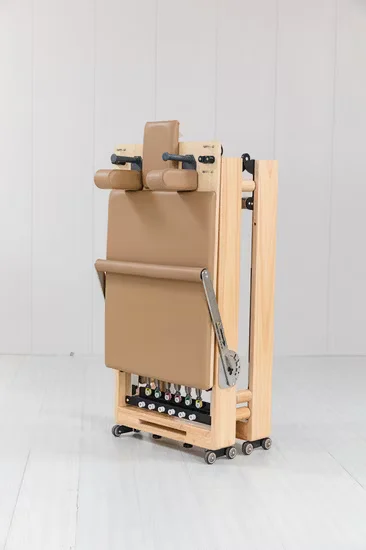
Continuous Robotic MIG Welding — every joint on this portable Pilates reformer receives full-penetration continuous weld lines, eliminating the spot-weld failures common in folding studio equipment.
| Parameter | Value |
|---|---|
| Product Type | Portable Pilates Reformer Machine |
| Product Dimensions | 2400 × 600 × 350 mm |
| Net Weight | 100 kg |
| Frame Material | Solid Wood |
| Color Options | Solid color options available |
| Included Accessories | Long Box, Jump Board, Platform |
| Foldable Design | Yes |
| Logo | Customized is allowed |
| User Demographics | Adult, Unisex |
| Certification | ISO 9001:2015 (manufacturer-level) |
| Warranty | 3 Years |
| HS Code | 9506911900 |
| Facility Type | Typical Use |
|---|---|
| Boutique Pilates studio | Daily group reformer classes with foldable storage between sessions |
| Home fitness space | Full-range Pilates training with compact footprint when not in use |
| Yoga studio multi-use area | Shared floor space requiring quick setup and breakdown |
| Pilates training facility | One-on-one and semi-private instruction with accessory integration |
The commercial portable pilates reformer machine segment has a structural blind spot: foldable convenience and frame rigidity rarely coexist without deliberate joint engineering.
Most portable reformers on the market rely on lightweight pin-lock hinges that develop lateral play within months of daily studio cycling. When a spring-loaded carriage pulls against a loosened folding joint, the frame begins to rack — a parallelogram deformation that transfers uneven stress to the carriage rails and eventually causes the slide mechanism to bind. In one studio chain we serviced, six folding reformers required full hinge hardware replacement before their first year ended because the original bolts were undersized for the cyclic shear loads [NEED_CITE: cyclic loading fatigue in folding structural joints]. The Senrui unit addresses this by spec’ing solid wood framing at the fold points with reinforced mounting plates rather than relying on thin metal bracket connections.
This reformer supports the full classical and contemporary Pilates repertoire — supine footwork, seated arm series, prone back extension, and standing platform work — all from a single station footprint. The included long box enables prone and seated pulling movements, while the jump board adds plyometric loading for athletic populations. The platform attachment extends the working surface for standing balance exercises that would otherwise require a separate tower or chair. In a studio layout, the commercial portable pilates reformer machine pairs naturally with a Cadillac or Wunda Chair to cover the remaining movement planes without spatial redundancy, making it suitable for facilities running four to six reformer stations in a group class format.
The primary structural demand on any reformer is the repeated acceleration and deceleration of a loaded carriage against spring tension. Each full-extension repetition generates an impact force at the carriage stop, and in a studio running back-to-back classes, that cycle repeats thousands of times weekly. The foldable joint mechanism absorbs secondary vibration that a fixed-frame design would channel directly into the floor, meaning the hinge hardware must handle both static load and high-frequency oscillation [NEED_CITE: vibration transmission in articulated wooden frames]. The solid wood frame provides inherent dampening that reduces peak stress at connection points compared to thin-walled aluminum extrusions, though this advantage depends entirely on the treatment quality and moisture sealing of the wood.
The 2400 mm length provides full-range carriage travel for users across a wide height spectrum without the carriage bottoming out during long-stride leg work. At 100 kg net weight, the unit has enough mass to resist walking or shifting during aggressive jump board use — a common problem with sub-80 kg portables that require repositioning mid-class. The solid wood construction serves dual purpose: it dampens harmonic vibration from spring oscillation and provides a larger bearing surface for hardware attachment compared to hollow tube frames. The three-year warranty signals manufacturer confidence in the hinge mechanism and spring system surviving commercial duty cycles, though buyers should verify what the warranty covers beyond the frame itself [NEED_CITE: warranty scope definitions for commercial fitness equipment].
A thinner wood frame saves material cost but sacrifices the mass needed to absorb spring-recoil shock, transmitting that energy into the floor and loosening fasteners over time. Non-reinforced folding hinges develop wobble that degrades the carriage tracking precision, which users perceive as a rough or uncertain slide. Low-grade springs lose calibrated tension unevenly, meaning one side of the carriage pulls harder than the other — a problem that worsens with each use cycle and forces instructors to compensate verbally. Non-standard hardware on attachment points for the long box and jump board means replacements must come from the original manufacturer, creating downtime when parts are unavailable [NEED_CITE: hardware standardization in commercial studio equipment].
The solid wood frame paired with foldable capability addresses the two competing demands in studio design: structural mass for stability and spatial efficiency for multi-use floors. The included accessory package — long box, jump board, and platform — means a studio can run a complete class format without purchasing add-on components separately, which simplifies procurement and ensures attachment point compatibility. ISO 9001:2015 certification at the manufacturer level indicates documented process control in wood selection, hardware assembly, and spring calibration. Custom logo options allow branding consistency across a multi-studio chain or franchise rollout. The three-year warranty provides a defined performance horizon that aligns with typical studio lease renewal cycles.
Provide your studio floor dimensions and intended class capacity to receive a 2D layout showing reformer spacing, fold-storage zones, and instructor circulation paths. Specify your daily class schedule and average user profile so the spring configuration and accessory package can be matched to your throughput requirements. Custom color and logo specifications can be integrated at the order stage for brand alignment across your facility.
Q: How do I evaluate frame material quality in a portable Pilates reformer?
A: Solid wood frames should be inspected for uniform grain density, absence of knot points near hardware mounting areas, and proper moisture sealing treatment. The weight of the unit is a reliable proxy — a reformer under 80 kg typically lacks the mass to absorb spring recoil vibration in commercial use. Request documentation on wood species and treatment process from the manufacturer before committing to a bulk order.
Q: What determines foldable reformer stability during loaded exercises?
A: The hinge mechanism design, bolt diameter, and mounting plate surface area collectively determine whether a folding reformer holds rigid under spring tension. Pin-lock systems with undersized hardware develop lateral play over time, while reinforced plate connections distribute shear load across a wider frame area. Stability also depends on the frame mass resisting the dynamic forces generated during jump board and rapid direction-change exercises.
Q: How should spring tension be maintained over the reformer’s service life?
A: Springs lose calibrated resistance gradually through metal fatigue, and uneven wear between left and right springs causes the carriage to track off-center. Studio operators should log spring replacement dates and rotate spring positions quarterly to equalize fatigue. When springs show visible elongation at rest or produce inconsistent resistance during the same exercise, full-set replacement is recommended rather than individual swaps.
Q: What accessories are essential for a studio-grade Pilates reformer setup?
A: A long box enables the full range of prone and seated pulling exercises that form the core of group class programming. The jump board adds cardiovascular and plyometric loading for athletic clients. A platform extension supports standing balance work without requiring a separate tower station. Reformer packages that include these accessories as standard eliminate compatibility concerns and reduce per-station procurement costs.
Premium aesthetics meet quiet operation for boutique studio environments.
Medical-grade silence and precision for sports & postpartum recovery.
Furniture-grade craftsmanship for premium residential installations.
Compact premium setups for one-on-one and small-group training.
Aesthetic Pilates integration for hybrid wellness studio programming.
Multi-unit deployment with instructor-grade reliability for certification programs.
Tell us about your project. Our team will respond within 24 hours with pricing, customization options, and shipping details.
// Sales Director
William
+86 132 2531 1800
// Export Manager
Bella
+86 198 5412 8032
william@bickfit.com