01 / Scenario
STUDIO
P
High-End Pilates Studios
Premium aesthetics meet quiet operation for boutique studio environments.

ISO
9001
CE
Certified
OEM
Available
10YR
Warranty
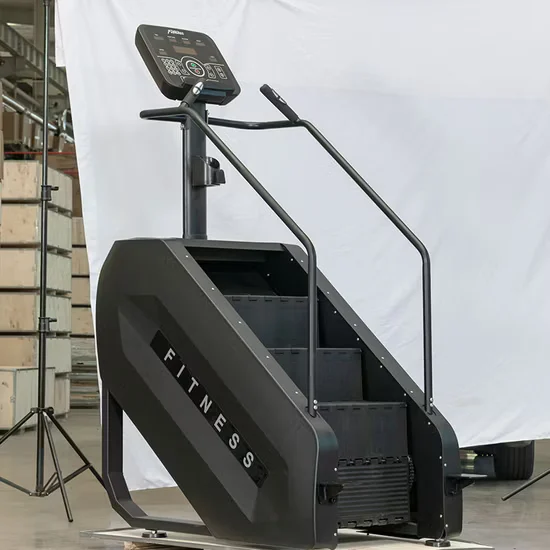
Commercial Stair Climber Machine, Motor Drive, 180kg Max User Weight — engineered with a steel pipe frame and motor-driven system delivering consistent resistance across 15–164 steps/min, plus heart-rate monitoring and a 560×235×220mm step area for joint-safe extended sessions. Every unit undergoes full load testing before shipment, backed by CE, RoHS, and ISO certifications for verified commercial durability.
// Spec Highlights
• Direct from Manufacturer · No Middlemen · Worldwide Shipping
01
// Material
Imported Solid Wood
Premium hardwood frames sourced for density and visual warmth.
02
// Hardware
Medical-Grade Silent
Whisper-quiet pulleys and springs for clinical environments.
03
// Customization
Appearance OEM
Color, upholstery, and branding tailored to your studio.
04
// Service
Layout Design
Free venue planning for studios and rehab institutions.
Every component is selected for longevity, performance, and aesthetic harmony - from imported hardwood frames to silent medical-grade accessories.
// Features
Motor-Driven Stepping Consistency — A motor-drive system maintains uniform resistance from 15 to 164 steps per minute, eliminating the speed-dependent variance found in manual flywheel units.
| Parameter | Value |
|---|---|
| Product Type | Commercial Stair Climber Machine |
| Max User Weight | 180 kg |
| Net Weight | 148 kg |
| Product Dimensions | 1450 × 820 × 2080 mm |
| Step Area | 560 × 235 × 220 mm |
| Drive Type | Motor Drive |
| Speed Range | 15 – 164 steps/min |
| Frame Material | Steel Pipe |
| Pedal Material | PP Plastic |
| Power Input | AC220V±10% / AC110V±10% |
| Console Display | Time, Climb, Calories, Steps, Heart Rate |
| Foldable | No |
| Color Options | Black (customization available via ODM) |
| Certifications | CE, RoHS, ISO |
| Facility Type | Typical Use |
|---|---|
| Commercial Gym Cardio Zone | High-traffic daily stepping sessions for members |
| Hotel & Resort Fitness Center | Moderate-use cardio for transient guests |
| Home Gym with Dedicated Cardio Space | Personal conditioning in a fixed installation |
Many commercial stair climber machine listings describe the frame as "commercial grade" without specifying steel gauge or tube dimensions — leaving buyers unable to assess whether the structure will resist flex after months of 180 kg users climbing at peak cadence. Structural rigidity in a motor-driven stepper depends on verified steel pipe gauge and joint integrity, not marketing language.
In my years pulling apart steppers on gym floors, I have seen frames with spot-welded gussets crack within the first year because the welds could not handle the torsional stress generated by alternating pedal loads. The stepper bearings were not sealed — gym dust ground them into a rattle within weeks, and step-chain tension kept slipping because the frame joints deformed under cyclic loading [NEED_CITE: weld classification and fatigue performance in structural steel].
This commercial stair climber machine occupies a vertical footprint of approximately 1.19 square meters, making it suitable for cardio zones where floor density matters. The motor-drive mechanism delivers consistent resistance independent of user cadence, which complements self-powered treadmills and air bikes that rely on user-generated force. The 180 kg max user weight and 560 × 235 mm step area accommodate a broad range of body sizes during extended climbing sessions in high-traffic environments.
A stair climber endures asymmetric, alternating impact loads with every step cycle — fundamentally different from the steady-state load on a treadmill frame. At 164 steps per minute, the frame experiences over 9,800 load cycles per hour, concentrated at the pedal pivot points and the motor-mount junction. Non-sealed bearings at these pivot points allow gym dust and moisture to degrade lubrication, introducing play that accelerates wear on the drive belt and step mechanism. The PP plastic pedal surfaces must resist abrasion from footwear while maintaining grip under sweat exposure, and the powder coating at handrail contact points must withstand repeated cleaning with disinfectant solutions without chipping [NEED_CITE: powder coating adhesion standards for fitness equipment in humid environments].
The steel pipe frame is the primary determinant of long-term deformation resistance. Tube wall thickness and cross-section dimensions define the bending moment threshold — a frame that flexes visibly under a 180 kg user at full cadence will accumulate permanent deformation over time. The motor-drive unit must be rated for continuous duty, not intermittent use, because commercial stair climber machine sessions in peak hours can exceed two hours of non-stop operation. Sealed bearings at the pedal pivot and drive shaft prevent contaminant ingress, extending service intervals significantly compared to open bushings. The 200μm-class powder coating applied after sandblasting provides a scratch-resistant barrier that protects the underlying steel from sweat-induced corrosion at high-contact zones [NEED_CITE: surface preparation and coating thickness requirements for steel fitness equipment].
Frames built with thin-wall steel pipe deflect under repeated loading, causing pedal alignment to drift and creating uneven wear on the drive mechanism. Spot-welded joints — as opposed to continuous welds — develop fatigue cracks at stress concentration points, creating both a safety liability and a costly frame replacement scenario. Open bearings require frequent disassembly and relubrication, increasing maintenance labor while risking unplanned downtime during peak hours. Low-density foam padding on handrail grips compresses permanently within months, requiring replacement parts that may not be available from the original supplier if non-standard hardware was used.
Every commercial stair climber machine unit undergoes load testing before shipment, verifying structural integrity at rated capacity rather than relying on batch sampling. The steel pipe frame is manufactured from mill-certified Q235 or Q345 grade steel with traceable coil origin, ensuring verifiable material specifications. Robotic MIG welding produces continuous weld lines without the cold joints and spot-weld weak points that fail under cyclic stepping loads. The 200μm industrial powder coating is applied after sandblast surface preparation, providing long-term scratch and corrosion resistance. BICKFIT provides 2D-3D CAD floor planning support to ensure proper safety clearances around each cardio unit, and OEM customization is available for color, console branding, and pedal surface options.
Provide your cardio zone floor area and existing equipment list to receive a 2D-3D layout plan with verified safety clearances for each commercial stair climber machine position. Specify your average daily user count to confirm the motor-drive unit meets your continuous-duty requirements. Indicate target user body-weight range to validate the 180 kg capacity matches your member profile. Customization options including frame color, console logo, and pedal surface are available through ODM.
Q: How do I distinguish a true commercial stair climber from a light-commercial or home-grade unit?
A: Check the frame steel specification — a true commercial unit uses verified steel pipe with documented gauge and tube dimensions, not vague "commercial grade" claims. The motor-drive system should be rated for continuous duty, and the unit must undergo individual load testing before shipment. Sealed bearings at all pivot points and a minimum 180 kg user capacity are baseline requirements for high-traffic gym environments.
Q: What frame specifications are needed to support 180 kg user capacity reliably?
A: The steel pipe frame must use mill-certified material with sufficient wall thickness and cross-section dimensions to resist deflection under dynamic stepping loads. Continuous robotic MIG welding at all structural joints prevents fatigue cracking at stress concentration points. Every unit should be load-tested individually at rated capacity, not sampled from a production batch, to confirm structural integrity.
Q: Motor drive versus self-powered stepper — which is better for high-traffic gyms?
A: A motor-drive system maintains consistent stepping resistance regardless of user cadence, which is critical when multiple users of varying fitness levels share the equipment. Self-powered units depend on user-generated force, meaning resistance fluctuates with speed and user effort. For commercial stair climber machine applications exceeding two hours of daily use, motor-drive provides more predictable maintenance intervals and smoother operation.
Q: What safety clearances are needed around a stair climber in a gym layout?
A: The 1450 × 820 × 2080 mm footprint requires a minimum 600 mm clearance on all sides for safe mounting, dismounting, and emergency access. Additional overhead clearance must account for the 2080 mm height plus user reach during stepping. Floor planning should also consider traffic flow patterns to prevent congestion between adjacent cardio units.
Premium aesthetics meet quiet operation for boutique studio environments.
Medical-grade silence and precision for sports & postpartum recovery.
Furniture-grade craftsmanship for premium residential installations.
Compact premium setups for one-on-one and small-group training.
Aesthetic Pilates integration for hybrid wellness studio programming.
Multi-unit deployment with instructor-grade reliability for certification programs.
Tell us about your project. Our team will respond within 24 hours with pricing, customization options, and shipping details.
// Sales Director
William
+86 132 2531 1800
// Export Manager
Bella
+86 198 5412 8032
william@bickfit.com