01 / Scenario
STUDIO
P
High-End Pilates Studios
Premium aesthetics meet quiet operation for boutique studio environments.

ISO
9001
CE
Certified
OEM
Available
10YR
Warranty
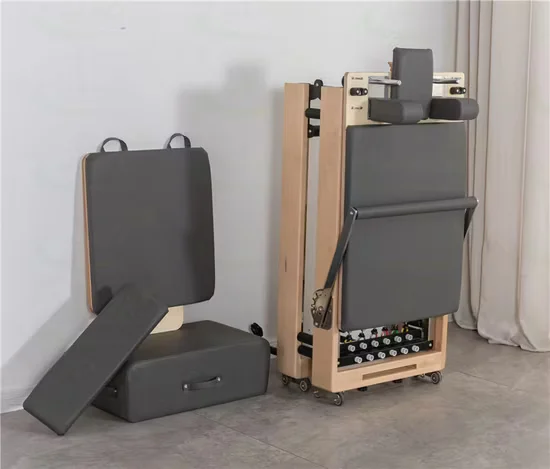
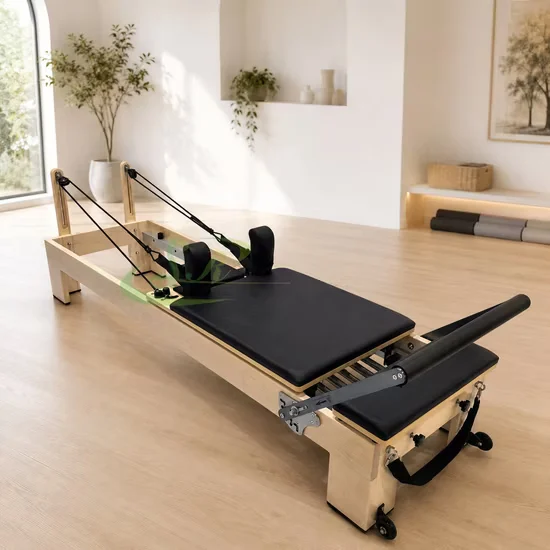
Pilates Cadillac Reformer with Full Trapeze Tower, Solid Wood Frame, 2400×770×2160mm — constructed from solid timber with verified joinery for long-term dimensional stability under spring tension, featuring sealed carriage bearings and integrated push-through bar, jump board, and platform attachments rated for daily commercial studio use. Every unit undergoes load testing and 32-point inspection before shipment, backed by a 3-year structural warranty with customizable color and logo options available.
// Spec Highlights
• Direct from Manufacturer · No Middlemen · Worldwide Shipping
01
// Material
Imported Solid Wood
Premium hardwood frames sourced for density and visual warmth.
02
// Hardware
Medical-Grade Silent
Whisper-quiet pulleys and springs for clinical environments.
03
// Customization
Appearance OEM
Color, upholstery, and branding tailored to your studio.
04
// Service
Layout Design
Free venue planning for studios and rehab institutions.
Every component is selected for longevity, performance, and aesthetic harmony - from imported hardwood frames to silent medical-grade accessories.
// Features
Solid Timber Rigidity — solid wood joinery resists spring-induced creep better than laminated alternatives, backed by a 3-year structural warranty.
| Parameter | Value |
|---|---|
| Product Type | Pilates Cadillac Reformer |
| Frame Material | Solid Timber Wood |
| Frame Construction | Joinery (species and joint type customizable) |
| Product Dimensions | 2400×770×2160mm |
| Net Weight | 150kg |
| Tower Configuration | Full Trapeze Tower |
| Included Accessories | Long Box / Jump Board / Platform |
| Color Options | Solid Color (customizable) |
| Logo | Customized |
| Target User | Adult, Unisex |
| Warranty | 3 Years |
| Facility Type | Typical Use |
|---|---|
| Commercial Pilates studio | Group and private reformer sessions with full tower exercises |
| Rehabilitation and physiotherapy center | Low-impact therapeutic movement and progressive resistance protocols |
| Boutique fitness studio | Integrated mat-and-apparatus class formats |
| Hotel and resort wellness facility | Guest-accessible reformer sessions and supervised programming |
| Private training room | Dedicated one-on-one instruction with full attachment range |
Solid timber joinery determines whether a commercial Pilates Cadillac reformer with trapeze tower holds geometry under daily spring tension or slowly racks out of square.
Many studio owners discover too late that laminated plywood frames delaminate at the stress points where tower uprights meet the carriage bed. Veneered particle board hides internal voids that compress under repeated jump board impacts. A commercial timber wood pilates cadillac reformer with trapeze tower built from solid stock with verified mortise-and-tenon or doweled connections distributes spring loads across the full grain length rather than concentrating force at fastener points [NEED_CITE: wood joinery fatigue under cyclic tension loading]. The difference surfaces within the first year of high-frequency studio scheduling.
This commercial timber wood pilates cadillac reformer with trapeze tower covers supine, prone, seated, and standing movement patterns through push-through bar, trapeze, and spring-loaded attachment points. It pairs with a dedicated mat zone and complements Wunda Chair or Spine Corrector stations in a full-apparatus studio layout. The 2400×770mm footprint fits standard studio bays with appropriate clearance for instructor circulation on three sides, accommodating users across a wide range of limb lengths and torso proportions.
The trapeze tower endures eccentric loading whenever a user applies force through the push-through bar at an angle offset from the upright centerline. Each session generates hundreds of spring tension cycles that transmit vibration through the tower-to-bed connection. Carriage wheels and bearings experience continuous lateral force during footwork sequences, while upholstery contact points compress and release under body weight shifts. Wood framing absorbs vibration differently than steel, reducing transmitted resonance to the floor [NEED_CITE: vibration dampening characteristics of solid timber vs. steel framing in fitness apparatus]. Surface finishes must withstand sweat, cleaning solvents, and repeated skin contact without degrading grain integrity.
Wood species selection directly affects how the frame responds to long-term spring tension. Dense hardwoods with tight grain patterns resist the slow deformation known as creep, while softer species compress at fastener points over months of use. Grain orientation in tower uprights should run parallel to the primary load path to prevent cross-grain splitting. Joint type is the second critical variable — mortise-and-tenon connections distribute force across broad glue surfaces, whereas screw-only assemblies concentrate stress at each fastener and loosen under vibration. Carriage wheel bearings determine glide consistency: sealed bearings exclude dust and chalk residue that accelerate wear in bushing-type systems. Upholstery density on the carriage bed must balance user comfort against compression set over thousands of use cycles, and replacement availability determines long-term operating cost [NEED_CITE: upholstery compression standards for commercial fitness equipment].
Frames built from laminated plywood or veneered composites show edge delamination where springs anchor, requiring full panel replacement rather than localized repair. Screw-only joinery loosens under vibration and demands periodic retightening that studio schedules rarely accommodate. Non-sealed bearings develop play that creates uneven carriage travel, affecting exercise precision and increasing instructor correction time. Low-density upholstery compresses permanently within months of commercial use, forcing reupholstery or full carriage replacement. Thin surface finishes wear through at contact points, exposing bare wood to moisture absorption and dimensional swelling [NEED_CITE: maintenance cost comparison for solid timber vs. composite fitness frames].
Solid timber sourcing should include species identification and moisture content documentation at the time of manufacture. Joinery methods must be specified in purchase documentation rather than left to production discretion. Every unit should undergo carriage load testing before shipment to verify wheel alignment and spring tension consistency. A 3-year structural warranty signals manufacturer confidence in frame timber selection and joint engineering. Customization options for color, logo, and accessory configuration allow studio branding alignment without compromising frame integrity.
Provide your studio floor dimensions and target apparatus count to receive a 2D-3D layout that positions this commercial timber wood pilates cadillac reformer with trapeze tower with correct safety clearances. Specify daily class volume and user throughput to confirm that the timber specification and joinery method match your operational intensity. Detail any custom color, logo, or accessory requirements to align equipment appearance with your studio design standards.
Q: How can I verify that a Pilates reformer frame is solid timber rather than laminated or veneered?
A: Examine exposed edges and end grain for continuous grain patterns that run through the full thickness. Laminated plywood shows alternating grain layers, while veneered particle board reveals uniform composite material beneath a thin surface layer. Request a cross-section sample or species certification from the manufacturer before placing a commercial order.
Q: What spring tension range suits a commercial studio versus a home setup?
A: Commercial studios serving diverse clients need a broader spring tension range to accommodate varying strength levels and therapeutic protocols. Spring sets should include multiple resistance options per carriage, with quick-change mechanisms for efficient class transitions. Verify that replacement springs are available as standard catalog items rather than custom-order components.
Q: How do trapeze tower attachment points affect frame longevity?
A: Each attachment point creates a stress concentration where dynamic loads transfer from the tower upright to the bed frame. Solid timber with proper joinery distributes these forces across a larger glue surface area, while screw-only connections gradually loosen under repeated off-center loading. The tower-to-bed connection method is the single most important structural detail for long-term frame geometry.
Q: What is the replacement cycle for carriage wheels, springs, and upholstery in a busy studio?
A: Carriage wheels with sealed bearings typically maintain smooth travel through years of daily use, while bushing-type systems develop play sooner. Springs lose calibrated tension gradually and should be tested annually against specification. Upholstery lifespan depends on density rating and cleaning protocol, with commercial-grade materials lasting significantly longer than residential alternatives under identical use volume.
Premium aesthetics meet quiet operation for boutique studio environments.
Medical-grade silence and precision for sports & postpartum recovery.
Furniture-grade craftsmanship for premium residential installations.
Compact premium setups for one-on-one and small-group training.
Aesthetic Pilates integration for hybrid wellness studio programming.
Multi-unit deployment with instructor-grade reliability for certification programs.
Tell us about your project. Our team will respond within 24 hours with pricing, customization options, and shipping details.
// Sales Director
William
+86 132 2531 1800
// Export Manager
Bella
+86 198 5412 8032
william@bickfit.com