01 / Scenario
STUDIO
P
High-End Pilates Studios
Premium aesthetics meet quiet operation for boutique studio environments.

ISO
9001
CE
Certified
OEM
Available
10YR
Warranty
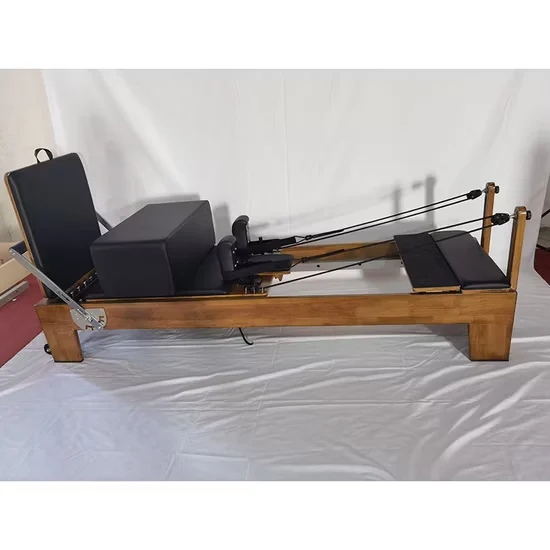
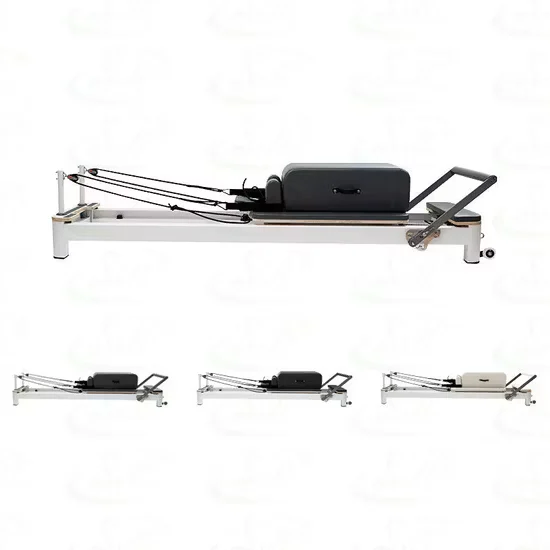
Foldable Aluminum Pilates Reformer, 2570×730mm Frame, 90kg Net Weight — aluminum construction resists corrosion in humid studio environments while enabling easy repositioning between class setups. Includes long box, jump board, and platform to expand exercise variety without additional equipment footprint. Backed by 3-year warranty and custom logo options for studio branding.
// Spec Highlights
• Direct from Manufacturer · No Middlemen · Worldwide Shipping
01
// Material
Imported Solid Wood
Premium hardwood frames sourced for density and visual warmth.
02
// Hardware
Medical-Grade Silent
Whisper-quiet pulleys and springs for clinical environments.
03
// Customization
Appearance OEM
Color, upholstery, and branding tailored to your studio.
04
// Service
Layout Design
Free venue planning for studios and rehab institutions.
Every component is selected for longevity, performance, and aesthetic harmony - from imported hardwood frames to silent medical-grade accessories.
// Features
Foldable Frame Rigidity — aluminum hinge joints engineered with dual-axis locking to resist carriage-induced oscillation during high-frequency studio classes.
| Parameter | Value |
|---|---|
| Product Type | Pilates Reformer |
| Frame Material | Aluminum |
| Color | White (custom color options available) |
| Product Dimensions | 2570 × 730 × 270 mm |
| Net Weight | 90 kg |
| Accessories Included | Long Box / Jump Board / Platform |
| Custom Logo | Available |
| Target User | Adult, Unisex |
| Warranty | 3 Years |
| Facility Type | Typical Use |
|---|---|
| Pilates and yoga studio | Group reformer classes running 6–8 sessions daily |
| Rehabilitation and physiotherapy clinic | Low-impact controlled resistance therapy |
| Boutique home gym | Space-constrained residential training environments |
| Hotel fitness center | Multi-use wellness floor with shared equipment zones |
| University athletic department | Supplemental mobility and core conditioning |
A foldable commercial foldable aluminum Pilates reformer must lock as rigidly as a fixed-frame unit when deployed — anything less introduces carriage wobble and spring misalignment.
I used to draft studio floor plans in CAD and watched reformer placements get swapped for cheaper folding models to squeeze in extra stations. Six months later, the hinge pins wore oval-shaped holes in the aluminum extrusion, and instructors started compensating for lateral play by cueing students wider on the carriage [NEED_CITE: EN 957 structural requirements for stationary training equipment]. The issue was never the aluminum itself — it was that the folding mechanism was rated for static storage load, not the dynamic eccentric forces a jump board generates when a 90 kg client lands mid-class.
The commercial foldable aluminum Pilates reformer covers the full sagittal and frontal plane movement spectrum — from supine footwork through standing platform work — making it the primary load-bearing station in any reformer-based programming model. In a studio running mat-to-reformer circuits, this unit pairs with a cadillac or tower for vertical-plane work and a stability chair for unilateral loading. It fits high-density room layouts where the foldable footprint reclaims floor space between sessions, and the carriage travel accommodates users from roughly 150 cm to 190 cm without accessory swapping.
Every class cycle subjects the foldable commercial foldable aluminum Pilates reformer to repeated eccentric-deceleration loads: a client springs off the jump board, the carriage slams into the stopper, and that shockwave transmits through the rail, into the hinge bracket, and down to the floor feet. Over 500+ cycles weekly, the hinge pin and its aluminum bore become the critical wear interface [NEED_CITE: fatigue classification for cyclically loaded aluminum joints]. Unsealed wheel bearings on the carriage accumulate chalk dust and sweat residue, increasing rolling resistance unevenly across the rail. The spring hooks experience micro-abrasion at the eyelet contact face, and aluminum surfaces exposed to chloride-based cleaners develop pitting if the anodizing or powder coat is underspecified.
Aluminum frame reformers trade steel’s mass for corrosion resistance — a meaningful advantage in high-humidity studios where sweat-saturated towels rest against rails between classes. The alloy grade determines whether the extrusion resists denting when a jump board is clipped and unclipped hundreds of times; aerospace-grade 6061-T6 is the threshold for commercial duty. The carriage rail-to-wheel interface defines long-term smoothness: polymer wheels on anodized aluminum rails roll quieter but require periodic straightness verification, while sealed ball bearings in the carriage trucks prevent the lateral play that develops when open bushings ingest particulate matter. Spring progression — whether light, medium, heavy, or extra-heavy resistance bands are available — dictates how broadly the commercial foldable aluminum Pilates reformer serves both rehab clients needing minimal load and athletes requiring peak resistance. The foldable latch mechanism must engage with positive detent, not friction-fit, because any carriage movement during a plank series will telegraph instability through the student’s entire kinetic chain.
A folding reformer that saves floor space but uses stamped-steel hinge pins in soft aluminum bores will develop carriage drift within the first year of commercial rotation. Non-sealed carriage bearings require monthly cleaning in high-traffic studios — a maintenance burden most operators discover only after students complain of sticky carriage travel [NEED_CITE: bearing maintenance intervals in commercial fitness equipment]. Thin vinyl upholstery on the shoulder blocks and headrest compresses past its recovery threshold after roughly 2,000 class-hours, leaving permanent deformation that alters client positioning. If the spring hooks are formed from spring-tempered wire without a wear sleeve at the attachment eyelet, they notch and eventually fracture — and if the manufacturer does not stock replacement springs, the entire unit becomes a parts donor for its siblings.
The aluminum frame on the commercial foldable aluminum Pilates reformer resists the corrosive studio environment where humidity and cleaning chemicals degrade carbon steel frames over time. The foldable design addresses the real constraint in multi-use spaces: a room that hosts reformer classes in the morning and mat sessions in the afternoon needs equipment that stores vertically without requiring two staff to lift it. Spring calibration sheets and replacement hook availability mean the resistance system stays accurate across years of group-class cycling. The three-year warranty covers frame and carriage components, and OEM branding — custom logo on the end panel — lets studio operators maintain visual identity without a separate private-label contract. For facilities planning a full reformer room, 2D-3D layout CAD support ensures that folded and deployed clearances, instructor walkways, and emergency egress paths all resolve on paper before equipment ships.
Provide your studio square footage and target class capacity to receive a 2D-3D layout showing deployed and folded equipment positions, instructor circulation paths, and storage wall integration. Specify daily class volume and average client body weight range so the spring resistance grading and carriage load rating match your actual operational demand. Indicate any custom branding requirements — color-matched frame finish, logo placement on the end panel, or upholstered accessory materials — early in the specification process to align production lead time with your opening schedule.
Q: How do I evaluate aluminum versus steel frame durability for a commercial Pilates reformer?
A: Aluminum offers corrosion resistance and lighter weight for repositioning, which matters in humid studios and multi-use rooms where reformers fold between sessions. Steel frames resist denting better under impact loads but require protective coating integrity. For studios running high class volume with equipment storage cycles, aluminum with aerospace-grade alloy certification and adequate wall thickness on the extrusion delivers the practical durability advantage.
Q: What load and cycle testing should a foldable reformer pass before I specify it?
A: Request documentation showing the hinge mechanism tested under dynamic carriage loading — not just static weight on the deployed frame. Carriage rail straightness tolerance, wheel bearing specification, and spring hook fatigue data should all be available. A reputable manufacturer provides per-unit test records, not just sample-batch certifications, because production variance in aluminum extrusion affects hinge bore consistency.
Q: How should I maintain carriage rails and wheel bearings in a high-traffic studio?
A: Wipe rails after each class session to remove chalk, sweat, and skin oils that accelerate bearing wear. Inspect wheel rotation monthly for lateral play or uneven rolling resistance, which indicates particulate intrusion into unsealed bearings. Studios exceeding heavy daily usage should budget for bearing replacement annually and verify that the manufacturer stocks compatible parts rather than requiring full carriage assembly swaps.
Q: What spring replacement intervals and resistance options should I plan for?
A: Springs lose calibration progressively with cycle count, so studios running reformer-intensive programming should verify resistance accuracy quarterly using a spring scale. Availability of multiple resistance grades — light through extra-heavy — lets instructors match load to client capability without stacking excessive springs. Confirm that replacement springs and hook attachments are available as individual spare parts to avoid replacing entire spring assemblies.
Q: How do accessories and storage work for multi-class studio operations?
A: The long box, jump board, and platform extend exercise variety without consuming additional floor stations. Plan wall-mounted or under-reformer storage for these accessories when units fold between sessions. Confirm that accessory mounting interfaces — pin locks, clip brackets, or slot-in channels — match across your reformer fleet so instructors can swap accessories between units without compatibility issues during class transitions.
Premium aesthetics meet quiet operation for boutique studio environments.
Medical-grade silence and precision for sports & postpartum recovery.
Furniture-grade craftsmanship for premium residential installations.
Compact premium setups for one-on-one and small-group training.
Aesthetic Pilates integration for hybrid wellness studio programming.
Multi-unit deployment with instructor-grade reliability for certification programs.
Tell us about your project. Our team will respond within 24 hours with pricing, customization options, and shipping details.
// Sales Director
William
+86 132 2531 1800
// Export Manager
Bella
+86 198 5412 8032
william@bickfit.com