01 / Scenario
STUDIO
P
High-End Pilates Studios
Premium aesthetics meet quiet operation for boutique studio environments.

ISO
9001
CE
Certified
OEM
Available
10YR
Warranty
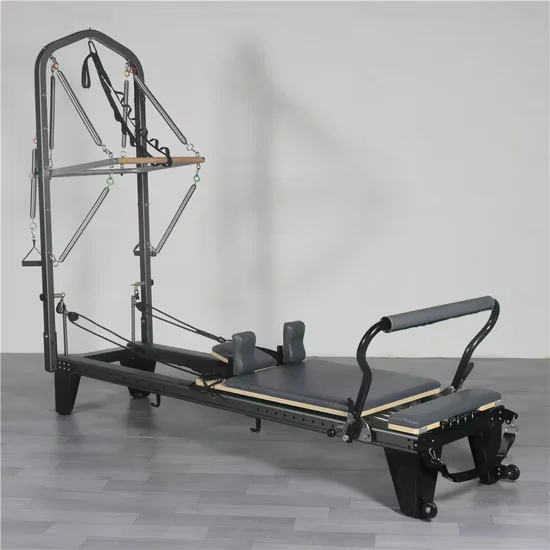
Folding Pilates Reformer, Solid Oak Wood Frame, 2400×600×350mm Dimensions — engineered with solid oak construction for dimensional stability and warp resistance under daily studio cycling. Includes long box, jump board, and platform accessories with foldable joint mechanism for space-efficient storage. Backed by 3-year warranty and ISO 9001:2015 / CE / SGS certified manufacturing with three-stage QC inspection on every unit.
// Spec Highlights
• Direct from Manufacturer · No Middlemen · Worldwide Shipping
01
// Material
Imported Solid Wood
Premium hardwood frames sourced for density and visual warmth.
02
// Hardware
Medical-Grade Silent
Whisper-quiet pulleys and springs for clinical environments.
03
// Customization
Appearance OEM
Color, upholstery, and branding tailored to your studio.
04
// Service
Layout Design
Free venue planning for studios and rehab institutions.
Every component is selected for longevity, performance, and aesthetic harmony - from imported hardwood frames to silent medical-grade accessories.
// Features
10-Year Frame Backing — solid oak construction and load-tested carriage systems supported by long-term structural warranty for studio operators.
| Parameter | Value |
|---|---|
| Product Type | Folding Pilates Reformer |
| Material | Solid Oak Wood |
| Product Dimensions | 2400×600×350mm |
| Net Weight | 100kgs |
| Accessory Options | Long Box / Jump Board / Platform |
| Color | Solid Color |
| Assembly State | Foldable |
| Logo | Customized Is Allowed |
| Age Group | Adult |
| Gender | Unisex |
| Certification | ISO 9001:2015 / CE / SGS |
| Warranty | 3 Years |
| Facility Type | Typical Use |
|---|---|
| Commercial Pilates studio | Daily group reformer classes and private sessions |
| Boutique fitness studio | Premium equipment floor with space-flexible layout |
| Hotel and resort wellness facility | Guest-facing wellness programming and spa-adjacent movement studios |
| Rehabilitation and physical therapy center | Controlled spring-resistance protocols for recovery and mobility work |
| Home Pilates practice | Foldable storage for dedicated residential training space |
Solid oak resists delamination and rail drift that composite frames develop within months of studio cycling.
Many studio operators purchase reformers advertised as wood-frame, only to discover the frame is laminated plywood or veneer-wrapped composite. Under daily carriage loading and repeated folding cycles, these layered materials begin separating at glue lines. The rail mounting points shift, carriage glide becomes uneven, and the entire unit develops lateral play that instructors notice during footwork sequences. Solid oak maintains dimensional stability through grain structure rather than adhesive bonds, meaning the rail alignment you set on day one holds through years of commercial scheduling [NEED_CITE: dimensional stability of solid hardwood vs. laminated composites under cyclic loading].
This commercial oak wood folding Pilates reformer covers the full classical and contemporary movement repertoire — supine footwork, seated arm work, prone pulling, and standing platform exercises. In a studio layout, it pairs with Cadillac towers and chair units to create progressive circuit programming. The foldable format serves boutique studios that convert floor space between group classes and private sessions. The carriage dimensions and spring configuration accommodate users from rehabilitation clients working low-resistance glides through athletic populations loading progressive tension sequences.
The carriage and rail interface absorbs eccentric loading every time a user returns the carriage under spring tension — a force cycle that repeats hundreds of times per day in a busy studio. The foldable hinge mechanism bears concentrated stress at the joint connection when the unit is deployed, particularly during standing exercises where lateral forces transfer through the frame. Spring attachment points experience sustained tension that can cause anchor hardware to loosen over months of use if not properly torqued. The oak frame itself handles compressive and bending loads well, but the hardware connections — rail screws, hinge bolts, spring anchors — represent the wear path that determines service life [NEED_CITE: fatigue performance of hardware connections in solid wood fitness equipment].
The relationship between rail straightness and carriage wheel clearance defines whether the reformer operates smoothly or develops the binding sensation that frustrates instructors. When rails are mounted with even slight parallel deviation, the carriage wheels bind against the guide surface under off-center loads — exactly what happens during single-leg footwork or standing work. Solid oak provides a stable mounting substrate that does not flex or warp with humidity changes, keeping rail geometry consistent. The carriage wheel material and bearing configuration determine noise level and maintenance intervals; sealed bearings resist sweat and dust infiltration that degrades glide quality in high-traffic environments. The foldable design adds a second structural consideration: the hinge mechanism must lock rigidly during use without introducing play that transfers into the rail system.
A reformer built on composite or low-grade pine frames may arrive at the studio looking identical to a solid oak unit in photos. The separation appears under scheduling pressure. Plywood layers delaminate at screw insertion points as humidity cycles cause expansion and contraction. Non-sealed carriage bearings develop play within the first year, creating the rattling sound that clients associate with cheap equipment. Upholstery on budget units uses thin vinyl over low-density foam, splitting at the seams and requiring reupholstery that costs nearly as much as a replacement carriage. Spring sets on economy reformers lose tension retention faster, requiring full spring replacement on a cycle that experienced studios recognize immediately.
The solid oak frame choice traces to grain-density requirements for long-term rail stability under commercial scheduling. Robotic MIG welding is applied to all metal hardware connections — carriage brackets, spring anchors, and hinge plates — ensuring continuous weld lines rather than spot-weld attachments that crack under repeated loading. Every unit undergoes load testing before shipment, with the carriage cycled under resistance to verify glide consistency. The 200μm powder coating on all metal hardware resists corrosion from sweat and cleaning chemicals common in studio environments. The 10-year structural backing covers the oak frame integrity, and 2D-3D floor planning CAD support ensures proper spacing between reformers for instructor circulation and client safety.
Provide your studio floor dimensions and class capacity targets to receive 2D-3D layout planning that accounts for instructor circulation paths and emergency clearance. Specify anticipated daily session volume so the carriage system and spring configuration can be matched to your scheduling density. Identify your primary user population — rehabilitation clients, general fitness members, or athletic training groups — to confirm spring resistance range and accessory selection. Communicate branding requirements including custom logo placement and color preferences early in the specification process.
Q: How do I verify a reformer is solid oak rather than laminated composite?
A: Request mill documentation showing wood species and sourcing origin. Examine frame cross-sections at hardware insertion points — solid oak shows continuous grain, while laminated composite reveals layered construction. Solid oak weighs significantly more than plywood alternatives at equivalent dimensions. The weight difference becomes apparent during folding and repositioning.
Q: What specifications determine whether the carriage glides smoothly over years of use?
A: Rail parallelism tolerance, carriage wheel material hardness, and bearing sealing quality all contribute. Sealed bearings resist dust and moisture infiltration that causes grinding. Solid oak frames maintain rail mounting geometry better than composite materials that flex under humidity changes. Request loaded glide test data from the manufacturer before purchasing.
Q: Are foldable reformers structurally compromised compared to fixed-frame designs?
A: Foldable units introduce a hinge joint that must lock rigidly during use. The engineering quality of the hinge mechanism and locking hardware determines whether structural integrity holds. Well-designed foldable reformers use reinforced hinge plates with positive-lock systems that eliminate play when deployed, performing comparably to fixed frames during all movement patterns.
Q: How should spring resistance be matched to different studio applications?
A: Rehabilitation centers benefit from lighter progressive tension springs that allow precise loading increments. Athletic training studios need heavier springs that maintain tension retention under high-load pulling patterns. Multi-use studios typically configure reformers with a full spring set covering both ranges, allowing instructors to adjust resistance based on individual client programming needs.
Premium aesthetics meet quiet operation for boutique studio environments.
Medical-grade silence and precision for sports & postpartum recovery.
Furniture-grade craftsmanship for premium residential installations.
Compact premium setups for one-on-one and small-group training.
Aesthetic Pilates integration for hybrid wellness studio programming.
Multi-unit deployment with instructor-grade reliability for certification programs.
Tell us about your project. Our team will respond within 24 hours with pricing, customization options, and shipping details.
// Sales Director
William
+86 132 2531 1800
// Export Manager
Bella
+86 198 5412 8032
william@bickfit.com