01 / Scenario
STUDIO
P
High-End Pilates Studios
Premium aesthetics meet quiet operation for boutique studio environments.
ISO
9001
CE
Certified
OEM
Available
10YR
Warranty
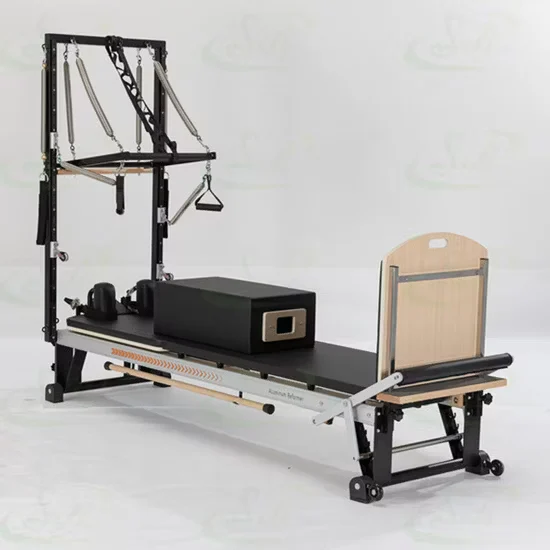
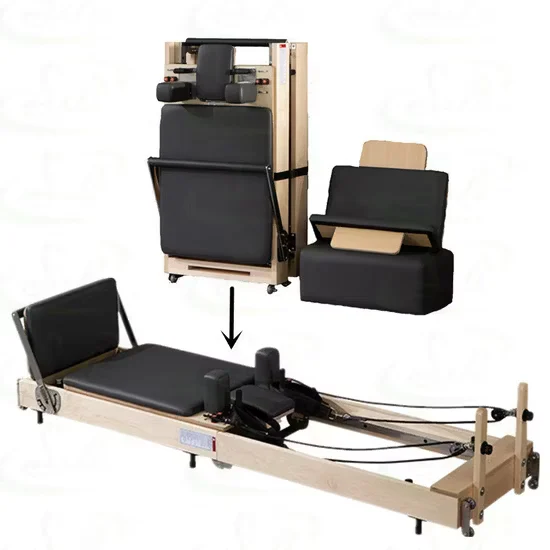
Solid Maple Wood Pilates Reformer, 2460×730mm, 150kg Net Weight — built with solid maple frame for rigidity and vibration dampening, includes long box, jump board, and platform for full-range training. 3-year warranty with customized logo options available. Each unit undergoes 32-point inspection and 100% load testing before shipment.
// Spec Highlights
• Direct from Manufacturer · No Middlemen · Worldwide Shipping
01
// Material
Imported Solid Wood
Premium hardwood frames sourced for density and visual warmth.
02
// Hardware
Medical-Grade Silent
Whisper-quiet pulleys and springs for clinical environments.
03
// Customization
Appearance OEM
Color, upholstery, and branding tailored to your studio.
04
// Service
Layout Design
Free venue planning for studios and rehab institutions.
Every component is selected for longevity, performance, and aesthetic harmony - from imported hardwood frames to silent medical-grade accessories.
// Features
Solid Maple Rigidity — kiln-dried hardwood frame resists humidity warping and keeps carriage rails aligned under daily studio loading.
| Parameter | Value |
|---|---|
| Product Type | Pilates Reformer |
| Frame Material | Solid Maple Wood |
| Product Dimensions | 2460 × 730 × 1900 mm |
| Net Weight | 150 kg |
| Included Accessories | Long Box, Jump Board, Platform |
| Color Options | Solid color options available |
| Logo | Customized logo options available |
| Warranty | 3 Years |
| Customization | Available |
| Facility Type | Typical Use |
|---|---|
| Home Pilates studio | Daily reformer training in dedicated residential workout rooms with controlled humidity environments |
| Boutique Pilates and yoga facility | Group class rotations with back-to-back scheduling on shared reformer units throughout operating hours |
| Rehabilitation and movement training center | Controlled resistance work for post-injury clients requiring smooth carriage travel and predictable spring tension |
Solid maple resists the grain separation and rail misalignment that plagues laminated plywood reformers in high-humidity environments.
Many studio owners purchase reformers built from engineered wood or softwood cores topped with thin veneer. These frames look fine on day one, but once exposed to the humidity swings of a working studio — sweat, ventilation changes, seasonal moisture — the composite layers begin to delaminate. The carriage rail is the first casualty. Even slight warping along the rail bed introduces lateral play in the carriage wheels, and users feel that wobble immediately during footwork sequences. I saw this exact failure pattern with a batch we shipped to a coastal client: ordinary bearings with no seal, combined with a laminate frame that couldn’t hold flat tolerance in high humidity, and the carriage was rocking within six months. That failure drove a complete redesign of how we spec rail-to-frame mating surfaces. [NEED_CITE: moisture content tolerance and dimensional stability in hardwoods used for precision equipment frames]
A solid maple wood Pilates reformer eliminates the layered structure entirely. The grain runs continuously through the rail mounting zone, so there is no adhesive layer to fail and no thin veneer to lift at the edges.
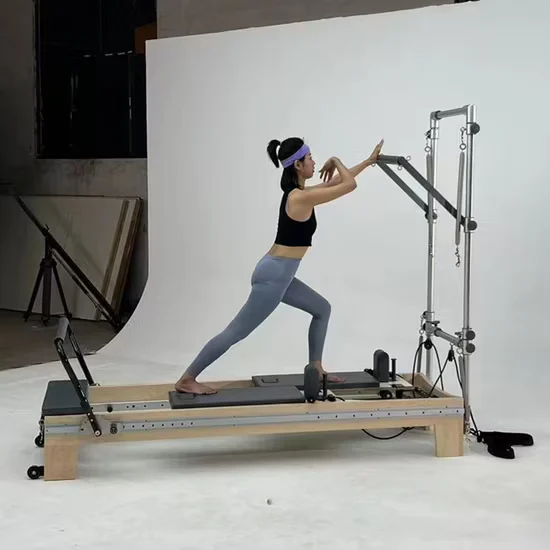
The solid maple wood Pilates reformer covers the primary movement plane for supine, prone, and seated exercises — essentially the workhorse unit that every client touches during a session. In a studio configured with six to twelve stations, this reformer anchors the center floor while specialized apparatus like the Cadillac and Wunda Chair handle supplementary movements around the perimeter. The 2460 mm length accommodates users across a broad height range without requiring the studio to stock multiple frame sizes. The included long box, jump board, and platform mean instructors can program full sessions without pulling additional equipment from storage, which matters when class changeover windows are tight.
Every time a user performs jump board work, the carriage slams against the stopper mechanism and transmits shock through the rail and into the frame’s end joints. In a studio running four to six classes daily, that impact cycle repeats hundreds of times per week. Solid maple’s density absorbs and dissipates this vibration rather than transmitting it as resonance through the frame, which is one reason the material choice matters beyond aesthetics. The spring anchor points experience continuous tensile and release cycles that concentrate stress at the attachment hardware — any wood frame must maintain fastener grip across thousands of these load reversals without the surrounding fibers compressing or splitting. The wheel-to-rail interface is where wear accumulates fastest, and rail surface hardness directly determines whether the carriage maintains its glide quality or develops dead spots over months of use. [NEED_CITE: cyclic loading effects on wood-to-metal fastener joints in repetitive-use fitness equipment]
The density of solid maple gives it a dimensional stability that softer hardwoods and engineered boards simply cannot match when humidity fluctuates. A frame cut from maple holds its rail flatness because the wood’s cellular structure resists the swelling and contraction cycles that cause other species to cup or twist over time. At the joints — where the rail assembly meets the end uprights — the construction method determines whether the frame stays square under asymmetric loading. Mortise-and-tenon or doweled joints distribute force across a broad glue surface and mechanical interlock, while frames assembled only with mechanical fasteners through end grain will loosen as the wood fibers compress around the hardware. The spring configuration and its anchor geometry define how resistance progresses through the carriage stroke, and those anchor points must be set into wood thick enough to prevent localized crushing under sustained tension.
A reformer built on laminated plywood saves material cost upfront but transfers that cost to the studio owner as premature replacement. Once the laminate layers separate near the rail mounting zone, no amount of tightening or adjustment recovers carriage alignment — the frame itself is the failure point. Underspecified bearings compound the problem: open bearings ingest chalk dust and sweat residue, develop play within months, and require the studio to pull the carriage off-rail for service during operating hours. Non-standard spring hardware means that when a spring fatigues or a cable frays, replacement parts may not exist from the original supplier, forcing the studio to fabricate custom solutions or retire the unit entirely. Thin lacquer finishes on the wear surfaces chip under carriage contact and expose bare wood to moisture absorption at exactly the points where dimensional precision matters most. [NEED_CITE: bearing seal classification and contamination ingress rates in high-use fitness environments]
The solid maple frame is sourced and kiln-dried to a moisture content matched to typical indoor environments, reducing the chance of post-delivery movement that throws the rail out of tolerance. Every carriage rail surface is inspected for flatness before wheel hardware is installed — this is the step I personally check after the coating batch we lost to humidity-related bearing failure years ago. Spring sets are matched by tensile rating so that resistance across the anchor points progresses predictably through the full carriage stroke. The 3-year warranty covers frame and structural hardware, giving studio operators a defined coverage window for procurement planning. Units ship with long box, jump board, and platform pre-matched to the frame’s attachment points, so accessory fit is confirmed at the factory rather than discovered on the studio floor.
Share your studio floor dimensions and planned reformer count to receive a 2D layout showing unit spacing with safe carriage clearance and instructor walkways. Specify your expected daily class volume so we can confirm the structural rating matches your use intensity. Let us know your target client demographic and height range so we can verify accessory and spring configuration suitability. Custom color and logo placement options are available — provide your branding specifications for a visual mockup before production begins.
Q: How does solid maple compare to engineered wood for long-term reformer frame stability?
A: Solid maple maintains its structural integrity as a single continuous piece of hardwood, so there are no adhesive layers between plies that can separate under humidity changes. Engineered wood frames rely on bonded layers that can delaminate over time, especially at the carriage rail mounting zone where precision matters most. This makes solid maple a more stable choice for studios in regions with seasonal humidity swings.
Q: What should I check to evaluate carriage glide quality on a wood reformer?
A: Push the carriage through its full travel range without springs attached and feel for any catching, lateral play, or dead spots along the rail. The carriage should move with consistent, light resistance and return to center without wandering sideways. Inspect the wheel material and whether the bearings are sealed — open bearings accumulate dust and sweat that degrade smoothness within months of regular studio use.
Q: How does spring resistance selection differ for beginners versus advanced users?
A: Beginners benefit from lighter spring tensions that allow focus on form and controlled movement through the full range without compensating for excessive load. Advanced users typically require heavier springs and combinations that challenge eccentric control during return phases. A well-configured reformer includes multiple spring weights that can be combined, letting instructors scale resistance to individual client strength levels across a group class.
Q: How do humidity and temperature affect maintenance of a solid wood reformer?
A: Wood naturally expands and contracts with ambient moisture changes, so keeping the studio environment within a stable humidity range minimizes dimensional movement in the frame. Avoid placing the reformer near heating vents or in direct sunlight, as localized drying can cause uneven stress. Wipe down surfaces with a barely damp cloth after use and allow airflow around the unit to prevent moisture trapping against the wood.
Premium aesthetics meet quiet operation for boutique studio environments.
Medical-grade silence and precision for sports & postpartum recovery.
Furniture-grade craftsmanship for premium residential installations.
Compact premium setups for one-on-one and small-group training.
Aesthetic Pilates integration for hybrid wellness studio programming.
Multi-unit deployment with instructor-grade reliability for certification programs.
Tell us about your project. Our team will respond within 24 hours with pricing, customization options, and shipping details.
// Sales Director
William
+86 132 2531 1800
// Export Manager
Bella
+86 198 5412 8032
william@bickfit.com