01 / Scenario
STUDIO
P
High-End Pilates Studios
Premium aesthetics meet quiet operation for boutique studio environments.

ISO
9001
CE
Certified
OEM
Available
10YR
Warranty
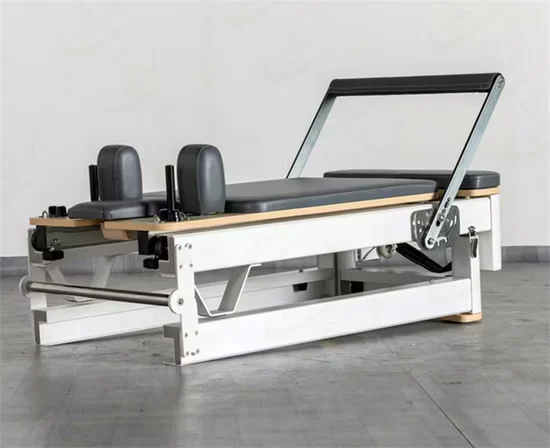
White Aluminium Pilates Reformer, 2570×730×270mm, 90kg Net Weight — engineered with aluminium alloy frame for high rigidity-to-weight ratio, minimizing rail deflection under repetitive loading. Includes long box, jump board, and platform with quick-swap interfaces for seamless training flow. Customizable logo and color options available with 3-year warranty. Backed by 32-point inspection and 100% load testing before shipment.
// Spec Highlights
• Direct from Manufacturer · No Middlemen · Worldwide Shipping
01
// Material
Imported Solid Wood
Premium hardwood frames sourced for density and visual warmth.
02
// Hardware
Medical-Grade Silent
Whisper-quiet pulleys and springs for clinical environments.
03
// Customization
Appearance OEM
Color, upholstery, and branding tailored to your studio.
04
// Service
Layout Design
Free venue planning for studios and rehab institutions.
Every component is selected for longevity, performance, and aesthetic harmony - from imported hardwood frames to silent medical-grade accessories.
// Features
Structural Traceability — Aluminium alloy material certified to the source coil, ensuring consistent frame rigidity across every commercial aluminium pilates reformer leaving our facility.
| Parameter | Value |
|---|---|
| Product Type | Pilates Reformer |
| Frame Material | Aluminium Alloy |
| Frame Color | White (customizable) |
| Product Dimensions | 2570 × 730 × 270 mm |
| Net Weight | 90 kg |
| Standard Accessories | Long Box, Jump Board, Platform |
| Target User | Adult, Unisex |
| Customization | Color and logo available on request |
| Warranty | 3 Years |
| Production Capacity | 80 Pieces / Month |
| Facility Type | Typical Use |
|---|---|
| Pilates studio | Core conditioning and flexibility classes on the commercial aluminium pilates reformer |
| Commercial fitness center | Dedicated reformer zone complementing strength and cardio floors |
| Rehabilitation and physical therapy clinic | Low-impact controlled movement for injury recovery and post-surgery protocols |
| Boutique fitness studio | Small-group reformer sessions with premium equipment positioning |
Rigidity under cyclic loading determines whether a reformer lasts years or months.
Many studio operators have encountered the same failure pattern: a reformer that felt solid on day one develops carriage wobble by month six, and the pulley system begins to bind under asymmetric loads. The root cause usually traces back to undersized aluminium profiles or wall thickness reductions made to cut unit cost. When the carriage track deflects even slightly under repeated jump board impacts, the entire movement quality degrades and maintenance calls multiply [NEED_CITE: aluminium extrusion fatigue behavior under cyclic loading in fitness equipment]. A commercial aluminium pilates reformer built with properly specified alloy and adequate profile dimensions avoids this trajectory entirely.
This reformer supports supine, prone, seated, and standing movement patterns, targeting core stabilizers, hip flexors, gluteal chains, and scapular stabilizers across the full range of studio programming. On a typical studio floor, it pairs with cadillacs and chair units to create a complete apparatus circuit, and its footprint allows high-density layouts without compromising instructor walkways. The platform dimensions accommodate a wide range of user body sizes, making it suitable for both group class environments and one-on-one rehabilitation sessions. The commercial aluminium pilates reformer occupies a central role in any apparatus-based programming model.
Reformer frames endure a combination of static carriage loads, dynamic jump board impacts, and eccentric forces when users perform unilateral movements at the strap limits. In a busy studio running six or more classes daily, the carriage track undergoes thousands of sliding cycles per week, concentrating wear at the mid-span deflection point and the pulley anchor zones. The aluminium alloy frame must resist micro-deformation at these stress concentration points without developing play that translates into audible carriage rattle or uneven resistance delivery [NEED_CITE: fatigue performance classification for aluminium structural components in repetitive-load applications]. Upholstery contact points on the shoulder rests and headrest face simultaneous compression and perspiration exposure, demanding material choices that resist both mechanical breakdown and chemical degradation.
The 90 kg net weight of this unit reflects an aluminium profile selection that prioritizes rigidity-to-weight balance, keeping the reformer stable during jump board work while remaining manageable for studio reconfiguration. The 2570 mm overall length provides full carriage travel for tall users without requiring excessive floor space, and the 730 mm width allows comfortable shoulder placement for broader-framed clients. Standard accessory compatibility with the long box, jump board, and platform means the quick-release interfaces must maintain positional accuracy through repeated attachment and removal cycles. Surface finishing on the white powder-coated frame resists chipping at the carriage stop points and high-contact grip areas, maintaining appearance through years of daily commercial use.
Reducing aluminium wall thickness by a small margin lowers the unit price noticeably but invites a cascade of downstream failures. Carriage track deflection under load causes pulley misalignment, accelerating cable wear and creating uneven spring resistance that instructors and clients detect immediately. Connection points between the frame and carriage rails become stress risers where hairline cracks propagate undetected until a structural failure occurs during use. Non-sealed bearings in the carriage system accumulate dust and perspiration residue, increasing friction and requiring frequent service interventions that pull equipment off the studio floor [NEED_CITE: bearing seal integrity requirements for high-cycle fitness equipment]. The cumulative cost of replacement parts, technician visits, and lost class revenue typically exceeds the initial savings within the first year.
Every commercial aluminium pilates reformer we produce uses aluminium alloy with material certification traceable to the supplier batch, so profile dimensions and mechanical properties remain consistent across production runs. Carriage track flatness and straightness are inspected on every unit before assembly, not sampled from a batch. Each assembled reformer undergoes sliding resistance testing to confirm carriage smoothness meets specification before packaging. The three-year warranty on this product reflects confidence in the structural specification rather than a marketing commitment, backed by a manufacturer that has equipped over 500 commercial facilities and exports to more than 45 countries. Customization of frame color and logo is available for studios building a branded environment, with OEM private label options for distributors.
Provide your studio floor dimensions and desired reformer count so we can return a layout showing safe spacing and traffic flow. Specify your expected daily class volume so we can confirm the structural grade matches your usage intensity. Share your user demographic profile to verify the carriage travel and accessory dimensions accommodate your client base. Indicate any customization requirements for frame color, logo placement, or upholstery selection so we can confirm process feasibility and lead time.
Q: How does an aluminium frame compare to steel for commercial reformer use?
A: Aluminium alloy offers a favorable rigidity-to-weight ratio, keeping the reformer stable during dynamic movements while allowing studio staff to reposition units without heavy lifting. Steel frames are heavier and may resist higher static loads, but aluminium with adequate profile dimensions performs well in the cyclic loading patterns typical of studio classes and rehabilitation sessions.
Q: What should I look for when evaluating carriage track durability?
A: Check whether the track flatness and straightness are inspected on every unit rather than sampled from a batch. The carriage should glide without lateral play or binding under off-center loads. Sealed bearings prevent dust and perspiration from degrading the sliding surface over time, which is critical in high-frequency studio environments.
Q: How often should upholstery be replaced in a commercial studio?
A: Upholstery lifespan depends on class volume, cleaning protocols, and material density. In studios running multiple classes daily, inspect shoulder rests and headrests monthly for surface cracking or compression set. Having replacement upholstery panels available from the manufacturer minimizes equipment downtime when refreshment is needed.
Q: What floor spacing do I need between reformers in a group class layout?
A: Plan enough lateral space between units for instructors to walk and assist clients, plus longitudinal clearance for the long box and jump board accessories when attached. Exact spacing depends on your room dimensions and class format, and a layout drawing can be provided based on your floor plan.
Premium aesthetics meet quiet operation for boutique studio environments.
Medical-grade silence and precision for sports & postpartum recovery.
Furniture-grade craftsmanship for premium residential installations.
Compact premium setups for one-on-one and small-group training.
Aesthetic Pilates integration for hybrid wellness studio programming.
Multi-unit deployment with instructor-grade reliability for certification programs.
Tell us about your project. Our team will respond within 24 hours with pricing, customization options, and shipping details.
// Sales Director
William
+86 132 2531 1800
// Export Manager
Bella
+86 198 5412 8032
william@bickfit.com