
Buy Commercial Weight Plates Wholesale Supplier Bick Factory Direct Price 2026
The cheapest weight plate per kilogram is almost never the lowest total cost of ownership.
To buy weight plates at the best price in 2026, you must match material grade, tolerance class, and container-loading strategy to your actual end-use scenario — not just chase the lowest per-kilo FOB quote. A factory-direct supplier who pre-validates flange bore compatibility, rubber compound durability, and mixed-SKU palletization will save you multiples of the unit-price gap you thought you won.
I still remember the angle grinder sparks flying across a gym floor in Riyadh. A commercial gym owner had just taken delivery of a full container of rubber-coated plates, and not a single one would slide onto his Olympic bars. The flange bore was off by a couple of millimeters — close enough to pass a casual visual check, but enough to jam hard on the chrome sleeve. Opening day was pushed back, and I spent the night widening every bore by hand. That was the project that moved me off the installation van and into the sales seat. Every quote I build now starts with one question: what bar and collar system is the end user running? [NEED_CITE: IWF Technical & Competition Rules on barbell sleeve and collar dimensions]

Once you anchor the conversation to the actual bar system, the rest of the pricing puzzle — material, rubber grade, packaging, container mix — falls into place. Let’s walk through it the way a real procurement cycle does.
What Types of Weight Plates Should You Buy for Your Gym in 2026?
Material and tolerance class decide service life and member experience far more than the unit price tag does.
When gym owners ask me to buy weight plates at the best price, they usually mean the lowest sticker number. But the real cost driver is how long the plate survives in a high-traffic commercial environment before it chips, cracks, smells, or damages the bar sleeve. Three families dominate the market in 2026: virgin rubber-coated, recycled rubber-coated, and competition-grade steel/urethane plates. The differences are not cosmetic.
| Attribute | Virgin Rubber-Coated | Recycled Rubber-Coated | Competition Steel/Urethane |
|---|---|---|---|
| Odor after unboxing | Noticeably reduced | Strong, persistent | Noticeably reduced |
| Crack resistance under drops | Robust | Vulnerable | Robust |
| Weight tolerance | Standard (±50 g class) | Uncontrolled | Controlled (±10 g class) |
| Flange bore consistency | Controlled | Uncontrolled | Controlled |
| Best-fit scenario | General commercial gym | Light home use, budget retail | CrossFit, IWF-affiliated clubs |
[NEED_CITE: IWF Technical & Competition Rules on plate weight tolerance and diameter]
A distributor in West Africa once ordered a mixed container of recycled-rubber plates because the per-kilo price looked attractive. Within half a year, the rubber layer on the heavier denominations was splitting at the insert — the recycled compound simply could not handle repeated drops on a concrete floor with only a thin rubber mat underneath. Replacement frequency ended up being several times higher than a virgin-rubber batch would have delivered, and the shipping cost of the replacements ate the original saving many times over.
A CrossFit box owner in the Gulf, by contrast, went with urethane-encased competition plates. The upfront price was noticeably higher, but the plates stayed dimensionally stable and the bars showed no sleeve scoring even after extended daily use. For a facility where plates hit the platform hundreds of times a day, the maintenance-cost curve flips in favor of the premium option surprisingly quickly.
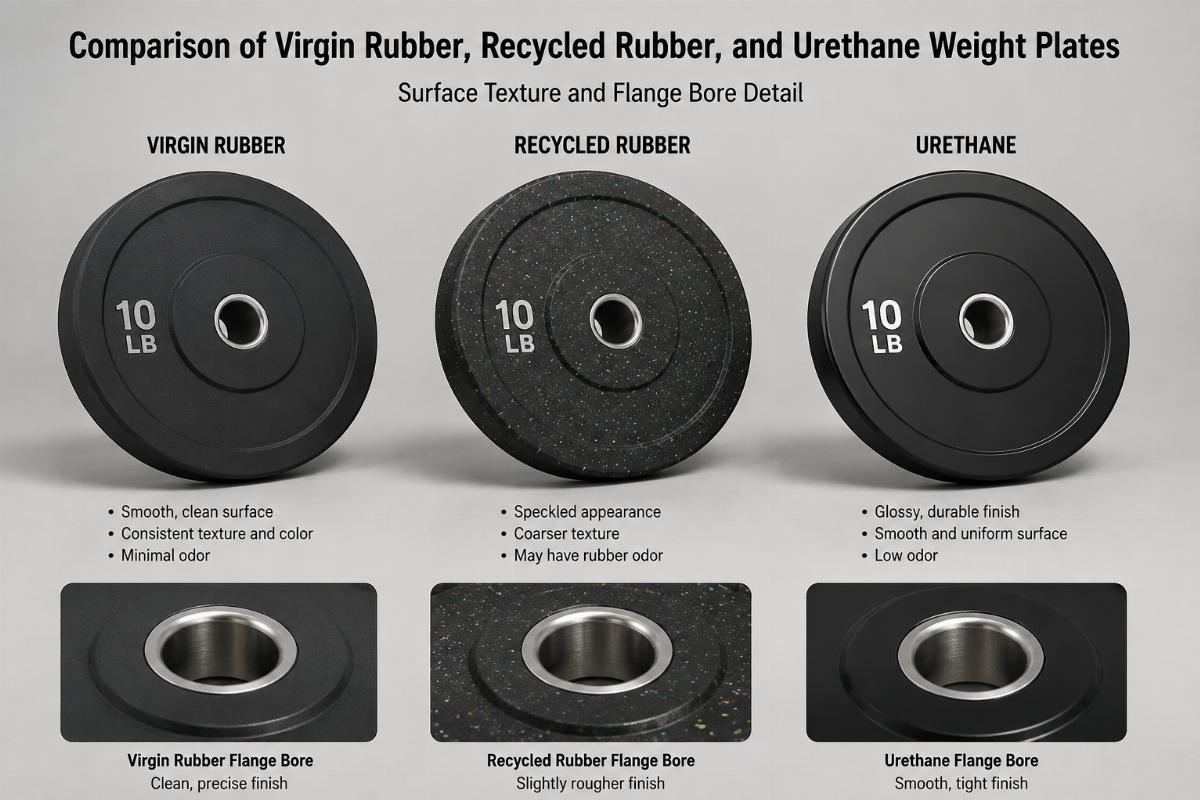
The takeaway is simple: do not let the per-kilo quote decide the material. Let the drop frequency, floor type, and member expectation decide the material — then let the material decide which supplier quote is actually the best price.
How to Compare Weight Plate Prices Across Suppliers Without Getting Tricked?
A valid price comparison only exists when bore diameter, tolerance class, rubber compound, and packaging standard are locked to the same spec across every quote.
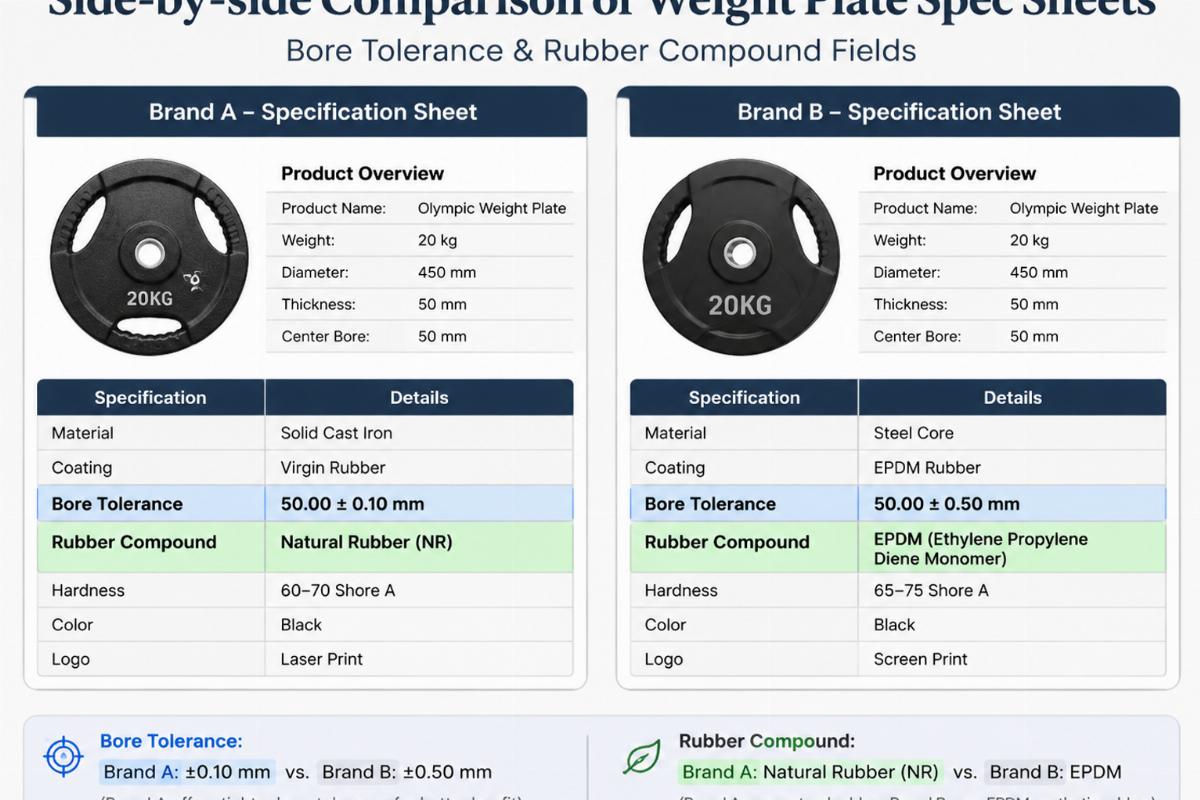
Suppliers love to quote "per kilogram" because it makes their number look clean. But a kilogram of recycled rubber with an undersized bore and no inner steel insert is a fundamentally different product from a kilogram of virgin rubber with a precision-machined insert and a reinforced flange. When buyers ask me to buy weight plates at the best price, the first thing I do is force every supplier onto the same spec sheet.
The comparison matrix I use in the field looks roughly like this:
| Comparison Dimension | Locked-Spec Quote | Open-Spec Quote |
|---|---|---|
| Flange bore diameter | Verifiable (matches IWF bar sleeve standard) | Self-reported |
| Weight tolerance class | Controlled (±10 g or ±50 g declared) | Not provided |
| Rubber compound origin | Full batch-level traceability | Sample-level only |
| Inner insert material | Certified steel insert | None / unverified |
| Packaging for sea freight | Full batch-level palletized, anti-rust | None |
[NEED_CITE: ISO weight-training equipment safety and dimensional standards]
A hotel developer in Southeast Asia compared three quotes for a boutique fitness center fit-out. The lowest quote looked extremely attractive until we opened the packaging spec: no palletization, no rust protection, plates shrink-wrapped in loose bundles. By the time the container reached the port, several cartons had shifted, plates had rubbed through the film, and the chrome-finished plates arrived with surface corrosion. The "saving" on the unit price was wiped out by the cost of replacing the affected plates and the reputational hit with the hotel operator.
The lesson is that the quote document itself is a specification contract. If the bore diameter is not written down, the supplier is not committing to it. If the tolerance class is not written down, you are buying a lottery ticket, not a plate. When you buy weight plates at the best price, you are really buying a documented spec at the best price — which is a very different thing.
What Are the Hidden Costs Behind the "Lowest Price" Weight Plates?
Flange bore deviation, poor rubber formulation, and weak packaging are the three silent cost traps that show up only after the container has cleared customs.
The Riyadh story I opened with is the textbook example of the first trap. A bore that is a couple of millimeters off sounds trivial until you have a full container of plates that will not mount. The rework — whether it is on-site machining, return freight, or scrapping — routinely costs several times the unit-price gap that tempted the buyer in the first place. [NEED_CITE: root cause distribution of commercial gym equipment field failures]
The second trap is rubber formulation. A plate that smells strongly of solvents when you open the container is telling you something about the compound. Recycled rubber blended with low-grade fillers may look identical to virgin rubber on a product photo, but it will crack, crumble, or leave black marks on flooring and bar sleeves within months of commercial use. A Middle East gym chain that switched to a cheaper plate supplier found itself replacing plates across multiple branches within the first year — the replacement logistics alone were a mid-five-figure headache, before counting member complaints.
The third trap is packaging. Plates are dense, heavy, and unforgiving of movement. A container loaded without proper palletization, edge protection, and anti-rust treatment will arrive with dented flanges, scratched finishes, and surface rust on any bare-steel or chrome components. The buyer pays twice: once for the damaged units, and once for the delay while replacements are sourced.
| Hidden Cost Category | Typical Symptom at Destination | Real Cost Multiplier vs. Unit Saving |
|---|---|---|
| Bore deviation | Plates will not mount on bar sleeve | Substantially extended rework time |
| Poor rubber compound | Cracking, odor, floor marking | Noticeably reduced service life |
| Weak packaging | Dented flanges, surface rust | Noticeably reduced usable yield |
This is where a factory-direct partner earns its keep. A manufacturer who runs bore-diameter checks and tolerance verification before the container is sealed — and who can prove it with inspection records — removes the first trap entirely. A manufacturer who controls the rubber compound in-house, rather than buying it from a third-party molder, removes the second. And a manufacturer who has shipped full containers to your destination region for years knows exactly how to palletize and protect for that specific route. When you buy weight plates at the best price from that kind of partner, the "price" you are comparing is the landed, usable, installed cost — not the FOB number on a spreadsheet.

How to Build a Cost-Effective Weight Plate Order for Container Shipment?
A mixed-SKU container plan, validated against the end-user’s bar system and floor type, is the single biggest lever for driving the per-plate landed cost down without sacrificing quality.
Most first-time buyers load a container with a single plate denomination — usually the most popular one, like the 20 kg plate — because it is simple. But a commercial gym needs a full ladder: 0.5 kg, 1.25 kg, 2.5 kg, 5 kg, 10 kg, 15 kg, 20 kg, and sometimes 25 kg. Smaller plates occupy disproportionately more volume per kilogram because of their diameter and the air space around them on the pallet. A container loaded only with 20 kg plates is heavy and efficient; a container loaded only with 2.5 kg and 5 kg plates is volumetrically full long before it is weight-limited, and the per-kilo freight cost climbs noticeably.
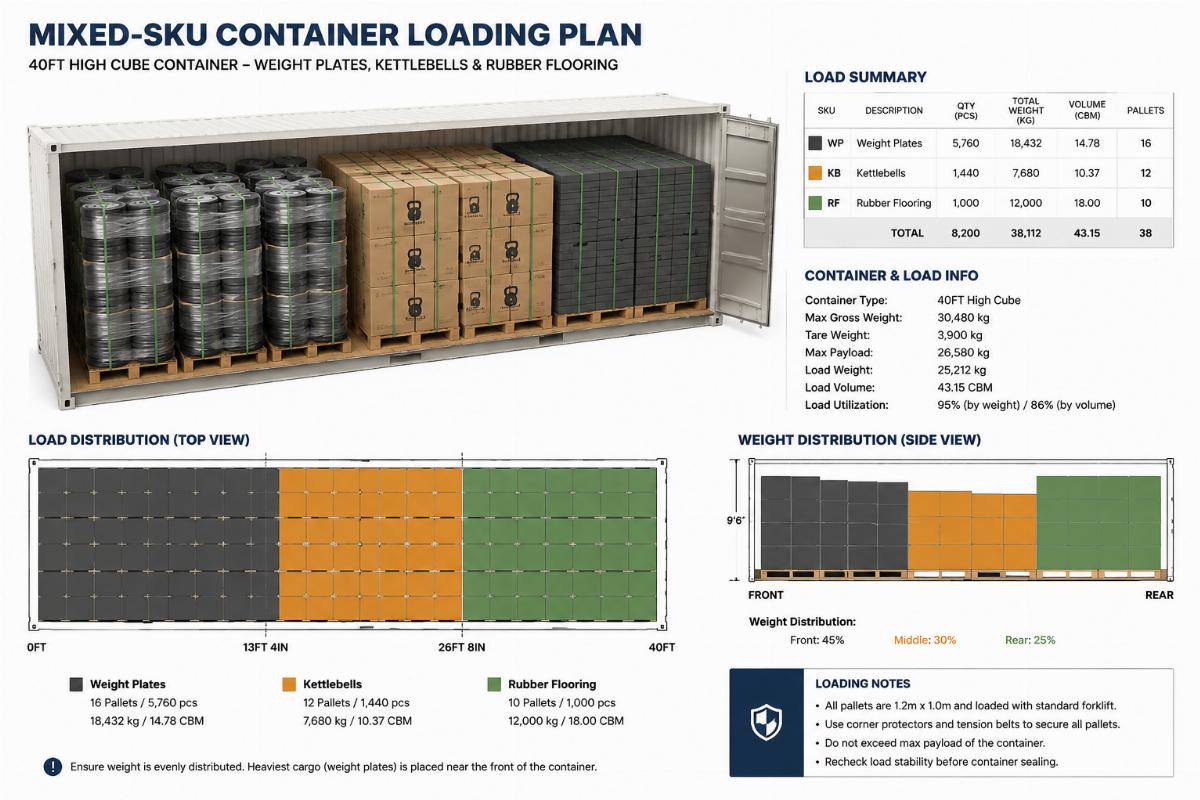
The practical method is to build the container around the weight ladder the gym actually needs, then fill the remaining volumetric space with complementary products that share the same destination and the same rubber-compound supply chain — bumper plates, kettlebells, dumbbells, or even rubber flooring rolls. This is standard consolidation practice, but it only works if the supplier is set up to handle mixed-SKU palletization and can keep the bore and tolerance spec consistent across every SKU in the container.
| Container Strategy | Volume Utilization | Per-Kilo Landed Cost | Risk of Spec Drift |
|---|---|---|---|
| Single denomination, full weight | High | Noticeably reduced | Noticeably reduced |
| Full weight ladder, single product | Moderate | Standard | Standard |
| Full weight ladder + consolidated accessories | Noticeably extended | Noticeably reduced | Controlled (single-source spec) |
A distributor in East Africa ran this exact exercise. The first container was pure 20 kg plates — efficient on paper, but the gym client needed the full ladder and had to order a second, smaller container of smaller plates at a much higher per-kilo freight rate. The second time, the distributor consolidated the full ladder with a batch of kettlebells and a set of rubber flooring tiles, all from the same manufacturer, all sharing the same spec-validation process. The per-plate landed cost dropped noticeably, the gym opened on schedule with the full range available, and the single-source spec discipline meant no bore or tolerance surprises at the other end.
The operational discipline required is straightforward: confirm the bar sleeve standard and collar type with the end user before the spec is locked; validate bore diameter and tolerance class on a pre-shipment sample from every SKU in the container; and choose a supplier whose factory-direct model means you are not paying a trading margin on top of a consolidation service. When you buy weight plates at the best price through that discipline, the price you see on the invoice is genuinely the lowest price you can achieve for that quality level — not the lowest price that will later cost you several times more in rework, replacement, and reputation.
Conclusion
The best price on a weight plate is the landed, installed, multi-year cost — not the FOB number per kilogram. Lock your spec to the end user’s bar system, force every supplier onto the same tolerance and compound standard, and consolidate your container around the full weight ladder plus compatible accessories. A factory-direct manufacturer who validates bore, tolerance, and compound before the container is sealed will consistently beat a cheaper quote that fails at the gym door.


