
Commercial Treadmill Supplier from China Factory for Egypt Gym Equipment
The cheapest unit on the spreadsheet often becomes the most expensive machine on the gym floor.
Sourcing from a reliable commercial treadmill supplier Egypt operators trust means verifying 220V/50Hz electrical compatibility, confirming continuous-duty motor ratings rather than peak figures, and structuring container-level logistics that absorb per-unit freight costs. Factory-direct procurement from Shandong-based manufacturers typically delivers equipment at substantially lower price points than European or American brands while allowing full voltage pre-adjustment before shipment.
I still remember a gym fit-out in Jakarta where twenty commercial treadmills arrived with motor housings wired for a different voltage standard. The moment the main breaker was thrown, half the units tripped the circuit. I spent days in a sweltering warehouse rewiring motor leads and replacing control boards, while the gym owner watched his opening week slip away. That project ended up costing several times what was saved on the purchase price. Since then, before I finalize any quote for the Middle East or North Africa, I pull up the destination country’s electrical code and plug configurations. [NEED_CITE: Egypt electrical standard voltage and frequency specifications per IEC regional adoption]
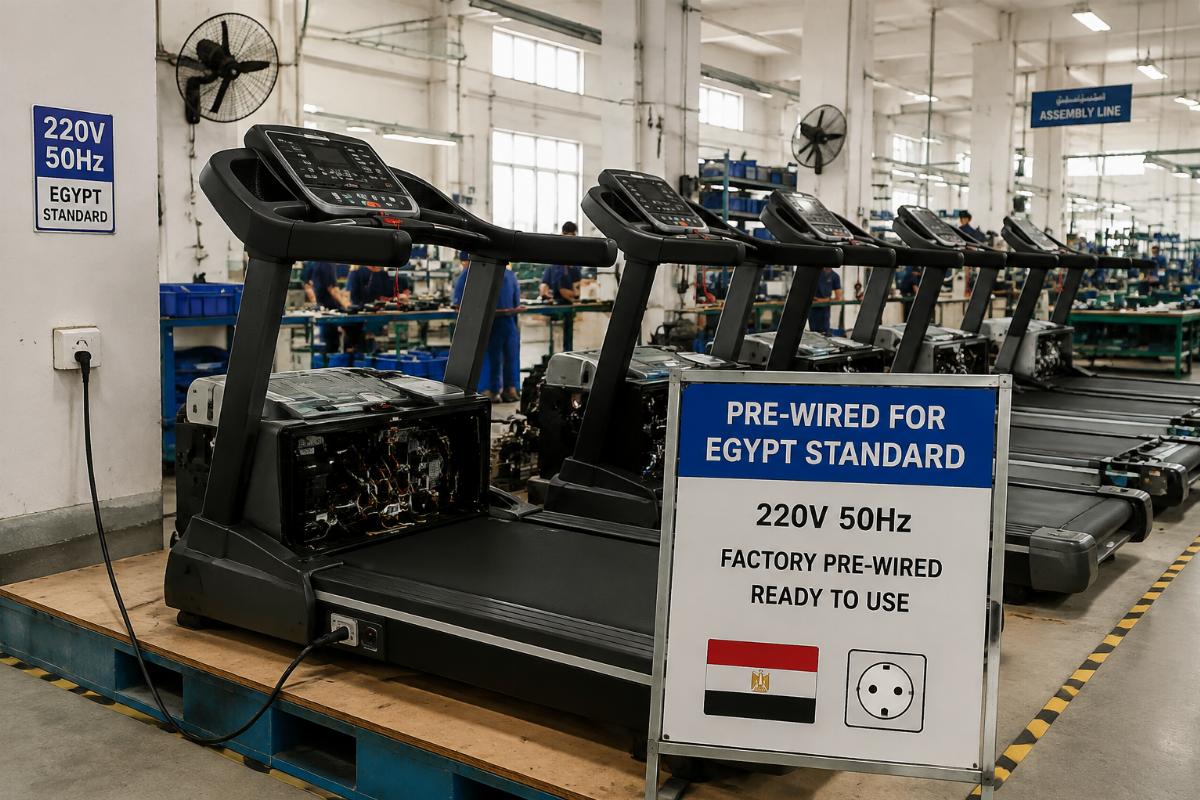
Getting the electrical spec right is only the starting line. The real discipline lies in matching motor output, running surface dimensions, and frame construction to how Egyptian gym members actually train—and then shipping those machines across the Mediterranean without blowing the landed cost through the roof.
Why Source Commercial Treadmills from China for Egypt?
Shandong Province has concentrated the world’s densest cluster of commercial fitness equipment manufacturing, offering gym owners and distributors direct factory access that bypasses Western brand markups entirely.
The logic is straightforward. A commercial treadmill supplier Egypt buyers work with directly eliminates the distributor layers that typically add substantial margin on top of factory pricing. When a gym chain in Cairo or Alexandria sources through a Shandong factory, the price differential compared to equivalent European or American branded equipment is dramatic—often cutting acquisition cost by a wide margin while delivering comparable structural durability. [NEED_CITE: global fitness equipment manufacturing concentration in Shandong Province China]
What makes this particularly relevant for the Egyptian market right now is the customization flexibility. Chinese factories routinely adjust motor winding configurations for specific voltage markets, modify console language packs to include Arabic, and reinforce frame welding for high-traffic commercial environments—all within the same production run. A distributor in the Middle East once told me that switching from a European brand to direct Chinese factory sourcing allowed him to expand his product range across multiple categories without increasing his capital outlay.
The product ecosystem is also complete. A single facility can supply the full spectrum of cardio equipment, strength machines, free weights, and functional training accessories. For a hotel developer in Hurghada outfitting a rooftop gym, or a fitness chain opening branches across the Nile Delta, this means one purchase order, one quality standard, and one shipping schedule. Container-load consolidation becomes practical rather than theoretical.

Critical Specs to Verify Before Ordering
A treadmill that runs perfectly in a Texas gym will shut down immediately in an Egyptian facility unless the electrical configuration matches local grid standards exactly.
Egypt operates on a 220V supply at 50Hz frequency, with Type C and Type O plug configurations. [NEED_CITE: Egypt standard voltage frequency and plug type specifications] This is non-negotiable. Any commercial treadmill supplier Egypt buyers engage must confirm these parameters before the machines leave the production floor. I have seen containers arrive at Alexandria port with 110V motors installed because the factory defaulted to a US-spec order form. The cost of rewiring or replacing motors on a full container load is not a minor inconvenience—it can exceed the freight savings entirely.
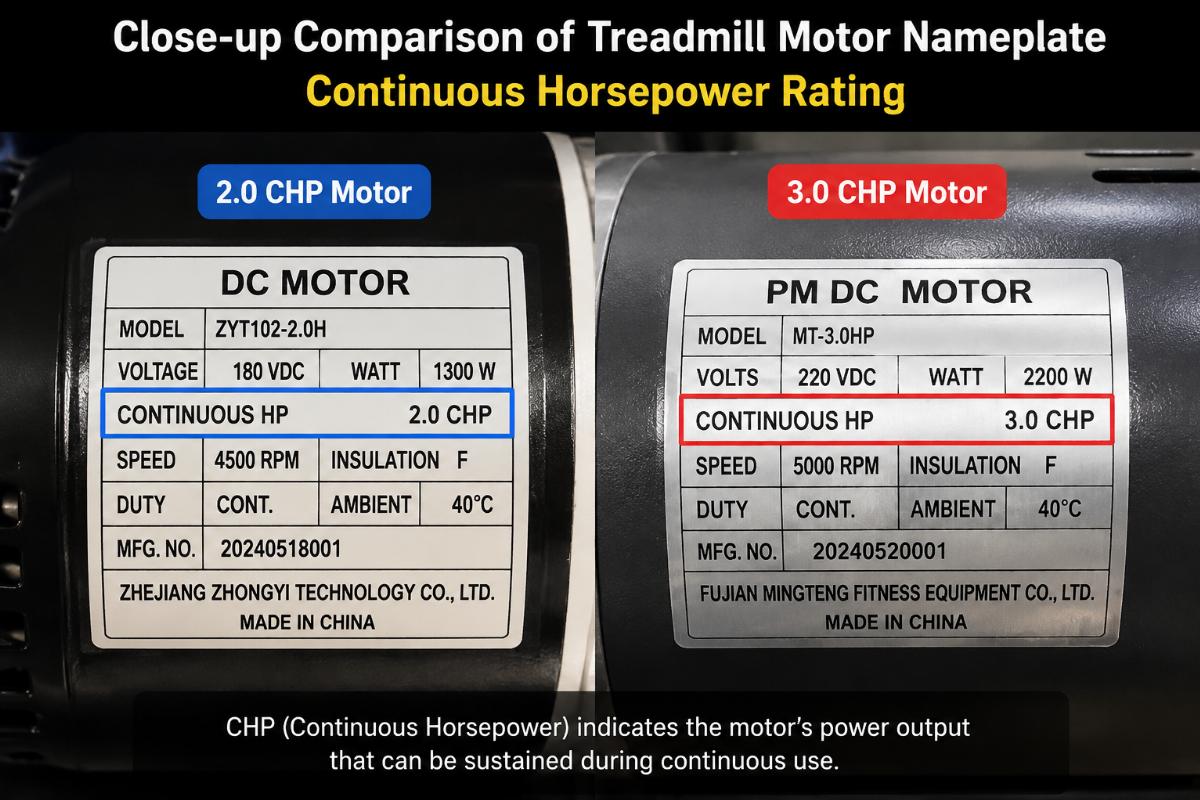
Beyond electrical compatibility, the motor rating deserves careful scrutiny. Manufacturers publish two figures: peak horsepower and continuous horsepower. Peak horsepower is the maximum output the motor can sustain for seconds under ideal conditions. Continuous horsepower reflects what the motor delivers during sustained commercial use—hour after hour, member after member. For a gym in Egypt where ambient temperatures regularly climb and air conditioning may not be industrial-grade, continuous horsepower is the only number that matters. [NEED_CITE: continuous horsepower versus peak horsepower definitions for commercial treadmill motors]
| Specification Factor | Commercial-Grade Requirement | Basic/Residential Grade |
|---|---|---|
| Motor Rating | Continuous horsepower rated for sustained load | Peak horsepower only listed |
| Running Surface | Wide belt suitable for tall users | Narrow belt, shorter deck |
| Frame Construction | Heavy-gauge welded steel | Thin-gauge tubular frame |
| Weight Capacity | High user weight threshold | Lower user weight limit |
| Electrical Compliance | Pre-configured for destination voltage | Default factory voltage |
I once reviewed a spec sheet from a buyer who had selected treadmills based solely on the highest horsepower number advertised. The figure was peak output. When we tested the same unit under continuous commercial loading conditions, the thermal protection kicked in within minutes. The machine was not underpowered in theory—it was mislabeled in practice.
For the Egyptian market, running surface dimensions also warrant attention. Average user height in the region tends toward the taller end of the global range, so a deck length that feels adequate in East Asian markets may cause users to overstride and hit the rear console housing. Specifying a longer running belt is a small cost addition that prevents member complaints and potential injury liability.
How to Evaluate a China Factory Direct Supplier?
A factory that can show you verifiable certifications, walk you through its production floor on live video, and reference completed installations in your target region is worth serious consideration—everything else is marketing.
The first filter is certification. CE marking indicates compliance with European safety and electromagnetic compatibility directives, which serves as a credible baseline for equipment quality. [NEED_CITE: CE certification requirements for commercial fitness equipment] However, certification alone is not sufficient. I have seen certificates that were purchased rather than earned through actual testing. The reliable approach is to request the test report number and verify it against the issuing body’s database.
The second filter is production transparency. A legitimate commercial treadmill supplier Egypt clients can trust will have no hesitation about conducting a live video walkthrough of the welding stations, motor testing rigs, and final assembly lines. During one evaluation process, a factory in Shandong showed me their motor burn-in testing area—where every treadmill motor runs under load for an extended period before assembly. Factories that skip this step to cut costs will produce units with early-field failures that only show up months after installation.
The third filter is regional track record. Ask the supplier for references in the Middle East or North Africa specifically. Equipment that performs well in Southeast Asia may face different challenges in Egyptian conditions—higher dust levels, different maintenance skill sets among local technicians, and varying expectations for console interface language. A supplier that has already navigated these variables for other Egyptian or regional clients has already solved problems you have not yet encountered.

Navigating Import Logistics and Costs to Egypt
The unit price on the proforma invoice is only a fraction of what you actually pay. Freight terms, customs duties, and port handling fees can reshape the economics entirely if not planned in advance.
Understanding the difference between FOB and CIF pricing is essential. FOB means the factory delivers the goods to the departure port and handles export clearance. From there, you control the ocean freight, insurance, and arrival logistics. CIF means the factory arranges freight and insurance to the destination port. Neither is inherently better—FOB gives you more control over freight costs if you have a reliable shipping agent, while CIF simplifies the process for first-time importers. [NEED_CITE: Incoterms FOB and CIF definitions for international trade]
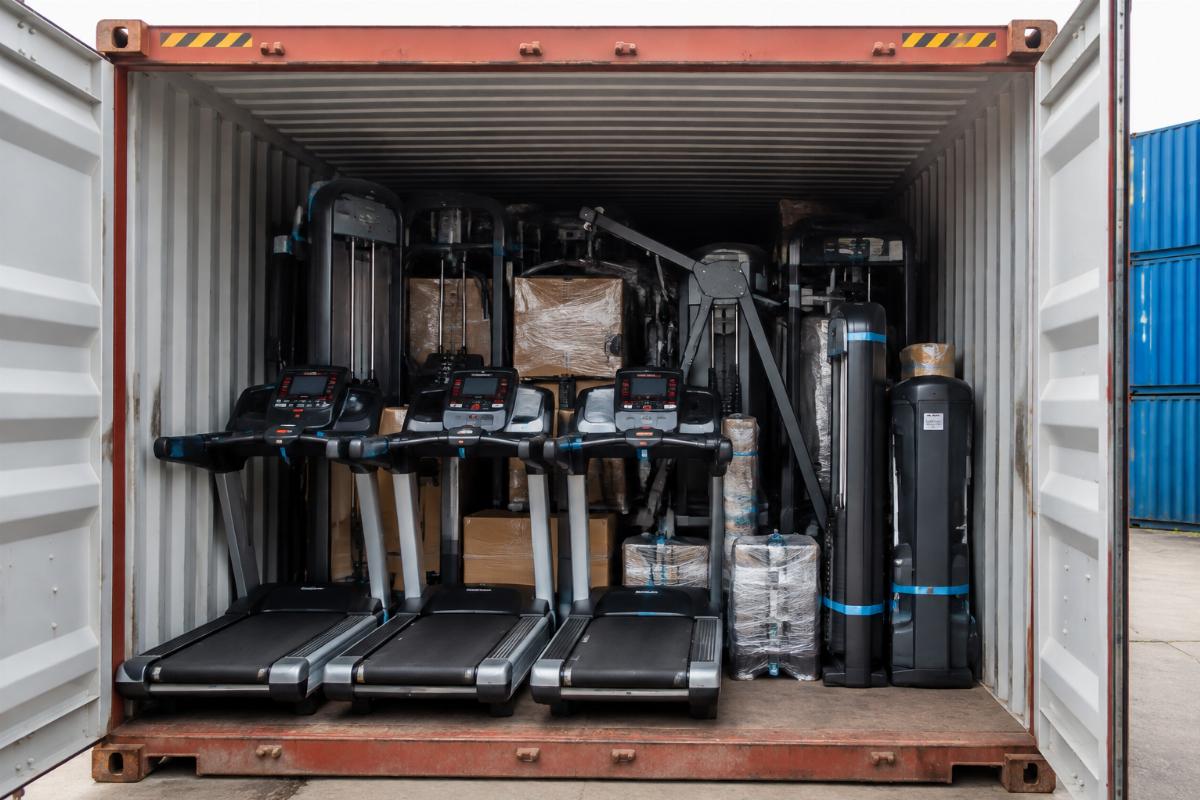
Container-load purchasing fundamentally changes the per-unit cost equation. A single treadmill shipped by air or less-than-container load carries a freight premium that can dwarf the machine’s factory price. Filling a full container with treadmills—or consolidating treadmills with ellipticals, strength equipment, and free weights into one shipment—spreads the fixed freight cost across many units. For a distributor placing an initial trial order, the per-unit cost will be noticeably higher than for a subsequent full-container reorder. This is normal and should be factored into initial pricing strategy.
Egypt’s import duty structure for fitness equipment should be confirmed with a local customs broker before placing the order. Tariff classifications can vary depending on whether the equipment is categorized as sporting goods, electrical machinery, or commercial fixtures. [NEED_CITE: Egypt customs tariff classification for commercial fitness and gym equipment] Getting this wrong can mean unexpected duty rates that erase the factory-direct savings entirely.
I worked with a hotel group that initially planned to import cardio and strength equipment in separate shipments. By consolidating everything into a single container order—treadmills, ellipticals, a full plate-loaded strength line, dumbbell sets, and rubber flooring—they reduced their total logistics timeline substantially and avoided paying port handling fees twice. The space planning and equipment list were finalized before the container was booked, which prevented costly last-minute amendments.
What After-Sales Support Should You Expect?
A factory that disappears after the container clears customs is not a supplier—it is a vendor. True partnership means spare parts availability, remote technical guidance, and warranty components that keep machines running for years.
Every commercial treadmill has wear components: drive belts, deck surfaces, lower rollers, and console electronics. The question is not whether these parts will need replacement—it is when. A responsible commercial treadmill supplier Egypt operators rely on will include a spare parts package with the initial order, sized to cover the first year of typical commercial wear. This package should be priced transparently and shipped in the same container to avoid paying separate international freight for a handful of belts and rollers.
Remote technical support is equally critical. When a console displays an error code in a gym in Port Said, the facility manager needs someone who can interpret that code via video call and guide a local technician through the repair. Factories that invest in multilingual technical support teams—covering Arabic and English at minimum—dramatically reduce equipment downtime. I have seen gyms lose entire weeks of revenue because a minor sensor fault required a technician to fly in from another country.
Warranty terms should be specific and documented. Ask which components are covered, for how long, and what the claim process looks like. A motor warranty is meaningless if the factory requires you to ship the defective motor back to China for inspection before sending a replacement. Practical warranty arrangements involve photo or video verification of the fault, followed by immediate dispatch of the replacement part.

Conclusion
Factory-direct procurement from China gives Egyptian gym owners, hotel developers, and equipment distributors a genuine cost advantage—but only when electrical standards, motor ratings, logistics structure, and after-sales support are handled with the same rigor applied to the purchase price. Verify the voltage configuration before the machines are built, insist on continuous horsepower ratings, consolidate shipments to control landed cost, and confirm that spare parts and technical support are part of the relationship—not an afterthought.


