
Commercial Gym Exercise Equipment Manufacturer | OEM Factory Direct
"Free shipping" on exercise equipment is almost never free — the freight cost is either baked into the unit price or offset by downgraded components that fail within months of installation.
Smart buyers who want to buy exercise equipment with free shipping must demand itemized FOB and CIF quotes, verify commercial-grade specifications against mill certificates, and partner directly with factories that offer transparent landed-cost calculations — this is the only way to avoid hidden markups and quality failures that erase any perceived shipping savings.
I still remember a container that rolled into Jebel Ali a few years back. A private studio owner in the Middle East had sent me a spec sheet copied directly from a top-tier American brand — every dimension, every weight stack increment, every cable routing path. We quoted accordingly. When the containers opened on the gym floor, the installer pulled a weight stack pin and immediately noticed the plates were thinner than expected. The pulley bearings spun with audible grit. The client called me from the loading dock, voice tight. That entire shipment had to be disassembled, re-inspected, and partially re-manufactured. The return freight and replacement parts cost several times what the original "shipping savings" would have covered. Since that day, I walk every serious buyer through the real math before a single purchase order is signed. [NEED_CITE: total landed cost methodology for imported fitness equipment per international trade standards]
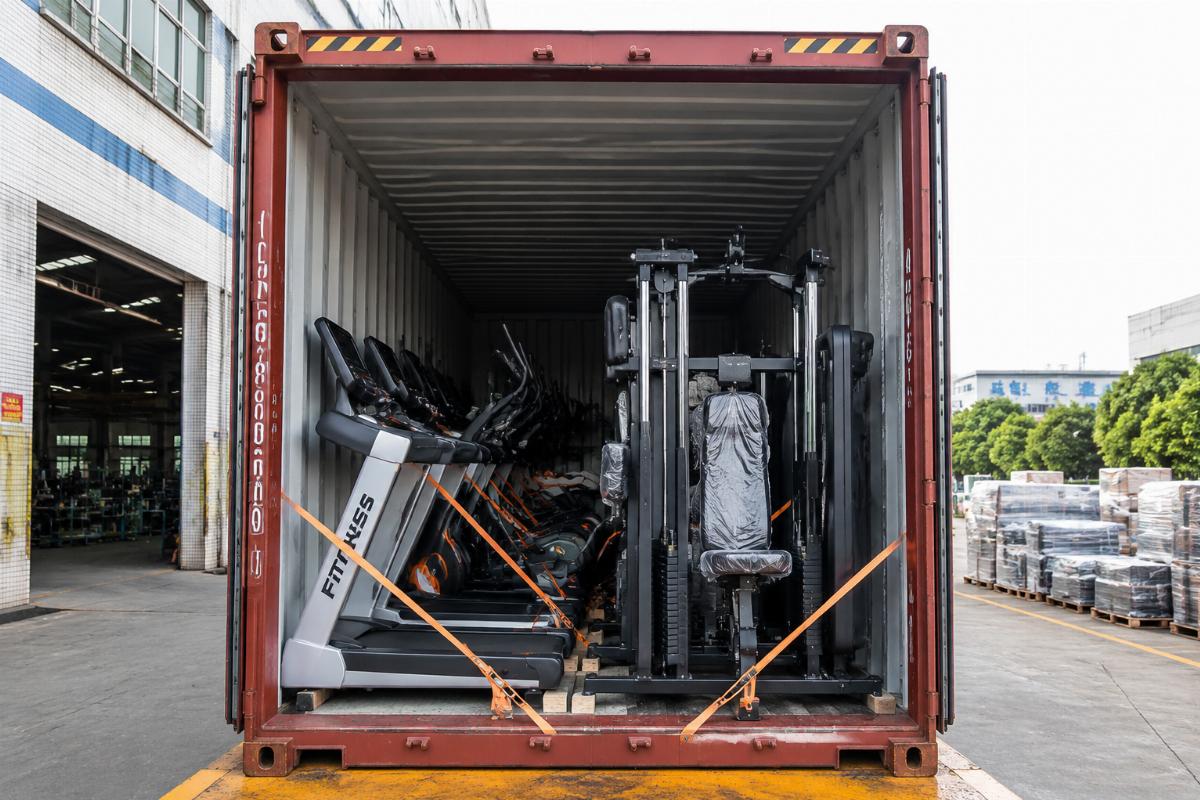
Let me walk you through what actually happens when you try to buy exercise equipment with free shipping, and how experienced operators calculate the real cost before committing to a container-load order.
What Does "Free Shipping" Really Mean When Buying Exercise Equipment?
The phrase "free shipping" is a marketing construct — not a cost elimination. When a distributor advertises free delivery on a commercial treadmill or a full set of plate-loaded machines, the ocean freight, insurance, and inland trucking have not vanished. They have been absorbed into one of two places: the unit price itself, or the manufacturing specification.
Here is how the two mechanisms work in practice:
| Cost Absorption Method | How It Appears | What the Buyer Actually Gets |
|---|---|---|
| Embedded freight in unit price | Higher per-piece quotation from distributor | Identical product specs, but shipping is pre-paid and invisible |
| Specification downgrade | Competitive per-piece quotation with "free shipping" | Thinner steel frames, lower-grade bearings, reduced weight stack coating — lifespan noticeably shortened |
| Transparent factory-direct CIF | Itemized FOB price plus separately quoted freight | Full commercial-grade specs, buyer controls shipping terms and insurance |
The first column is what most buyers encounter when they search for deals. The third column is what experienced procurement teams actually request when they buy exercise equipment with free shipping through a direct factory relationship. [NEED_CITE: Incoterms 2020 definitions for FOB and CIF in commercial equipment transactions]
A distributor in Southeast Asia once showed me two quotations side by side for a hotel fitness center project. The "free shipping" offer from a trading company listed a per-unit price that appeared attractive. My factory-direct CIF quote for the same machine configuration came in noticeably lower on the unit price, with freight listed as a separate line item. When we added both together — unit cost plus freight plus insurance plus port charges — the factory-direct total landed cost was substantially lower, and the specification sheet carried verifiable mill certificates for every steel batch. The hotel developer switched to the transparent quote within the same week.
The lesson is straightforward: if you cannot see the freight line item, you cannot negotiate it, and you cannot verify whether the product spec has been compromised to fund it.
How to Compare Total Landed Cost Across Suppliers?
Total landed cost is the only honest comparison metric — comparing unit prices alone guarantees you will choose the wrong supplier.
The framework includes every expense from the factory floor to the gym door:
- FOB factory price (the base manufacturing cost)
- Ocean freight (calculated by container type — 20GP, 40GP, or 40HQ)
- Marine insurance (typically a small percentage of cargo value)
- Import duty and tariffs (varies by destination country HS code)
- Port handling charges and customs clearance fees
- Inland transportation from port to final site
[NEED_CITE: HS code classification and tariff determination for fitness equipment imports by destination country]
When buyers contact us to buy exercise equipment with free shipping, I always ask them to send me the competitor’s "free shipping" quotation first. Then I build a side-by-side landed cost table. In a recent case involving a fitness chain in Latin America, the distributor’s per-unit price for a functional trainer appeared competitive because shipping was listed as zero. Our factory-direct FOB price was lower, and when we added a separately quoted 40HQ ocean freight rate, the combined total still came in noticeably below the distributor’s all-in price. The difference was large enough to fund an entire additional set of free weights for the same budget.
| Cost Component | "Free Shipping" Distributor Quote | Factory-Direct CIF Quote |
|---|---|---|
| Unit price | Noticeably higher (freight embedded) | Substantially lower (transparent) |
| Freight line item | Not shown | Separately itemized |
| Specification verification | Self-reported only | Mill certificates provided |
| Total landed cost | Higher | Noticeably lower |
| Customization flexibility | Limited | Full OEM/ODM available |
The critical insight is that factory-direct pricing from a manufacturer like Bick typically runs well below branded distributor pricing — and when freight is quoted transparently rather than hidden, the buyer retains full control over logistics decisions. You can consolidate cardio, strength, and free weights into a single container, maximizing cubic meter utilization and driving the per-unit freight cost down further. [NEED_CITE: container loading optimization methods for mixed fitness equipment shipments]
Which Specs Matter Most to Avoid Costly Quality Failures?
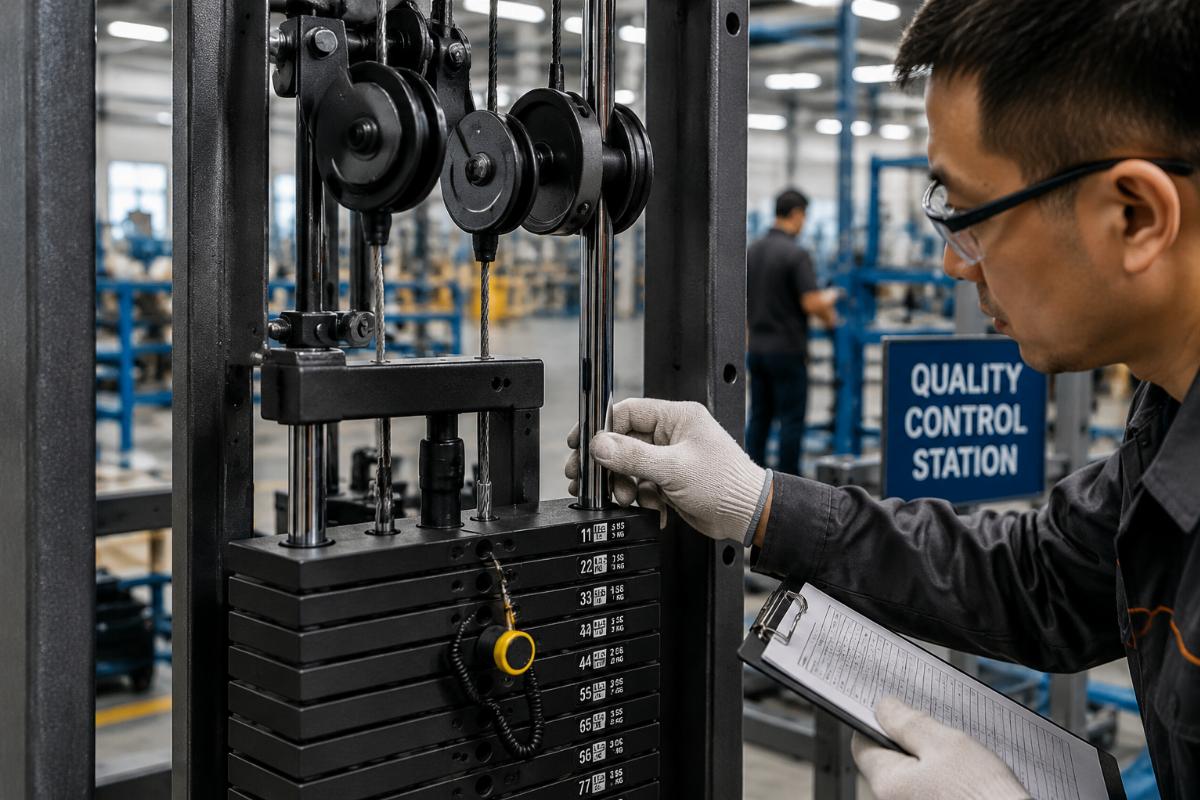
Steel frame thickness, pulley bearing grade, and weight stack coating process are the three specifications that determine whether commercial equipment survives its intended lifespan — and they are the exact specs that get downgraded when "free shipping" is funded through manufacturing shortcuts.
When I inspect a competitor’s machine that has failed in the field, the pattern is almost always the same:
| Specification | Commercial-Grade Standard | Downgraded "Free Shipping" Version |
|---|---|---|
| Steel frame wall thickness | Heavy-duty commercial gauge | Noticeably thinner — flexes under load |
| Pulley bearing grade | Sealed precision bearing | Basic bushing — grit intrusion accelerated |
| Weight stack plate coating | Full encapsulation — resistant to chipping | Thin spray — chips within months, exposes raw cast iron |
| Cable routing | Guided with low-friction liners | Unguided — cables fray prematurely |
| Weld quality | Continuous, ground, and inspected | Intermittent, visible porosity |
[NEED_CITE: commercial fitness equipment structural integrity standards per EN and ASTM specifications]
A gym owner in the Gulf region once sent me photos of a cable crossover purchased through a "free shipping" deal. Within a short operational period, the weight stack plates showed visible corrosion around the guide rod holes. The coating had chipped away because it was a thin surface spray rather than a full encapsulation process. Replacing the entire weight stack would have cost a fraction of the original machine price — but the shipping to return the defective unit and the downtime for the gym floor during replacement erased any savings the buyer thought they had achieved.
When you buy exercise equipment with free shipping from a direct manufacturer, the specification sheet should include verifiable documentation: steel mill certificates confirming material grade and thickness, bearing manufacturer part numbers, and coating process descriptions. If a supplier cannot provide these, the spec sheet is self-reported and unverifiable.
How to Optimize Container Loading for Maximum Cost Efficiency?
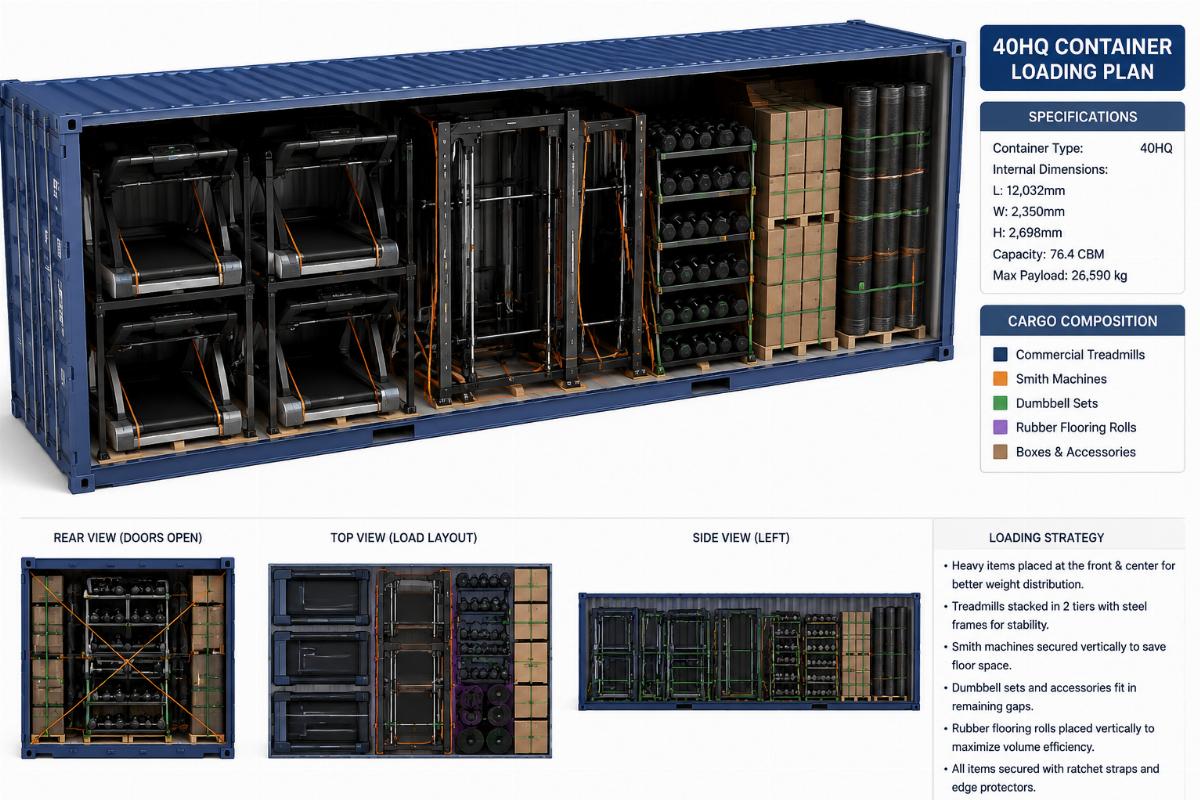
The single most effective way to reduce per-unit freight cost is to consolidate your entire equipment package — cardio, strength machines, free weights, and flooring — into one factory’s container rather than sourcing from multiple vendors and拼柜.
Here is the operational logic:
-
Map the gym layout first. Before ordering anything, finalize the floor plan with equipment placement, traffic flow, and electrical requirements. This determines exact quantities and models needed.
-
Calculate cubic meter requirements by equipment category. Treadmills and ellipticals ship partially disassembled to maximize container density. Strength machines can be nested. Free weights and plates are dense but compact. Flooring rolls fill void spaces.
-
Select container type based on total CBM. A 40HQ container offers the highest cubic capacity and is the standard choice for full gym fit-outs. A 20GP works for boutique studios or supplement orders.
-
Load sequence matters. Heavy items (plates, loaded barbells) go on the bottom. Machines are secured with internal bracing. Fragile components (console screens, upholstery) are wrapped and positioned to avoid compression damage.
[NEED_CITE: container loading best practices for mixed cargo including heavy fitness equipment]
A hotel developer in East Africa was initially sourcing cardio from one supplier, strength equipment from another, and free weights from a third. Each supplier quoted "free shipping" on their individual orders — but the buyer was paying for three separate less-than-container-load shipments, each with its own customs documentation, port handling fees, and inland delivery charges. When we consolidated the entire project into a single 40HQ from our factory, the per-unit freight cost dropped substantially, customs clearance was handled once instead of three times, and the project delivery timeline shortened noticeably.
The buyer’s total cost for the consolidated shipment was lower than the sum of the three "free shipping" orders — and every piece of equipment came from one production line with consistent quality standards and a single warranty point of contact.
What Should You Verify Before Placing a Bulk Order?
Before committing to a container-load purchase, request factory audit reports, product certifications, warranty documentation with spare parts availability, and reference projects in your region — any supplier unwilling to provide these should be treated as a high-risk partner.
The verification checklist includes:
-
Factory audit documentation. Third-party inspection reports confirm that the manufacturing facility maintains consistent quality control processes, not just that a sample passed inspection.
-
Product certifications. CE marking is mandatory for European market access and is increasingly requested by customs authorities in other regions. Verify that the certificate covers the specific models you are ordering.
-
Warranty terms and spare parts commitment. A meaningful warranty includes not just replacement coverage but confirmed spare parts availability with defined lead times. Ask for a spare parts catalog with part numbers and typical dispatch timelines.
-
Reference installations. Request contact information or case documentation for completed projects in your country or region. A manufacturer with genuine international delivery experience will have verifiable references.
[NEED_CITE: CE certification requirements and verification methods for imported fitness equipment]
When buyers reach out to buy exercise equipment with free shipping, I provide the full documentation package before any deposit is requested. Factory audit reports, CE certificates for each product category, a detailed spare parts list, and photographs from recent installations in the buyer’s region. This is not optional — it is the baseline for any serious commercial transaction.
A distributor in West Africa had previously been burned by a supplier who provided a CE certificate that turned out to cover a completely different product category. Customs held the container for weeks, and the demurrage charges alone were significant. Since then, that distributor requires certificate numbers that can be independently verified against the issuing body’s database before placing any order.

Conclusion
"Free shipping" is a pricing illusion — the real cost lives in the total landed calculation, the specification integrity, and the container loading efficiency. Buyers who demand transparent FOB or CIF quotes, verify commercial-grade specs against mill certificates, and consolidate their full equipment package through a single factory consistently achieve lower total costs and fewer operational failures than those who chase superficial freight waivers.


