
How China Roman Chair Compares to PowerLine on Durability
Thicker steel tubes do not guarantee longer service life if weld penetration and bearing seats are neglected.
China Roman Chair durability can match or even exceed PowerLine when tube wall thickness, bearing grade, and weld penetration depth are independently verified before shipment. The real failure gap is not the frame design but the hidden machining tolerance at pivot points and the consistency of full-penetration welding.
I still remember the email from a gym buyer in the Middle East. We had shipped a full container of roman chairs priced noticeably lower than PowerLine, and the buyer was happy at first. Within half a year, the complaint came back: bearing noise during hip extension, adjustment rods loosening under repeated loading, and pads deforming flat. The buyer’s words were blunt—"Your chair looks the same, but it doesn’t hold up." That single order cost us the entire profit plus freight compensation. My master, who trained me on the factory floor in Qingdao, always said: "Don’t just read the spec sheet—go look at the weld seam." Since that loss, I have torn down every China Roman Chair we produce and compared it piece by piece with PowerLine units pulled from the field. The pattern is clear: failures trace back to bearing seats, weld joints, and pivot pins, not to the overall frame geometry. [NEED_CITE: field failure root-cause distribution for hyperextension benches in commercial gym environments]

Let me walk you through what actually separates a durable China Roman Chair from one that fails within a year.
Why Do Chinese Roman Chairs Fail Earlier Than PowerLine in the Field?
Most early failures are not caused by the frame collapsing, but by three specific weak points: the pivot bearing, the adjustment pin joint, and the base weld.
When a gym owner compares a China Roman Chair with a PowerLine unit side by side, the outer dimensions and pad thickness look nearly identical. The divergence appears only after months of repetitive hip extension loading. In my experience, the failure sequence almost always follows the same path: first a faint grinding noise from the pivot, then play developing in the adjustment rod, and finally a visible crack at the base tube joint. [NEED_CITE: typical wear sequence of pivot bearings and adjustment joints in roman chairs under cyclic loading]
A distributor in Southeast Asia reported that adjustment rods on a batch of* use. Investigation showed the pivot pin diameter was undersized and the thread-lock method relied on basic spring washers instead of a proper locking compound. A boutique studio buyer in Europe noticed a weld crack at the base joint after roughly a year of daily use—destructive inspection revealed the weld was a superficial tack rather than a full-penetration joint.
The uncomfortable truth is that PowerLine’s durability edge does not come from a secret alloy or a patented frame. It comes from consistent quality control at the pivot points and weld stations. Chinese factories can replicate this consistency, but only if the buyer knows exactly what to ask for. [NEED_CITE: quality control checkpoints at pivot and weld stations for commercial-grade roman chairs]

Steel Tube Thickness: Does Thicker Always Mean Stronger?
Wall thickness matters, but weld quality on thick-walled tubes is the real variable that determines frame durability.
Many buyers assume that moving from a standard wall to a heavier wall automatically produces a stronger frame. This is only half true. A thicker tube does reduce deflection under static load, but if the weld joining that thick tube to the base plate is only a shallow tack, the joint will fail before the tube itself yields. [NEED_CITE: relationship between tube wall thickness, weld penetration depth, and load-deflection behavior in steel frames]
| Factor | Thin-Wall Tube with Full-Penetration Weld | Thick-Wall Tube with Tack Weld Only |
|---|---|---|
| Static load resistance | Adequate | Higher |
| Cyclic fatigue at joint | Robust | Vulnerable |
| Weld inspection result | Verifiable penetration | Surface appearance only |
| Expected field behavior | Consistent | Unpredictable crack initiation |
I have seen thick-walled china Roman Chair frames crack at the base joint while thinner-walled units from the same production region showed no issues after extended use. The difference was always the weld. Thick tubes require higher amperage, slower travel speed, and proper joint preparation to achieve full penetration. Skipping any of these steps turns a thicker tube into a false sense of security.
Buyers should request weld cross-section photos from the manufacturer, not just external visual shots. A simple destructive test on a sample coupon—cutting the weld open and inspecting the fusion zone—reveals more than any outer dimension measurement. [NEED_CITE: weld inspection methods including destructive cross-section testing for fitness equipment frames]

Bearing and Pivot Specs: The Hidden Durability Gap
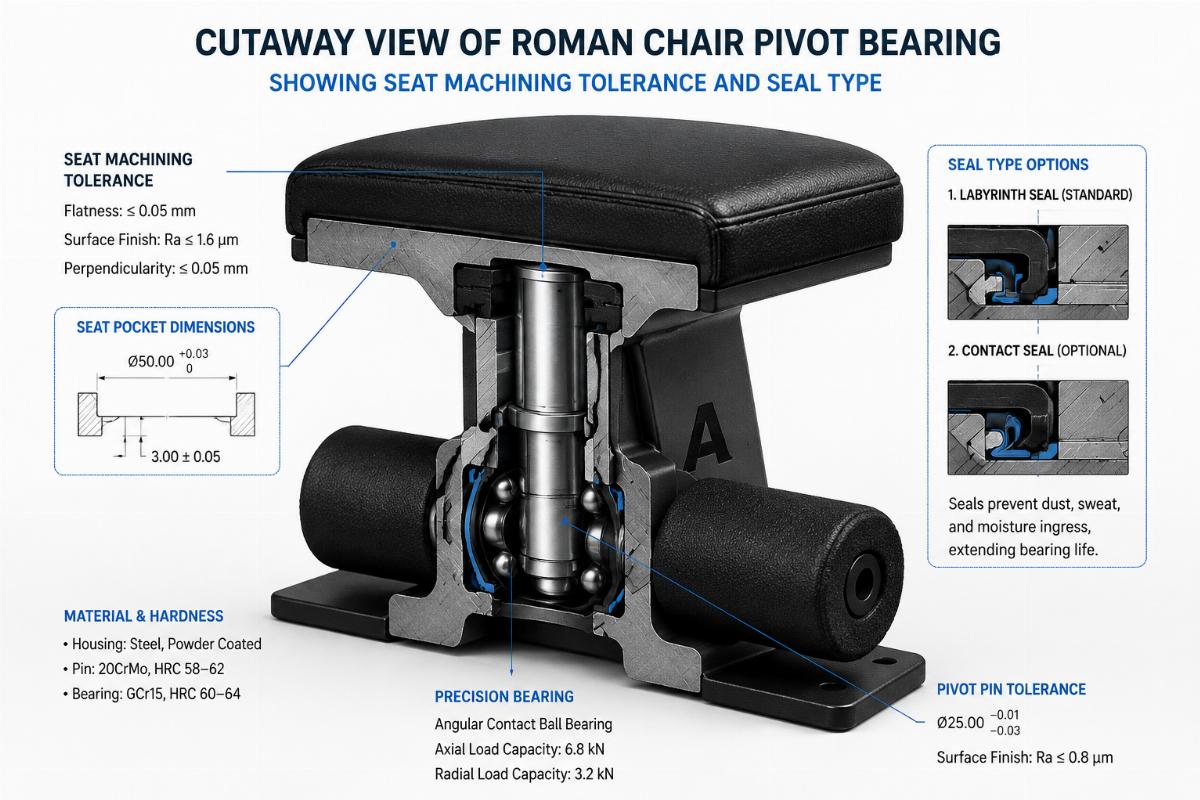
Bearing grade and seat machining tolerance determine service life under repetitive hip extension loads, and this is where most china Roman Chair units fall short of PowerLine.
The pivot bearing on a roman chair handles thousands of load cycles per week in a commercial gym. Most buyers never look at the bearing specification—they only notice the problem when noise appears. The bearing seat inside the frame must be machined to a precise tolerance; if the seat is oversized or out-of-round, the bearing will develop play and begin grinding long before the outer race reaches its rated life. [NEED_CITE: bearing seat machining tolerance and its effect on pivot bearing service life under cyclic loading]
| Specification | Basic Grade | Commercial Grade |
|---|---|---|
| Bearing seal rating | Dust cover only | Contact seal rated for contaminated environments |
| Seat machining tolerance | Uncontrolled | Controlled to standard precision grade |
| Load cycle endurance | Noticeably reduced | Substantially extended |
| Noise development | Early onset | Delayed or absent |
The Middle East gym case I mentioned earlier turned out to be a combination of an underspecified bearing and a seat bore that was slightly egg-shaped. Replacing the bearing alone did not fix the noise—the seat had to be re-machined. PowerLine avoids this by holding tighter machining tolerances at the pivot station, a practice that any competent china Roman Chair manufacturer can match with proper process control. [NEED_CITE: bearing selection and seat machining requirements for pivot joints in commercial fitness equipment]
Weld Quality: Full Penetration versus Tack Weld
Visual inspection alone cannot distinguish a full-penetration weld from a tack weld—buyers must request destructive sample tests or cross-section documentation.
A tack weld looks acceptable from the outside. The bead is smooth, the coverage is complete, and a casual visual check passes it. But inside, the fusion zone barely reaches the inner wall of the tube. Under cyclic loading from repeated hip extensions, that shallow fusion becomes a fatigue crack origin. [NEED_CITE: fatigue crack initiation at incomplete penetration welds under cyclic loading in tubular steel structures]
The boutique studio buyer whose base joint cracked after roughly a year had no way to detect the problem before shipment. The weld passed visual inspection. Only when the joint was sectioned after failure did the lack of penetration become obvious.
Buyers evaluating a china Roman Chair should ask the manufacturer for one of three things: a weld procedure specification document, a cross-section photo of a production weld coupon, or permission to perform a destructive bend test on a sample joint. Any manufacturer confident in their weld quality will provide at least one of these without hesitation. [NEED_CITE: weld procedure qualification and destructive testing methods for tubular steel fitness equipment frames]

Pad Foam Density and Vinyl Abrasion Resistance
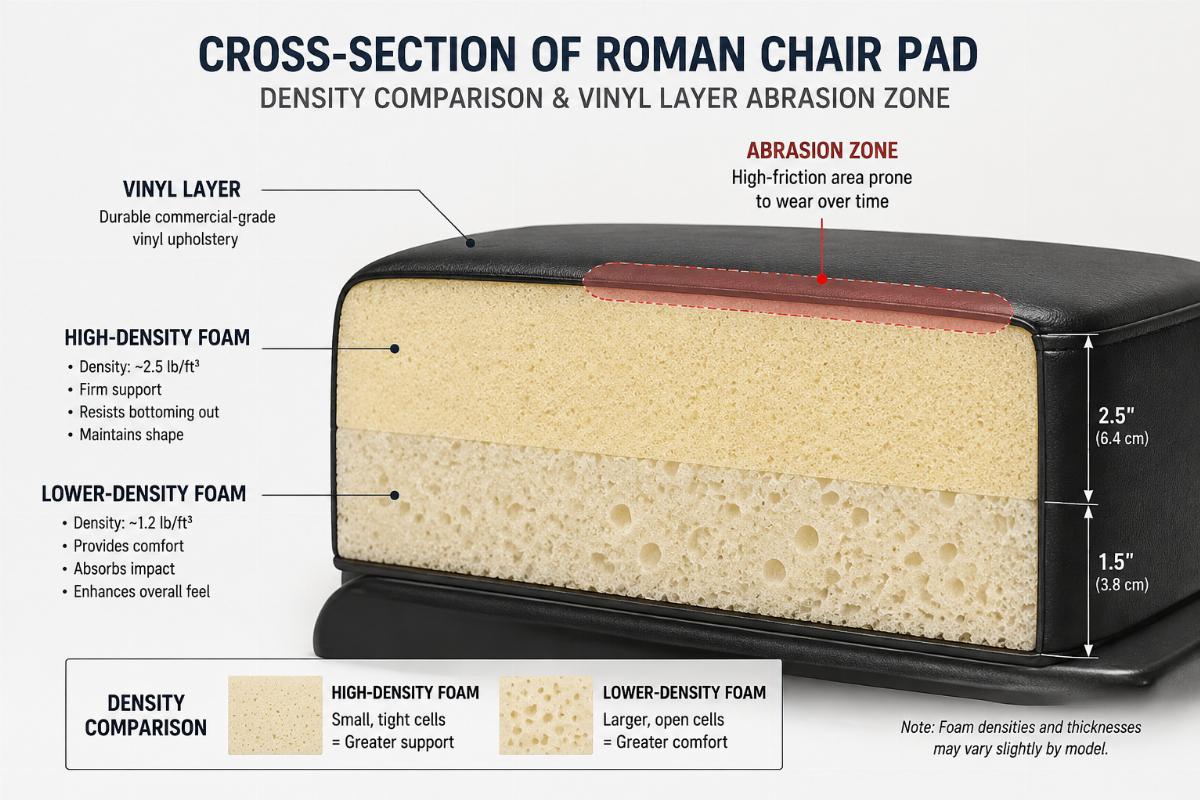
Pad deformation and vinyl cracking are often blamed on material quality, but the root cause is usually foam density specification and abrasion cycle rating.
After bearing noise and weld cracks, the third most common complaint on a china Roman Chair is pad flattening and vinyl splitting. Many buyers specify pad thickness in millimeters but ignore foam density. A thick pad made from low-density foam will compress permanently within months, while a thinner pad with higher density foam retains its shape far longer. [NEED_CITE: relationship between foam density, permanent set, and service life in fitness equipment padding]
Vinyl abrasion resistance is measured in double-rub cycles. Commercial-grade vinyl should withstand a high cycle count before showing wear, especially at the hip contact zone where friction is concentrated. Specifying vinyl by thickness alone misses this entirely.
| Pad Attribute | Low Specification | Commercial Specification |
|---|---|---|
| Foam density | Low | High |
| Permanent set after cycling | Noticeable | Minimal |
| Vinyl abrasion resistance | Basic | Substantially extended |
| Surface cracking | Early onset | Resistant |
When the Middle East client reported pad deformation, the foam density was found to be well below what sustained daily use requires. Upgrading the foam and specifying a higher abrasion-rated vinyl resolved the issue on the replacement batch. [NEED_CITE: foam density and vinyl abrasion cycle testing standards for commercial fitness equipment padding]
How to Verify a China Roman Chair Matches PowerLine Durability
A short checklist of specifications, test requests, and documentation requirements separates a durable china Roman Chair from one that will fail in the field.
Based on the failure patterns I have documented across multiple markets, here is what any serious buyer should require before placing an order:
- Request tube wall thickness measurement reports on production samples, not just catalog values.
- Ask for bearing specification sheets including seal type and seat machining tolerance class.
- Require weld cross-section photos or a destructive bend test report on a production coupon.
- Specify pad foam density and vinyl double-rub cycle rating in the purchase contract.
- Request a sample unit for independent third-party load cycling before approving bulk production.
- Verify that adjustment pin diameter and thread-lock method are documented and match the sample.
Any manufacturer producing a china Roman Chair built to match PowerLine durability will welcome these requests and provide the documentation without delay. Resistance to any of these checkpoints is itself a warning sign. [NEED_CITE: pre-shipment verification checklist for commercial roman chair durability specifications]

Conclusion
Durability is decided at the bearing seat, the weld fusion zone, and the foam density—not on the spec sheet’s outer dimensions. A china Roman Chair built with controlled machining tolerance, full-penetration welds, and properly specified padding will hold up under daily commercial use just as well as a PowerLine unit, at a noticeably lower cost. The buyer’s job is to verify these hidden specifications before the container is sealed.


