01 / Scenario
STUDIO
P
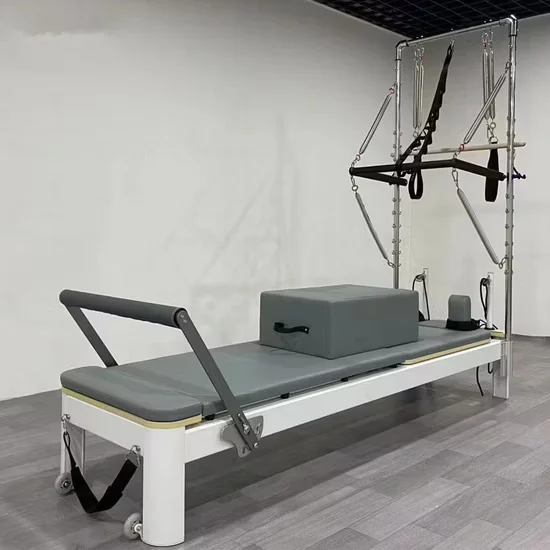
High-End Pilates Studios
Premium aesthetics meet quiet operation for boutique studio environments.

ISO
9001
CE
Certified
OEM
Available
10YR
Warranty
Commercial Pilates Reformer Machine, 2570×730×1100mm, 110kgs — engineered with reinforced frame construction and precision-machined carriage rail system for smooth operation under repetitive studio use. Includes long box, jump board, and platform accessories with 3-year warranty coverage. Direct manufacturer supply with full OEM-ODM capability and custom branding options available.
// Spec Highlights
• Direct from Manufacturer · No Middlemen · Worldwide Shipping
01
// Material
Imported Solid Wood
Premium hardwood frames sourced for density and visual warmth.
02
// Hardware
Medical-Grade Silent
Whisper-quiet pulleys and springs for clinical environments.
03
// Customization
Appearance OEM
Color, upholstery, and branding tailored to your studio.
04
// Service
Layout Design
Free venue planning for studios and rehab institutions.
Every component is selected for longevity, performance, and aesthetic harmony - from imported hardwood frames to silent medical-grade accessories.
// Features
Frame Integrity Under Cyclic Loading — Every Pilates reformer we ship passes a three-stage structural inspection including dynamic load testing on the carriage and rail system before crating.
| Parameter | Value |
|---|---|
| Product Type | Pilates Reformer Machine |
| Model NO. | SRY-27 |
| Frame Finish | Powder coated, Black |
| Product Dimensions | 2570 × 730 × 1100 mm |
| Net Weight | 110 kg |
| Included Accessories | Long Box, Jump Board, Platform |
| Logo | Customized |
| Age Group | Adult |
| Gender | Unisex |
| Warranty | 3 Years |
| Facility Type | Typical Use |
|---|---|
| Commercial Pilates studio | Group reformer classes with back-to-back scheduling |
| Boutique movement studio | Semi-private sessions with frequent accessory swaps |
| Rehabilitation and physiotherapy center | Controlled resistance work for post-injury recovery protocols |
| Hotel and resort fitness center | Guest-accessible equipment requiring low maintenance overhead |
Sealed carriage bearings are the single largest factor in reformer longevity under studio traffic.
Most reformers on the market use open-face bearings on the carriage wheels to cut unit cost. In a dusty studio environment with chalk residue, hair, and fiber from upholstery, those open bearings accumulate particulate within months. The wheel develops lateral play, the carriage drifts off the rail centerline, and the user feels a gritty, inconsistent glide. [NEED_CITE: bearing ingress protection ratings for fitness equipment environments] I came up through load testing and QC on the Ningjin manufacturing line before moving into product engineering. A batch of early-production reformers we shipped used open bearings — within six months, studio operators were reporting that the carriage felt rough and required constant re-alignment. For the commercial pilates reformer machine we build now, we specify sealed bearings on every carriage wheel and every pulley in the cable routing path, because the cost of a sealed unit is negligible compared to a service call.
The reformer covers linear horizontal resistance across supine, prone, seated, and standing orientations, engaging the full posterior chain, core stabilizers, and hip complex through a continuous range of motion. In a dedicated Pilates studio layout, this unit anchors the primary floor zone and is typically paired with a Cadillac or tower for vertical-plane work and a Wunda chair for loaded standing movements. It fits high-scheduling-density facilities where a single unit may see eight or more sessions per day. The carriage platform and accessory configuration accommodate users across a broad anthropometric range, from shorter practitioners using the jump board to taller users on full-length stroke work.
The reformer frame experiences cyclical eccentric loading each time a user drives the carriage against spring tension and reverses direction at end range. This creates repeated stress reversals at the rail mounting points and the cross-member welds connecting the legs to the main beam. In a commercial pilates reformer machine running six to ten sessions daily, the carriage bearings and rail surfaces endure thousands of reciprocating cycles per week, and any gap in the weld bead becomes a fatigue initiation site. Upholstery on the carriage platform and headrest takes concentrated compressive load from body weight and resists shear from limb repositioning. Powder coating on the frame rails and contact points must withstand sweat, cleaning chemicals, and mechanical abrasion from accessory changes. [NEED_CITE: fatigue failure mechanisms in cyclically loaded welded steel frames]
Frame dimensional stability on a reformer depends on tube wall thickness, cross-section profile, and the continuity of weld joints at load-bearing nodes. A welded joint with incomplete penetration will pass a visual inspection but develop a propagating crack under repeated asymmetric carriage loading. Bearing specification determines whether the carriage rolls smoothly after twelve months of studio use or develops play that requires wheel replacement. The spring system — its wire diameter, coil count, and end-hook geometry — governs both the resistance curve felt by the user and the fatigue life under continuous tension-release cycles. Upholstery density on the carriage surface dictates how long the pad holds its shape before compressing into a hard, uneven surface that users notice immediately. Powder coating applied at industrial thickness over a properly sandblasted substrate resists chipping at the high-contact rail edges and fastener points. Accessory mounting points — the long box slots, jump board brackets, and platform attachment hardware — must be machined to consistent tolerances so that swapping accessories does not require force or produce wobble.
Using thinner-gauge tube on the main beam saves material cost per unit but allows perceptible flex when a heavy user drives the carriage at full stroke — that flex transmits into the rail mounting hardware and accelerates wear on the wheel-to-rail interface. Open bearings eliminate a small per-unit expense but create a maintenance liability that surfaces within the first year of commercial use, when operators report inconsistent glide and request carriage overhauls. Low-density upholstery foam compresses permanently under repeated body-weight loading, and a sunken pad surface is both uncomfortable and visually degrading in a premium studio environment. Insufficient powder coating thickness at contact edges chips under accessory insertion and removal, exposing bare steel to sweat and humidity that initiate surface corrosion. [NEED_CITE: comparative maintenance cost between sealed and unsealed bearings in commercial fitness equipment]
Our frame construction starts with Q235 and Q345 industrial steel sourced from certified mills, with material traceability maintained from coil to finished unit. Weld joints on this reformer are executed by robotic MIG cells producing continuous beads with full penetration — no spot-weld short cuts that become failure points under cyclic carriage loading. Every unit undergoes a load test on the carriage system and a structural inspection before it leaves the Ningjin plant, not sample-based testing on a production batch. The powder coating is applied at 200μm industrial thickness over a sandblast-prepared surface, protecting rail edges and accessory mounting points from the chipping that exposes bare metal in high-use studios. The three-year warranty on this reformer reflects confidence in the structural specification. We also provide 2D and 3D floor planning CAD support so operators can verify unit placement, safe clearance around the carriage travel path, and accessory storage zones before the equipment ships.
Provide your studio floor dimensions and equipment list to receive a 2D-3D layout showing carriage clearance zones and accessory storage placement. Specify expected daily session volume so we can confirm the structural grade matches your traffic profile. Detail the user population range to verify that the carriage stroke and accessory configuration cover your client base. Communicate color, logo, and upholstery preferences early in the order cycle to align production with your opening or renovation timeline.
Q: How do I distinguish a commercial-grade pilates reformer from a light-commercial unit?
A: Commercial-grade reformers specify sealed bearings on carriage wheels and pulleys, continuous-weld frame joints rather than spot welds, and industrial-thickness powder coating. Light-commercial units typically use open bearings and thinner coating that degrade under daily studio scheduling. Request the bearing specification, weld type, and coating thickness from any supplier before committing.
Q: What frame characteristics determine long-term durability in a studio environment?
A: Frame rigidity depends on steel gauge, tube cross-section dimensions, and whether weld joints are continuous or intermittent. A frame that flexes under full-stroke carriage loading transfers stress into the rail mounting hardware, accelerating wear. Verify that the manufacturer uses certified steel with traceable mill documentation and robotic welding for consistent joint quality.
Q: How does carriage bearing quality affect studio maintenance schedules?
A: Sealed bearings prevent dust, chalk, and fiber from entering the race, maintaining smooth carriage travel for significantly longer intervals between service. Open bearings in a studio environment accumulate particulate quickly, causing lateral play and inconsistent glide that operators notice within months. Specifying sealed bearings at purchase reduces ongoing maintenance overhead.
Q: What should I confirm about the spring system before purchasing?
A: Verify that springs are rated for continuous tension-release cycling at commercial frequency and that replacement springs are available as individual components rather than requiring a full carriage teardown. Spring wire gauge and end-hook geometry affect both the resistance curve and fatigue life under daily studio use.
Q: Is upholstery replacement available if the carriage pad compresses over time?
A: Confirm with the manufacturer that replacement upholstery pads are stocked or producible for the specific reformer model and that the pad attaches with a removable fastener system rather than permanent adhesive. This ensures a worn pad can be swapped without sending the entire carriage assembly back to the factory.
Premium aesthetics meet quiet operation for boutique studio environments.
Medical-grade silence and precision for sports & postpartum recovery.
Furniture-grade craftsmanship for premium residential installations.
Compact premium setups for one-on-one and small-group training.
Aesthetic Pilates integration for hybrid wellness studio programming.
Multi-unit deployment with instructor-grade reliability for certification programs.
Tell us about your project. Our team will respond within 24 hours with pricing, customization options, and shipping details.
// Sales Director
William
+86 132 2531 1800
// Export Manager
Bella
+86 198 5412 8032
william@bickfit.com