01 / Scenario
STUDIO
P
High-End Pilates Studios
Premium aesthetics meet quiet operation for boutique studio environments.

ISO
9001
CE
Certified
OEM
Available
10YR
Warranty
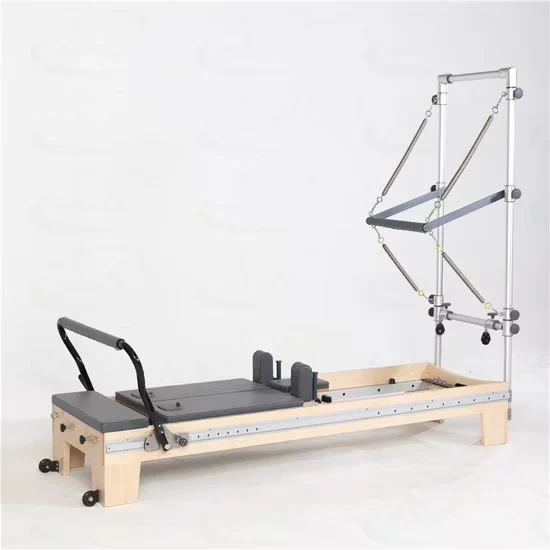
Pilates Reformer with Half Wood Maple Foldable Frame, 2400×600×350mm, 100kg Net Weight — solid maple carriage rail resists warping under humidity cycles, foldable joint locks maintain zero-play alignment during loaded sessions, includes long box, jump board, and platform for full studio programming. Every unit undergoes 32-point inspection and 100% load testing before dispatch.
// Spec Highlights
• Direct from Manufacturer · No Middlemen · Worldwide Shipping
01
// Material
Imported Solid Wood
Premium hardwood frames sourced for density and visual warmth.
02
// Hardware
Medical-Grade Silent
Whisper-quiet pulleys and springs for clinical environments.
03
// Customization
Appearance OEM
Color, upholstery, and branding tailored to your studio.
04
// Service
Layout Design
Free venue planning for studios and rehab institutions.
Every component is selected for longevity, performance, and aesthetic harmony - from imported hardwood frames to silent medical-grade accessories.
// Features
Carriage Rail Integrity — Solid maple rail and steel frame maintain alignment through thousands of loaded studio cycles.
| Parameter | Value |
|---|---|
| Product Type | Pilates Reformer |
| Model | SRY-20B |
| Frame Material | Solid Maple Wood and Steel |
| Product Dimensions | 2400 × 600 × 350 mm |
| Net Weight | 100 kg |
| Accessories Included | Long Box, Jump Board, Platform |
| Color | Solid Color, custom options available |
| Logo | Customized Is Allowed |
| Warranty | 3 Years |
| Production Capacity | 80 Pieces per Month |
| Facility Type | Typical Use |
|---|---|
| Pilates Studio | Group reformer classes with high daily turnover and back-to-back scheduling |
| Boutique Fitness Center | Semi-private and one-on-one instruction combining reformer with apparatus-based sessions |
| Rehabilitation and Physiotherapy Center | Controlled movement protocols requiring smooth, predictable carriage resistance |
| Home Studio | Dedicated training space where foldable storage maximizes usable floor area |
The rail-to-carriage interface determines whether a reformer stays precise or develops lateral wobble within months of studio scheduling.
Many studios purchase equipment labeled as commercial pilates reformer maple wood foldable without verifying the grain orientation or moisture content of the wood. Boards cut from lower-grade lumber warp under seasonal humidity shifts, and the carriage begins to track off-center. Sealed bearings matter, but they cannot compensate for a rail surface that has lost dimensional flatness. Operators end up shimming wheels or replacing entire carriage assemblies to restore the glide their members expect [NEED_CITE: dimensional stability of hardwoods under cyclic humidity loading].
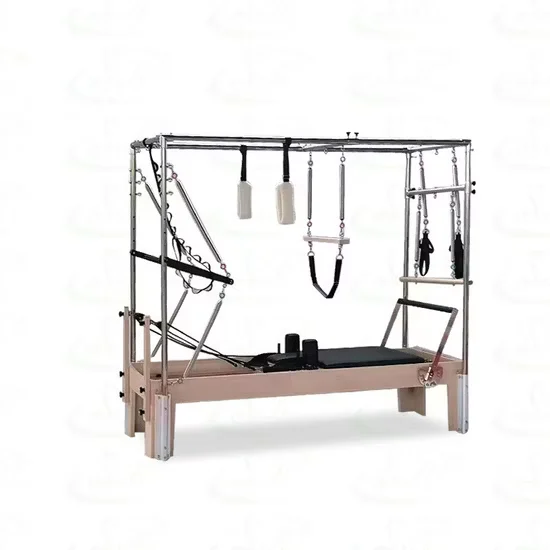
This reformer targets the full sagittal and frontal plane movement spectrum — footwork sequences through long box pulling straps and jump board plyometric intervals. In a studio layout, it pairs with cadillacs and chair apparatus to create circuit-style class formats. The foldable frame suits facilities running six or more group sessions daily where floor reconfiguration between classes is routine. It accommodates users from rehabilitation clients working with minimal spring tension to advanced practitioners loading full spring stacks for leg and arm series. The commercial pilates reformer maple wood foldable platform supports instructors who need quick transitions between apparatus setups.
Every reformer session cycles the carriage hundreds of times against spring tension, generating repetitive lateral and eccentric forces at the wheel-to-rail contact point. The foldable hinge mechanism must sustain these loads without introducing play — any looseness at the joint propagates as lateral drift across the full rail length. Spring attachment points endure repeated tensioning and release, and fatigue accumulates first at the anchor holes and mounting hardware. The upholstery on the shoulder rest and headrest absorbs constant compression and sweat exposure, demanding replacement availability as a maintenance variable [NEED_CITE: fatigue behavior of hinge mechanisms under cyclic tensile loading].
Solid maple is chosen for its high Janka hardness rating and tight grain structure, which together resist surface denting from carriage wheels and maintain a consistent glide track over years of use. Moisture content at the time of milling determines whether the rail will cup or twist once installed in a climate-controlled studio — kiln-dried stock with equilibrium moisture content matched to interior environments minimizes this risk. The foldable frame joint relies on steel locking pins and precision-machined hinge barrels to preserve alignment each time the unit is deployed. Spring resistance calibration follows a progressive tension curve so that instructors can prescribe incremental loading without abrupt resistance jumps between settings.
Reformers built with laminated or low-density wood rails develop surface grooves where carriage wheels track, eventually creating a rough, uneven glide that no amount of lubrication corrects. Hinge mechanisms using stamped steel pins instead of machined barrels develop rotational play that manifests as carriage drift under loaded footwork. Non-sealed wheel bearings packed with generic grease dry out under studio cleaning chemical exposure, producing grinding noise and requiring premature replacement. Springs wound from undersized wire lose tension calibration faster, forcing instructors to compensate with verbal cues rather than trusting the apparatus feedback [NEED_CITE: bearing failure modes in fitness equipment under chemical exposure].
The steel frame sections provide rigid anchoring for the foldable hinge and spring bar, preventing the torsional flex that pure-wood frames exhibit under jump board impact loads. Every unit undergoes load testing before shipment, verifying carriage glide and hinge lock integrity under weighted conditions. The 200μm industrial powder coating on steel components resists chipping at contact points where springs and accessories attach repeatedly. For studios planning multi-unit layouts, 2D-3D CAD floor planning ensures safe clearance between adjacent reformers during full-extension exercises. Custom logo application and color selection allow brand consistency across a studio’s entire apparatus fleet.
Provide your studio floor dimensions and target unit count to receive a 2D-3D layout showing safe spacing for group class choreography. Specify your average daily class throughput so the structural grade matches your usage intensity. Confirm the user population range to ensure carriage dimensions and spring resistance options cover your clientele. Indicate any custom color, logo, or upholstery requirements for brand alignment across your apparatus fleet.
Q: How do you evaluate commercial versus light-duty pilates reformer construction?
A: Check the rail material grade, frame joint mechanism, and wheel bearing type. Commercial units use solid hardwood rails with kiln-dried moisture specifications, steel-reinforced foldable joints with machined locking hardware, and sealed bearings rated for continuous use. Light-duty reformers substitute laminated wood, stamped hinges, and open bearings that degrade within months of studio-level scheduling.
Q: What are the durability trade-offs between maple wood and aluminum rails?
A: Maple offers superior surface hardness and vibration dampening, producing a quieter carriage glide with less transmitted resonance. Aluminum rails resist humidity-related warping entirely but transmit more vibration and can develop surface scoring from wheel contact over time. Studio environments with stable climate control benefit from maple’s glide characteristics, while high-humidity locations may favor aluminum’s dimensional consistency.
Q: What structural points should you verify before purchasing a foldable reformer?
A: Inspect the hinge mechanism for machined barrels rather than stamped pins, and confirm the locking system holds without lateral play when fully deployed. Request load test documentation showing the carriage tracks true under weighted conditions. Verify that the foldable joint has been cycle-tested through repeated open-close sequences to confirm long-term alignment retention.
Q: What is the replacement cycle for carriage wheels and bearings?
A: Sealed bearings in a commercial studio environment typically require inspection at regular maintenance intervals, with replacement driven by audible grinding or measurable lateral play rather than a fixed calendar schedule. Wheel condition depends on rail surface hardness and cleaning chemical exposure. Ensure your supplier stocks compatible replacement assemblies to minimize apparatus downtime during servicing.
Premium aesthetics meet quiet operation for boutique studio environments.
Medical-grade silence and precision for sports & postpartum recovery.
Furniture-grade craftsmanship for premium residential installations.
Compact premium setups for one-on-one and small-group training.
Aesthetic Pilates integration for hybrid wellness studio programming.
Multi-unit deployment with instructor-grade reliability for certification programs.
Tell us about your project. Our team will respond within 24 hours with pricing, customization options, and shipping details.
// Sales Director
William
+86 132 2531 1800
// Export Manager
Bella
+86 198 5412 8032
william@bickfit.com