01 / Scenario
STUDIO
P
High-End Pilates Studios
Premium aesthetics meet quiet operation for boutique studio environments.
ISO
9001
CE
Certified
OEM
Available
10YR
Warranty
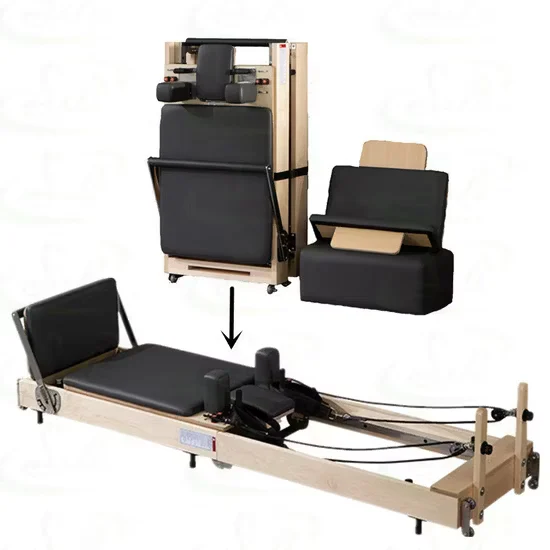
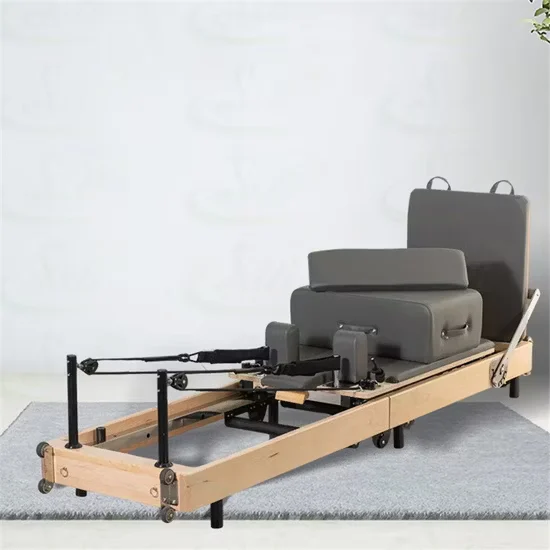
Pilates Studio Reformer, White Maple Wood Frame, 2400×600×350mm, 100kg — solid hardwood construction with foldable hinge mechanism for compact storage in high-density studio floors; includes long box, jump board, and platform accessory kit with 3-year warranty. Every unit undergoes rail glide testing and spring calibration verification before shipment.
// Spec Highlights
• Direct from Manufacturer · No Middlemen · Worldwide Shipping
01
// Material
Imported Solid Wood
Premium hardwood frames sourced for density and visual warmth.
02
// Hardware
Medical-Grade Silent
Whisper-quiet pulleys and springs for clinical environments.
03
// Customization
Appearance OEM
Color, upholstery, and branding tailored to your studio.
04
// Service
Layout Design
Free venue planning for studios and rehab institutions.
Every component is selected for longevity, performance, and aesthetic harmony - from imported hardwood frames to silent medical-grade accessories.
// Features
Every Unit Load-Tested — each commercial white maple wood pilates reformer leaves the facility only after passing a full carriage-load cycle that confirms rail straightness and spring calibration under working conditions.
| Parameter | Value |
|---|---|
| Product Type | Pilates Reformer |
| Frame Material | Solid White Maple Hardwood |
| Dimensions (L × W × H) | 2400 × 600 × 350 mm |
| Net Weight | 100 kg |
| Foldable | Yes |
| Included Accessories | Long Box, Jump Board, Platform |
| Color Options | Solid Color finishes available |
| Customization | Logo and finish customization available |
| Warranty | 3 Years |
| Facility Type | Typical Use |
|---|---|
| Boutique Pilates Studio | Daily group and private reformer classes with fold-and-stack storage between sessions |
| Hotel and Resort Wellness Suite | Compact in-room or spa-adjacent placement where full rail length must be preserved without permanent floor commitment |
| Rehabilitation and Physiotherapy Center | Low-vibration, stable platform for controlled therapeutic movement and post-injury conditioning |
| Private Home Studio | Full-length reformer capability that folds away when the room serves other functions |
A warped rail turns every exercise into an uneven resistance problem that no spring swap can fix.
Many studio owners discover too late that laminated plywood or undersized timber frames begin to twist under repeated spring tension. The carriage drifts to one side, resistance becomes asymmetrical, and the rail surface develops grooves that accelerate wheel wear. Within the first year of high-frequency scheduling, the reformer either needs a costly rail replacement or gets pulled from the rotation entirely. [NEED_CITE: EN 957 structural requirements for stationary training equipment]
A commercial white maple wood pilates reformer serves as the primary apparatus in most Pilates programming, covering supine, prone, seated, and standing movement patterns across the full 2.4 m rail travel. It pairs with a Cadillac or tower unit for decompression work and a Wunda Chair for loaded stability challenges. In studios running back-to-back classes, the foldable footprint lets operators clear floor space for mat sessions without moving equipment to storage. The frame accommodates users across a wide height range thanks to adjustable spring anchoring and accessory positioning.
Every reformer stroke places alternating tension and shear on the rail surface, carriage wheels, and spring anchor points. In a studio scheduling six or more classes per day, the carriage completes thousands of cycles weekly, concentrating wear at mid-rail where most exercises operate. The folding hinge introduces a second stress path: each deployment and collapse cycles the latch and pivot under the full 100 kg dead weight plus user load. [NEED_CITE: fatigue performance in structural hardwood joinery under cyclic loading] Sweat and cleaning solvents gradually degrade unprotected metal hardware at hinge points, making material selection and finish integrity critical for long-term function.
The 2400 mm solid white maple frame provides a continuous grain path along the full rail length, which resists the torsional twist that laminated or finger-jointed alternatives develop under uneven spring tension. Rail straightness tolerance directly determines whether the carriage tracks true or develops lateral play over time — a tolerance that depends on both the initial milling and the moisture content stability of the wood species. The included long box, jump board, and platform each add specific load vectors: the jump board in particular sends impact shock back through the rail and frame with every landing, demanding a joint structure that transfers force without loosening. Spring resistance grading affects not just exercise difficulty but also the cyclic stress amplitude on anchor hardware. A foldable design that maintains full rail length avoids the mid-frame hinge that compromises carriage travel on shorter collapsible models.
A reformer built with thin laminated rails will develop visible carriage drift within months of commercial scheduling, forcing the studio to either rotate the unit out or absorb the injury risk of uneven resistance. Non-replaceable carriage wheels mean that once grooving appears on the rail surface, the entire rail-carriage assembly becomes a write-off. Low-grade spring steel loses its calibrated resistance curve after repeated full-extension cycles, leaving instructors unable to match resistance to client level. Hinge latches rated below commercial cycle counts develop slop that makes the deployed frame feel unstable, eroding client confidence during balance-dependent exercises. [NEED_CITE: commercial fitness equipment maintenance cost patterns in high-frequency studio environments]
The solid white maple selection prioritizes grain continuity and density over cosmetic grain matching, giving the rail structure the torsional rigidity that daily class scheduling demands. Each unit ships with the full accessory set — long box, jump board, and platform — so operators avoid the compatibility gaps that arise when sourcing add-ons separately. The foldable mechanism maintains the complete 2.4 m rail travel when deployed, supporting the full exercise catalog without compromise. Facility planning support includes 2D and 3D CAD layouts that account for reformer spacing, fold-clearance zones, and accessory storage walls, so studios avoid the dead space between apparatus that wastes rent. OEM customization allows studio branding on the frame while keeping the underlying structural spec unchanged.
Provide your studio floor dimensions and target apparatus count to receive a 2D or 3D layout that accounts for reformer spacing, fold-clearance arcs, and accessory storage zones. Specify your expected daily class volume so the structural grade matches your scheduling density. Confirm the height and weight range of your client population to verify that the spring resistance configuration and accessory adjustability cover your programming needs. Indicate any finish customization or logo placement requirements early so production scheduling stays aligned with your opening timeline.
Q: How do I confirm the reformer frame is solid hardwood and not laminated plywood?
A: Request the wood species certification and inspect the rail end grain — solid white maple shows continuous grain lines running the full length, while laminated construction reveals alternating ply layers. Moisture content documentation should accompany each batch. Laminated frames are lighter and cheaper initially but develop torsional warp under repeated spring tension, leading to carriage drift and uneven resistance that cannot be corrected with spring adjustment alone.
Q: What rail length is needed to support a full Pilates exercise repertoire?
A: A 2400 mm rail provides the carriage travel necessary for full-extension exercises including long stretch, elephant, and full leg press variations. Shorter rails force clients to compromise range of motion on taller users. The foldable design on this reformer preserves the complete rail length when deployed, avoiding the mid-frame hinge that interrupts smooth carriage travel on some collapsible alternatives.
Q: What are the trade-offs between foldable and fixed-frame reformers?
A: Fixed frames eliminate hinge maintenance entirely and provide marginally higher perceived rigidity. Foldable reformers trade that incremental rigidity for the ability to clear floor space between sessions, which matters in studios running mixed mat and apparatus classes or in facilities where the room serves multiple functions. The key engineering question is whether the fold mechanism maintains full rail continuity when deployed — a mid-rail hinge will create a dead spot in carriage travel.
Q: How often should springs be replaced in a commercial studio setting?
A: Springs in daily commercial use gradually lose their calibrated resistance curve, particularly those used at full extension frequently. Operators should document resistance feel monthly and replace individual springs when the load no longer matches the graded specification. Having replacement springs in stock from the original manufacturer ensures resistance grading stays consistent across all units in the studio, rather than mixing spring rates from different sources.
Premium aesthetics meet quiet operation for boutique studio environments.
Medical-grade silence and precision for sports & postpartum recovery.
Furniture-grade craftsmanship for premium residential installations.
Compact premium setups for one-on-one and small-group training.
Aesthetic Pilates integration for hybrid wellness studio programming.
Multi-unit deployment with instructor-grade reliability for certification programs.
Tell us about your project. Our team will respond within 24 hours with pricing, customization options, and shipping details.
// Sales Director
William
+86 132 2531 1800
// Export Manager
Bella
+86 198 5412 8032
william@bickfit.com