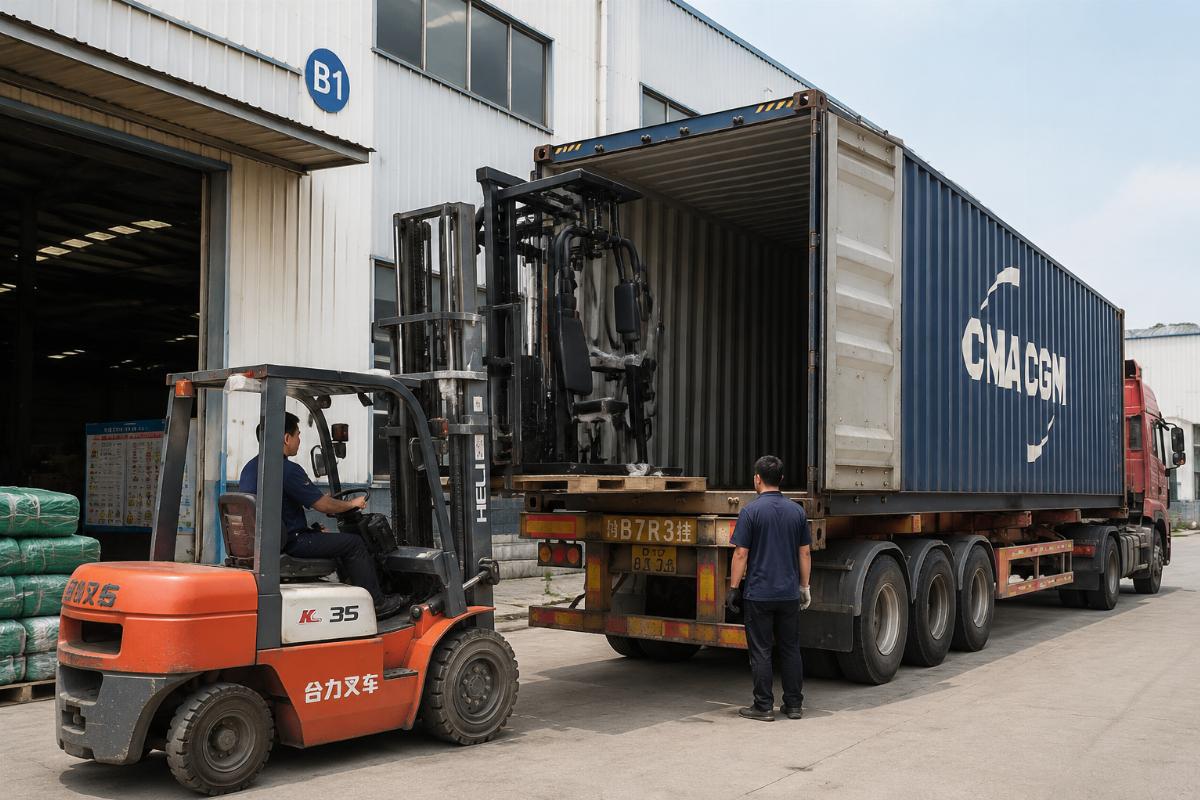
Buy Pec Deck Machine Container Load Wholesale Supplier Deal
The lowest unit price in a Pec Deck machine container load deal rarely means the lowest total cost. Hidden expenses from thin-wall tubing deformation, weight stack guide rail damage, and poor consolidation packaging routinely erase the initial savings and turn a profitable shipment into a mid-six-figure write-off.
When sourcing a Pec Deck machine container load deal, the three non-negotiable acceptance criteria are main frame tube wall thickness, weight stack guide rail packaging rigidity, and pulley assembly material grade — not the quoted FOB price per unit.
I spent my early years welding frames at a fitness equipment factory in Jining, Shandong, before moving into overseas project coordination. On one shipment to a hotel project in Riyadh, we loaded a full container of Pec Deck machines and Smith machines. The buyer had chosen the thinnest available tube gauge to cut per-unit cost. When the container arrived at Jebel Ali and was stripped, the weight stack guide rails on nearly every Pec Deck had bent during ocean transit. The machines could not be assembled on site. Replacement parts had to be air-freighted, and the logistics cost completely swallowed the margin we had built into the order [NEED_CITE: ocean freight vibration impact on unbraced steel structures per ISTA 3A transit testing standards]. That single decision — saving a fraction on tube thickness — turned a profitable deal into a loss. Since then, the first thing I check on any Pec Deck machine container load deal is the structural wall-to-diameter ratio and the guide rail fixation method inside the crate.
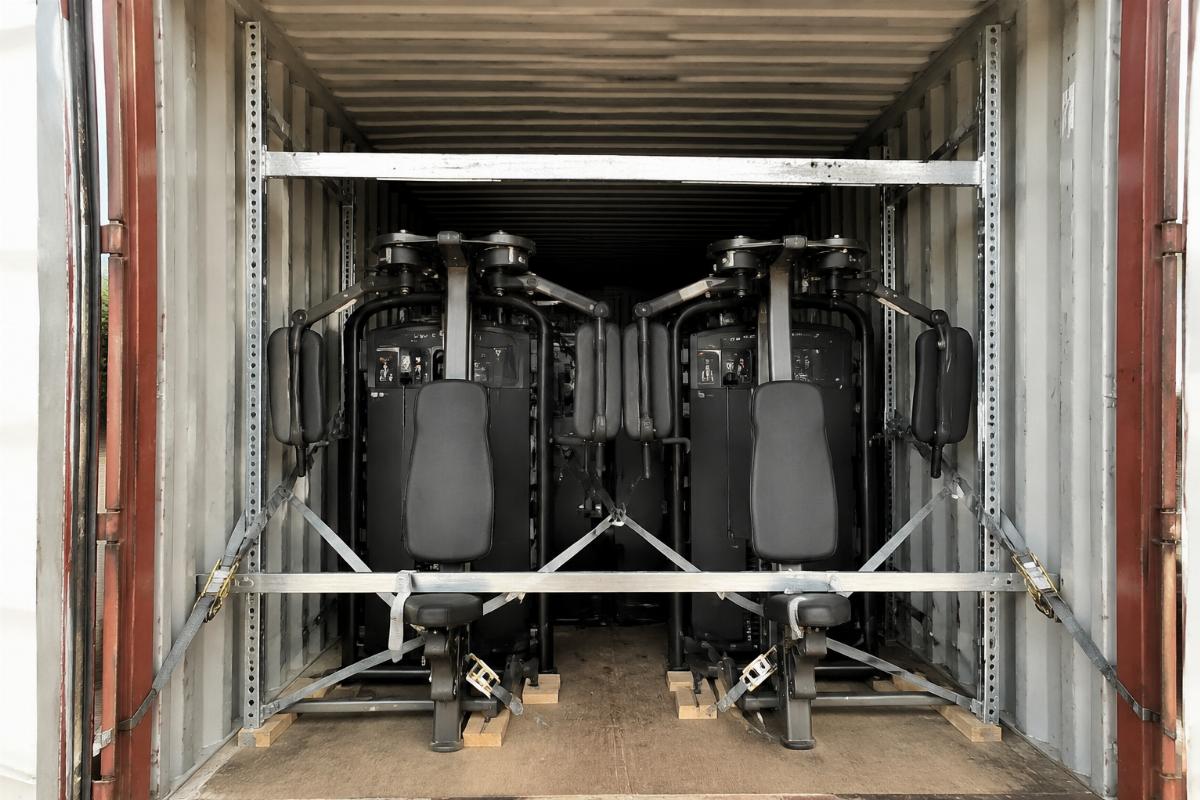
Let me walk you through the specs, cost structures, packaging risks, inspection protocols, and consolidation logic that actually determine whether a container load of Pec Deck machines makes or breaks your margin.
What Specs Matter Most When Buying Pec Deck Machines in Container Loads?
Tube wall thickness, guide rail straightness tolerance, and pulley cable material are the three acceptance red lines — appearance and unit price are secondary.
Most buyers opening a Pec Deck machine container load deal for the first time focus on the finish color, the seat cushion stitching, and the weight stack increment. Those are cosmetic and functional details that matter, but they do not determine whether the machine survives a six-week ocean voyage and ten years of commercial use. The structural skeleton does.
| Structural Element | Minimum Commercial-Grade Requirement | Risk if Below Standard |
|---|---|---|
| Main frame tube wall | Heavy-duty wall-to-diameter ratio per EN ISO 20957 | Frame flex under load, permanent deformation in transit |
| Weight stack guide rails | Precision-ground, independently braced in packaging | Rail bending, weight stack jamming, unusable on arrival |
| Pulley assembly | Sealed bearing, aircraft-grade cable | Cable fraying, bearing seizure, safety hazard under use |
| Weld joints | Continuous full-penetration, ground smooth | Crack propagation under repetitive loading |
[NEED_CITE: EN ISO 20957 stationary training equipment structural integrity requirements]
A distributor in West Africa once received a Pec Deck machine container load deal where the main frame tubes measured noticeably below the heavy-duty threshold. The machines looked fine in the showroom for the first few weeks. Within months, the pivot arms developed visible play at the bearing housings. The root cause was not the bearing itself — it was the frame flexing under load because the tube wall could not resist torsional stress. The distributor had to reinforce every unit locally, which cost several times the original per-unit savings.

The lesson is simple: when evaluating a Pec Deck machine container load deal, request the mill test certificate for the frame tubing and verify the wall-to-diameter ratio against commercial-grade standards before you sign the purchase order.
How Do You Structure a Container Load Deal Without Losing Money on Hidden Costs?
The FOB price is only the starting point — packaging reinforcement, loading plan engineering, and destination inspection costs must be factored into the true landed cost.
A Pec Deck machine container load deal looks straightforward on a proforma invoice: unit price times quantity, plus freight. But the real cost structure has layers that most buyers miss until they hit the first unexpected charge at the destination port.
The hidden cost categories include:
- Packaging reinforcement for guide rails and weight stacks — Standard export cartons are designed for single-machine LCL shipments, not for the sustained vibration of a fully loaded FCL container. Guide rails need additional steel or timber bracing inside the crate. This adds a modest per-unit cost but prevents catastrophic rail bending.
- Loading plan design and lashing materials — A container stuffed without a professional loading plan will see machines shifting during transit. Steel wire lashing, timber blocking, and anti-slip matting are consumable costs that must be budgeted. [NEED_CITE: CTU Code guidelines for cargo transport unit loading and securing]
- Pre-shipment inspection and loading supervision — Hiring a third-party inspector to verify tube thickness, weld quality, and packaging integrity before the container doors are sealed costs a few hundred dollars but saves tens of thousands in claims and air-freight emergencies.
- Destination port unpacking and first-article inspection — Stripping the container without a documented inspection protocol means you lose the ability to file a carrier or supplier claim for transit damage.
A hotel project buyer in the Gulf once structured a Pec Deck machine container load deal purely on the lowest FOB unit price. The supplier did not include guide rail bracing in the packaging quote because the buyer did not ask for it. On arrival, multiple units had bent rails. The air-freight cost for replacement rails and the on-site labor for reassembly exceeded the original savings by a wide margin.
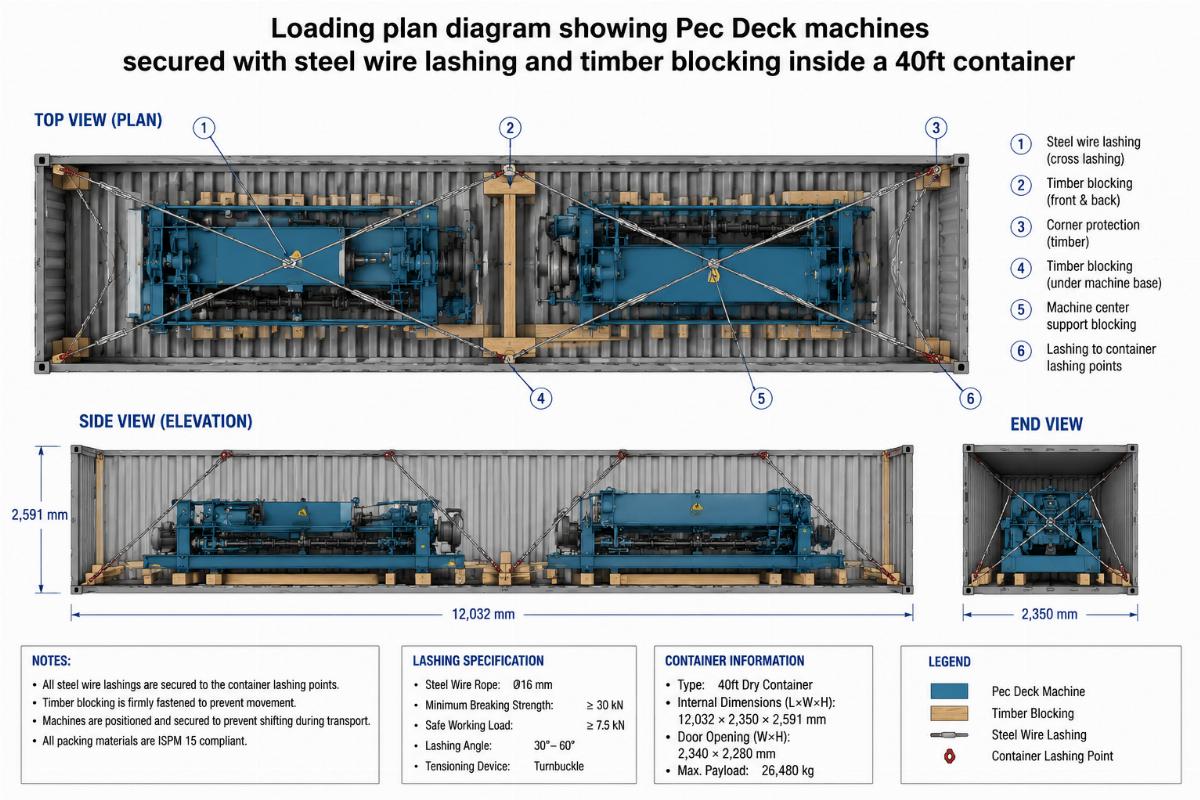
At Bick, every Pec Deck machine container load deal includes a professional loading plan drawing reviewed and approved by the buyer before production begins, along with factory-supplied guide rail bracing and pre-shipment loading supervision. This is not an upsell — it is the baseline engineering that prevents the hidden costs from materializing.
What Packaging Failures Cause the Most Damage During Ocean Shipping?
Weight stack guide rail deformation and inter-unit paint abrasion are the two dominant failure modes — both stem from insufficient fixation nodes and missing inter-unit isolation.
Ocean shipping subjects a fully loaded container to constant low-frequency vibration, occasional sharp impacts from container handling, and sustained compression from stacking. A Pec Deck machine is particularly vulnerable because it combines a tall, narrow frame with a precision-aligned internal weight stack system.
The most common packaging failures I have documented across multiple Pec Deck machine container load deal shipments include:
- Guide rail fixation failure — The weight stack guide rails are long, slender steel components. If they are not independently braced at multiple points inside the carton, vibration causes them to flex and permanently bend. Once bent, the weight stack will not slide smoothly, and the machine is effectively unusable until the rail is replaced.
- Inter-unit contact abrasion — When multiple machines are loaded into a container without adequate separation or protective wrapping, the painted surfaces contact each other during transit. The result is widespread paint chipping and scratching that requires full repainting on arrival.
- Loose hardware migration — Bolts, washers, and adjustment pins packed loosely inside the carton or inside the machine frame migrate during transit and scratch internal surfaces or jam moving parts.
[NEED_CITE: ISTA 3A packaged product testing for parcel delivery system vibration and shock]
A Southeast Asian gym chain received their first Pec Deck machine container load deal with standard packaging. The paint damage was extensive, and several weight stacks had jammed due to rail deformation. For the second and third shipments, the buyer worked with the supplier to upgrade the packaging: each guide rail was braced at multiple fixation points with steel clips, machines were wrapped in protective foam sleeves, and all loose hardware was sealed in tagged bags mounted to the frame. The damage rate dropped to near zero on the subsequent shipments. The packaging upgrade added a small per-unit cost, but it was a fraction of the repainting and repair labor that the first shipment had required.
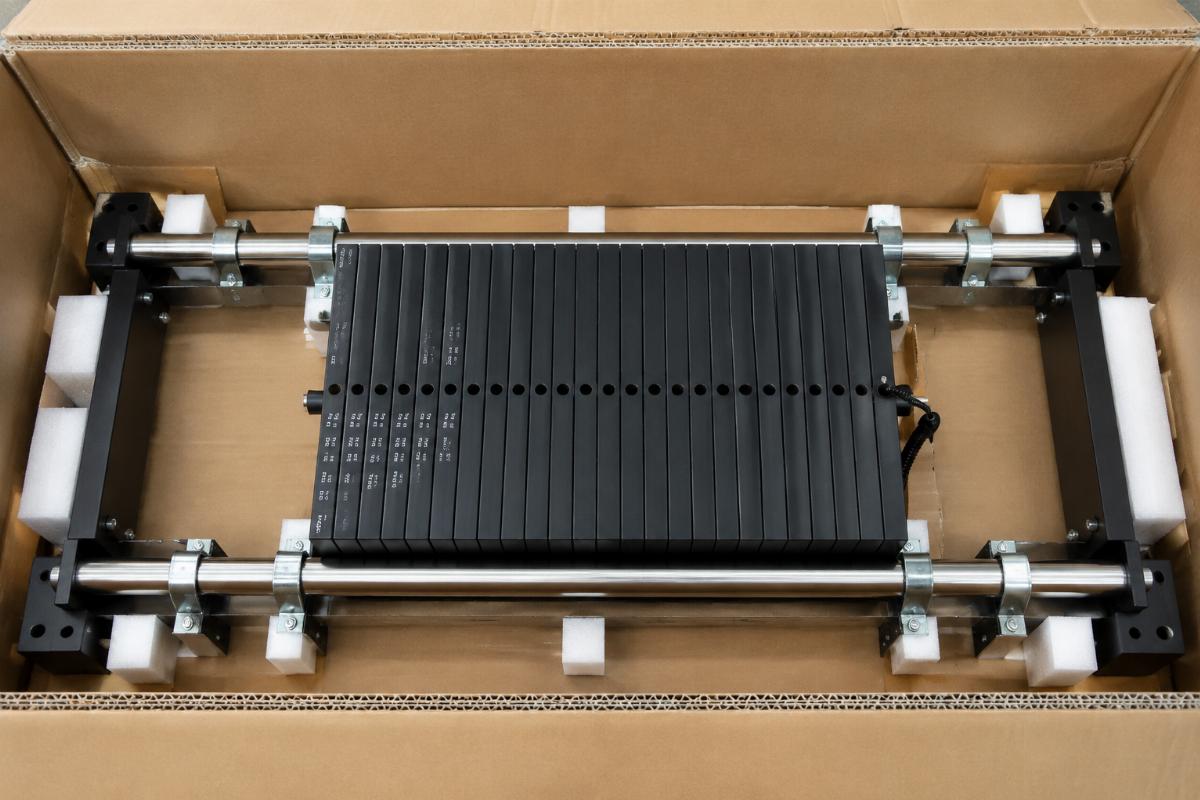
The principle is clear: packaging is not a cost to be minimized — it is an insurance policy priced per unit. In a Pec Deck machine container load deal, the packaging specification must be reviewed and approved with the same rigor as the machine specification itself.
How Should You Inspect a Pec Deck Container Load Before Signing the Release?
At destination, prioritize guide rail straightness, weight stack insertion smoothness, and weld seam integrity — photograph every defect before moving a single unit out of the container.
The moment the container doors open at the destination port is the most critical inspection window in the entire Pec Deck machine container load deal process. Once the machines are moved out of the container and into the warehouse, it becomes nearly impossible to prove that damage occurred during transit rather than during handling or storage.
The recommended inspection sequence is:
- Photograph the container seal number and door condition before opening. If the seal is broken or the door shows impact damage, document it immediately and notify the carrier in writing before unloading begins.
- Check guide rail straightness on every unit. Run a straight edge along each guide rail. Any visible gap indicates bending. Do not assume the weight stack will "break in" — a bent rail will not self-correct.
- Test weight stack insertion and extraction. Slide the weight stack pin through every hole in the stack. If the pin binds or catches at any point, the rail is misaligned or the stack plates are warped.
- Inspect all weld seams on the main frame and pivot arms. Look for hairline cracks, porosity, or incomplete fusion. A crack in a load-bearing weld is a structural safety issue, not a cosmetic defect.
- Check pulley alignment and cable condition. Spin each pulley by hand. It should rotate freely without grinding or lateral play. Inspect the cable for kinks, fraying, or uneven strand wear.
[NEED_CITE: third-party inspection protocol for strength training equipment per international fitness equipment safety standards]
A Middle East distributor once skipped the on-dock inspection on a Pec Deck machine container load deal to save time. The machines were moved directly to the warehouse. Weeks later, during assembly, the installation team discovered that a significant portion of the units had bent guide rails. Without contemporaneous photographic evidence from the container strip, the distributor could not file a successful claim against the carrier or the supplier. The loss was absorbed entirely by the distributor.

The discipline is non-negotiable: inspect before you sign, photograph before you move, and document before you discuss. In a Pec Deck machine container load deal, the inspection at the port is your last line of defense against absorbing transit damage as your own cost.
When Does Consolidating Multiple Machines in One Container Actually Save Money?
Consolidation saves money only when the loading plan is engineered professionally — otherwise, repair labor and air-freight costs at destination will consume every dollar of freight savings.
The logic of consolidating multiple machine types into a single container is sound: you maximize the use of cubic space, reduce the per-unit freight cost, and simplify customs clearance. But the execution is where most Pec Deck machine container load deal consolidation attempts fail.
The common mistake is treating the container as a simple box to be filled. Machines are loaded in whatever order they come off the production line, with minimal blocking and no engineered load distribution. The result is predictable: heavy machines shift against lighter ones, frames contact and abrade each other, and guide rails absorb impact loads they were never designed to withstand.
A professional consolidation loading plan addresses:
- Weight distribution — Heavier machines like Smith machines and plate-loaded units are positioned low and centered to maintain the container’s center of gravity.
- Inter-unit isolation — Every machine is wrapped or separated to prevent surface contact during transit.
- Fixation to the container floor — Steel wire lashing and timber blocking secure each machine to the container’s lashing points, preventing any shift regardless of sea conditions.
- Accessibility for unloading — The loading sequence is planned so that machines can be stripped in logical order without having to move other units out of the way.
[NEED_CITE: IMO/ILO/UNECE Code of Practice for Packing of Cargo Transport Units loading principles]
A fitness equipment distributor in Latin America ran a comparison across three consecutive Pec Deck machine container load deal shipments. The first was consolidated without a professional loading plan — the freight cost was low, but the damage rate on arrival was high, and the repair labor consumed the freight savings entirely. The second and third shipments used an engineered loading plan with full lashing and isolation. The freight cost per unit was slightly higher, but the damage rate dropped to near zero, and the total landed cost was substantially lower.

Consolidation is a powerful tool in a Pec Deck machine container load deal, but only when the loading plan is treated as a structural engineering exercise, not an afterthought.
Conclusion
A successful Pec Deck machine container load deal is won on tube thickness, packaging rigidity, and loading plan engineering — not on the quoted unit price. The buyers who treat these three variables as non-negotiable acceptance criteria consistently achieve lower total landed costs and higher on-site reliability than those who optimize for the lowest proforma invoice number.