
China Factory Chest Press Machine vs Body-Solid Pro Club: Warranty Comparison for Sale
Longer warranty periods do not guarantee better coverage—what matters is whether the warranty explicitly lists consumable parts, supply timelines, and response mechanisms.
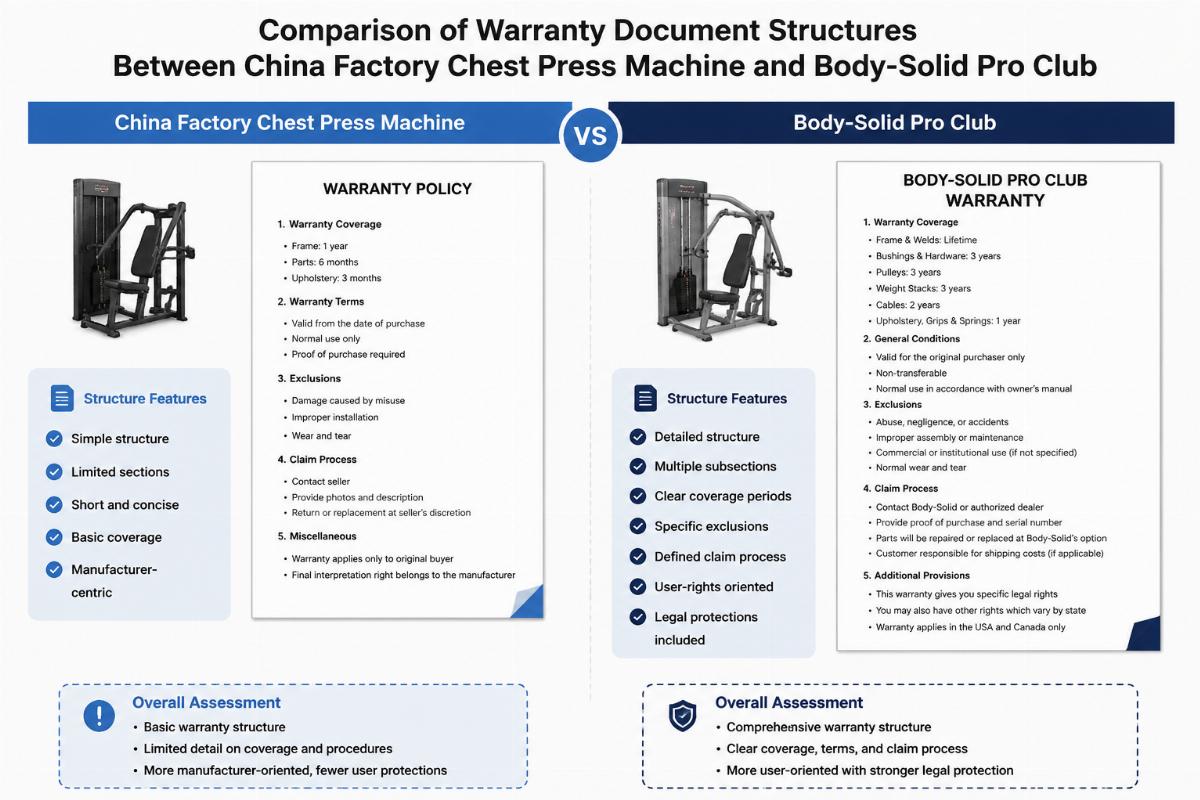
When comparing a China factory chest press machine against the Body-Solid Pro Club series, the core difference lies not in how many years of coverage each offers, but in how transparently each defines frame protection, component replacement windows, consumable exclusions, and after-sales response speed. China factory chest press machine warranties frequently provide extended frame coverage but may leave parts supply timelines ambiguous, while established US brands like Body-Solid Pro Club offer structured terms with clearer labor policies but shorter frame periods and higher replacement costs.
I still remember a container of chest press machines we shipped to a gym project in the Middle East a few years back. The buyer was excited—everything arrived on schedule, the frames looked solid, and the upholstery was clean. But three weeks after installation, a cable pulley seized. The buyer opened the warranty claim and discovered the warranty document said "parts covered" without specifying which parts, without listing a supply timeline, and without clarifying whether shipping costs for replacement components were included. That single ambiguity stretched the downtime from what should have been a routine two-week fix into nearly two months of back-and-forth emails. The gym’s grand opening got delayed, and the buyer withheld final payment until every machine was running. [NEED_CITE: commercial gym equipment downtime cost impact on membership revenue]
Since then, I have dissected warranty documents from major international brands and compared them line by line with what Chinese manufacturers provide. The patterns are consistent, and they reveal what really separates a useful warranty from a marketing headline.
Let me walk you through what each section of a chest press machine warranty actually means, how the two sourcing paths differ, and what you need to verify before signing a purchase order.
What Does Warranty Coverage Actually Include for Chest Press Machines?
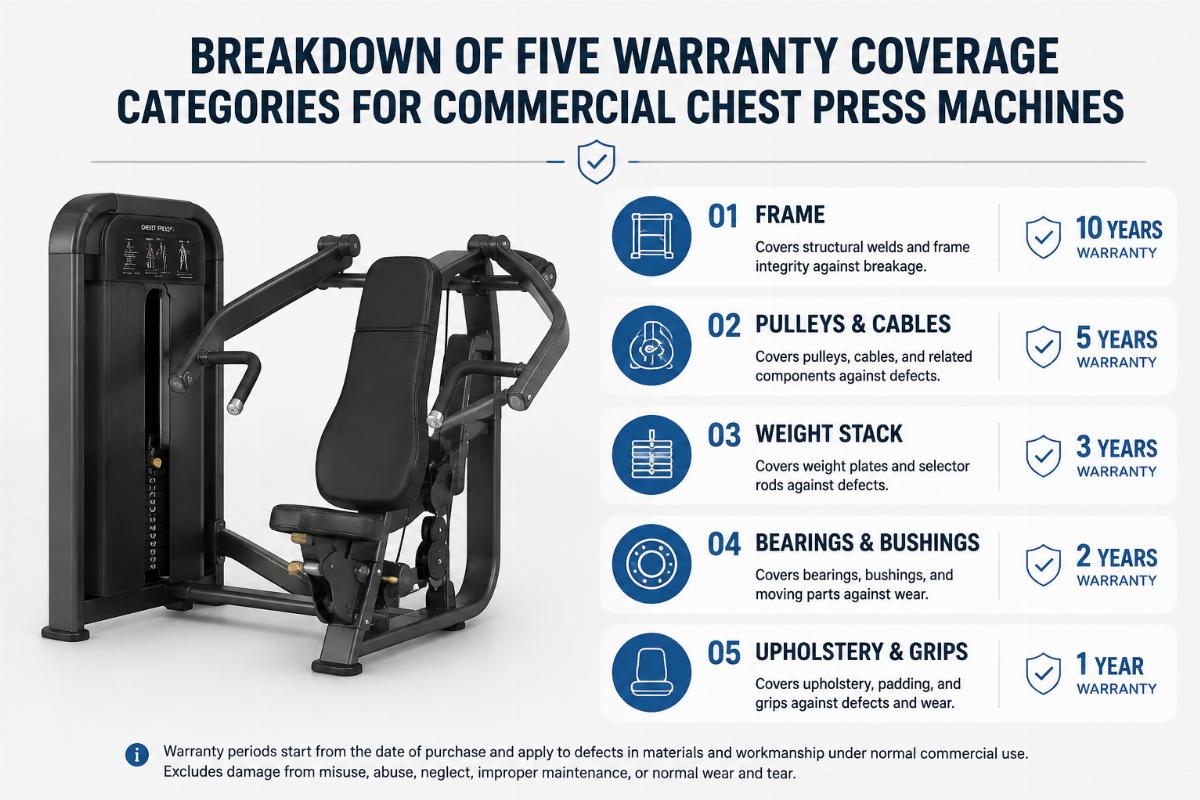
A chest press machine warranty typically covers five distinct categories: frame, moving parts, consumables, labor, and shipping—and each category has its own rules, exclusions, and time windows.
Understanding these categories is the foundation of any meaningful chest press machine warranty comparison. Many buyers focus solely on the headline number—"ten-year frame warranty"—without realizing that the frame is the least likely component to fail on a properly built machine. The real operational risk sits in cables, pulleys, bearings, seat adjustment mechanisms, and weight stack guide rods. [NEED_CITE: common failure points on commercial plate-loaded and selectorized chest press machines per industry maintenance data]
Here is how the five categories break down:
- Frame: The welded steel structure. This is what long warranty periods usually cover. On a quality machine, the frame rarely fails unless there is a manufacturing defect in the welds or a corrosion issue from poor coating.
- Moving parts: Pulleys, bearings, guide rods, selectorized pin mechanisms, and cable attachment points. These experience daily wear and are the most common warranty claim items.
- Consumables: Cables, grip sleeves, seat pads, and upholstery. Most warranties explicitly exclude these or cover them for a much shorter period.
- Labor: The cost of technician time for diagnosis and repair. Some brands cover labor during the first year; others never do.
- Shipping: Who pays to send replacement parts across borders. This is where many warranty claims break down—especially for international buyers sourcing a China factory chest press machine.
[NEED_CITE: ISO 20957 safety and durability requirements for strength training equipment]
A Middle East distributor I worked with once received a shipment where the warranty document stated "five-year comprehensive coverage." When a guide rod bent under normal use in the second year, the manufacturer argued that guide rods were classified as "wear items" and fell outside comprehensive coverage. The document had never defined what "comprehensive" meant. That ambiguity cost the distributor a significant amount in emergency air freight and local fabrication.
The lesson is straightforward: a warranty is only as strong as its definitions. If the document does not explicitly list which components fall under each category, you are negotiating in the dark.
How Do China Factory Warranties Compare to Body-Solid Pro Club Terms?
China factory chest press machine warranties generally offer longer frame coverage periods, while Body-Solid Pro Club terms provide more structured labor policies and clearer consumable exclusion lists—but the practical advantage depends on your location, service infrastructure, and willingness to manage cross-border parts logistics.
Let me lay out the structural differences based on what I have seen across multiple warranty documents from both sides.
| Warranty Dimension | China Factory Chest Press Machine | Body-Solid Pro Club |
|---|---|---|
| Frame Coverage Period | Typically longer (extended range) | Standard commercial range |
| Moving Parts Coverage | Often included but timelines unclear | Clearly defined with specific time windows |
| Consumable Exclusions | Sometimes vaguely stated | Explicitly listed with short or no coverage |
| Labor Coverage | Rarely covered for international buyers | Limited domestic labor coverage |
| Parts Supply Commitment | Varies—often not contractually bound | Structured through authorized dealer network |
| Cross-Border Shipping Cost | Usually buyer’s responsibility | Domestic shipping more predictable |
| Customization Flexibility | High—can negotiate bespoke terms | Fixed terms through dealer agreements |
[NEED_CITE: commercial strength equipment warranty trend comparison between Asian manufacturers and US brands]
A distributor in Southeast Asia was evaluating both options for a chain of boutique gyms. The China factory chest press machine option offered a notably longer frame warranty, which initially looked like the clear winner. But when the distributor dug into the parts supply section, there was no contractual commitment on how quickly replacement pulleys or cables would be dispatched. The Body-Solid Pro Club terms, by contrast, had a shorter frame period but clearly stated that replacement parts would ship within a defined window through the regional dealer.
The distributor ultimately chose the China factory route—but only after negotiating a written commitment on parts dispatch timelines and securing a local buffer stock of high-wear components. That negotiation is something the Body-Solid dealer structure would not have allowed.
Here is the counterintuitive reality: a China factory chest press machine warranty can be more protective than a major US brand warranty, but only if you actively negotiate the terms rather than accepting the standard document. The flexibility works both ways—it can work against you if you are passive, and it can work for you if you push for clarity.

What Should Gym Owners Look for in Warranty Spare Parts Lists?
A transparent spare parts list with explicit supply commitments is the single most important element of a chest press machine warranty—more important than the headline coverage period.
This is where most buyers get tripped up. They see "ten-year warranty" and assume that means ten years of hassle-free operation. But a warranty without a functioning parts supply chain is just a piece of paper. [NEED_CITE: gym equipment maintenance downtime correlation with parts availability]
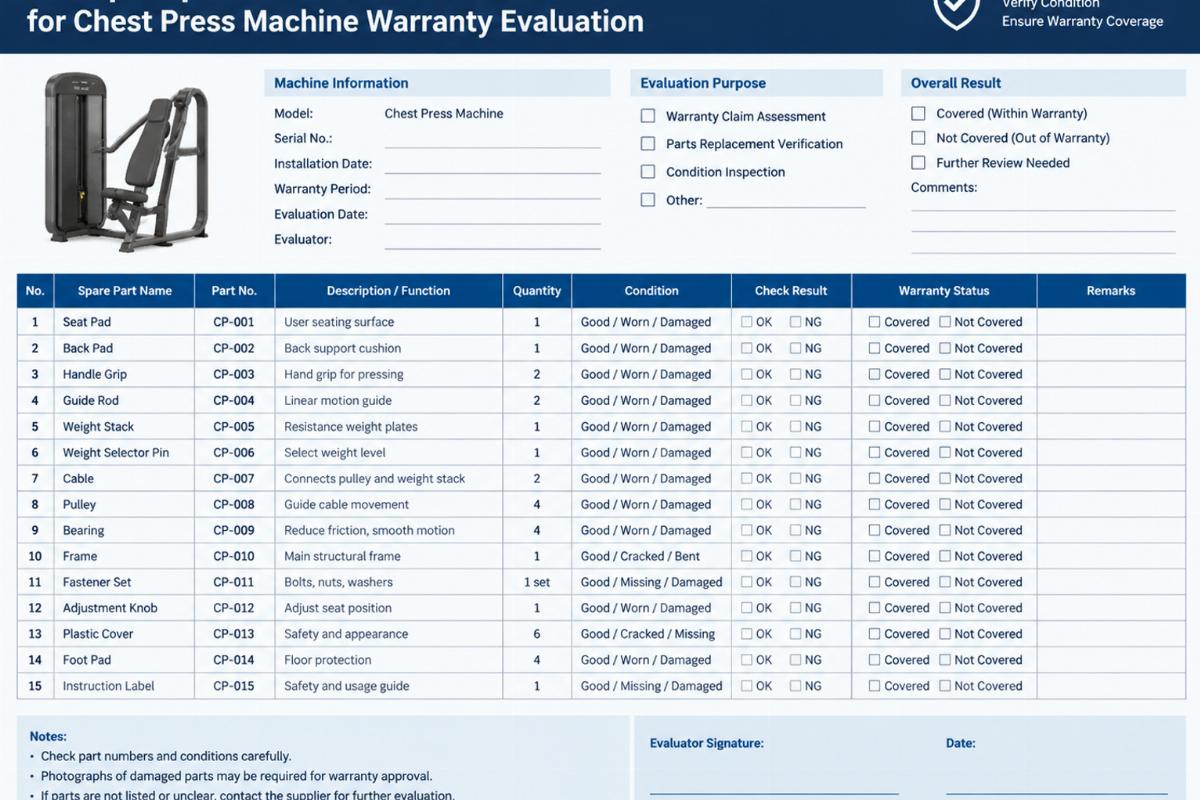
When I review a warranty document for a client, the first thing I check is whether it includes a spare parts list. Not a vague reference to "available parts," but an actual itemized list that covers:
- Part numbers and descriptions for every replaceable component
- Pricing or pricing formulas for those parts during the warranty period
- Dispatch timelines for standard and custom components
- Minimum stockholding commitments from the manufacturer or dealer
- Shipping method and cost responsibility for international orders
A hotel fitness center project in the Gulf region taught me why this matters. The developer had purchased a full set of strength equipment, including chest press machines, from a supplier whose warranty document was beautifully formatted but contained no parts list. When a selectorized pin mechanism cracked during the warranty period, the supplier acknowledged the claim but then took weeks to confirm whether the specific part was even still in production. The gym floor sat with a non-functional machine for an extended period, and the hotel had to field complaints from guests who expected a fully operational fitness center.
[NEED_CITE: importance of spare parts catalog transparency in commercial fitness equipment procurement]
If you are sourcing a China factory chest press machine, request the spare parts list before you sign the purchase order. Verify that it includes part numbers, not just generic descriptions. Ask for a written commitment on dispatch timelines—distinguishing between standard components that ship from stock and custom or less common parts that may require production. And clarify who bears the shipping cost for warranty replacements, because cross-border freight for a single pulley assembly can be disproportionately expensive.
The same principle applies when buying from established brands, but the difference is that major brands typically already have these lists in place. With a China factory chest press machine, you may need to drive the creation of that list yourself—which, again, is where negotiation leverage becomes valuable.
How Can Distributors Verify After-Sales Response Times?
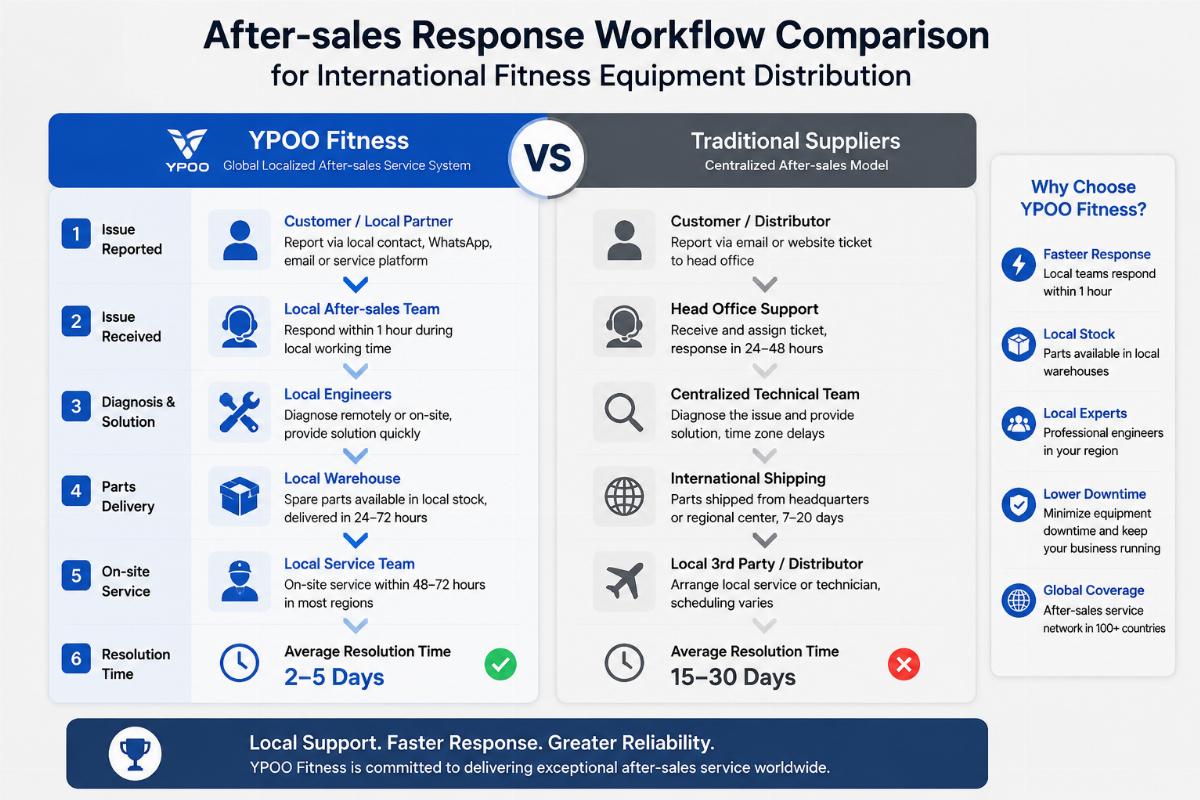
Distributors must request documented response time guarantees and evidence of local or regional service partner networks before finalizing any chest press machine warranty comparison.
Response time is the metric that separates a warranty that works on paper from one that works in practice. A manufacturer can promise "prompt after-sales support," but without a defined response window and a verifiable service structure, that phrase means nothing when a gym owner is calling you at seven in the morning because a chest press machine is down.
[NEED_CITE: IHRSA operational standards for fitness equipment maintenance and member experience]
Here is what I recommend distributors ask for during the evaluation stage:
- Written response time commitments: Not "we will respond quickly," but a specific window—such as technical acknowledgment within a defined short period and resolution plan within a defined longer period.
- Service partner network documentation: If the manufacturer claims to have local service partners in your region, ask for their names, locations, and scope of authorization. A China factory chest press machine supplier with a genuine regional network will have this information readily available.
- Escalation procedures: What happens if the local partner cannot resolve the issue? Is there a direct line to the factory’s engineering team?
- Remote diagnostic capability: Can the manufacturer support video-based troubleshooting to reduce the need for physical site visits?
- Training provisions: Does the warranty include training for your local technicians on common repairs?
A distributor in Latin America once shared his experience with me. He had been sourcing from a well-known international brand and was impressed by the warranty document. But when a cable crossover needed a pulley replacement, the brand’s regional service partner was booked weeks out, and the distributor’s own technicians were not authorized to perform the repair under the warranty terms. The machine sat idle, and the gym clients were frustrated.
When that same distributor later evaluated a China factory chest press machine option, he negotiated a clause allowing his own trained technicians to perform warranty repairs with factory remote guidance—and the factory provided video training sessions as part of the onboarding process. The result was faster resolution and lower downtime, even though the brand did not have a formal local service partner in that country.
The takeaway: response time is not just about how fast the manufacturer replies—it is about how quickly the problem gets solved, and that depends on the entire service structure behind the warranty.
What Are the Hidden Costs of Poor Warranty Terms?
The hidden costs of inadequate warranty terms—downtime, emergency freight, member dissatisfaction, and reputational damage—can multiply the initial savings from choosing a cheaper equipment option many times over.
This is the section I wish every buyer would read before making a final sourcing decision. The upfront price of a chest press machine matters, but it is a fraction of the total cost of ownership. And the warranty terms you accept directly influence that total cost.
[NEED_CITE: total cost of ownership analysis for commercial gym equipment including maintenance and downtime]
Consider the cascading effects of a vague or poorly structured warranty:
- Downtime revenue loss: A non-functional chest press machine in a commercial gym means members cannot train chest effectively. If it is the only chest press on the floor, peak-hour congestion increases, member complaints rise, and renewal rates can suffer.
- Emergency shipping costs: When a critical part is not available through normal channels, buyers resort to air freight for a single component. The shipping cost for one small part can exceed the part’s value many times over.
- Technician costs: If the warranty does not cover labor and you need to hire a local technician for diagnosis and repair, those costs accumulate—especially if the issue recurs.
- Reputational damage: For distributors, repeated equipment failures and slow resolution erode trust with gym owners. For hotel developers, a broken machine in the fitness center generates negative guest reviews.
- Contractual disputes: Ambiguous warranty language leads to disagreements about what is covered, consuming management time and sometimes requiring legal intervention.
A gym owner in East Africa shared a situation where he purchased equipment from a supplier with an attractive price but minimal warranty structure. Within the first year, multiple machines needed parts. The supplier was responsive in principle but slow in execution—parts took extended periods to arrive, and shipping costs were the buyer’s responsibility. By the end of the year, the total expenditure on emergency parts, air freight, and local repairs had grown to a multiple of what he would have paid for a machine with a more comprehensive warranty from the start.
This is not an argument that every China factory chest press machine has poor warranty terms. As I noted earlier, the flexibility of Chinese manufacturing means you can negotiate strong terms—if you know what to ask for. But it is a warning that the cheapest warranty on paper can become the most expensive warranty in practice.

Conclusion
A chest press machine warranty comparison must go beyond headline coverage periods and examine the specific definitions, parts lists, supply timelines, and response structures that determine whether the warranty actually protects your operation. China factory chest press machine warranties offer flexibility and potentially longer frame coverage, but they require active negotiation and detailed verification. Established brands like Body-Solid Pro Club provide more standardized terms with clearer domestic support but less room for customization. The buyers who succeed are those who treat the warranty document as a operational blueprint—not a marketing brochure.


