
Commercial Fitness Equipment Supplier for Jordan: China Factory Direct OEM & Wholesale
Most importers assume CE certification is a universal passport. It is not—Jordanian customs at Aqaba Port reject certificates that do not match their specific formatting and issuing-body requirements, turning a routine shipment into a weeks-long storage nightmare.
Sourcing from a reliable fitness equipment supplier for Jordan requires matching equipment specifications to Middle Eastern usage patterns, ensuring CE documentation meets Aqaba Port formatting rules, and optimizing container loading to control per-unit freight costs on mixed cargo.
Growing up in Linyi, Shandong, I spent my childhood around welding sparks and the smell of hot steel. My family ran a small hardware workshop, and I eventually moved into commercial fitness equipment manufacturing. I have handled dozens of full-container shipments heading to the Middle East. One order stands out: a comprehensive gym package—Smith machines, cable crossovers, and commercial treadmills—destined for a new facility in Amman. The buyer arranged their own freight forwarder to cut costs. When the container reached Aqaba Port, customs flagged the CE certificates. The format did not align with Jordanian import regulations. The cargo sat at the port for weeks, and the accumulated storage fees ended up rivaling the original ocean freight. We had to redo documentation overnight and coordinate with a local clearing agent to release the goods. Since then, I personally review every certificate, packing list, and bill of lading before any container leaves the factory floor. [NEED_CITE: Jordan Customs import documentation requirements for CE-marked fitness equipment]
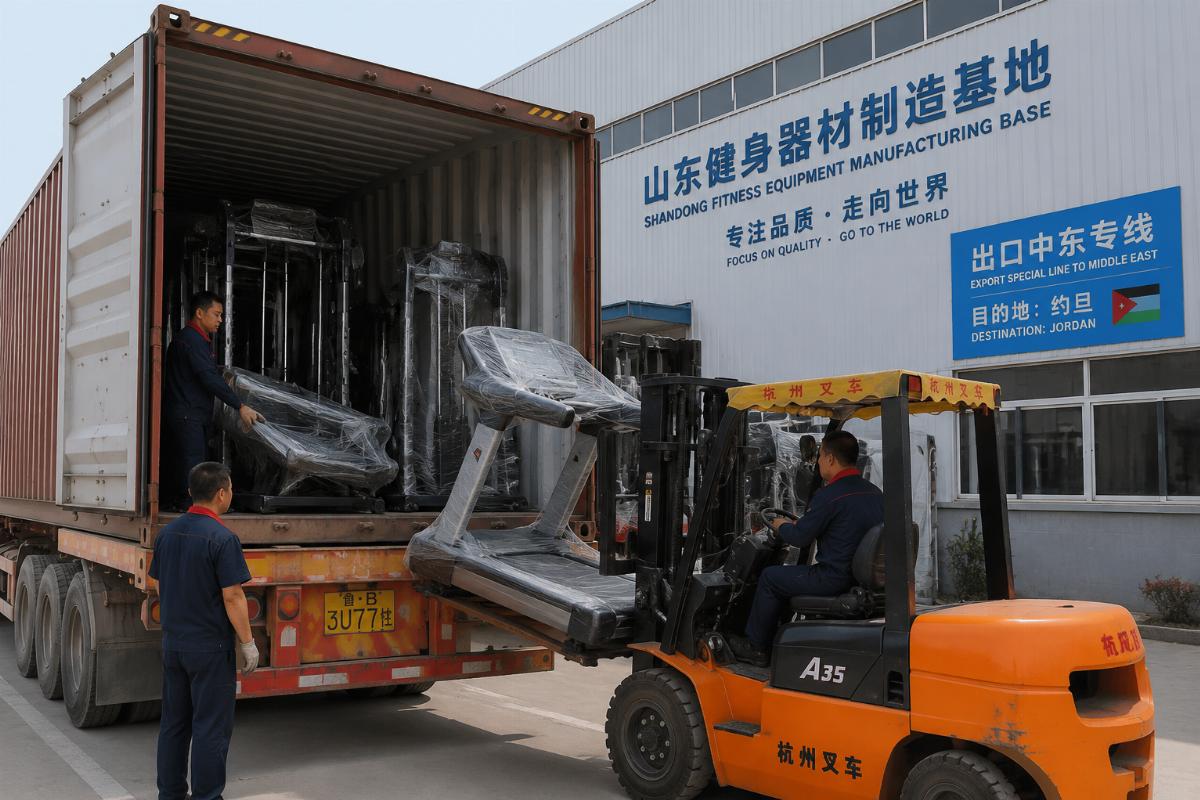
That experience shaped how I approach every order. Below is what I have learned about spec selection, certification compliance, equipment configuration, pricing, and container logistics—directly from the factory floor to the Jordanian market.
What Fitness Equipment Specs Work Best for Jordan Gyms?
Jordanian commercial gym users favor heavy-stack Smith machines and high-load-capacity power racks, while cardio equipment must handle elevated ambient temperatures with enhanced cooling systems.
The Middle Eastern gym-going population tends toward heavier compound lifting. This means selectorized pin-loaded machines and Smith machines need stack weights that accommodate advanced lifters, and frame construction must resist lateral flex under substantial loads. When I review orders for this region, the first thing I check is the frame steel wall thickness on Smith machines. A standard residential-grade frame flexes noticeably under heavy barbell work, whereas a commercial-grade frame with thicker-walled tubing maintains rigidity through full range of motion. [NEED_CITE: Structural steel tubing wall thickness standards for commercial strength equipment]
Here is how frame specifications compare across typical market tiers:
| Specification Factor | Residential-Grade | Light Commercial | Full Commercial |
|---|---|---|---|
| Frame Steel Wall Thickness | Thin-walled | Standard-walled | Heavy-duty thick-walled |
| Weight Stack Capacity | Limited range | Moderate range | Extended heavy-stack range |
| Cable Pulley System | Basic routing | Standard routing | Multi-axis precision routing |
| Weld Construction | Spot-welded | Continuous weld | Full continuous weld, ground smooth |
| Finish Durability | Basic coating | Standard powder coat | Heavy-duty powder coat, corrosion-resistant |
For cardio equipment, ambient temperature is the critical variable. Jordan’s summer temperatures regularly climb well above typical European or North American gym conditions. Treadmill motors and elliptical drive systems generate internal heat; when combined with high ambient temperatures, inadequate cooling leads to premature electronics failure. Commercial treadmills destined for this market need elevated motor horsepower ratings and enhanced ventilation design to dissipate heat effectively. [NEED_CITE: Motor thermal management requirements for fitness equipment in high-ambient-temperature environments]
A hotel fitness center I supplied near the Dead Sea region faced an extreme version of this challenge. The high humidity and salinity in that environment accelerated corrosion on standard finishes. We specified enhanced rust-prevention treatment on all metal surfaces and selected cardio equipment with sealed electronic enclosures. The equipment ratio leaned toward compact, multi-function units rather than large single-purpose machines, given the limited floor space typical of hotel gyms.

How to Avoid CE Certification Delays at Aqaba Port?
Jordanian customs requires CE certificates in a specific format with recognized issuing bodies—generic or incorrectly formatted certificates will be rejected, causing port storage fees that can exceed the original freight cost.
This is the single most overlooked aspect of exporting fitness equipment to Jordan. Many importers assume that because their equipment carries a CE mark, it will clear customs anywhere in the world. That assumption is dangerously wrong for Aqaba Port. Jordanian customs authorities have their own verification protocols for CE documentation, and the certificate must meet specific formatting standards and be issued by an approved notification body. [NEED_CITE: Jordan Standards and Metrology Organization import certification requirements for fitness equipment]
The documentation process involves several layers. First, the CE certificate itself must follow the correct template format recognized by Jordanian authorities. Second, the issuing body must be listed among approved entities. Third, supporting technical documentation—including test reports and declarations of conformity—must accompany the shipment and align precisely with the certificate details. Any discrepancy between the product description on the certificate and the actual shipped goods triggers an inspection hold.
From my experience, here are the critical checkpoints:
- Verify the CE certificate template matches Jordanian customs expectations before production begins
- Confirm the issuing body is recognized by Jordanian import authorities
- Ensure product descriptions on certificates match commercial invoices and packing lists exactly
- Prepare a complete technical file including test reports, not just the certificate alone
- Work with a clearing agent at Aqaba Port who understands fitness equipment classification
A distributor in Amman once placed an order for a full gym fit-out. The equipment was manufactured correctly, and the CE certificates were technically valid. However, the certificates were formatted according to a template that Jordanian customs did not accept for that product category. The container was held at the port, and daily storage charges accumulated rapidly. By the time the issue was identified and corrected documentation was prepared and submitted, the additional costs had become substantial. We now prepare a complete documentation package for every Jordan-bound shipment and cross-check every detail against current customs requirements before the container is sealed.

Which Equipment Should You Prioritize for a Complete Gym Package?
A well-balanced commercial gym in Jordan should allocate floor space across strength machines, cardio equipment, and free-weight zones in proportions that reflect local training preferences, while hotel and apartment gyms benefit from compact multi-function equipment.
Equipment configuration depends entirely on the facility type. A full commercial gym catering to serious lifters in Amman will have different needs than a boutique studio or a hotel fitness room. I have supplied packages across all these categories, and the configuration logic follows clear patterns.
For a commercial gym, the typical allocation breaks down as follows: strength machines occupy the largest share, reflecting the local preference for heavy compound training; cardio equipment takes a significant but secondary portion; and free-weight areas complete the offering. Within the strength category, Smith machines and power racks form the backbone, supplemented by plate-loaded and selectorized machines targeting every major muscle group. Cable crossover units serve both strength and functional training needs. Cardio selection should include commercial treadmills as the primary unit, with ellipticals and exercise bikes providing variety.
For hotel and apartment fitness centers, space efficiency becomes the priority. Compact commercial-grade treadmills, all-in-one functional trainers, and adjustable dumbbell systems deliver broad workout variety within a smaller footprint. The equipment must still meet commercial durability standards—hotel guests train at all hours, and equipment abuse is common—but the footprint per unit needs to stay minimal.
| Facility Type | Strength Equipment Focus | Cardio Priority | Free-Weight Emphasis |
|---|---|---|---|
| Full Commercial Gym | Smith machines, power racks, full selectorized line | Commercial treadmills, ellipticals, bikes | Full dumbbell sets, barbells, benches |
| Hotel / Apartment Gym | Multi-function trainers, compact cable units | Space-efficient treadmills, vertical bikes | Adjustable dumbbells, kettlebell sets |
| Boutique Studio | Functional trainers, specialty stations | Limited cardio, rowing machines | Battle ropes, plyo boxes, medicine balls |
A fitness equipment supplier for Jordan who understands these distinctions can guide buyers toward the right configuration rather than simply pushing maximum volume. The goal is a facility that serves its members effectively, not one that is overcrowded with redundant equipment.

How Does Factory-Direct Pricing Compare to Branded Equipment?
Sourcing directly from a Chinese factory delivers pricing substantially below international premium brands while maintaining equivalent steel specifications and commercial-grade construction—making it the logical choice for distributors and gym owners managing capital expenditure.
The pricing gap between factory-direct Chinese equipment and internationally branded fitness equipment is significant. Buyers who have compared quotations across both channels consistently find that factory-direct pricing falls well below premium brand levels, even when matching material specifications and build quality. This is not a reflection of inferior manufacturing—it reflects the elimination of brand premiums, multi-layer distribution markups, and regional dealer margins.
For a fitness equipment supplier for Jordan serving commercial clients, this pricing advantage translates directly into competitive positioning. A gym owner outfitting a new facility can allocate the same capital across a broader equipment range, or a distributor can maintain healthy margins while offering competitive retail pricing. The key is verifying that the factory’s construction standards match commercial requirements: thick-walled steel frames, continuous welds, heavy-duty powder coating, and commercial-grade upholstery.
OEM branding services add another layer of value. Distributors in the Middle East frequently request private-label manufacturing, where the equipment carries their brand identity rather than the factory’s. This builds brand equity in their local market and creates customer loyalty that generic imports cannot achieve. The minimum order quantities for OEM work have become increasingly flexible—buyers can start with sample units for market testing before committing to full container orders.
I have worked with a Jordanian distributor who began with a single trial container of strength equipment under their own brand. The market response was strong, and within a short period, they expanded to multiple container orders annually, adding cardio equipment and free-weight accessories to their product line. The factory-direct model allowed them to scale without the capital burden of branded inventory.

What Is the Best Container Loading Strategy for Jordan Orders?
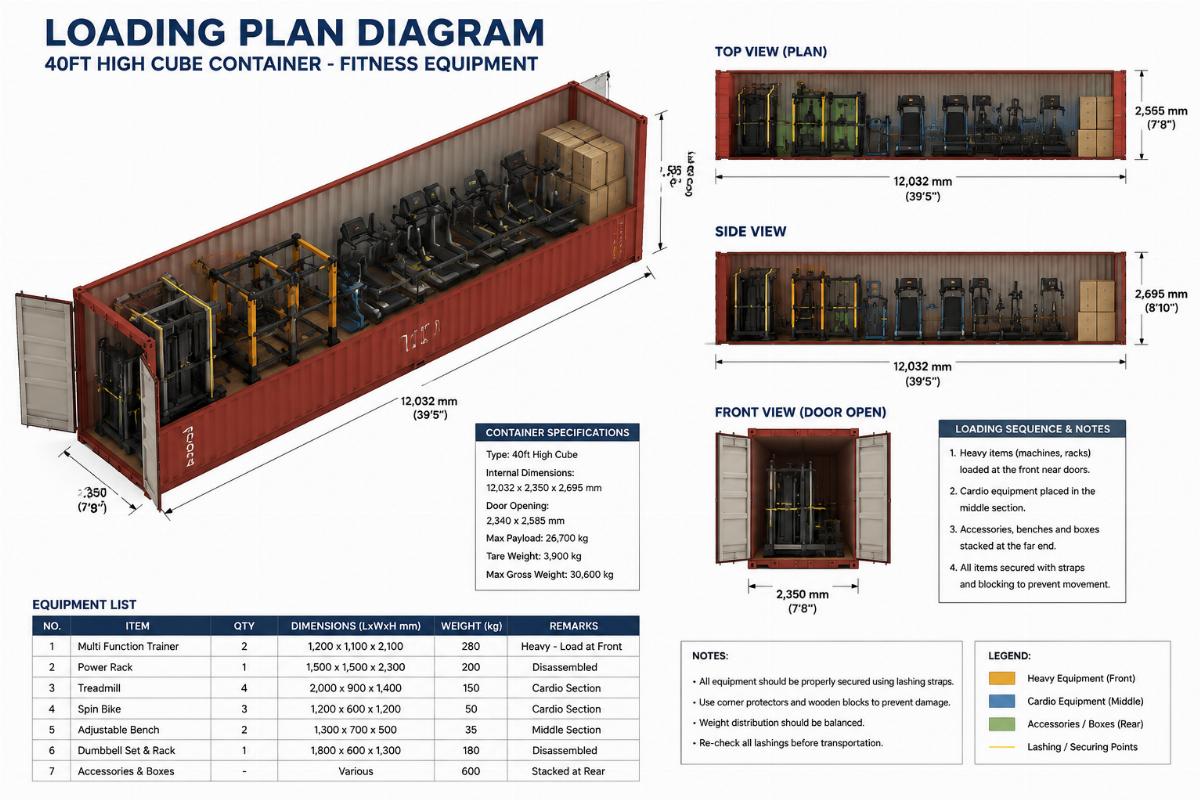
Mixing strength equipment and cardio equipment in a single container requires precise volume calculation—improper loading plans waste space and increase per-unit freight costs, while optimized loading maximizes every cubic meter of a high-cube container.
Container logistics is where many buyers lose money without realizing it. A standard high-cube container offers substantial volume, but fitness equipment comes in wildly different dimensions and shapes. Smith machines are tall and relatively narrow. Treadmills are long and low. Weight plates are dense and compact. Plate-loaded machines are bulky and irregular. Throwing these items into a container without a calculated loading plan results in wasted space—and wasted space means higher per-unit freight costs.
The optimal approach involves creating a detailed loading plan before production begins. Each piece of equipment is measured for its packed dimensions, and the total volume is calculated against the container’s usable capacity. Heavy items like weight plates and dumbbells are positioned on the container floor to create a stable base. Taller items like Smith machines and power racks are loaded vertically against the walls. Cardio equipment is positioned to fill the remaining gaps. The goal is to eliminate void space while maintaining weight distribution that keeps the container within safe transport limits.
For buyers ordering a complete gym package, consolidating all equipment into full containers rather than shipping partial loads yields meaningful freight savings. A fitness equipment supplier for Jordan who offers container consolidation services can combine strength, cardio, and free-weight equipment into optimized loads, reducing the number of containers needed and lowering the per-unit shipping cost.
| Loading Consideration | Poor Planning | Optimized Planning |
|---|---|---|
| Space Utilization | Significant void space | Maximized volume usage |
| Weight Distribution | Unbalanced, potential surcharges | Evenly distributed within limits |
| Per-Unit Freight Cost | Elevated due to wasted space | Minimized through efficient loading |
| Unloading Efficiency | Disorganized, time-consuming | Sequential, accessible arrangement |
I have seen orders where buyers assumed that ordering a full container was automatically the most economical approach—only to discover that poor loading meant the container arrived barely half full. The freight cost was spread across fewer effective units, driving up the landed cost per item. A proper loading plan, prepared before production starts, prevents this entirely.
Conclusion
Successful fitness equipment procurement for Jordan hinges on three pillars: equipment specifications matched to regional training preferences, CE documentation formatted to Aqaba Port requirements, and container loading optimized to control landed costs. Working with an experienced fitness equipment supplier for Jordan who understands these factors from the factory floor to the port of entry eliminates the surprises that turn profitable deals into costly lessons.


