
Commercial Functional Trainer Alternatives to PowerLine | OEM Factory Direct
A true PowerLine alternative is not about matching the exterior silhouette — it is about verifying that pulley bearings, cable routing geometry, and frame tubing can survive daily commercial abuse without premature failure.
If you are sourcing a Functional Trainer PowerLine Alternatives for a commercial gym, hotel fitness center, or distribution business, the answer is straightforward: benchmark frame steel grade, pulley bearing type, cable tensile rating, and weight stack stability against PowerLine’s baseline specs, then request verifiable material certificates and third-party test reports before placing an order. Visual similarity means nothing when sealed bearings fail within months and cables start fraying under normal use.
I learned this the hard way. A buyer in the Middle East once brought me a catalog from a well-known overseas brand and asked for a matching functional trainer at a lower price point. The machine I sourced looked nearly identical — same dual adjustable pulleys, same weight stack housing, same footprint. But the pulley assemblies used standard open bearings instead of sealed units, and the cable routing angles were not optimized for smooth travel. Within a few months, the steel cables developed visible fraying, the weight stacks wobbled during lateral pulls, and the buyer refused to settle the remaining balance. That entire order became a loss, and the reputational damage with that client took years to repair. [NEED_CITE: common failure modes in cable-based strength equipment per EN 957-1]
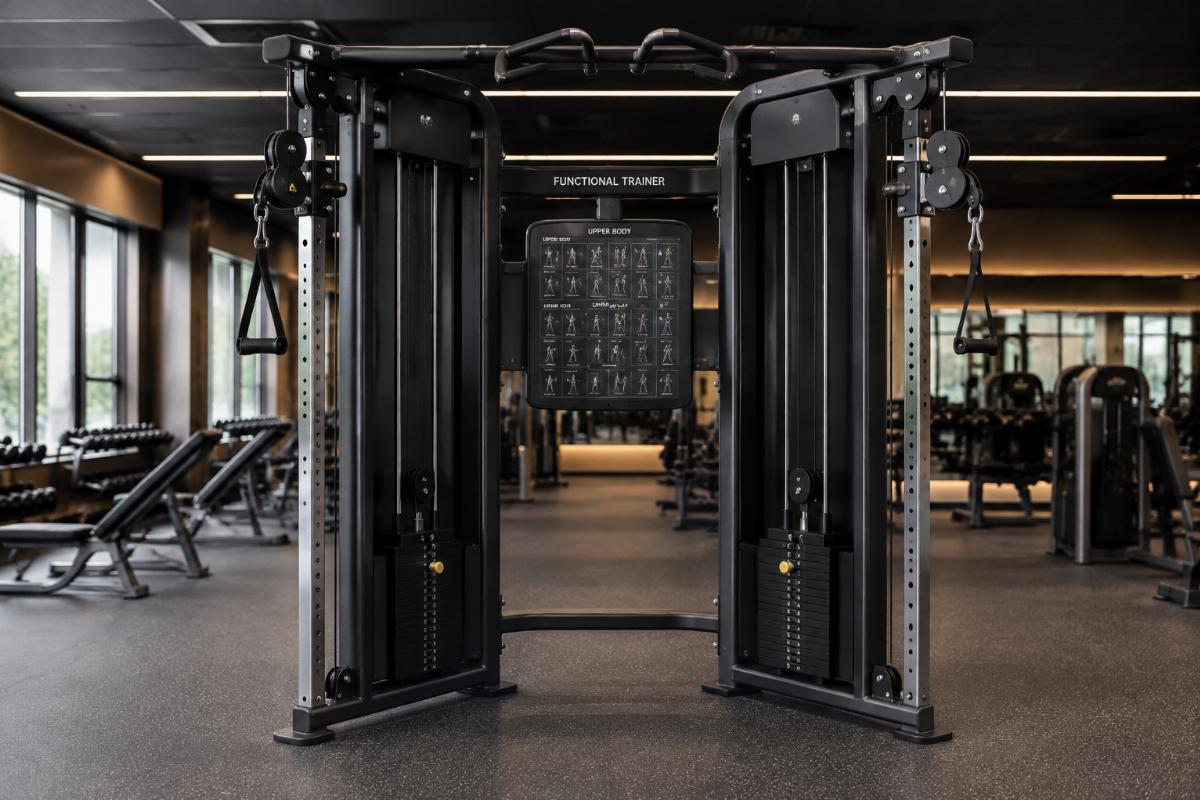
The lesson was clear: finding reliable Functional Trainer PowerLine Alternatives requires looking past the surface and inspecting the hidden components that determine real commercial durability.
What Makes a Functional Trainer "Commercial-Grade"?
Commercial-grade durability is defined by the internal mechanical components, not the external appearance or brand label.
When gym owners and distributors search for Functional Trainer PowerLine Alternatives, they often start by comparing photos. But the machines that survive heavy daily use in commercial environments share a set of engineering characteristics that are invisible in product images.
The frame is the foundation. Commercial functional trainers typically use cold-rolled steel with a minimum wall thickness that resists flex under dynamic loads. The steel grade matters — standard structural grades versus higher-strength low-alloy grades produce noticeably different long-term rigidity. [NEED_CITE: structural steel grade comparison for fitness equipment frames per ASTM standards]
The pulley system is the heart. Sealed bearings with precision ratings in the P4 to P5 range ensure smooth cable travel and resist contamination from gym dust and sweat. Open bearings or low-grade sealed units degrade rapidly, causing cable jitter, uneven wear, and eventual fraying. The pulley groove profile must match the cable diameter precisely — a mismatch accelerates fatigue failure.
The cable itself must meet specific tensile strength requirements. Commercial-grade cables use aircraft-grade steel wire rope with a nylon or vinyl coating. The break strength must substantially exceed the maximum load imposed by the weight stack plus dynamic force multipliers during explosive movements. [NEED_CITE: wire rope tensile testing standards for fitness equipment per EN 957-1]
The weight stack mechanism requires precision-machined guide rods, stable stacking plates, and a reliable selector pin system. Wobbly guide rods or loose stacking plates create noise, user discomfort, and accelerated wear.
A Middle East gym operator once shared that their previous functional trainer — sourced purely on visual matching — required cable replacement and bearing overhaul within the first year. The downtime and service costs erased any initial savings from choosing a cheaper option.

PowerLine Functional Trainer: Key Specs to Benchmark
Before evaluating any alternative, establish PowerLine’s critical specifications as your baseline for comparison.
PowerLine functional trainers are recognized in the commercial and semi-commercial segments for robust construction. When sourcing Functional Trainer PowerLine Alternatives, you need to understand the key parameters that define their performance tier.
The frame construction uses heavy-gauge steel tubing with reinforced welding at high-stress joints. The exact steel grade and wall thickness are proprietary, but the overall mass and rigidity place it in the commercial-duty category.
The pulley system features multiple ratio options — typically a one-to-one ratio for isolation work and a two-to-one ratio for compound movements. The pulleys use sealed bearings designed for extended service life under continuous use.
The cable routing geometry is engineered to minimize friction and ensure smooth resistance throughout the full range of motion. The attachment points and adjustment mechanisms allow users to target muscles from multiple angles.
The weight stack uses precision-ground guide rods and stacked plates with a spring-loaded selector pin. The stack capacity and increment options are designed for progressive overload across user levels.
When evaluating Functional Trainer PowerLine Alternatives, request documentation that confirms equivalent or superior specifications in these areas. Self-reported claims without verifiable certificates are insufficient for commercial procurement.

Top Functional Trainer Alternatives: Spec-by-Spec Comparison
The most reliable alternatives match or exceed PowerLine’s core mechanical specifications while offering competitive pricing through optimized manufacturing.
When comparing Functional Trainer PowerLine Alternatives, the evaluation must focus on verifiable parameters rather than marketing claims. The following comparison matrix highlights the critical differentiators across three representative alternatives positioned in the commercial segment.
| Parameter | PowerLine Baseline | Alternative A | Alternative B | Alternative C |
|---|---|---|---|---|
| Frame Steel Grade | Commercial-grade cold-rolled | Standard structural | Higher-strength low-alloy | Commercial-grade cold-rolled |
| Frame Wall Thickness | Heavy-gauge | Standard | Heavy-gauge | Heavy-gauge |
| Pulley Bearing Type | Sealed precision | Standard sealed | Sealed precision | Sealed precision |
| Cable Construction | Aircraft-grade steel wire | Standard steel wire | Aircraft-grade steel wire | Aircraft-grade steel wire |
| Cable Coating | Nylon/vinyl | Basic vinyl | Nylon/vinyl | Nylon/vinyl |
| Weight Stack Guide Rods | Precision-ground | Standard machined | Precision-ground | Precision-ground |
| Adjustment Mechanism | Spring-loaded pin | Basic pin | Spring-loaded pin | Spring-loaded pin |
| Certification | Industry standards | Self-reported | Third-party verified | Third-party verified |
| Price Positioning | Premium tier | Budget tier | Mid-tier | Competitive tier |
Alternative A appears cost-effective on paper but uses standard structural steel and basic sealed bearings. In field use, this combination leads to frame flex under heavy loads and premature bearing failure. [NEED_CITE: failure rate comparison of bearing types in fitness equipment per ISO 15243]
Alternative B uses higher-strength steel and sealed precision bearings, matching PowerLine’s durability profile. The cable and weight stack components are equivalent. Third-party testing confirms compliance with commercial safety standards.
Alternative C offers comparable specifications to PowerLine with verified certifications. The manufacturing process uses optimized supply chain management to reduce costs without compromising core components.
A Latin American gym chain evaluated all three alternatives for a multi-location rollout. They selected Alternative C based on the verification documentation and field testing results. After extended deployment across multiple facilities, the equipment maintained performance without the cable or bearing issues that plagued their previous machines.

How to Verify Build Quality When Sourcing Alternatives
Request material certificates, bearing specifications, and cable test reports — visual inspection alone cannot confirm commercial durability.
When sourcing Functional Trainer PowerLine Alternatives, buyers must implement a verification protocol that goes beyond product photos and spec sheets. The following checkpoints separate genuine commercial-grade equipment from machines that only look the part.
First, request the material certificate for the frame steel. The certificate should specify the steel grade, wall thickness, and mechanical properties. If the supplier cannot provide this documentation, the frame construction is unverified.
Second, confirm the pulley bearing specifications. Ask for the bearing type, precision rating, and sealing method. Sealed bearings with precision ratings in the P4 to P5 range are required for commercial use. Standard open bearings or low-grade sealed units will fail prematurely.
Third, verify the cable specifications. Request the cable diameter, wire rope construction, break strength, and coating material. The break strength must substantially exceed the maximum weight stack load plus dynamic force multipliers. [NEED_CITE: cable tensile testing requirements per EN 957-1 for fitness equipment]
Fourth, inspect the weight stack assembly. The guide rods must be precision-ground for smooth travel. The stacking plates must be stable without lateral play. The selector pin mechanism must engage securely without excessive force.
Fifth, request third-party test reports for safety and performance standards. Self-reported compliance is insufficient. Verified certification from accredited testing laboratories confirms that the equipment meets commercial requirements.
A Southeast Asian hotel group sourced functional trainers for multiple properties. They required full documentation packages including material certificates, bearing specs, and third-party test reports. Suppliers who could not provide complete documentation were eliminated from consideration. The selected equipment performed reliably across all locations without premature failures.

Cost vs. Value: When Does a Cheaper Alternative Become a Liability?
Cutting corners on pulleys, cables, or frame construction leads to premature failures, warranty claims, and reputational damage that erase any initial cost savings.
The temptation to choose the lowest-priced Functional Trainer PowerLine Alternatives is understandable, especially for high-volume procurement. But the total cost of ownership tells a different story.
Machines built with substandard components fail prematurely. Cables fray and snap. Bearings seize or develop play. Frames flex under load. These failures create direct costs — replacement parts, service labor, equipment downtime — and indirect costs — member dissatisfaction, reputational damage, lost revenue.
A Middle East distributor once sourced a large quantity of functional trainers based purely on price. The machines looked identical to premium brands but used inferior bearings and cables. Within months, cables began fraying across multiple units. The distributor faced warranty claims, replacement costs, and angry gym owners. The total expense — including return shipping, replacement parts, and lost business — far exceeded the initial savings.
The lesson is clear: the cheapest option is rarely the best value. Commercial-grade equipment requires investment in quality components. The return on that investment is measured in extended service life, reduced maintenance costs, and customer satisfaction.
When evaluating Functional Trainer PowerLine Alternatives, calculate the total cost of ownership over the expected service life. Include the cost of potential failures, warranty claims, and reputational damage. The machine with the lowest upfront cost often carries the highest long-term expense.

Conclusion
Finding reliable Functional Trainer PowerLine Alternatives requires verifying core mechanical specifications, not just matching外观.
Commercial durability depends on frame steel grade, pulley bearing precision, cable tensile strength, and weight stack stability. Request material certificates, bearing specifications, and third-party test reports to confirm commercial-grade construction. The lowest-priced option often carries the highest long-term cost when failures and warranty claims are factored in. Choose alternatives that match or exceed PowerLine’s core specifications with verified documentation and competitive pricing through optimized manufacturing.


