
Commercial Gym Equipment Supplier China Factory Direct OEM Wholesale
The cheapest quote on the spreadsheet is rarely the cheapest machine on the gym floor. When sourcing from a fitness equipment supplier Philippines operators trust for long-term durability, the real cost drivers hide in tube-wall thickness, bearing grade, and weld penetration—none of which appear in a standard quotation.
For Philippine gym owners, hotel developers, and distributors, the core answer is this: verify the Chinese fitness equipment supplier Philippines buyers rely on through a spec matrix that cross-references load capacity, OEM tolerance control, and container consolidation capability—not unit price alone. [NEED_CITE: Southeast Asia commercial fitness equipment market growth drivers and import specifications]

I still remember a batch of Smith machines and power racks we shipped to a Middle East gym chain years back. The client wanted their own branding, so we reworked the weight-stack pin angle per their revised drawing. When the containers landed, the pins jammed. Coaches could not move the selectorized stack. The entire shipment sat in a warehouse for weeks before we flew a technician out to diagnose the issue. The root cause was a sub-millimeter angular deviation between the drawing and the machined jig—something no amount of email confirmation could catch. That incident reshaped how I approach every OEM order: tolerance verification happens on the floor, with hands on the machine, not in a PDF.
If you are evaluating a fitness equipment supplier Philippines operators shortlist, the sections below walk through the exact spec checks, OEM pitfalls, and loading strategies that separate a smooth rollout from a costly field failure.
How to Compare China Fitness Equipment Suppliers by Spec Matrix?
A spec matrix turns vague "commercial-grade" claims into verifiable parameters, letting you rank each fitness equipment supplier Philippines buyers shortlist against the same baseline. [NEED_CITE: commercial fitness equipment durability standards and load-testing protocols]
When a hotel developer in Cebu or a gym chain in Manila asks me to compare three or four factories, I build a side-by-side table covering the parameters that actually determine service life under high-frequency use. Below is the framework I use, with qualitative tiers rather than marketing numbers that no one can independently verify.
| Parameter | Tier A (Full Commercial) | Tier B (Light Commercial) | Tier C (Home-Grade) |
|---|---|---|---|
| Main frame tube wall | Heavy-duty, ≥3 mm class | Mid-range, ~2 mm class | Thin-wall, <1.5 mm |
| Bearing grade on pulleys | Sealed precision, P4–P5 class | Standard sealed | Open or unsealed |
| Weld process | Full penetration, continuous | Spot-welded joints | Intermittent, visible gaps |
| Cable rating | Multi-strand steel core | Single-strand nylon core | Nylon-coated wire |
| Surface treatment | Shot-blast + electrostatic powder | Hand-sand + spray | Wipe-and-paint |
| OEM tolerance verification | On-site pull test, multi-cycle | Sample-level check | Drawing-only review |
| Certification documentation | CE file with test report available | Self-declared CE | Not provided |
[NEED_CITE: ISO and EN standards governing commercial strength equipment structural testing]
A boutique studio owner in Makati once forwarded me a quote from a factory that listed "commercial Smith machine" at a price roughly half of what we quoted. The spec sheet looked identical on paper. When I asked for the tube-wall certificate and the weld procedure specification, the supplier went silent. The machine in their showroom used thin-wall tubing with spot welds—fine for a home garage, catastrophic under ten hours of daily commercial use.
The takeaway is straightforward: any fitness equipment supplier Philippines buyers engage should be willing to share mill certificates for the steel, weld procedure records, and bearing grade documentation. If they cannot, the price advantage is an illusion paid for by premature frame fatigue.

Why OEM Fitness Equipment Fails on Site? (And How to Prevent It)
Ninety percent of OEM field failures trace back to one issue: the gap between the approved drawing and the physical jig tolerances, unchecked before mass production. [NEED_CITE: root cause distribution of fitness equipment field failures per industry service data]
Let me walk you through the Smith machine incident I mentioned earlier in more detail, because the lesson applies to every piece of selectorized or plate-loaded equipment in a gym package.
The client sent revised CAD files changing the pin insertion angle on the weight stack. Our engineering team updated the CNC program. The first-off sample looked correct in photos. But when the production run was assembled and the selector pin was inserted repeatedly, a cumulative angular drift in the guide-rail jig caused the pin to bind at the bottom of the travel. The deviation was too small to see with the naked eye but large enough to create friction lock under load.
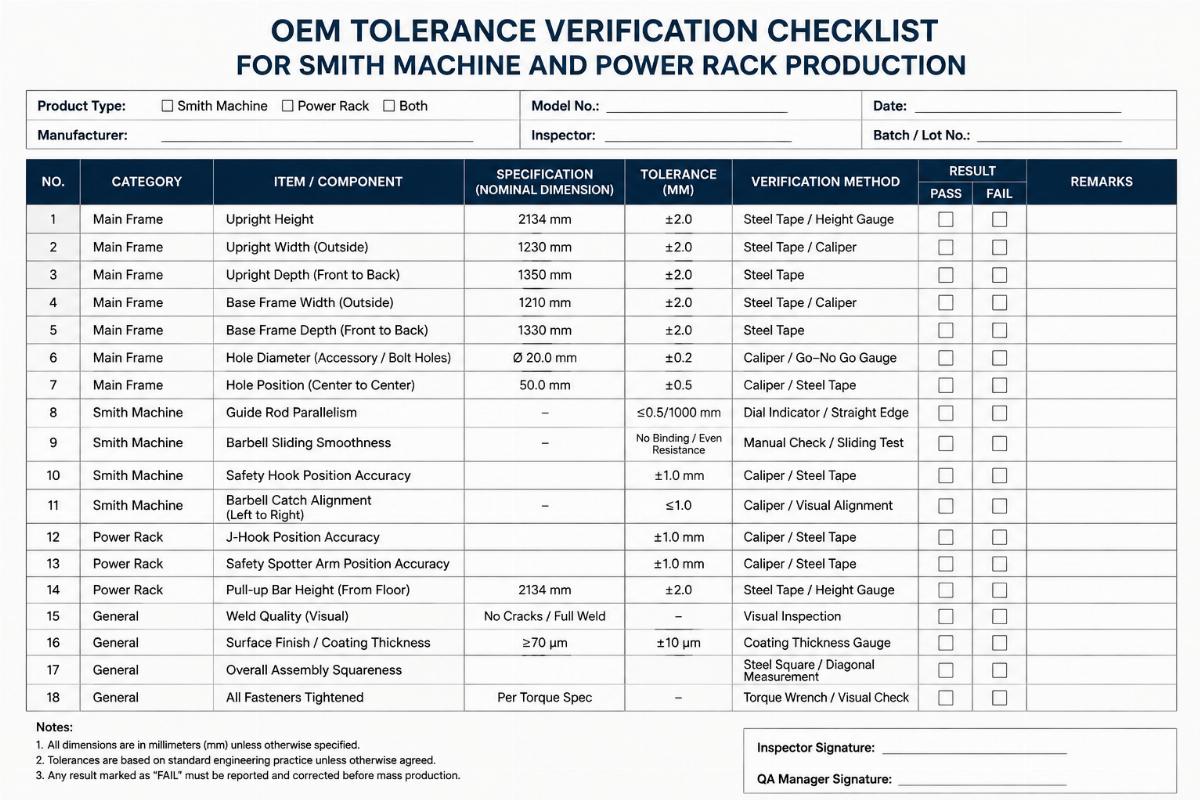
Here is the verification checklist I now insist on for every OEM order, regardless of order size:
- Jig alignment check: Measure guide-rail angular deviation against the CAD datum before any production run begins.
- First-article pull test: Assemble the first unit and run the selectorized stack through its full range of motion for multiple cycles under load, checking for binding, noise, or uneven resistance.
- Pulley groove alignment: Verify that cable routing does not introduce lateral drag, which accelerates cable fraying and bearing wear.
- Bearing preload verification: Confirm that bearings are seated without excessive preload (causes heat and premature failure) or excessive play (causes wobble and noise).
- Pin and bushing fit: Check clearance between selector pins and receiver holes; too tight causes jamming, too loose causes rattle and misalignment.
[NEED_CITE: fitness equipment OEM quality control checkpoints and tolerance verification methods]
A distributor in Southeast Asia once received a container of cable crossover machines where the pulley brackets were welded slightly off-axis. The cables tracked unevenly, fraying within months. The factory’s response was to ship replacement cables—treating the symptom, not the disease. The real fix required re-welding the brackets, which the factory refused to cover under warranty because the deviation was "within acceptable range."
When you evaluate a fitness equipment supplier Philippines operators partner with, ask specifically: do you perform a first-article pull test on every OEM design change, and can you share the test protocol? A supplier who hesitates is telling you everything you need to know.
How to Optimize Container Loading for Philippines Gym Projects?
Mixing cardio, strength, and free-weight equipment in a single consolidated container consistently delivers lower per-unit freight cost than shipping single-category full containers, while meeting the multi-category needs of a commercial gym buildout. [NEED_CITE: container loading optimization methods for mixed fitness equipment shipments]
Philippine gym projects almost never need one hundred treadmills or two hundred power racks. A typical commercial gym or hotel fitness center requires a balanced mix: a dozen cardio units, a full suite of strength machines covering every muscle group, a free-weight zone with dumbbells and plates, and functional training accessories. Ordering each category separately means paying for partially empty containers.
The loading strategy I use for gym projects in the Philippines and across Southeast Asia follows a consistent logic:
- Heavy, dense items anchor the floor: Plate-loaded machines, dumbbell sets, and weight plates go on the container floor. Their weight stabilizes the load and maximizes the deadweight allowance.
- Mid-density items fill the middle layer: Power racks, Smith machines, and cable crossovers stack above the floor load. Their height is managed by disassembling uprights where the design allows.
- Light, voluminous items fill the upper volume: Treadmills, ellipticals, and exercise bikes occupy the upper space. Their cartons are relatively light but consume significant cube.
- Accessories and flooring fill voids: Rubber flooring rolls, battle ropes, medicine balls, and small accessories pack into every remaining gap, eliminating shift during transit.
[NEED_CITE: container consolidation best practices for mixed commercial fitness equipment shipments]
A hotel developer in Palawan was initially quoted separate container costs for cardio, strength, and free-weight orders from three different suppliers. When we consolidated the entire gym package into a mixed container, the per-unit freight cost dropped noticeably compared to the sum of the three separate shipments. More importantly, the project received one coordinated delivery instead of three staggered arrivals, which simplified customs clearance and site scheduling.
When you request a quote from a fitness equipment supplier Philippines buyers work with, ask for a container loading plan before finalizing the order. A supplier who can show you a loaded-container rendering with weight distribution and cube utilization is thinking about your total landed cost, not just the ex-works price.

What After-Sales Support Should You Expect from a China Supplier?
Reliable after-sales support from a Chinese fitness equipment supplier means spare parts availability and technical guidance, not just a warranty certificate signed at the time of order. [NEED_CITE: after-sales service expectations and spare parts supply chains for imported fitness equipment]
The fitness equipment business is not a one-time transaction. Cables fray, upholstery tears, bearings wear, and electronics fail. The question is never whether something will need service—it is how quickly and affordably the replacement part reaches the gym floor.
For Philippine buyers, the geographic distance from Chinese manufacturing hubs makes spare parts logistics a critical factor. Here is what a structured after-sales framework looks like in practice:
- Spare parts inventory: The supplier maintains a running stock of wear items—cables, pulleys, seat pads, selector pins, bearing cartridges—specific to your order’s configuration.
- Parts identification documentation: Every machine ships with an exploded-view parts diagram and part numbers, so your maintenance team can order the exact component without back-and-forth emails.
- Technical support access: Video-call troubleshooting for installation or repair issues, with the supplier’s technical team walking your staff through the process in real time.
- Warranty claim process: A clear, written procedure for warranty claims, including response timelines and shipping terms for replacement parts.
[NEED_CITE: spare parts supply chain management for commercial fitness equipment distributors in Southeast Asia]
A gym chain operator in the Visayas region told me about their experience with a previous supplier: the machines were reasonably priced, but when a cable crossover needed a replacement pulley bracket six months in, the supplier took weeks to respond, then quoted a replacement cost that included a full new bracket assembly rather than just the worn component. The downtime cost the gym membership revenue far exceeding the original price difference between suppliers.
When vetting a fitness equipment supplier Philippines operators engage long-term, ask for their spare parts catalog and their average lead time for warranty component delivery. A supplier who can show you a stocked parts warehouse and a documented response protocol is building for a relationship, not a single shipment.

Conclusion
Spec verification, OEM tolerance control, container consolidation, and after-sales infrastructure together determine the true cost of gym equipment sourced from China. Philippine gym owners, hotel developers, and distributors who evaluate a fitness equipment supplier Philippines operators trust through these four lenses consistently avoid the field failures, freight surprises, and maintenance bottlenecks that turn a low purchase price into a high total cost of ownership.


