Commercial Chest Press Machine OEM Manufacturer for Sale
Most gym owners think factory calibration is the final word. It is not. Shipping vibration, uneven flooring, and ambient heat routinely shift pivot points and rail alignment long before the first rep is logged.
Proper Chest Press Machine Alignment and Calibration requires systematic rail lubrication, pivot point verification, and load path adjustment — environmental factors in hot climates demand specific maintenance protocols beyond factory defaults.
I still get voice messages from a gym owner in Riyadh about that one seated chest press. He thought the guide rods needed more grease, so he had a local auto shop pack the rails with wheel bearing grease. By mid-July, with the gym floor hitting ambient temperatures well above normal, the grease melted and ran down the rods onto the base plate. Members were slipping. When I flew out to sort it, half the HVAC units in that facility were down, sweat was dripping off my hard hat, and the rail bores were completely gummed up. Since that day, every piece of commercial strength equipment we ship to Gulf countries gets an extra coat of dry PTFE lubricant at the factory, plus an Arabic-language maintenance card tucked into the crate. I learned this trade from old-school mentors who drilled one rule into me: the machine is never the problem — the environment is. [NEED_CITE: root cause distribution of strength equipment field failures per ISO 20957-1]

Let me walk you through what actually matters when you install, align, and maintain these machines in the field.
Why Does Chest Press Machine Alignment Matter for Member Safety?
A misaligned chest press forces the user’s shoulder joint through an unnatural arc, converting a clean horizontal press into a twisted shear load on the rotator cuff.
The biomechanics are straightforward. The pivot axis of the arm assembly must intersect the user’s glenohumeral joint center within a narrow tolerance band. When the seat rail is off by even a small margin, or when the chest pad height does not match the user’s sternum line, the movement path deviates. Over hundreds of reps, that deviation accumulates into joint stress, member complaints, and eventually injury claims. [NEED_CITE: shoulder joint kinematics during machine chest press vs free weight bench press]
I have seen连锁 gym chains lose entire membership cohorts because members blamed the equipment for shoulder pain that was actually caused by a batch of machines installed with seat rails drifting outside acceptable parallelism. The complaint rate dropped noticeably once we recalibrated the full floor.
The key takeaway: alignment is not a cosmetic concern. It is a safety-critical parameter that directly affects joint loading patterns.
What Are the Key Alignment Points on a Commercial Chest Press?
Four critical zones require verification during installation and every scheduled maintenance visit: the seat rail, the chest pad height adjustment, the arm pivot axis, and the weight stack guide rods.
Each zone controls a different segment of the load path, and neglecting any one of them compromises the entire movement pattern.
| Alignment Zone | Function | Tolerance Expectation | Verification Method |
|---|---|---|---|
| Seat Rail | Controls user position relative to pivot | Parallelism within narrow band | Feeler gauge or laser level |
| Chest Pad Height | Aligns pad to sternum center | Matched to user anthropometric range | Manual measurement against reference |
| Arm Pivot Axis | Defines movement arc center | Coaxial with intended joint center | Dial indicator or alignment jig |
| Weight Stack Guide Rods | Ensures smooth load transfer | Vertical plumb and parallel | Plumb bob and straightedge |
[NEED_CITE: commercial strength equipment installation tolerance standards per EN 957 / ASTM F2216]
A distributor in Southeast Asia once received a full container of chest press units. The machines looked perfect in the crate. But after installation on a mezzanine floor with slight deflection, the guide rods were no longer plumb. The weight stack dragged on every downward return. Members complained of jerky resistance. The fix was not new parts — it was shimming the base frame and re-verifying rod parallelism with a straightedge.

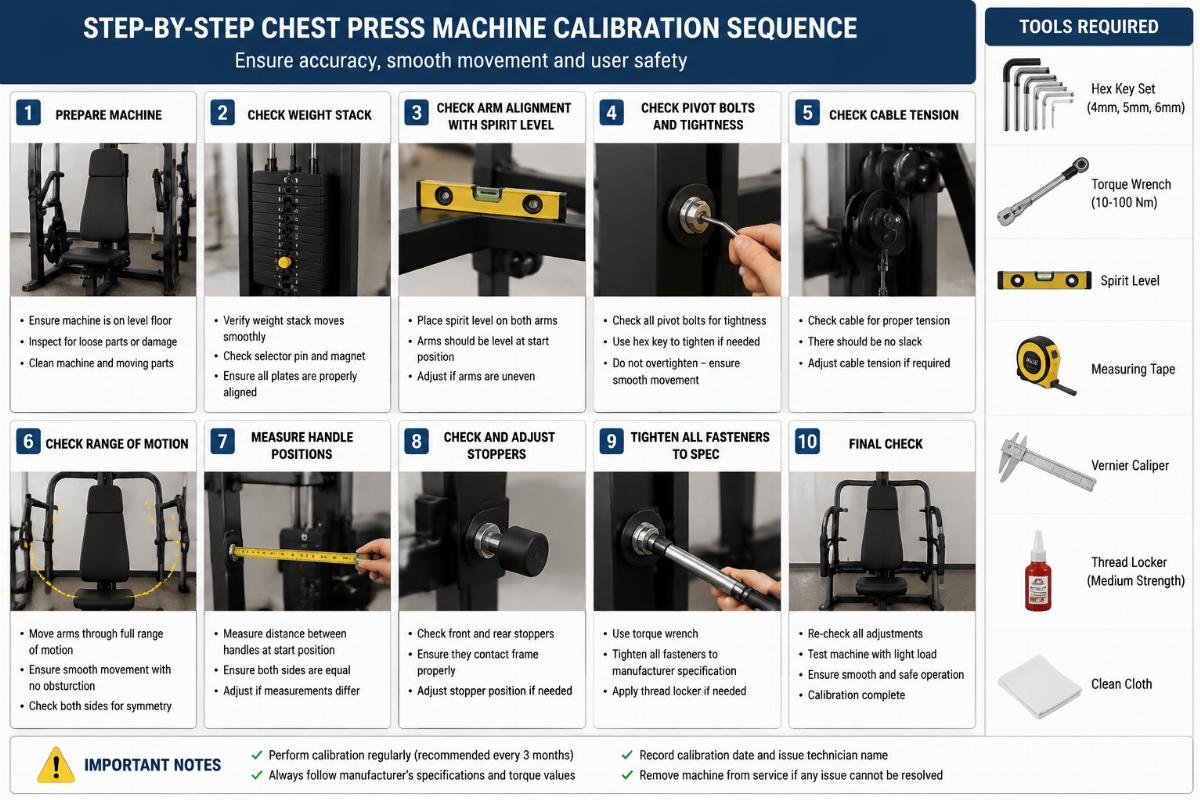
How to Calibrate a Chest Press Machine Step by Step?
Follow a six-point calibration sequence from base leveling to load path verification, using the right tools at each stage.
This sequence is what our field technicians use across installation sites in the Middle East, Africa, and Latin America. It works because it addresses the load path from the ground up, not from the top down.
Step 1 — Base Leveling. Place a machinist’s level on the main frame base plate. Adjust the leveling feet until the frame sits perfectly horizontal in both axes. An unlevel base is the single most common cause of downstream alignment drift. [NEED_CITE: importance of base leveling in selectorized strength equipment installation]
Step 2 — Seat Rail Parallelism. Run a feeler gauge or laser level along both rails of the seat slider. Check for parallelism at the front, middle, and rear positions. Any deviation beyond the acceptable band means the seat will track unevenly, shifting the user’s position relative to the pivot.
Step 3 — Chest Pad Height Alignment. Adjust the chest pad to its mid-range position. Verify that the pad centerline aligns with the intended sternum contact point for the target user height range. This is a biomechanical alignment, not just a mechanical one.
Step 4 — Arm Pivot Axis Verification. Use a dial indicator or the manufacturer’s alignment jig to confirm that the pivot axle is coaxial with the designed joint center. Rotate the arm assembly through its full range and check for binding or lateral play.
Step 5 — Weight Stack Guide Rod Plumb. Hang a plumb bob alongside each guide rod. Check vertical alignment at the top and bottom mounting points. Rods that are out of plumb cause the weight stack to bind, creating inconsistent resistance throughout the range of motion.
Step 6 — Load Path Verification. Load the stack to mid-range and perform slow, controlled reps. Listen for scraping, feel for drag, and watch for lateral movement of the carriage. The load path should be smooth and silent through the entire stroke.
A gym owner in the Gulf once called us because two machines on the floor felt "rough" compared to the others. Our technician ran this exact sequence and found that the guide rods on both units had shifted during a floor renovation when movers bumped the frames. A thirty-minute recalibration restored smooth operation. No parts were needed. [NEED_CITE: field calibration procedures for selectorized strength machines per manufacturer maintenance manuals]
What Maintenance Intervals Prevent Alignment Drift?
Climate and usage intensity determine calibration frequency — monthly checks for hot climates, quarterly for temperate regions, and semi-annual for low-usage facilities.
This is not a generic recommendation. It comes from years of tracking field performance across vastly different environments.
In temperate climates with controlled HVAC, a quarterly inspection catches most drift before it becomes a member complaint. The rails stay lubricated, the pivot points hold their alignment, and the weight stack runs clean.
In hot climates — and I am talking about facilities where the gym floor regularly sees ambient temperatures well above normal — the lubrication breaks down faster, the metal expands and contracts with daily temperature swings, and the alignment drifts noticeably within weeks. Monthly checks are not optional there. They are mandatory.
A fitness chain operating across multiple countries in the Middle East learned this the hard way. They started with a quarterly schedule copied from their European locations. Within months, member complaints about rough movement and seat rail sticking were piling up. Switching to a monthly protocol, combined with the dry lubricant specification we provide, brought the complaint rate down to negligible levels.
We include an Arabic-language maintenance card with every shipment to the region. It lists the inspection points, the lubrication type, and the interval. The card is laminated and designed to hang on the machine frame so the technician always has it on hand.

Which Lubrication Standards Apply to Guide Rails in Extreme Heat?
Dry PTFE-based lubricants outperform traditional wet grease above elevated ambient temperatures because they do not melt, migrate, or attract dust.
This is the single most counterintuitive lesson I have learned in the field. Most people assume that more grease means smoother operation. In a hot environment, it means the opposite.
Traditional lithium-based grease has a dropping point — the temperature at which it turns from a semi-solid to a liquid. Once that threshold is crossed, the grease runs off the rail, pools on the base plate, and creates a slip hazard. Worse, the remaining thin film dries out and turns into an abrasive paste that scores the rail bore.
Dry PTFE lubricants leave a solid film that does not melt at gym-floor temperatures. They do not attract dust or lint. They do not create slip hazards. And they last substantially longer between reapplication cycles in hot climates. [NEED_CITE: dry film lubricant performance vs conventional grease at elevated temperatures in fitness equipment applications]
When we ship to the Gulf region, every guide rod and seat rail gets a factory-applied dry PTFE coating before crating. The maintenance card specifies the same lubricant for field reapplication. We have seen the maintenance interval extend meaningfully compared to wet grease, and the slip-hazard complaints have essentially disappeared.
A distributor in North Africa once tried substituting a local automotive grease to cut costs. Within weeks, the gym floor was stained, the rails were scoring, and the weight stacks were binding. The cost of the service call and the replacement parts was several times the savings on lubricant. They switched back to the specified dry PTFE product and have not looked back.

Conclusion
Chest Press Machine Alignment and Calibration is not a one-time factory setting — it is an ongoing discipline shaped by environment, usage, and lubrication chemistry.
Base leveling, rail parallelism, pivot axis verification, and guide rod plumbness form the foundation. Climate-driven maintenance intervals and dry lubricant specifications keep the system running smoothly over time. Get these right, and the machine delivers the biomechanically correct movement path that members expect and that their joints require.