01 / Scenario
STUDIO
P
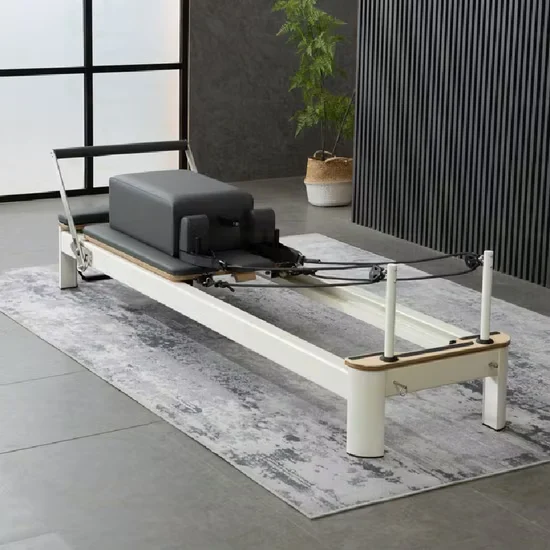
High-End Pilates Studios
Premium aesthetics meet quiet operation for boutique studio environments.

ISO
9001
CE
Certified
OEM
Available
10YR
Warranty
Maple Wood White Pilates Reformer, Solid Maple Frame, 2460×730×680mm Dimensions — engineered with solid maple carriage rail and frame construction to resist warping and maintain rail parallelism under repetitive studio loading. Includes long box, jump board, and platform for multi-plane training without additional equipment. Ships with 3-year warranty, custom logo options, and 80-piece monthly production capacity.
Backed by 32-point inspection protocol and 100% load testing before dispatch.
// Spec Highlights
• Direct from Manufacturer · No Middlemen · Worldwide Shipping
01
// Material
Imported Solid Wood
Premium hardwood frames sourced for density and visual warmth.
02
// Hardware
Medical-Grade Silent
Whisper-quiet pulleys and springs for clinical environments.
03
// Customization
Appearance OEM
Color, upholstery, and branding tailored to your studio.
04
// Service
Layout Design
Free venue planning for studios and rehab institutions.
Every component is selected for longevity, performance, and aesthetic harmony - from imported hardwood frames to silent medical-grade accessories.
// Features
Solid Maple Carriage Rail — kiln-dried maple resists warping and maintains rail parallelism through years of daily studio loading.
| Parameter | Value |
|---|---|
| Product Type | Pilates Reformer |
| Frame Material | Solid Maple Wood |
| Finish Color | White (Solid Color) |
| Product Dimensions | 2460 × 730 × 680 mm |
| Net Weight | 100 kg |
| Included Accessories | Long Box, Jump Board, Platform |
| Upholstery | Commercial-grade vinyl, standard or high-density options available |
| Carriage Rail Interface | Precision-machined maple rail with low-friction wheel system |
| Spring System | Progressive resistance, multiple tension levels |
| Customization | Logo customization available |
| Production Capacity | 80 Pieces / Month |
| Warranty | 3 Years |
| Facility Type | Typical Use |
|---|---|
| Commercial Pilates Studio | Group reformer classes and private sessions with full accessory rotation |
| Rehabilitation and Physiotherapy Center | Controlled resistance exercises for post-injury and mobility recovery |
| Boutique Fitness and Wellness Facility | Hybrid classes combining reformer work with mat-based programming |
| Hotel and Resort Wellness Area | Guest-access reformer sessions with durable finish for high turnover |
| Home Studio | Dedicated personal practice with commercial-grade construction |
A solid maple frame keeps the carriage tracking true under repetitive eccentric loading, while laminated alternatives delaminate at the rail joint.
Walk into any studio running reformers with veneer-coated or laminated wood frames, and you will eventually find the rail surface peeling at the carriage contact zone. Humidity cycles and daily carriage loading work together to separate the veneer from the substrate. Once the rail surface lifts, the carriage wheels catch and the glide degrades. Studio owners end up sanding, re-gluing, or replacing entire frames — maintenance that a solid maple construction avoids because the grain runs continuously through the full cross-section. The density and grain structure of maple hold fastener tension and resist the compression set that softer woods develop where the carriage repeatedly impacts the rail stops [NEED_CITE: EN 957 structural requirements for stationary training equipment].
This commercial maple wood pilates reformer covers the full spectrum of supine, prone, seated, and standing movement patterns that form the core of classical and contemporary Pilates programming. In a studio configuration, it pairs with Cadillac units for advanced decompression work and chairs for upright balance challenges. The included long box, jump board, and platform allow a single station to serve multiple exercise categories without requiring separate equipment purchases. The 2460 mm length accommodates taller practitioners while keeping the footprint manageable for studios running four to eight reformers per class.
A reformer carriage undergoes cyclic loading that most gym equipment never experiences. Each repetition of footwork on the jump board sends an impact pulse through the rail and into the frame joints. Eccentric control during long-stretch series places sustained lateral force on the carriage wheels and rail interface. The spring attachment points see tension cycling hundreds of times per class, and the upholstery absorbs compressive force from body weight in every position. Maple’s interlocked grain structure distributes these multi-directional stresses without developing the localized compression zones that appear in softer hardwoods after months of daily studio scheduling [NEED_CITE: material fatigue behavior in cyclically loaded wood structures].
The rail-to-wheel interface is the single most important tolerance on any reformer. If the wheel diameter and rail width are not matched to tight clearance, the carriage either binds under off-center loading or develops lateral play that degrades movement precision. Solid maple allows the rail to be machined directly from the frame stock, maintaining consistent width along the full travel distance — something that laminated construction cannot guarantee because the veneer layer introduces a variable thickness at the contact surface. Spring selection matters equally: progressive resistance springs provide smooth tension transition through the range of motion, while single-rate springs create a noticeable jump between engagement and full extension. Upholstery density determines whether the padding compresses permanently after months of body weight loading or retains its profile through daily commercial use.
A reformer built with laminated particleboard or MDF saves money at purchase but introduces predictable failure points. The rail surface chips under carriage wheel pressure, exposing the composite core to moisture absorption and swelling. Non-precision wheels develop flat spots from repeated impact against the rail stops, creating a rough glide that clients notice immediately. Low-density foam padding compresses within months and requires re-upholstery — downtime that removes the unit from class scheduling. Springs without documented tension specifications make it impossible to maintain consistent resistance calibration across a fleet of reformers, so instructors cannot cue clients by spring color with confidence [NEED_CITE: commercial equipment maintenance cost analysis in fitness facilities].
Every BICKFIT-built commercial maple wood pilates reformer starts with kiln-dried solid maple selected for grain consistency and density uniformity. The rail surfaces are precision-machined to maintain parallelism across the full carriage travel, preventing the tracking drift that develops in frames where the rails are attached as separate components. Each unit ships with the complete accessory ecosystem — long box, jump board, and platform — so studio owners can run diverse programming without delayed accessory procurement. The 3-year warranty covers structural and mechanical components, and the production capacity supports fleet orders for multi-studio rollouts. Logo customization allows brand consistency across the studio floor, and 2D layout support ensures proper clearance zones between reformers for safe client movement during class transitions.
Share your studio floor dimensions and target reformer count to receive a 2D layout with recommended clearance zones and traffic flow paths. Specify your expected daily class volume so we can match spring configuration and upholstery density to your usage intensity. Indicate any customization requirements including logo placement, frame color, or upholstery selection to align with your studio branding.
Q: How do I verify that a reformer frame is solid maple rather than laminated or veneer construction?
A: Examine the rail cross-section and any exposed end grain. Solid maple shows continuous grain lines running through the full thickness, while veneer construction reveals a thin decorative layer over a different substrate material. Request a material certification from the manufacturer specifying solid wood species, and inspect the rail surface for uniform grain pattern without repeating print texture that indicates a laminated overlay.
Q: What carriage wheel and rail specifications should I check before purchasing?
A: Confirm the wheel material, diameter, and the specified clearance tolerance between wheel and rail. The rail surface should be machined from the same stock as the frame rather than attached as a separate component. Ask for the lateral play specification under loaded conditions — excessive play causes carriage wobble during unilateral exercises and degrades the precision that clients expect from commercial reformer work.
Q: How does spring configuration affect resistance feel and long-term maintenance?
A: Progressive resistance springs increase tension gradually through the range of motion, providing smooth transitions that suit most Pilates exercises. Single-rate springs engage abruptly and create a less refined experience. Verify that replacement springs are available with documented tension specifications so you can maintain consistent resistance calibration across your fleet and cue clients by spring color reliably over years of use.
Q: What upholstery specifications matter for daily commercial studio use?
A: Commercial-grade vinyl with high-density foam resists compression set and surface cracking far longer than standard padding. Check the foam density rating and confirm that replacement upholstery kits are available as spare parts. In a studio running multiple classes daily, low-density foam compresses permanently within months, requiring re-upholstery downtime that removes the reformer from your class scheduling.
Q: How should I plan studio layout around the reformer footprint?
A: The 2460 × 730 mm footprint requires clearance on all sides for safe client access during transitions and for instructor circulation during group classes. Plan minimum spacing between adjacent reformers to accommodate the long box and jump board extensions. Consider traffic flow from entry to each station and ensure adequate room at the head and foot of each reformer for standing exercises and platform work.
Premium aesthetics meet quiet operation for boutique studio environments.
Medical-grade silence and precision for sports & postpartum recovery.
Furniture-grade craftsmanship for premium residential installations.
Compact premium setups for one-on-one and small-group training.
Aesthetic Pilates integration for hybrid wellness studio programming.
Multi-unit deployment with instructor-grade reliability for certification programs.
Tell us about your project. Our team will respond within 24 hours with pricing, customization options, and shipping details.
// Sales Director
William
+86 132 2531 1800
// Export Manager
Bella
+86 198 5412 8032
william@bickfit.com