01 / Scenario
STUDIO
P
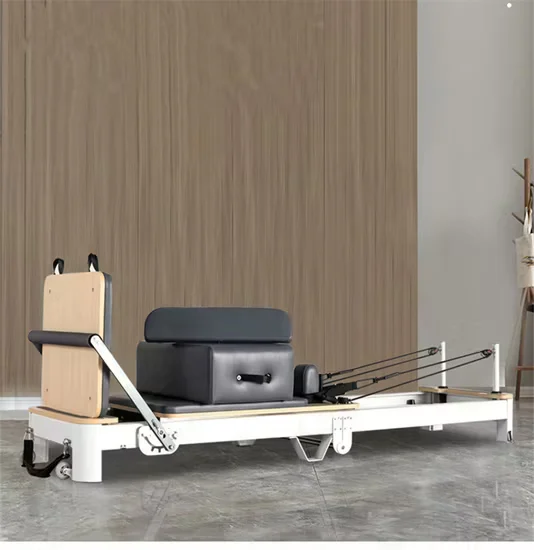
High-End Pilates Studios
Premium aesthetics meet quiet operation for boutique studio environments.
ISO
9001
CE
Certified
OEM
Available
10YR
Warranty
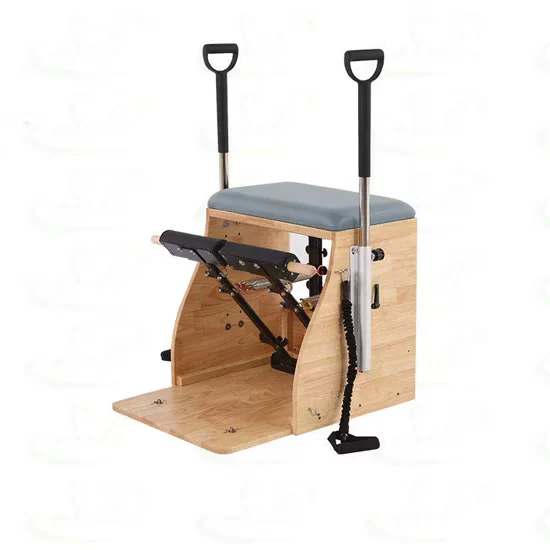
Wooden Pilates Chair, 800×620×1100mm, 45kg Solid Wood Frame — engineered for studio-level durability with reinforced joint construction and precision-machined pedal mechanism delivering smooth resistance progression. Compact footprint optimized for high-density floor planning with adequate clearance for user movement. Every unit undergoes 32-point inspection and 100% load testing before shipment to ensure commercial-grade performance.
// Spec Highlights
• Direct from Manufacturer · No Middlemen · Worldwide Shipping
01
// Material
Imported Solid Wood
Premium hardwood frames sourced for density and visual warmth.
02
// Hardware
Medical-Grade Silent
Whisper-quiet pulleys and springs for clinical environments.
03
// Customization
Appearance OEM
Color, upholstery, and branding tailored to your studio.
04
// Service
Layout Design
Free venue planning for studios and rehab institutions.
Every component is selected for longevity, performance, and aesthetic harmony - from imported hardwood frames to silent medical-grade accessories.
// Features
Solid Wood Frame Integrity — Every joint is reinforced to handle continuous spring-tension cycles without loosening or splitting in high-traffic studio environments.
| Parameter | Value |
|---|---|
| Product Type | Pilates Chair |
| Material | Solid Wood |
| Product Dimensions | 800 × 620 × 1100 mm |
| Footprint | 800 × 620 mm |
| Net Weight | 45 kg |
| Frame Construction | Solid wood with reinforced joints |
| Pedal Mechanism | Precision-machined with spring resistance |
| Color Options | Solid color, customized options available |
| Logo | Customized is allowed |
| Warranty | 3 Years |
| Certification | CE |
| Facility Type | Typical Use |
|---|---|
| Commercial Pilates studio | Daily group reformer-to-chair transition classes with continuous spring loading |
| Rehabilitation and physical therapy center | Controlled lower-limb and core activation under supervised clinical protocols |
| Boutique fitness facility | Small-group Pilates chair sessions in space-dense training floors |
| Home studio | Dedicated personal practice with a compact footprint requirement |
Solid wood eliminates the delamination failure mode that ends the service life of veneer and particle board chairs within the first year of studio use.
Walk into any Pilates studio running engineered wood chairs and you will find the same pattern: hairline cracks propagating along the pedal-mounting joints, veneer peeling away from the base where spring anchors concentrate stress, and side panels that have shifted out of square after months of asymmetric loading. These failures are not cosmetic. When the pedal anchor plate loses rigid backing, the spring resistance becomes unpredictable mid-repetition — a safety problem, not just a maintenance ticket [NEED_CITE: EN 957 structural requirements for stationary training equipment]. A commercial wooden Pilates chair built from solid stock distributes those cyclic loads through the full cross-section of the timber rather than through a thin face layer glued to a composite core.
The Pilates chair targets sagittal-plane lower-body work — plantar flexion, dorsiflexion, hip extension — plus the deep stabilizers of the trunk that fire during unilateral pedal presses. On a studio floor, it pairs with a reformer for supine-to-seated progressions and a ladder barrel for the posterior chain complement. The 800 × 620 mm footprint leaves enough clearance for an instructor to cue from any side, which matters in group-class layouts. The commercial wooden Pilates chair suits facilities running four or more sessions per day, and the pedal platform accommodates users across a broad height range without swap-out components.
Every pedal press loads the spring anchor and its surrounding wood in shear, and a studio running back-to-back classes accumulates hundreds of those cycles daily. The fatigue path concentrates where the anchor hardware meets the frame — if the joint relies solely on adhesive and light fasteners, micro-movement opens gaps that compound each week. Reinforced mechanical fastening at those junctions keeps the anchor plate seated flush, which in turn keeps pedal resistance consistent. Sweat and cleaning solvents also attack exposed end-grain over time, so sealed contact surfaces at the pedal hinge extend the interval between maintenance visits [NEED_CITE: cyclic loading and fatigue performance in timber joints under mechanical fasteners].
The 45 kg net weight signals a frame with enough mass to stay planted during aggressive single-leg presses without relying on floor anchors — a chair under 30 kg tends to walk across the floor during use. The 800 × 620 mm footprint is compact enough for dense studio layouts but wide enough that the base resists lateral tipping during standing pedal work. Solid wood as a material choice matters structurally: it provides continuous grain through the joint zones, unlike engineered board where the internal structure offers no directional strength. The 3-year warranty on the frame and mechanism gives studio operators a verifiable horizon for capital-expenditure planning rather than hoping the equipment survives an unspecified lifespan.
A chair built from particle board with a wood-look veneer may ship at half the weight and a fraction of the cost, but the failure timeline in a commercial setting is measured in months, not years. Once the pedal anchor tears free of the composite core, the entire side panel typically needs replacement — there is no local repair for delaminated board. Non-reinforced joints loosen under spring tension and require re-tightening weekly, which means technician hours that were never budgeted. Thin finishes on low-grade wood absorb moisture from sweat and cleaning products, swelling and warping the pedal channel until movement becomes rough. None of these costs show up on the purchase order [NEED_CITE: comparative lifecycle cost of engineered wood versus solid timber in commercial fitness equipment].
BICKFIT approaches Pilates equipment with the same structural rigor applied to its 11-gauge steel strength lines: the frame material must be verifiable, the joints must be engineered for cyclic load, and the warranty must carry real coverage. The solid wood construction on this chair is specifiable by grade and species, not hidden behind a generic "wood frame" label. For studio operators planning a full floor layout, the 800 × 620 mm footprint is integrated into 2D-3D CAD drawings that account for instructor clearance zones and safe passage between stations — not just the equipment envelope. OEM customization for color and branding keeps the equipment visually aligned with the studio identity without compromising the structural specification. The three-year warranty is backed by the same QC discipline that load-tests every steel unit before shipment.
Provide your studio floor area and current equipment list to receive a 2D-3D layout that positions each commercial wooden Pilates chair with correct spacing and traffic flow. Specify expected daily session volume so the spring tension range can be matched to your user base. Communicate any branding or color requirements early so OEM customization is built into production rather than applied after delivery.
Q: Why does solid wood outperform engineered wood in a commercial Pilates chair?
A: Solid wood maintains continuous grain through the high-stress joint zones where pedal anchors mount, distributing cyclic spring loads across the full cross-section. Engineered wood relies on adhesive bonds between layers that degrade under repeated tension and moisture exposure, leading to delamination at the anchor points — the most common structural failure in studio environments.
Q: How should I evaluate pedal mechanism durability before purchasing?
A: Check that the pedal hinge uses machined metal components rather than plastic bushings, and confirm the spring anchor plate is mechanically fastened through the frame rather than surface-mounted with adhesive. Run the pedal through its full range by hand and feel for any lateral play or binding, which signals imprecise tolerances that worsen under daily studio cycling.
Q: What spring resistance options are available for different user levels?
A: The chair ships with springs configured for a standard commercial progression suitable for most studio class formats. Custom spring tension ranges are available to accommodate rehabilitation settings requiring lighter initial resistance or advanced athletic training requiring heavier maximum load. Specify your primary user population when ordering to ensure the correct range is installed.
Q: What floor space do I need around each Pilates chair?
A: The chair itself occupies 800 × 620 mm, but safe studio operation requires a minimum 600 mm clearance on all sides for instructor access and user movement during standing exercises. For multi-chair layouts, allow additional passage width between stations. Request a CAD layout drawing that accounts for these clearances within your total floor plan.
Q: What ongoing maintenance does a wooden frame Pilates chair require?
A: Primary maintenance involves monthly inspection and retorque of all mechanical fasteners at the pedal anchor and hinge points, quarterly spring condition checks, and regular cleaning with pH-neutral products to protect the wood finish from sweat and solvent damage. Spring replacement should be done as matched sets to maintain balanced resistance across both pedals.
Premium aesthetics meet quiet operation for boutique studio environments.
Medical-grade silence and precision for sports & postpartum recovery.
Furniture-grade craftsmanship for premium residential installations.
Compact premium setups for one-on-one and small-group training.
Aesthetic Pilates integration for hybrid wellness studio programming.
Multi-unit deployment with instructor-grade reliability for certification programs.
Tell us about your project. Our team will respond within 24 hours with pricing, customization options, and shipping details.
// Sales Director
William
+86 132 2531 1800
// Export Manager
Bella
+86 198 5412 8032
william@bickfit.com