
Boutique Studio Setup Cost: Complete Equipment Budget Wholesale Supplier
Comparing bundled quotes hides the real cost drivers behind boutique studio equipment.
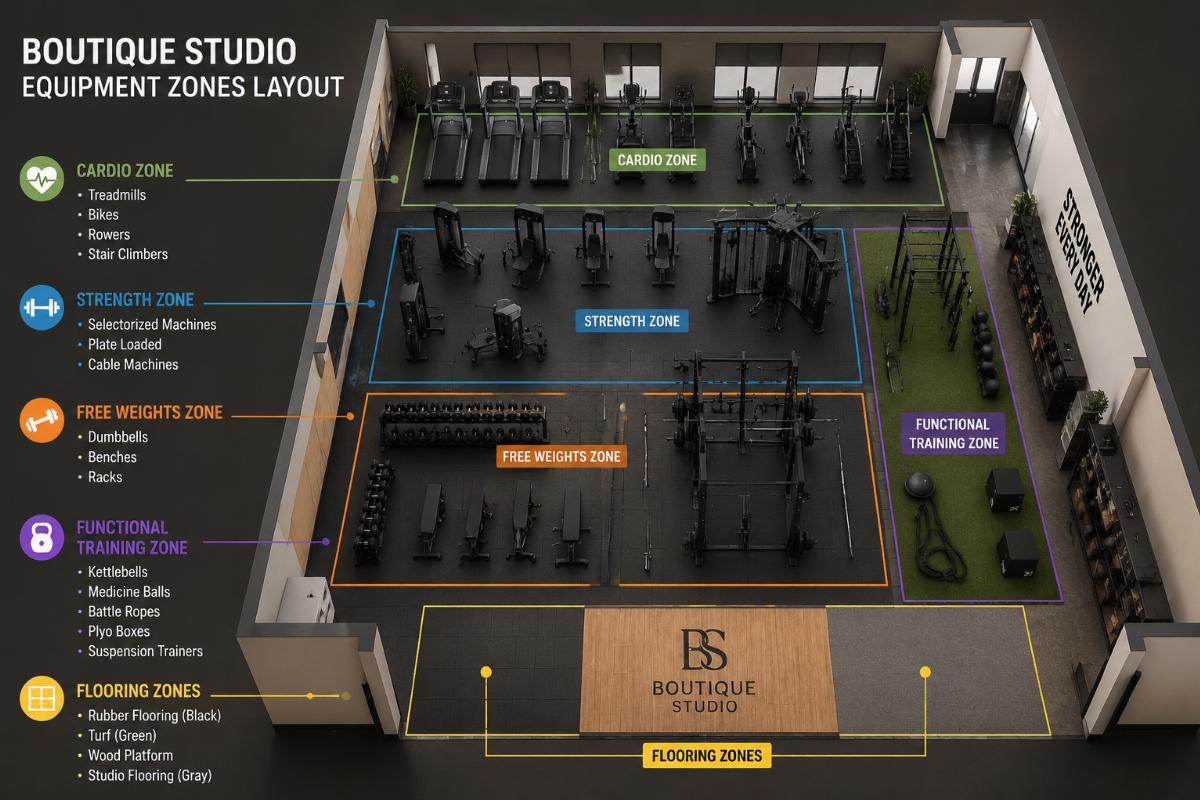
A complete boutique studio equipment package typically covers five functional zones — cardio, selectorized and plate-loaded strength, free weights, functional training, and flooring — and the wholesale price varies drastically depending on whether you are comparing factory-direct builds against branded retail markups or cutting corners on tube thickness, motor horsepower, and plate tolerance.
I have unboxed more than twenty containers of fitness gear at warehouses near Jebel Ali port. Back when I was still on the procurement side doing quality inspections, I flew into Riyadh to oversee a boutique studio fit-out. The client had printed screenshots from premium European brand websites and asked me to match the specs. I sent over a standard quotation, and the prospect vanished. Weeks later I learned he had forwarded my quote untouched to another vendor who undercut the price. The Smith machines that arrived had cross-members with wall thickness noticeably thinner than what the spec sheet implied. Once assembled, the barbells wobbled under load. The entire batch was rejected. That episode reshaped how I break down every boutique studio equipment cost line item — screw by screw, zone by zone. [NEED_CITE: failure root-cause distribution in commercial strength equipment per ISO fitness-safety audit frameworks]
Let me walk you through what a realistic equipment budget actually looks like when you stop comparing sticker prices and start comparing build quality.
What Does a Complete Boutique Studio Equipment Package Include?
A full boutique studio package is organized by movement pattern and functional zone, not by a single lump-sum line item.
When studio owners ask me for a boutique studio equipment cost breakdown, I separate the list into five categories. Each zone has a baseline configuration and optional upgrades that shift the price meaningfully.
| Zone | Baseline Items | Optional Upgrades |
|---|---|---|
| Cardio | Commercial treadmills, ellipticals, spin bikes | Rowing machines, stair climbers, branded console customization |
| Strength Machines | Smith machines, power racks, cable crossovers, selectorized stations | Plate-loaded single-station machines, weight-stack upgrades |
| Free Weights | Adjustable benches, dumbbell sets, barbells, weight plates, kettlebells | Competition-grade plates, rubber-coated hex dumbbells, Olympic bar sets |
| Functional Training | Functional trainers, plyo boxes, battle ropes, medicine balls | Wall-ball targets, sled tracks, suspension trainers |
| Flooring & Accessories | Rubber tiles, mats, mirror panels, storage racks | Custom logo inlays, shock-pad underlayment, branded signage |
The reason I structure quotes this way is simple: when a supplier hands you a single total price, you have no way to tell whether the treadmill motor is a heavy-duty AC drive or a downgraded DC unit, or whether the Smith machine uses commercial-grade linear bearings or budget bushings. [NEED_CITE: equipment specification transparency standards recommended by international fitness industry associations]
A boutique studio in a North African hotel chain once asked me to spec a compact cardio zone. The initial quote from a competing vendor looked attractive until I noticed the treadmill running surface length and width were noticeably reduced compared to standard commercial dimensions, and the motor horsepower rating was downgraded by a full tier. The client would have saved on paper but lost member retention within months.

How Much Does Each Equipment Category Cost at Factory-Direct Price?
Factory-direct boutique studio equipment cost runs substantially below branded retail, but the gap narrows when you match specifications correctly.
Premium international brands carry distribution margins, marketing overhead, and regional dealer markups. When you source directly from a manufacturer with OEM and ODM capability, the price difference on comparable commercial-grade builds is significant — often in the range of forty to fifty percent below retail for equivalent spec tiers. [NEED_CITE: commercial fitness equipment pricing structure analysis comparing factory-direct versus branded retail channels]
Here is a qualitative comparison matrix showing how cost tiers separate across categories:
| Category | Branded Retail Tier | Factory-Direct Commercial Tier | Budget Import Tier |
|---|---|---|---|
| Treadmills | Premium AC motor, full-size deck, integrated touchscreen | Commercial AC motor, standard deck, customizable console | Downgraded DC motor, shortened deck, basic LED console |
| Smith Machines | Heavy-gauge frame, linear bearings, multi-grip bar | Heavy-gauge frame, bushing or bearing options, standard bar | Thin-wall frame, basic bushings, limited grip positions |
| Selectorized Machines | Precision weight stacks, ergonomic cam profiles, premium upholstery | Standard weight stacks, proven cam geometry, durable upholstery | Lightweight stacks, simplified cam paths, thin padding |
| Free Weight Plates | Tight tolerance, certified calibration, premium coating | Standard tolerance, verifiable calibration, rubber or urethane coating | Wide tolerance, unverified weight, minimal coating |
| Functional Trainers | Dual adjustable pulleys, commercial cables, integrated storage | Dual adjustable pulleys, standard cables, basic storage | Single adjustment point, light-duty cables, no storage |
The critical insight is that the factory-direct tier and the budget import tier can look identical in a photograph. The difference lives inside the frame welds, the bearing selection, and the quality control process. [NEED_CITE: quality control variance between certified commercial manufacturers and unverified import suppliers]
I have seen buyers receive two quotes for a cable crossover machine where the external dimensions appeared identical. The lower-priced unit used cable pulleys with noticeably smaller bearing diameters, which translated into rougher movement feel and accelerated cable wear. The boutique studio equipment cost looked lower on paper, but the replacement cycle would have been drastically shorter.

Which Specs Determine Real Cost Differences Between Quotes?
The real boutique studio equipment cost gap hides in tube wall thickness, load capacity ratings, running surface dimensions, motor power class, and weight plate tolerance — not in the brand name on the shroud.
Most buyers assume brand premium is purely a logo tax. In reality, the hidden specification differences account for the majority of the cost gap between a genuine commercial build and a budget alternative. Here is where you need to look:
Frame Construction — Commercial-grade strength equipment uses heavy-gauge steel tubing with reinforced gussets at high-stress junctions. Budget alternatives reduce wall thickness by a noticeable margin, which compromises rigidity under dynamic loads. A Smith machine横梁 that flexes during heavy squats is not just uncomfortable — it is a safety liability.
Load Ratings — Every power rack and Smith machine carries a rated load capacity. The difference between a unit rated for standard commercial use and one with a substantially higher capacity lies in the steel grade, the welding process, and the reinforcement design. [NEED_CITE: structural load testing standards for commercial strength equipment per international safety certifications]
Treadmill Deck and Motor — Running surface length and width directly affect user comfort and safety. A deck that is noticeably shorter forces taller users into an unnatural stride. Motor power class determines whether the treadmill handles continuous commercial use or burns out under moderate daily traffic.
Weight Plate Tolerance — This is where many budget free-weight packages fail silently. A plate that is labeled as a certain weight but deviates by a wide margin creates imbalanced loading, member complaints, and credibility damage for the studio. Commercial-grade plates hold to a tight tolerance range; budget plates drift noticeably. [NEED_CITE: weight calibration tolerance standards for commercial free-weight equipment]
Bearing and Pulley Quality — In selectorized machines and functional trainers, the bearing size and cable routing design determine smoothness and longevity. Undersized bearings generate friction, wear cables faster, and create the kind of maintenance headaches that shut down revenue-generating floor space.
Here is a specification comparison framework you can use when evaluating quotes:
| Specification Point | Commercial-Grade Build | Budget Build |
|---|---|---|
| Frame Tube Wall | Heavy-gauge, reinforced | Thin-wall, minimal reinforcement |
| Weld Quality | Full-penetration, ground smooth | Spot welds, visible seams |
| Load Capacity Rating | High commercial rating | Basic residential-adjacent rating |
| Treadmill Deck | Full commercial dimensions | Noticeably shortened |
| Motor Class | Continuous-duty AC | Downgraded DC or low-duty AC |
| Plate Tolerance | Tight, verifiable | Wide, unverified |
| Bearing Selection | Commercial-grade | Undersized or unbranded |
When the Riyadh client received those Smith machines with the thin cross-members, the wall thickness difference was not dramatic in absolute terms — but it was enough to create visible bar deflection under load. The entire order had to be pulled and replaced, which cost the project substantially more than the original price difference would have saved.

How to Avoid Low-Price Traps When Comparing Studio Equipment Quotes?
The most reliable way to protect your boutique studio equipment cost budget is to demand a line-item specification breakdown before comparing any total price.
Here is the process I follow with every studio client:
Step One — Request Unit-Level Specs — Ask the supplier to list every piece of equipment with its individual specification sheet, not a summary paragraph. You need tube dimensions, motor ratings, load capacities, bearing types, and plate tolerances for each item.
Step Two — Benchmark Against Known Standards — Compare each specification against international safety and performance standards for commercial fitness equipment. [NEED_CITE: CE certification requirements and testing protocols for commercial gym equipment]
Step Three — Calculate the True Replacement Cost — A machine that costs less upfront but needs bearing replacement or cable routing overhaul within a short period has a higher total cost of ownership than a unit with a higher initial price and a longer service interval.
Step Four — Verify MOQ and Customization Flexibility — Extremely low minimum order quantities sometimes signal that the manufacturer cannot amortize tooling and quality-control costs across the production run, which pushes unit cost up even if the quoted price looks low. A manufacturer with flexible MOQ from single units to full container loads — like the production facilities I work with in Shandong — can offer genuine factory-direct pricing because the volume across their client base supports consistent production standards.
Step Five — Inspect or Request Third-Party Verification — For large orders, nothing replaces a physical inspection. For smaller studio packages, request certified test reports and material documentation.
A CrossFit-style box in Southeast Asia once sourced a functional training free-weight package from a vendor who quoted an attractive per-kilogram price. When the plates arrived, the weight deviation on individual plates was substantially wider than the stated tolerance. Members noticed the imbalance during lifts, complaints multiplied, and the studio had to reorder the entire free-weight set from a verified commercial supplier. The original savings were erased many times over.

What Is the Recommended Budget Allocation Ratio for a Boutique Studio?
A balanced boutique studio equipment cost allocation distributes spending across all five functional zones based on member usage patterns and revenue generation potential, not on whichever category has the flashiest marketing.
Based on fit-outs I have supported across multiple regions, here is a qualitative allocation framework:
| Zone | Recommended Budget Share | Rationale |
|---|---|---|
| Cardio | Substantial share | High member traffic, first-impression equipment, retention driver |
| Strength Machines | Significant share | Core revenue generator for personal training, high perceived value |
| Free Weights | Moderate share | Essential for serious members, high durability requirements |
| Functional Training | Moderate share | Growing demand, versatile space usage, lower per-unit cost |
| Flooring & Accessories | Smaller but critical share | Safety foundation, noise control, brand presentation |
The exact ratio shifts depending on your studio concept. A strength-focused boutique will allocate more to machines and free weights. A HIIT-oriented studio will front-load cardio and functional training. But the mistake I see most often is over-investing in one zone while under-specifying another — which creates bottlenecks and member frustration.
Container consolidation matters for international buyers. When you source your entire package from a single manufacturer with turnkey capability, you can consolidate cardio, strength, free weights, and flooring into shared container loads. This reduces per-unit freight cost significantly compared to sourcing each category from separate vendors and paying for multiple less-than-container shipments. [NEED_CITE: international freight consolidation cost impact analysis for commercial gym equipment imports]
The manufacturers I partner with in Shandong offer full turnkey packages — cardio through flooring — with OEM branding, CE certification, and container-load consolidation support. This means a boutique studio owner in Dubai, Nairobi, or São Paulo can receive a complete, specification-verified package from a single production source, with warranty coverage and spare-parts support built into the agreement.

Conclusion
Stop comparing total prices and start comparing specifications. The boutique studio equipment cost you actually pay is determined by tube thickness, motor class, bearing quality, plate tolerance, and structural reinforcement — not by the number on a summary quote. Break every package down by zone, demand unit-level spec sheets, benchmark against commercial standards, and consolidate your sourcing with a manufacturer that can deliver the full range under consistent quality control. The upfront discipline saves you from the far more expensive lesson of equipment failure and member churn.


