
Commercial Treadmill Supplier for Oman: China Factory Direct
Bigger horsepower does not mean longer life in extreme heat. Continuous torque delivery and thermal dissipation design determine whether a treadmill survives an Omani summer or becomes scrap metal within months.
When sourcing from a commercial treadmill supplier for Oman, gym owners and distributors must prioritize continuous horsepower rating, deck thickness and material, belt ply construction, and frame steel gauge over peak motor claims. These four parameters, matched to local ambient temperature and daily foot traffic, separate equipment that runs for years from units that fail prematurely under desert conditions. [NEED_CITE: environmental stress factors affecting commercial fitness equipment lifespan]
I still get WhatsApp messages from a gym owner in the Gulf asking why his belts keep tracking to one side. My first sales deal after transferring from the installation and service team was supplying him with several commercial treadmills. He pushed for the lowest price, and the deck panels came in thinner than what the climate and usage demanded. The combination of high ambient temperature and heavy daily use destroyed the belts and deck surfaces in a shockingly short window. He pointed at the shredded rubber pieces pulled from the motor compartment and made his frustration very clear. Since that day, I reverse-engineer every spec from the actual operating environment—how powerful the air conditioning is, how many users run daily, what the floor loading looks like.

Let me walk you through how to evaluate a commercial treadmill supplier for Oman properly, based on what actually breaks on the gym floor.
Why Do Gym Treadmills in Oman Wear Out So Fast?
Three environmental killers accelerate treadmill degradation in the Gulf: sustained high ambient temperature, fine airborne sand dust, and extended daily operating hours. These factors interact rather than act independently, creating compound stress on motors, decks, and electronics that standard tropical or temperate climate designs simply cannot handle. [NEED_CITE: impact of high temperature and particulate contamination on electric motor insulation life]
Heat is the primary enemy. When a gym sits in an environment where outdoor temperatures regularly exceed typical thresholds, even well-air-conditioned interiors struggle to keep equipment compartments cool. The motor enclosure on a treadmill traps heat generated by friction between the belt and deck, by the motor itself under load, and by the drive electronics. Without adequate thermal headroom, the motor winding insulation degrades, the lower control board components drift out of tolerance, and the belt lubricant breaks down faster. [NEED_CITE: Arrhenius equation application to motor insulation thermal aging]
Sand dust is the silent killer. Fine particulate infiltration through ventilation slots settles on the motor windings, the lower control board, and the deck surface beneath the belt. On the deck, dust acts as an abrasive between the belt and the board, accelerating wear on both. On the electronics, dust combined with humidity during occasional cooler months creates conductive paths that cause intermittent faults or permanent short circuits.
High usage rates compound everything. A busy commercial gym in Muscat or Salalah may see continuous operation for extended daily periods, with users running at various speeds and weights. Each hour of use adds thermal cycles, mechanical friction hours, and electronic switching cycles. Equipment rated for temperate climate usage patterns reaches its fatigue limits much sooner when deployed in these conditions.
I inspected a hotel fitness center on the coast where the treadmills were positioned near a glass facade. Despite air conditioning, solar heat gain raised the ambient temperature around the equipment zone noticeably above the rest of the gym. The motors on those units ran hotter than identical models in the interior training area, and the failure rate told the story.

Four Core Parameters You Must Verify When Choosing a Commercial Treadmill Supplier for Oman
Motor continuous horsepower, deck thickness and material, belt ply construction, and frame steel gauge form the critical quartet that determines treadmill durability under demanding conditions. Peak horsepower claims on marketing brochures mean almost nothing—what matters is what the motor can deliver continuously without overheating, and how the mechanical structure handles sustained load.
Let me break down each parameter and what to look for when evaluating a commercial treadmill supplier for Oman.
Motor: AC vs DC and the Continuous Horsepower Reality
Commercial environments demand AC induction motors. DC motors, common in home treadmills, rely on brush contact that wears, generates heat, and fails under continuous commercial use. AC motors eliminate brush wear entirely and handle sustained loading far better. However, not all AC motors are equal. The critical figure is continuous horsepower—the rating the motor can deliver indefinitely at a given ambient temperature without thermal shutdown or insulation damage. [NEED_CITE: AC induction motor thermal class ratings and continuous duty definitions per IEC standards]
In high-ambient environments, the effective continuous output drops because the motor cannot shed heat as efficiently. A motor rated for a certain continuous output at a standard ambient temperature will deliver less usable continuous power when the surrounding air is already hot. This is why motor thermal design—fan sizing, ventilation path engineering, and insulation class—matters as much as the raw horsepower figure.
Deck: Thickness, Material, and Lubrication Method
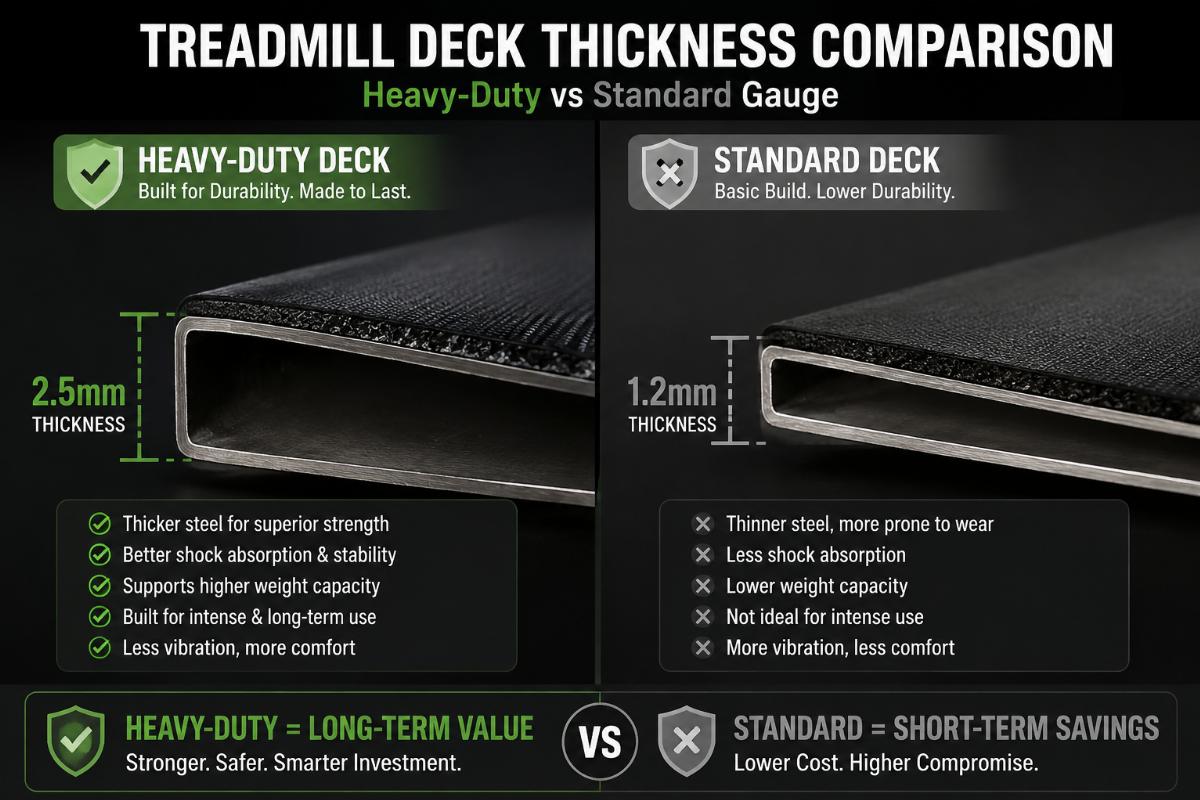
The deck is the surface the belt slides over. It absorbs impact from user footfalls and generates friction heat. Thicker decks resist deflection under heavy users, reduce flexing fatigue, and provide more material for the belt to slide against without wearing through. Pre-lubricated decks reduce maintenance but require the lubricant to withstand high temperatures without breaking down. Self-lubricating deck materials offer longer service intervals but must be evaluated for compatibility with the specific belt compound used. [NEED_CITE: treadmill deck deflection standards and user weight capacity testing methods]
Thin decks flex under load, generating excess heat from internal material hysteresis and accelerating belt wear from uneven contact pressure. In hot environments, this flexing heat adds to the already elevated ambient thermal load on the motor.
Belt: Ply Count and Surface Texture
Commercial treadmill belts are constructed from multiple layers—typically a rubber compound outer surface for grip and wear resistance, and inner fabric or cord plies for tensile strength and dimensional stability. More plies generally mean better resistance to stretching, tearing, and edge fraying. The surface texture pattern affects both grip and heat generation—aggressive patterns grip well but can generate more friction heat, while smoother patterns reduce heat but may feel slippery under sweaty conditions. [NEED_CITE: conveyor belt ply construction principles applied to fitness equipment]
In dusty environments, the belt surface texture also determines how much particulate gets trapped and carried into the deck interface, where it acts as an abrasive.
Frame: Steel Gauge and Welding Quality
The frame must resist torsional flex under dynamic loading from running users. Thicker steel tubing and proper gusseting at stress points prevent frame twist, which would otherwise misalign the roller and deck, causing uneven belt wear and tracking problems. Weld quality at joints determines long-term structural integrity—poor welds crack under cyclic loading.
| Parameter | What to Specify for Oman Conditions | What to Avoid |
|---|---|---|
| Motor Type | AC induction with verified continuous rating at elevated ambient | DC motor or unverified peak-only claims |
| Motor Thermal Design | Oversized cooling fan, high-temperature insulation class | Standard tropical rating without heat derating data |
| Deck Thickness | Heavy-duty gauge, verified deflection under load | Thin residential-grade deck |
| Deck Lubrication | High-temperature stable lubricant or verified self-lubricating material | Standard lubricant without thermal stability data |
| Belt Construction | Multi-ply with reinforced edges | Two-ply or single-ply construction |
| Frame Steel | Heavy-wall tubing with gusseted joints | Thin-wall tubing, inadequate joint reinforcement |
When we configure treadmills for Gulf clients through our Shandong production facility, we specify AC motors with continuous ratings validated for elevated ambient operation, heavy-gauge decks with high-temperature lubrication systems, multi-ply belts with reinforced edge construction, and heavy-wall frame steel with full gusseting at all critical joints. These are not premium upgrades—they are the baseline configuration for equipment expected to survive in this environment.
How to Verify a Commercial Treadmill Supplier for Oman Is a Real Factory, Not a Trading Company
Request production line video evidence, core component brand documentation, and verifiable references from similar Middle East installations. Trading companies cannot provide these because they do not control manufacturing. A genuine commercial treadmill supplier for Oman will have no hesitation sharing detailed production evidence.
Ask for a live or recently recorded video walkthrough of the production floor. You should see welding stations, motor testing rigs, deck machining equipment, and assembly lines. If the supplier sends polished marketing videos with no actual manufacturing footage, that is a red flag. Request specific views—welding of the frame joints, motor dyno testing, deck thickness measurement with calipers. A real factory will comply immediately. [NEED_CITE: supply chain verification methods for industrial equipment sourcing]
Demand documentation for core components. Who manufactures the motors? What brand are the lower control boards? What is the belt supplier? A factory that sources core components from named, reputable suppliers will provide this information willingly. A trading company or a workshop assembling from unspecified sources will give vague answers.
Request contact information for existing clients in similar markets. Not just any clients—specifically gym owners or distributors in the Gulf or similar hot-climate regions. Call or message those references directly. Ask about equipment uptime, failure frequency, spare parts availability, and technical support responsiveness.
Verify certifications independently. CE marking is essential for many markets, but certificates can be forged or misapplied. Request the actual certificate number and verify it through the issuing body. [NEED_CITE: CE certification verification procedures for fitness equipment]
During my time handling technical support before moving to commercial roles, I visited dozens of facilities claiming to be manufacturers. The difference between a real factory and an assembly workshop is immediately visible in the testing equipment. A genuine commercial treadmill supplier for Oman will have motor dyno test stations, frame load testing fixtures, and belt tracking test rigs. These are capital-intensive investments that trading companies simply do not make.
We maintain full production lines at our Shandong facilities with in-house motor testing, frame welding and load verification, and complete assembly and run-in testing before shipment. We provide CE documentation with verifiable certificate numbers, and we can connect prospective buyers with existing clients across multiple regions who operate our equipment in demanding conditions.

The Complete Process from Order to After-Sales with a Reliable Commercial Treadmill Supplier for Oman
Clear technical specification agreement, detailed contract terms covering warranty and spare parts, and structured long-term technical support form the foundation of a successful procurement relationship. Skipping any of these steps leads to disputes, equipment downtime, and frustrated end users.
Step One: Technical Specification Alignment
Do not start with a product catalog. Start with your operating environment. Share the gym layout, expected daily user volume, ambient temperature conditions, power supply specifications, and any space constraints. A competent commercial treadmill supplier for Oman will use this information to recommend specific configurations rather than simply quoting their standard models.
Discuss motor sizing based on expected user weight profiles and daily usage hours. Discuss deck and belt specifications based on the intensity of use. Discuss frame requirements based on the user demographic—hotel guests versus serious gym users place very different demands on equipment.
Step Two: Contract Clarity on Warranty and Spare Parts
Warranty terms must be explicit. What components are covered? For how long? What is the claim process? More importantly, what spare parts are stocked and what is the supply lead time? In remote locations, waiting weeks for a critical component means extended equipment downtime and lost revenue. [NEED_CITE: spare parts inventory management principles for commercial fitness equipment]
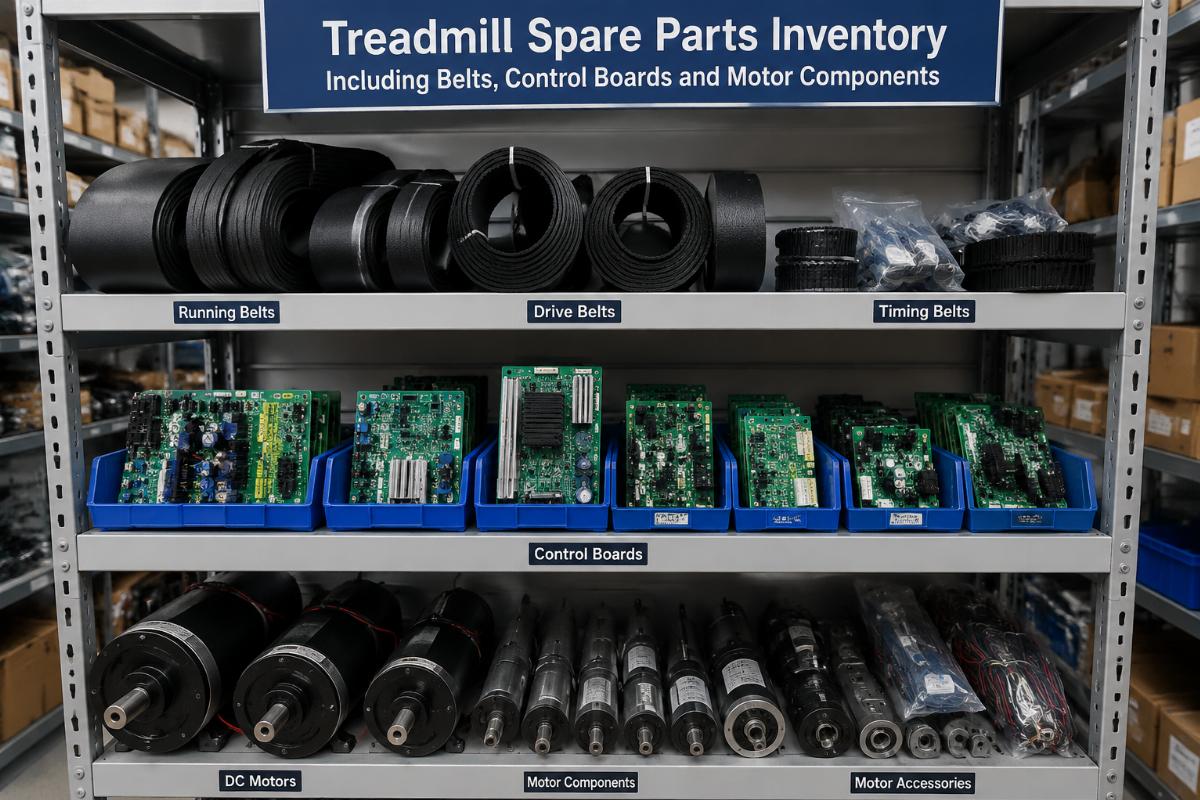
Negotiate a spare parts package with your initial order. Belts, lower control boards, drive motors, and key sensors should be stocked locally based on your installed base size. The cost of holding these spares is minimal compared to the revenue impact of equipment downtime.
Step Three: Installation Support and Technical Training
Request installation supervision or detailed installation guides with video support. Proper installation—leveling, belt tensioning, alignment verification—directly affects equipment lifespan. Train your maintenance staff on basic troubleshooting, belt tracking adjustment, and lubrication schedules.
Step Four: Ongoing Technical Support
Establish a direct communication channel with the factory technical team. When problems arise—and they will, because all mechanical equipment requires maintenance—you need rapid response. A reliable commercial treadmill supplier for Oman will provide remote diagnostic support, video call troubleshooting, and rapid spare parts dispatch.
I have supported clients through issues ranging from belt tracking problems caused by improper installation to control board failures from dust ingress. The difference between a supplier who responds within hours with diagnostic guidance and one who takes weeks to acknowledge the problem is massive in terms of equipment uptime and client satisfaction.
Our approach includes providing comprehensive spare parts recommendations based on installed base size, video-supported installation guidance, direct technical team access for troubleshooting, and rapid spare parts dispatch from our facility. We treat after-sales support not as a cost center but as the foundation of long-term client relationships across multiple regions.
Conclusion
Sourcing commercial treadmills for Oman requires matching equipment specifications to environmental reality, not marketing claims. Continuous motor rating, deck construction, belt durability, and frame integrity—verified through factory evidence and supported by clear warranty and spare parts terms—determine whether your investment delivers years of service or months of frustration. Choose a commercial treadmill supplier for Oman based on technical transparency, verifiable production capability, and demonstrated after-sales commitment.


