Commercial Back Extension Bench for Gym | Wholesale Supplier
Most buyers assume Denmark’s import duty on fitness equipment is the cost killer — it is not. The real cash trap is the 25% VAT layered on top of a CIF tax base that includes freight and insurance, not just your FOB invoice.
Denmark enforces the EU Common Customs Tariff (TARIC), which sets import duty rates for most commercial gym equipment between 0% and 2.7%, depending on the HS code subcategory. However, the effective landed cost is driven far higher by Denmark’s 25% VAT, calculated on the CIF value (goods + freight + insurance), and by strict CE documentation requirements at Copenhagen port clearance.
I still remember a container of plate-loaded machines we shipped to a Nordic distributor a few winters back. The buyer’s broker called at 6 a.m. Danish time — the cargo was held because the commercial invoice listed "gym equipment" generically instead of breaking out each item by HS code. The container sat at the terminal for nearly two weeks, racking up storage fees that wiped out the margin on the entire order. That kind of mistake is not about duty rate — it is about paperwork discipline. [NEED_CITE: Danish Customs clearance documentation requirements for non-EU commercial goods imports]
Getting the paperwork right from day one is what separates a smooth clearance from a margin-eating delay. Let me walk you through the five questions every buyer shipping commercial gym equipment into Denmark needs answered before the container ever leaves the factory floor.
What Import Duty Rate Applies to Fitness Equipment in Denmark?
Denmark applies the EU Common Customs Tariff, meaning most commercial fitness equipment enters at 0% to 2.7% duty — but the exact rate depends entirely on how the product is classified under the TARIC nomenclature.
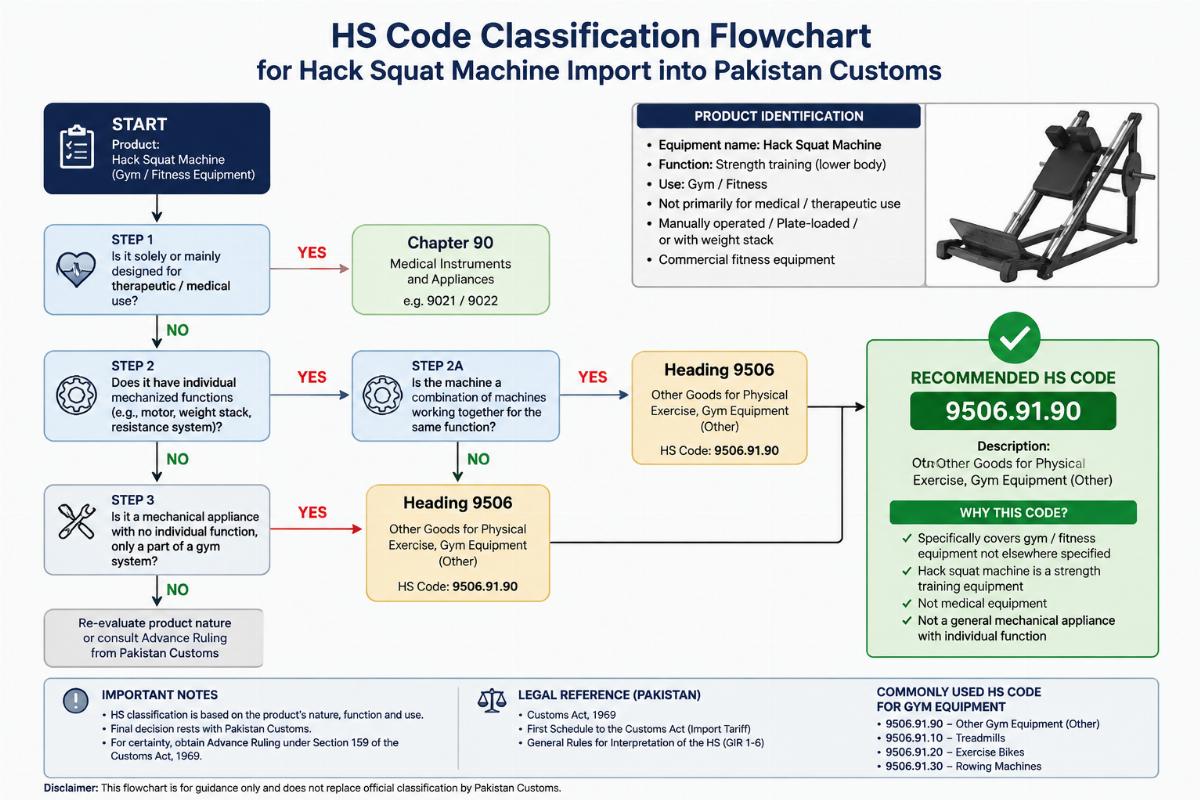
The TARIC database is the single source of truth here, and it is publicly accessible. For commercial gym equipment, the relevant headings fall under Chapter 95, specifically:
| Product Category | Typical HS Heading | Duty Rate Range | Classification Notes |
|---|---|---|---|
| Strength machines (cable crossovers, plate-loaded, selectorized) | 9506.91 | 0% – 2.7% | Classified as general physical exercise apparatus |
| Cardio equipment (treadmills, ellipticals, spin bikes) | 9506.91 | 0% – 2.7% | Motorized units still fall under exercise apparatus |
| Free weights (dumbbells, barbells, weight plates) | 9506.91 / 7326 | 0% – 2.7% / up to 2.7% | Steel-cast items may be reclassified under steel articles |
| Benches and frames | 9506.99 | 0% – 2.7% | Back extension bench and similar accessories |
| Rubber gym flooring | 4016.91 | 0% – 5.7% | Classified under rubber articles, not fitness equipment |
The critical takeaway: a back extension bench classified correctly under 9506.99 attracts minimal or zero duty. But if the same bench gets lumped under a generic steel furniture heading by an inexperienced broker, the rate can shift noticeably. [NEED_CITE: TARIC database classification rules for exercise equipment under heading 9506]
I have seen a European distributor lose hundreds of euros on a single container because their customs broker coded adjustable back extension benches under a generic "metal furniture" heading instead of the exercise apparatus subheading. The duty difference was small in percentage terms, but multiplied across a full 40-foot container of heavy steel equipment, it added up fast.
The fix is simple: request a pre-shipment HS code confirmation from your supplier before the goods leave the factory. A reliable manufacturer will provide the exact eight-digit CN code for every SKU in your order, matched against the current TARIC schedule. [NEED_CITE: EU Combined Nomenclature code structure for fitness equipment classification]
How Is the Tax Base Calculated — FOB or CIF?
Danish customs calculates both import duty and VAT on the CIF value — cost, insurance, and freight — not the FOB invoice price. This means your ocean freight and insurance premiums are part of the taxable base.
This catches many first-time importers off guard. You might negotiate a great FOB price with your supplier, but the moment the goods hit a Danish port, the tax authority adds freight and insurance to determine the dutiable value. [NEED_CITE: EU Customs Code provisions on customs value calculation under CIF terms]
Here is how the calculation works in practice:
- Step 1: Start with the FOB invoice value of the goods.
- Step 2: Add international freight charges (ocean shipping to Copenhagen or Aarhus).
- Step 3: Add marine insurance premiums.
- Step 4: The sum is your CIF value — this is the base for duty calculation.
- Step 5: Apply the applicable duty rate (from the TARIC table above) to the CIF value.
- Step 6: Add the duty amount back to the CIF value, then apply Denmark’s 25% VAT to that combined total.
So the VAT is effectively charged on top of duty, on top of freight, on top of the goods value. It compounds.
A Nordic gym chain buyer I worked with once told me they had budgeted their import costs based on the FOB price alone. When the VAT invoice arrived, the number was substantially higher than expected — because the freight cost for a full container of commercial back extension benches and plate-loaded machines from East Asia to Northern Europe is not trivial. The lesson: always model your landed cost on CIF, not FOB.
One more detail that matters: if your supplier provides a freight quote that looks unusually low, Danish customs may reject it and apply their own reference freight rates. This is not common, but it happens when the declared freight value is clearly below market. [NEED_CITE: Danish Customs valuation audit procedures for suspected undervaluation of freight costs]
Which HS Codes Cover Strength Machines, Cardio, and Free Weights?
Correct HS code classification is the single most impactful paperwork decision for Denmark fitness equipment imports — the difference between 0% duty and a higher rate often comes down to one heading digit.
Let me break down the classification logic we use at the factory when preparing export documents for Danish buyers:
Strength machines — including cable crossovers, Smith machines, power racks, plate-loaded machines, and selectorized equipment — are classified under HS 9506.91 as "articles and equipment for general physical exercise." A commercial back extension bench falls squarely in this category. The duty rate is typically at the lower end of the range. [NEED_CITE: EU explanatory notes on heading 9506.91 scope for gym apparatus]
Cardio equipment — treadmills, ellipticals, rowing machines, spin bikes — also falls under 9506.91, even when motorized. The presence of an electric motor does not reclassify the unit under electrical machinery headings, as long as the primary function is physical exercise. This is a point of confusion for some brokers who assume motorized equipment automatically shifts to a different chapter.
Free weights — this is where it gets tricky. Dumbbells, barbells, and kettlebells are generally classified under 9506.91. However, cast iron weight plates and certain steel-based items can be argued into heading 7326 (other articles of iron or steel) by some customs authorities. The rate difference between these two headings is small but real, and it varies by member state interpretation. [NEED_CITE: EU customs classification rulings on cast iron weight plates vs exercise equipment]
Rubber flooring and accessories — gym flooring rolls, plyo boxes with rubber surfaces, and similar items may fall under rubber or wood headings rather than Chapter 95. This matters because the duty rate can be noticeably higher.
What I recommend to every buyer: ask your supplier for a packing list that itemizes every product with its corresponding CN code, and cross-reference it against the TARIC database before shipment. If your customs broker disagrees with the supplier’s classification, resolve it before the container arrives — not after.
What Certifications and Documents Prevent Port Delays?
Denmark requires full CE compliance documentation for all commercial fitness equipment entering the EU, and missing paperwork is the number one cause of clearance delays at Copenhagen port.
The CE marking requirement is not optional and not negotiable. For commercial gym equipment, the relevant directives are:
- Machinery Directive (2006/42/EC) — covers all powered and mechanically complex equipment, including treadmills, cable machines, and any unit with moving parts under load. A commercial back extension bench with adjustable pads and pivot points falls under this directive. [NEED_CITE: EU Machinery Directive scope and application to commercial fitness equipment]
- Electromagnetic Compatibility (EMC) Directive (2014/30/EU) — applies to any equipment with electronic components, including motorized treadmills, ellipticals with digital consoles, and selectorized machines with electronic weight stacks.
- Low Voltage Directive (2014/35/EU) — applies to equipment operating within certain voltage ranges, relevant for motorized cardio units.
Beyond CE directives, Danish customs expects the following document package for smooth clearance:
- Commercial invoice with itemized HS codes and CIF value breakdown
- Packing list matching invoice line by line
- Bill of lading or airway bill
- CE Declaration of Conformity for each product category
- Test reports from an accredited laboratory (not self-declared without supporting data)
- Certificate of Origin (EUR.1 or origin statement if preferential treatment applies)
- Insurance certificate
A Scandinavian fitness chain buyer once shared that their first import from a new Asian supplier got stuck because the CE Declaration of Conformity listed the wrong authorized representative address in the EU. It took weeks to get the corrected document from the factory, and the demurrage charges were painful. [NEED_CITE: EU import documentation requirements for CE-marked fitness equipment at member state ports]
The takeaway: do not assume your supplier’s CE file is complete and accurate. Request to review the full document package before shipment. Verify that the authorized representative is based in the EU, that test reports match the actual product configuration, and that the Declaration of Conformity covers every SKU in the order — not just a generic product family.
How Does Denmark’s 25% VAT Affect Cash Flow for Importers?
Denmark’s 25% VAT is payable at the point of import, calculated on the CIF value plus duty — but registered businesses can recover it through their periodic VAT return, meaning the real impact is on working capital timing, not on final cost.
This is the part that confuses many buyers who see "25%" and panic. Let me clarify how it actually works:
When your container clears customs at Copenhagen, Danish customs will issue a VAT assessment based on the CIF value plus any duty owed. This VAT must be paid before the goods are released. For a full container of commercial gym equipment — say, a mix of back extension benches, cable crossovers, and plate-loaded machines — the VAT amount can represent a significant cash outflow. [NEED_CITE: Danish VAT import collection mechanism and payment timing requirements]
However, if you are a registered business with a valid Danish VAT number (or a VAT number from another EU member state with proper registration), you can claim this import VAT as input tax on your next VAT return. The net cost to your business is zero — but the cash flow timing matters. You need to have the funds available to pay the VAT at import, and you may wait weeks or even a month before recovering it through your return.
For buyers setting up a new gym or distributing equipment across Northern Europe, this means:
- Budget for the VAT cash outflow at import, separate from your supplier payment and freight costs.
- Ensure your VAT registration is active and in good standing before the goods arrive — any administrative delay in your VAT status will delay the release.
- Consider working with a Danish fiscal representative if you do not have a local entity, as this can streamline the VAT recovery process. [NEED_CITE: Danish VAT fiscal representation rules for non-EU-established importers]
I have worked with distributors in the Baltic region who structured their import timing around their VAT return cycles to minimize the cash flow gap. It is a small planning step, but it makes a noticeable difference when you are moving multiple containers per quarter.
Conclusion
Denmark’s import duty on commercial fitness equipment is manageable — typically 0% to 2.7% under the EU Common Customs Tariff — but the total landed cost is shaped far more by VAT timing, CIF-based tax calculation, and documentation compliance than by the headline duty rate.
Getting the HS code right, preparing a complete CE document package, and planning for the VAT cash outflow are the three actions that determine whether your container clears Copenhagen smoothly or sits at the terminal burning through your margin. A commercial back extension bench is a straightforward product, but the import process around it is not — treat the paperwork with the same seriousness you give the steel quality.