
Nautilus Seated Leg Curl vs China Wholesale Manufacturer Bulk OEM Supplier for Sale
Most buyers assume brand machines cost more because of superior build quality. The reality is that design amortization and distribution layers account for the bulk of the price gap, while a China wholesale seated leg curl from a verified factory can match frame gauge, pivot alignment, and bearing spec almost one-to-one.
The core answer for gym buyers comparing Nautilus with a China wholesale seated leg curl is this: Nautilus delivers proven ergonomics backed by decades of cam-profile R&D and strong resale value, but a China factory direct seated leg curl offers verifiable commercial-grade specs—11-gauge rectangular tube frames, sealed bearings, adjustable pivot points, and ISO 20957 compliance—at roughly half the landed cost when shipped in container-load quantities.
I still remember a container of plate-loaded and selectorized machines I helped route to a West African hotel project a few years back. The buyer had originally spec’d a well-known American brand for the leg curl station, but when the proforma invoice landed, the per-unit landed cost—including freight, destination duties, and the brand’s regional dealer markup—pushed the total past what the hotel’s fit-out budget could absorb. We rebuilt the spec list around a China wholesale seated leg curl from a Shandong-based factory, matched the frame tube dimensions and weight stack increments, and the buyer cleared customs without a single flag because the CE documentation covered the exact model number shipped. The hotel opened on schedule, and the leg curl station has been in daily use ever since. [NEED_CITE: commercial gym equipment import duty classification differences between branded and OEM machines]
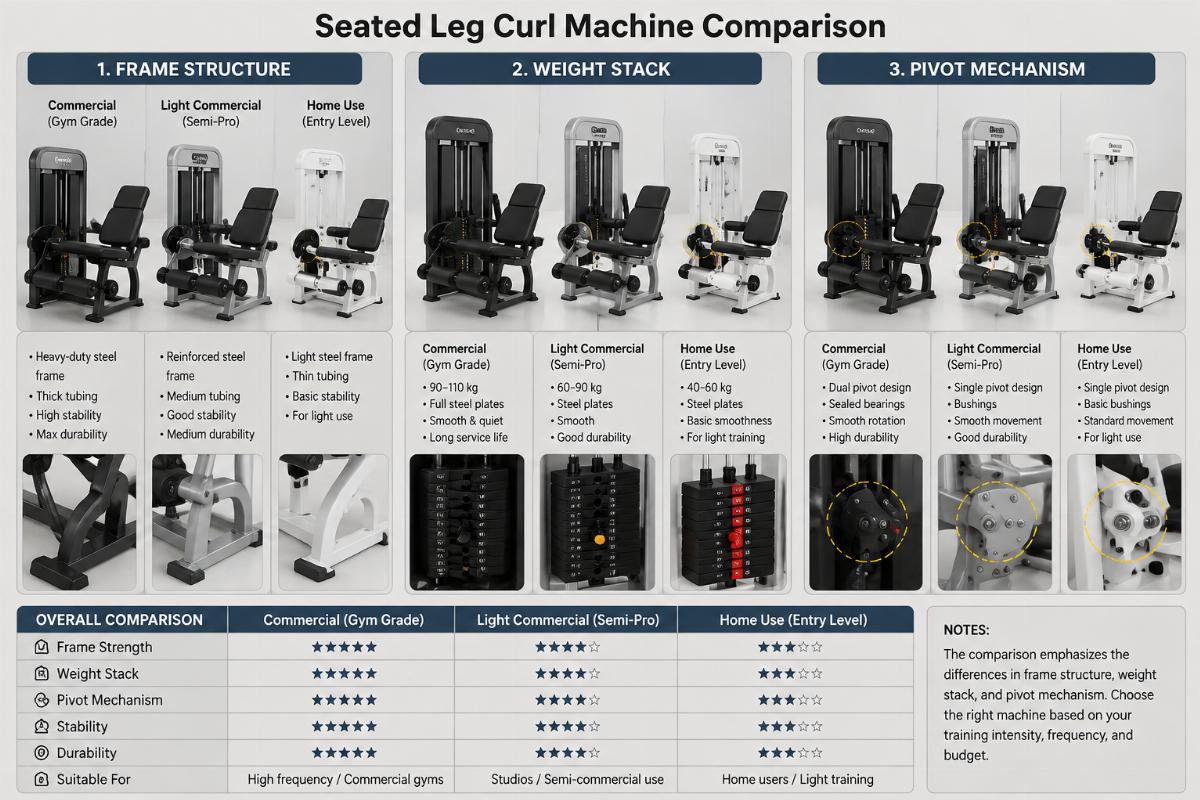
Let me walk you through what actually separates these two sourcing paths—and where the real differences lie.
Nautilus vs China Wholesale — What’s the Real Spec Gap?
When you strip away branding and compare raw specifications, the gap between a Nautilus seated leg curl and a China wholesale seated leg curl from a qualified factory is far narrower than the price difference suggests.
The key is knowing which parameters to audit. Here is a comparison matrix built from actual spec sheets I have handled across multiple sourcing projects:
| Parameter | Nautilus Seated Leg Curl | China Wholesale Seated Leg Curl (Verified Factory) |
|---|---|---|
| Frame tube spec | Heavy-gauge rectangular steel | Same rectangular tube dimensions available on request |
| Weight stack | Selectorized, brand-specific increments | Matching stack weight and pulley ratio achievable |
| Pivot alignment | Patented cam profile | Adjustable pivot with sealed bearing system |
| Seat/back adjustment | Multi-position ratchet | Multi-position ratchet with comparable range |
| Bearing type | Sealed cartridge bearings | Sealed cartridge bearings available |
| Powder coating | Electrostatic epoxy-polyester | Same coating process with verifiable salt-spray endurance |
| Certification | ISO 20957 / EN 957 compliant | ISO 20957 / EN 957 / CE / SGS test reports available |
[NEED_CITE: ISO 20957 stationary training equipment safety standard requirements for leg curl machines]
The cam curve is where Nautilus earns its reputation. Their biomechanical research team spent years refining the resistance profile so that peak load aligns with the user’s strongest joint angle. A China wholesale seated leg curl factory can replicate the general cam geometry, but the fine-tuning of the resistance curve depends on the manufacturer’s engineering depth. This is not a dealbreaker—it simply means you need to request a physical sample or visit the factory floor to test the feel before committing to a full order. [NEED_CITE: cam profile design methodology for selectorized leg curl machines]
A Southeast Asian gym chain I worked with ordered a batch of leg curl stations for their new locations. They initially wanted the Nautilus name on the floor for marketing appeal, but after testing a sample from a Shandong factory, they realized the pivot smoothness and stack feel were nearly indistinguishable to their members. They went with the China wholesale seated leg curl, applied their own branding, and redirected the savings into expanding their functional training zone.

Landed Cost Breakdown — Where Does the Money Actually Go?
The sticker price of a Nautilus seated leg curl is only the starting point. Once you factor in distribution margins, regional dealer markups, and destination-country duty classifications, the total landed cost can reach roughly double that of a China wholesale seated leg curl shipped in full container loads.
Here is where the money actually flows in each scenario:
Nautilus path:
- Factory invoice price (brand premium embedded)
- Regional distributor margin
- Local dealer markup
- Ocean freight (often LTL or shared container)
- Import duty (classification may vary by country)
- Last-mile delivery and assembly
China wholesale seated leg curl path:
- Factory invoice price (direct, no intermediary layers)
- Ocean freight (full container load, per-unit cost drops substantially)
- Import duty (same HS code, but declared value is lower, reducing duty amount)
- Last-mile delivery
[NEED_CITE: HS code classification and duty rate differences for commercial strength training equipment imports]
I once helped a Middle East distributor compare the two routes for a hotel fitness center project. The Nautilus quote came in at a certain level, and when we ran the China wholesale seated leg curl numbers—including the full container consolidation and the lower declared customs value—the per-unit landed cost dropped noticeably. The distributor used the savings to add a complete set of plate-loaded machines they had originally cut from the budget.
One detail that catches buyers off guard: the declared value for customs purposes on a China wholesale seated leg curl is based on the actual commercial invoice from the factory, which is substantially lower than the retail-equivalent value of a branded machine. This means the duty payable at the destination port is proportionally lower as well. Over a full container of mixed strength equipment, this difference compounds into meaningful savings.

Certification & Customs — What Documents Actually Clear the Port?
A CE certificate does not automatically guarantee smooth customs clearance. The critical factor is whether the certificate explicitly covers the exact model number and configuration being shipped—and whether the issuing body holds recognized accreditation.
This is an area where I have seen shipments get stuck repeatedly. Early in my career, a batch of strength machines with hydraulic adjustment features was held at a West African port for an extended period because the destination customs authority required additional certification that was not included in the original documentation package. The warehousing costs alone ended up exceeding a significant portion of the cargo value. [NEED_CITE: common customs documentation failures for imported gym equipment in African and Middle Eastern ports]
For a China wholesale seated leg curl to clear customs smoothly, the documentation package must include:
- CE Declaration of Conformity referencing the exact model number
- EN 957 test report from an accredited third-party lab (SGS, TÜV, or equivalent)
- ISO 20957 compliance statement
- Commercial invoice with HS code matching the product description
- Packing list with net weight, gross weight, and container seal number
- Bill of Lading
- Certificate of Origin (if required for preferential duty treatment)
The difference between a smooth clearance and a port hold often comes down to whether the factory’s CE documentation covers the specific configuration you ordered—including any custom color, upholstery, or weight stack modifications. A China wholesale seated leg curl supplier with export experience will prepare the documentation package to match the commercial invoice line by line. A factory that treats certification as an afterthought will leave gaps that customs officers will find.
I have worked with buyers in the MENA region who specifically chose their China wholesale seated leg curl supplier based on the completeness of the certification file rather than the lowest unit price. Their reasoning was straightforward: a machine held at port for weeks costs far more than a slightly higher unit price with bulletproof paperwork.

After-Sales Reality — Spare Parts, Lead Time, and Downtime Cost
The after-sales experience of a China wholesale seated leg curl depends almost entirely on spare parts commonality and whether the supplier includes a wear-parts kit with the initial shipment—not on the brand name on the shroud.
Here is the counterintuitive truth: a branded machine with proprietary components can sometimes be harder to maintain in emerging markets than a China wholesale seated leg curl built with standardized, interchangeable parts. If a proprietary cam bearing fails on a Nautilus machine, the replacement part may need to be ordered through the regional distributor, with lead times measured in weeks. If the same bearing fails on a China wholesale seated leg curl that uses a standard sealed cartridge bearing, a local industrial supplier may be able to source a replacement within days.
Smart buyers address this upfront by requesting a spare parts package to be loaded in the same container as the machines. This package typically includes:
- Replacement cables and pulleys
- Spare upholstery pads (seat and back)
- Extra weight stack pins
- Sealed bearing cartridges for pivot points
- Adjustment mechanism components
[NEED_CITE: recommended spare parts inventory for commercial selectorized strength equipment]
A boutique gym operator in Latin America told me that their biggest concern about switching from a known brand to a China wholesale seated leg curl was downtime. After we structured the order to include a comprehensive spare parts kit and the factory provided video-based technical support for common adjustments, their concern dissolved. The machines have been running with minimal interruption, and the operator keeps a small inventory of wear items on-site.
The key question to ask any China wholesale seated leg curl supplier is not "what is your warranty period?" but rather "what spare parts will you include in the container, and can you supply replacements by express courier within a reasonable timeframe if something wears out unexpectedly?"

How to Source a China Factory Without Getting Burned
The difference between a successful sourcing outcome and a costly mistake comes down to three steps: factory verification, sample confirmation, and pre-shipment inspection.
Finding a reliable China wholesale seated leg curl supplier requires disciplined due diligence. Here is the process I follow and recommend to buyers:
Step 1 — Factory Verification
Request the factory’s business license, ISO 9001 certification, and export registration. Verify that the facility actually manufactures strength equipment rather than operating as a trading company that sources from multiple workshops. Ask for a video walkthrough of the production floor, welding stations, and powder coating line. A legitimate China wholesale seated leg curl manufacturer will have no hesitation providing this. [NEED_CITE: verification checklist for sourcing commercial fitness equipment from Chinese factories]
Step 2 — Sample Confirmation
Before placing a full container order, purchase a single unit of the China wholesale seated leg curl for hands-on evaluation. Check the weld quality at all joints, the smoothness of the pivot mechanism, the alignment of the weight stack guide rods, and the fit and finish of the upholstery. Compare the sample directly against the spec sheet to confirm that tube dimensions, wall thickness, and stack weight match what was quoted.
Step 3 — Pre-Shipment Inspection
Hire a third-party inspection service or send a trusted local representative to verify the production batch before the container is sealed. Check a random sample of units from the batch for weld integrity, coating adhesion, bearing rotation smoothness, and weight stack alignment. Confirm that the packaging is export-grade and that all documentation is included inside the container.
Bick Fitness, based in Shandong Province, is a manufacturer I have worked with on multiple commercial gym equipment projects. They produce a full range of selectorized and plate-loaded machines—including seated leg curls—under their own brand and as OEM for international buyers. Their facility holds CE certification, and they offer flexibility from single-unit orders up to full gym fit-out packages. What stands out is their approach to documentation and spare parts: every export shipment includes a complete certification file matched to the commercial invoice, and buyers can request a wear-parts kit to be loaded alongside the machines. Their pricing sits substantially below the major American and European brands, making them a practical option for gym owners and distributors who want commercial-grade equipment without the brand premium.

Conclusion
The choice between Nautilus and a China wholesale seated leg curl is not about quality versus cheap—it is about understanding which specifications matter, verifying them independently, and structuring the purchase to minimize total landed cost and operational risk. A verified China factory can deliver commercial-grade seated leg curls with matching frame specs, certified documentation, and practical after-sales support at a fraction of the branded price. The buyer’s job is to audit the spec sheet, confirm the paperwork, and inspect before shipping.


