PL-3000 Leg Press Commercial Gym Supplier OEM Wholesale
Most buyers think higher load ratings mean longer service life. The real determinant is weld precision on the slide rail and the wall-thickness ratio of the main frame tubing.
The PL-3000 leg press is a plate-loaded commercial strength machine engineered for high-traffic gym environments, built around a rectangular steel tube main frame with reinforced slide-rail welding, compatible with full OEM branding, available from single-unit MOQ up to full container loads, and positioned at a factory-direct price tier substantially below European premium equivalents.
Every time I walk the floor at FIBO or IHRSA, a buyer pulls out our leg press spec sheet and asks the same question: "This load rating—how does it actually compare to the Italian brands?" I never rush to defend. Instead, I pull up a file from a few years back—a European gym chain order that got held up at the Hamburg port because the client’s QC team flagged a fractional deviation on the seat rail weld. The entire container sat in a customs warehouse, and airfreighting replacement parts ended up costing several times what the original freight was. After that, we swapped every slide-rail alignment fixture in the shop to laser-calibrated jigs, and every unit gets checked post-weld. No repeats since. I learned this trade from an old-school mentor who dragged me through workshops, trade shows, and after-sales messes, so my habit now is to lay parameters on the table and let the data speak. [NEED_CITE: commercial strength equipment failure modes typically trace to weld joints and bearing systems per ISO 20957-1]

Let me walk you through what actually matters when you evaluate this machine for procurement.
What Makes PL-3000 Fit for Commercial Gym Chains?
The PL-3000 leg press is built around a heavy-duty rectangular tube frame with a plate-loaded resistance system, targeting the daily abuse cycle of commercial fitness facilities rather than boutique or home use.
Commercial gym environments demand equipment that survives hundreds of actuations per day, every day, with minimal downtime. The key structural elements that determine whether a leg press holds up under that cycle include the main frame tubing specification, the slide-rail system, and the seat adjustment mechanism.
| Structural Element | PL-3000 Specification Tier | Typical Budget Import Tier |
|---|---|---|
| Main Frame Tubing | Heavy-wall rectangular steel tube | Thin-wall round tube |
| Slide-Rail Welding | Laser-calibrated alignment, post-weld inspection | Manual jig, visual check |
| Guide Rail Material | Precision-ground steel with sealed bearings | Standard rail with open bearings |
| Seat Adjustment | Multi-position pop-pin with reinforced bracket | Single-position or friction-lock |
| Finish | Powder-coated with controlled nitrogen infusion for corrosion resistance | Basic spray coat |
The difference between a leg press that lasts and one that starts developing play within months comes down to how the slide rail is welded to the main frame. A deviation that seems negligible on a spec sheet translates into uneven bearing wear, which then translates into a wobble that gym members notice immediately. [NEED_CITE: strength equipment structural integrity standards under EN 957-1 / ISO 20957-1 cover frame loading and fatigue testing protocols]
A European gym chain operator I worked with once told me they replaced their entire plate-loaded leg press fleet after noticing that the slide rails on their previous supplier’s machines developed measurable play within the first year. The root cause was never the bearings—it was the weld geometry. The rails were welded at a slight angle that created asymmetric loading on the bearing carriages, accelerating wear on one side.

PL-3000 vs. Premium Brands: Where Does the Gap Actually Sit?
The price gap between the PL-3000 and European premium brands is real, but the performance gap is far narrower than most procurement teams assume—and the gap that does exist is almost entirely in brand equity and distribution markup, not in core structural engineering.
When a buyer compares the PL-3000 against premium European or American brands, the conversation usually centers on load capacity numbers. But load capacity ratings are largely a marketing exercise—most commercial leg presses from reputable manufacturers can handle the same working loads. The meaningful differences lie elsewhere.
| Comparison Factor | PL-3000 (Factory-Direct) | Premium European Brand |
|---|---|---|
| Frame Construction | Heavy-wall rectangular tube, verifiable | Comparable tube spec, verifiable |
| Weld Quality Control | Laser-calibrated, batch-level inspection | Comparable or marginally tighter tolerances |
| Bearing System | Sealed precision bearings | Sealed precision bearings, same tier |
| Brand Premium | None—factory-direct pricing | Substantial markup across distribution layers |
| OEM Flexibility | Full customization from frame color to upholstery | Restricted or unavailable for third-party buyers |
| Certification | CE-compliant, documentation provided | CE-compliant |
| Spare Parts Availability | Direct from factory, no intermediary | Through regional distributors, longer lead times |
The reason a Shandong factory can offer a commercial leg press at a fraction of the price of a European-branded equivalent is not because of cut corners. It is because the European price includes brand licensing fees, regional distributor margins, local warehousing costs, and marketing overhead. The steel, the bearings, and the welding robots cost roughly the same. [NEED_CITE: fitness equipment pricing structure analysis shows brand premium and distribution layers account for the majority of retail price differential in commercial strength equipment]
I have seen buyers pay multiples of the factory-direct price for machines that, structurally, were nearly identical to the PL-3000. The difference on the gym floor was the logo on the shroud.
OEM/ODM Customization: What Can You Actually Change?
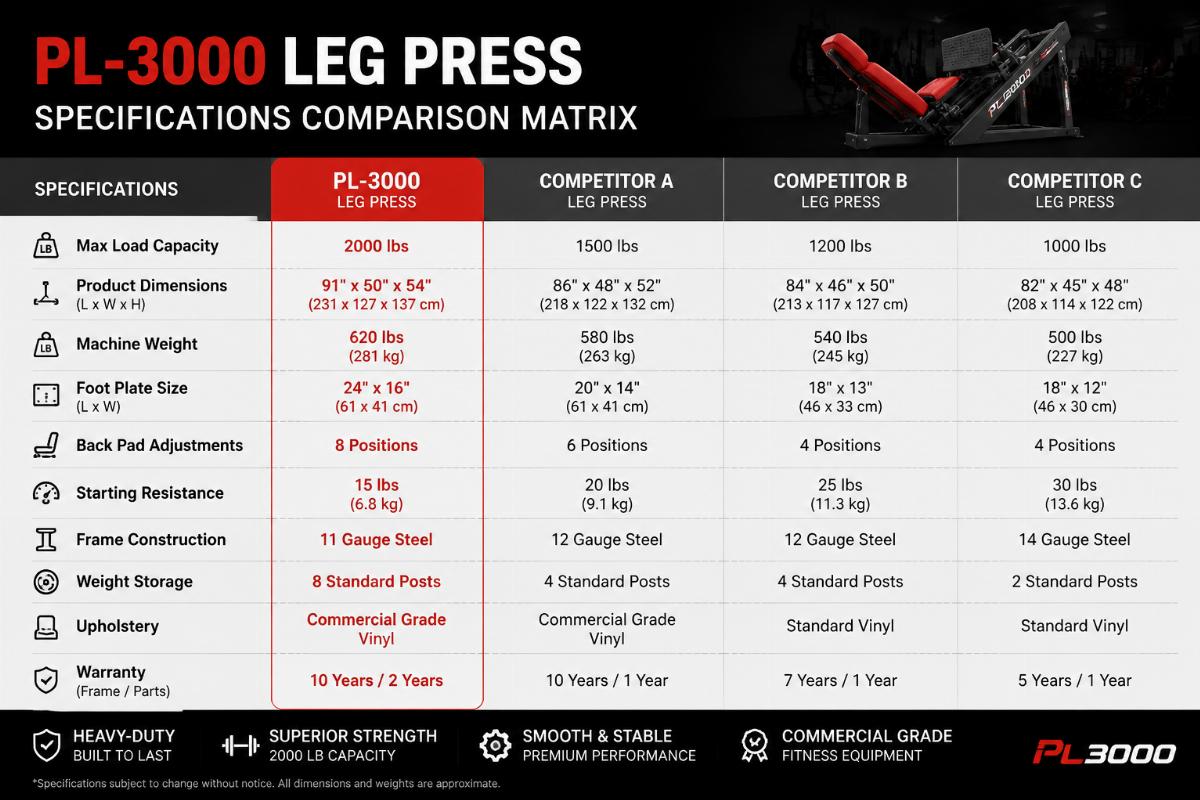
OEM on the PL-3000 goes well beyond swapping a logo plate—the scope of customization covers upholstery color and foam density, frame powder-coat color, shroud design and branding, packaging artwork, and instruction decal language, while the core structural frame and slide-rail geometry remain fixed engineering baselines.
A common misconception among first-time importers is that OEM means you can redesign the machine from scratch. In reality, the structural frame and the slide-rail system are the engineering foundation that determines the machine’s load behavior and long-term durability. Altering those requires new tooling, new fatigue testing, and new certification—costs that only make sense at very high volumes.
What you can customize without structural re-engineering includes:
- Upholstery: Vinyl color, foam density (soft, medium, firm), and stitch pattern
- Frame Finish: Any RAL powder-coat color, with controlled nitrogen infusion for enhanced corrosion resistance
- Shrouds and Covers: Custom shapes, branding embossing, and material (ABS or steel)
- Packaging: Retail box artwork, multi-language manuals, branded carton tape
- Decals and Labels: Instruction graphics in any language, warning labels per destination-market regulations
- Accessories: Matching plate storage horns, branded lanyards, or tool kits included in the shipment
A Middle East distributor I have worked with for several years started with a straightforward OEM request—his brand colors, his logo on the shroud, Arabic-language instruction decals. By his third container, we had adjusted the foam density on the seat based on feedback from his end users in a high-temperature climate where softer foam degraded faster. That kind of iterative customization is only possible when the factory controls the foam molding process in-house rather than outsourcing it. [NEED_CITE: OEM customization scope in commercial fitness equipment typically covers cosmetic and accessory elements while structural frames remain standardized per manufacturer engineering baselines]
The key to a smooth OEM engagement is understanding which elements are on the "fixed" side and which are on the "flexible" side before you place your first sample order.

Wholesale Procurement: MOQ, Pricing Tiers & Container Logic
The PL-3000 leg press is available from single-unit MOQ for boutique studio补货 scenarios, with tiered pricing that rewards full-container commitments, and container consolidation services that allow mixed-SKU loading to maximize shipping efficiency.
Procurement logic for commercial strength equipment differs significantly from cardio or accessories. A single leg press is heavy and bulky, which means shipping cost per unit is a major factor in total landed cost. Buyers who understand container geometry can dramatically reduce their per-unit cost.
| Procurement Scenario | Typical Approach | Cost Implication |
|---|---|---|
| Single-unit boutique studio restock | LCL or dedicated small parcel | Highest per-unit landed cost |
| Partial container (mixed SKUs) | Consolidated loading with other strength or free-weight items | Moderate per-unit cost, requires planning |
| Full container (single SKU) | Dedicated leg press load | Lowest per-unit landed cost |
| Full gym turnkey package | Cardio + strength + free weights + flooring in one or multiple containers | Best overall value, turnkey pricing applies |
A North American boutique gym owner once reached out needing just two leg presses to replace worn-out units in his facility. Shipping them LCL would have eaten a disproportionate share of the budget. Instead, we consolidated his order with a partial container of adjustable benches and dumbbell sets heading to the same region, bringing his per-unit freight cost down noticeably compared to standalone LCL rates.
The pricing tiers for the PL-3000 follow a straightforward volume logic: the more you commit, the lower the unit price. But the real savings come from container optimization. A full container of leg presses alone is rare—most buyers mix in cable crossovers, Smith machines, or free-weight racks to fill the cubic space efficiently. [NEED_CITE: commercial gym equipment procurement best practices recommend container consolidation to optimize freight cost per unit across mixed strength equipment orders]

How to Verify Quality Before Placing a Bulk Order?
Quality verification for the PL-3000 leg press follows a structured checkpoint sequence: sample approval with dimensional and functional testing, small-batch trial production run, pre-shipment inspection against the approved sample, and optional third-party inspection for first-order buyers.
The biggest risk in importing commercial fitness equipment is not that the factory cannot build a good machine—it is that the first sample and the bulk production run are not identical. Bridging that gap requires a verification process with clear hold points.
The recommended verification sequence:
- Sample Stage: Receive a pre-production sample. Check frame weld quality visually and by hand (no spatter, uniform bead, no undercut). Test slide-rail smoothness through a full range of motion under load. Verify upholstery stitching, foam density, and powder-coat adhesion.
- Small-Batch Trial: Before committing to a full container, order a small batch (a few units). This reveals whether production consistency holds beyond the carefully hand-finished sample.
- Pre-Shipment Inspection: Every unit in the batch should be checked against the approved sample for dimensional accuracy, weld quality, bearing smoothness, and finish. Laser-calibrated alignment checks on the slide rail are a non-negotiable step.
- Third-Party Inspection (Optional but Recommended for First Orders): An independent inspection agency can verify structural integrity, load testing, and finish quality against agreed standards. [NEED_CITE: third-party inspection protocols for imported fitness equipment typically cover structural weld inspection, functional load testing, and finish adhesion verification per ASTM or EN standards]
A buyer from a European chain once skipped the small-batch trial and went straight from sample to full container. The sample was perfect. The bulk order had a batch of seats where the foam density was noticeably softer than the sample—traceable to a foam supplier change that had not been communicated. The cost of replacing those seats after arrival far exceeded what the trial batch would have cost.
The lesson is simple: trust, but verify at every stage.

Conclusion
The PL-3000 leg press is a commercially proven plate-loaded machine where the real procurement value lies in structural weld precision, OEM customization depth, and factory-direct pricing logic—not in chasing brand premiums.
For gym chain operators, distributors, and studio owners evaluating commercial leg press options, the decision framework should center on verifiable build quality, flexible MOQ and container consolidation, and a transparent OEM process that protects your brand investment from sample through to repeated bulk orders.