Selling SX-900 Selectorized Series Gym Equipment from China Manufacturer
Heavier weight stacks do not automatically mean better resistance feel. The actual training experience on any selectorized machine is dictated by pulley ratio, cable routing geometry, and stack-to-handle mechanical advantage — not just the total poundage printed on the shroud.
SX-900 Selectorized Series Specifications cover weight stack configuration, main frame gauge and tubing dimensions, cable-pulley transmission ratio, guide rod diameter, and surface treatment standards — and matching these specs to the real installation environment (voltage stability, usage frequency, container loading plan, maintenance access) matters far more than reading a single parameter sheet.
I still remember a shipment we sent to a commercial gym project in the Gulf region a few years back. The buyer had carefully compared weight stack numbers across three Chinese suppliers, picked the one with the highest stack weight, and placed a full container order. Within months, several machines started throwing error codes on the digital consoles. The root cause was not the stack — it was the electronic display boards burning out because the local grid voltage fluctuated well outside the tolerance range the buyer had assumed was universal. The after-sales replacement cost ended up swallowing most of the margin on that entire container. That order taught me, in the most expensive way possible, that SX-900 Selectorized Series Specifications must be evaluated as a complete system, not a spec sheet competition. [NEED_CITE: commercial gym equipment failure root cause distribution by component category]

Let me walk you through how we now approach these specifications at the factory level, and what buyers across different regions should actually be looking at before signing a purchase order.
What Are the Core SX-900 Selectorized Series Specifications?
Three specification clusters decide whether a machine fits the project: weight stack configuration, frame structure, and footprint dimensions. Everything else — upholstery color, logo placement, console style — is cosmetic. Get these three wrong, and the machine will underperform or fail to fit the floor plan, no matter how polished it looks.
The weight stack on the SX-900 series typically starts at a low initial resistance suitable for rehabilitation and warm-up work, increments in consistent steps through the mid-range, and reaches a maximum that covers advanced commercial users. The exact starting weight, increment step, and total stack weight vary by machine model within the series — a lateral raise machine carries a different stack than a leg press, for instance. What matters is not just the top number but the ratio between the stack weight and the actual resistance felt at the handle or pad. A machine with a heavier stack but an aggressive pulley reduction can feel lighter than a machine with a smaller stack and a direct pull ratio. [NEED_CITE: selectorized machine pulley ratio effect on perceived resistance]
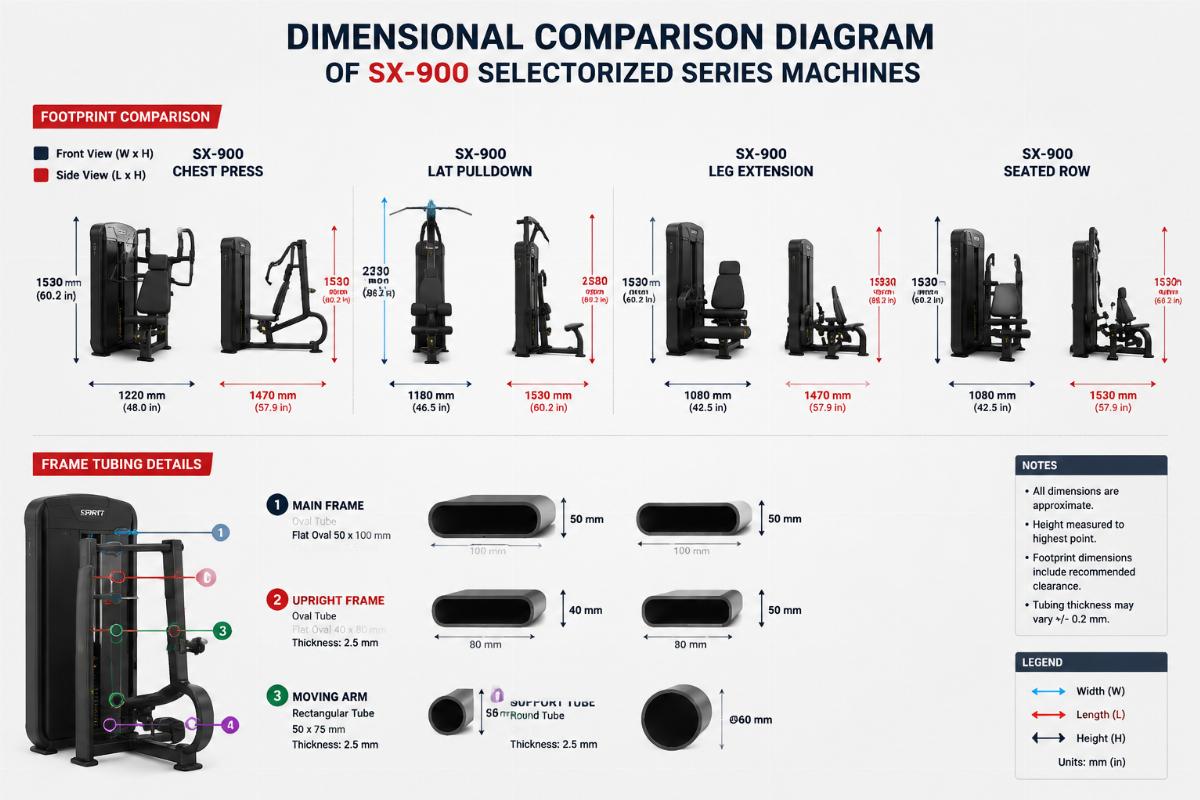
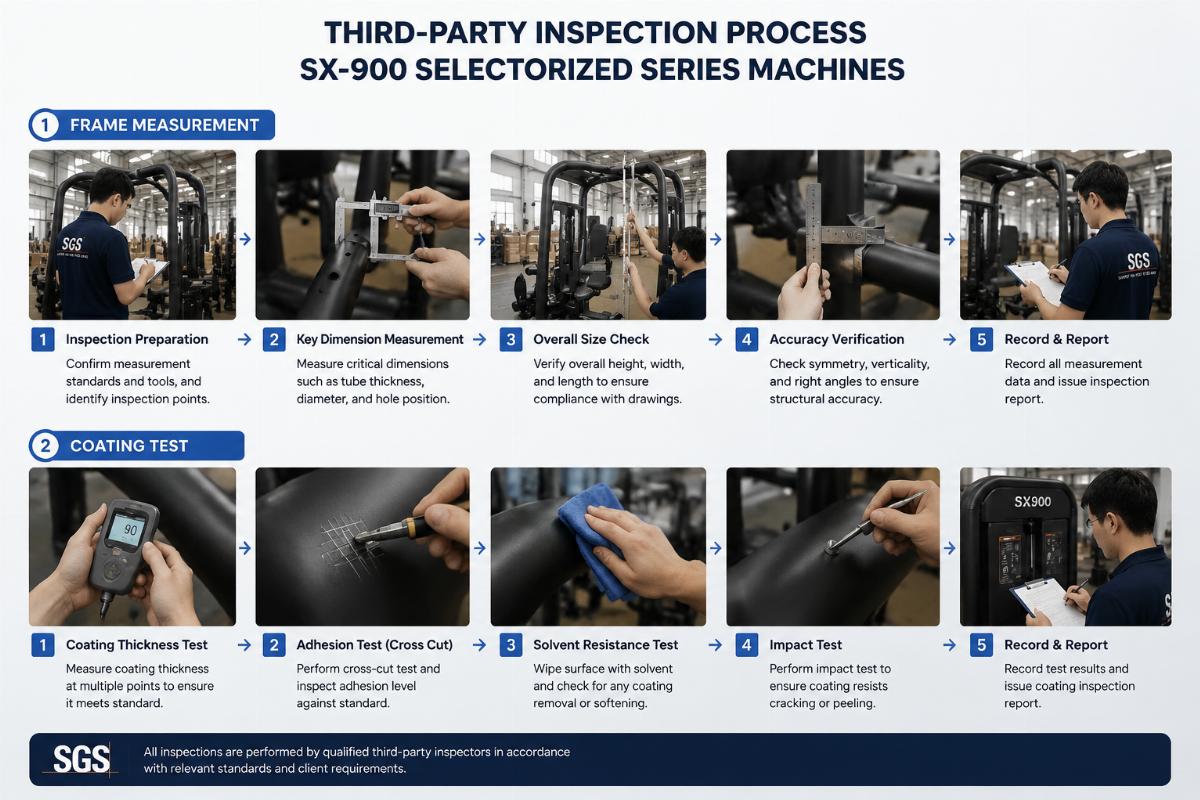
Frame specifications center on the main structural tubing. The SX-900 series uses oval and rectangular steel tubes in the primary load-bearing structure, with wall thickness selected to balance rigidity and weight. The steel grade and the welding process matter at least as much as the tube diameter. A thick-walled tube made from low-grade mild steel with poor weld penetration will flex and crack sooner than a moderately sized tube made from higher-grade steel with full-penetration welds. We always recommend buyers request the steel grade certificate and weld inspection records rather than just measuring tube thickness with calipers on arrival.
Footprint dimensions determine how many machines fit on the gym floor and, critically, how many fit in a shipping container. The SX-900 series is designed with a compact footprint relative to its training envelope, which directly affects container loading efficiency — a topic I will cover in detail below.
| Specification Cluster | Key Parameters | Verification Method |
|---|---|---|
| Weight Stack | Start weight, increment step, total weight, stack-to-handle ratio | Physical test pull + ratio calculation |
| Frame Structure | Tube shape, wall thickness, steel grade, weld type | Material certificate + weld inspection report |
| Footprint | Length, width, height, usable floor space | Dimensional drawing + actual measurement |
How Do Different Installation Scenarios Match SX-900 Specifications?
High-frequency commercial gyms need to prioritize wear-component specs; hotel and apartment projects should prioritize space efficiency and visual finish quality. One size does not fit all, and the specification priorities shift dramatically depending on who walks through the door every day.
A twenty-four-hour commercial gym in a dense urban area sees continuous machine turnover. Members range from first-time users who load the stack aggressively and drop the pin without control, to serious lifters who train near maximum capacity for hours. In this environment, the cable and pulley system takes enormous cumulative abuse. The wire rope diameter, the pulley bearing type, and the guide rod surface finish become the specifications that determine whether the machine runs smoothly for years or starts squeaking and fraying within months. We supply these high-traffic installations with upgraded wire ropes and sealed bearings as standard, because replacing a frayed cable in a busy gym means taking the machine offline and losing member satisfaction. [NEED_CITE: commercial gym equipment maintenance frequency by usage intensity category]
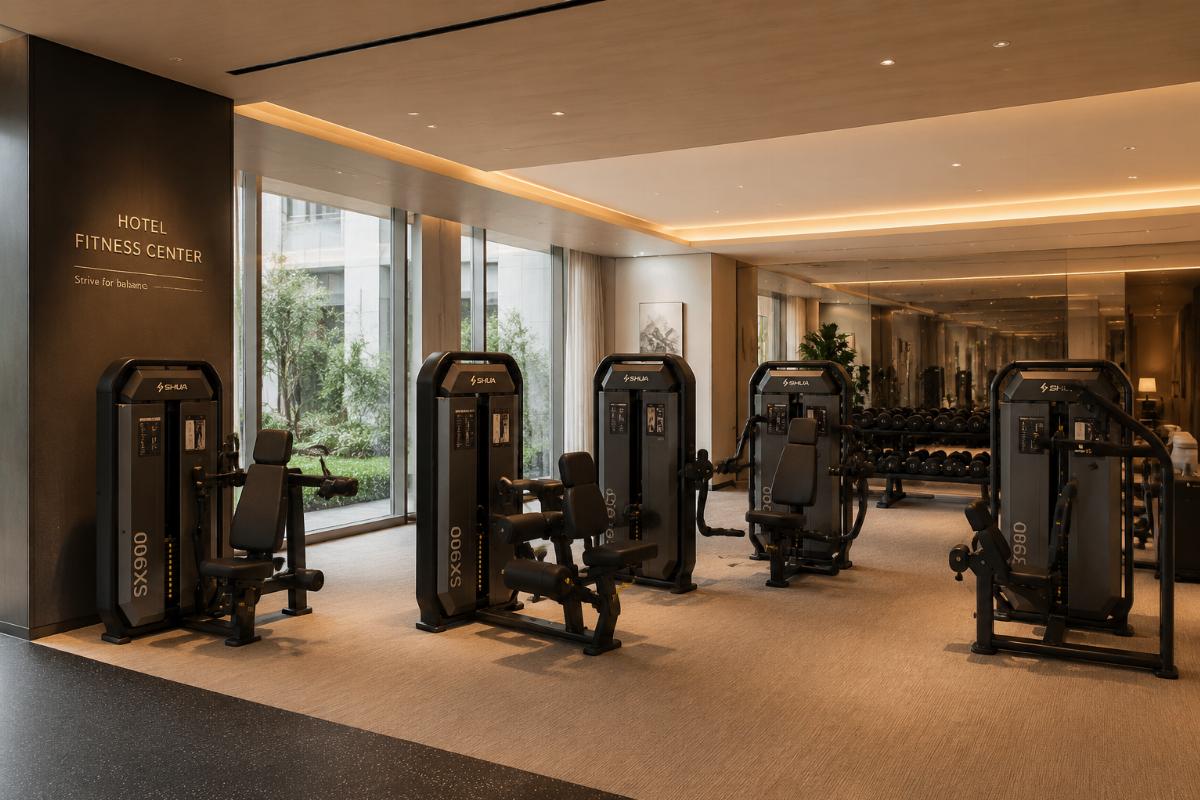
A hotel fitness center tells a completely different story. The user volume is lower, the sessions are shorter, and the aesthetic expectation is significantly higher. Here, the specifications that matter most are the powder coating finish quality, the upholstery material grade, and the overall visual integration with the hotel interior design. The SX-900 series offers multiple upholstery color options and a clean frame profile that works well in hospitality environments. The frame specs can be standard rather than heavy-duty, because the usage pattern simply does not demand the same structural endurance.
For distributors importing into regions with unstable power grids — parts of the Middle East, sub-Saharan Africa, and certain Southeast Asian markets — an additional specification consideration applies to any SX-900 model equipped with an electronic console. The power supply board must be rated for the local voltage fluctuation range. We have seen consoles fail not because the board was defective, but because it was specified for a narrow voltage band that did not match the actual grid conditions at the installation site. A simple specification adjustment at the ordering stage — requesting a wide-voltage power supply — eliminates this failure mode entirely.
How to Optimize Container Loading for SX-900 Bulk Orders?
Disassembly design and packaging engineering directly determine how many machines fit in a single container, which in turn controls the per-unit landed cost. For distributors and large gym project buyers purchasing full container loads, this is not a logistics detail — it is a profit driver.
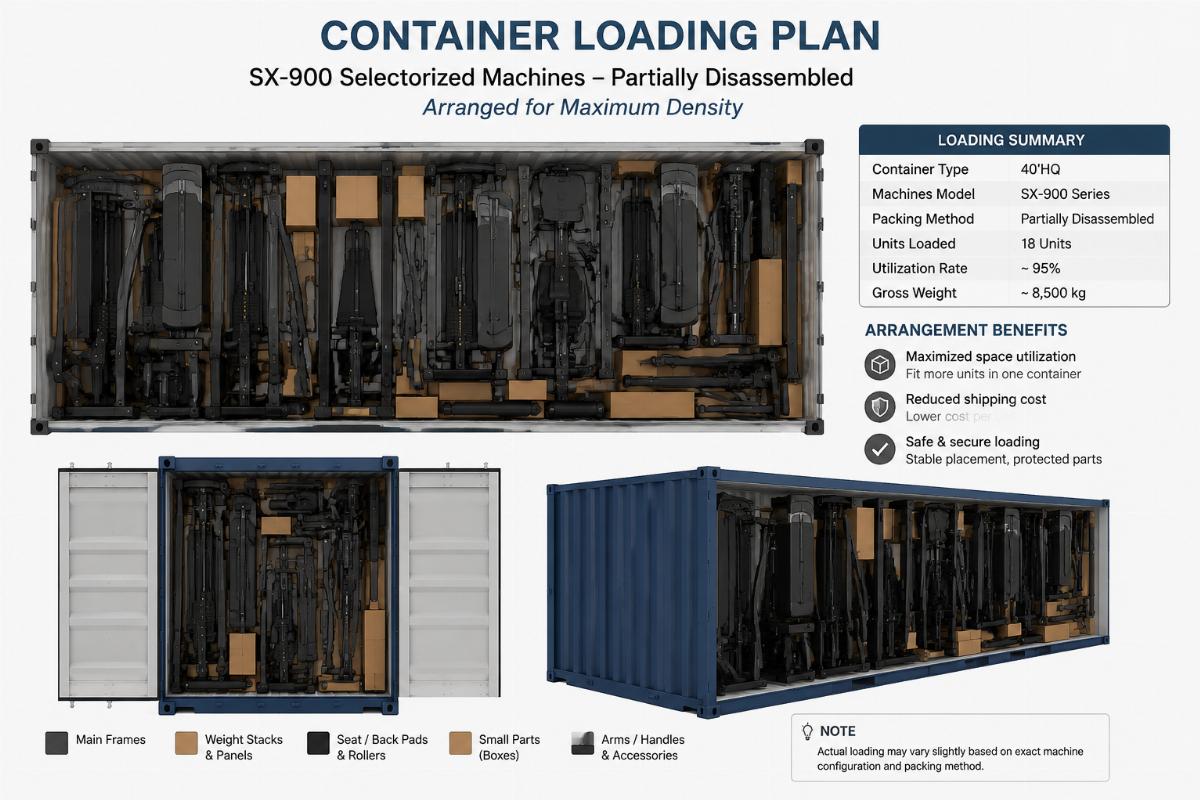
A standard twenty-foot container can hold a substantial number of fully assembled selectorized machines, but the count increases significantly when the machines are partially disassembled. The SX-900 series is engineered with this reality in mind. The weight stack can be separated from the main frame, the seat assemblies detach, and the pulley covers remove without special tools. This modular approach means more units per container, fewer containers needed per order, and lower freight cost per machine delivered to port.
The packaging design also matters. Flat-pack carton dimensions must be calculated against the container’s internal dimensions to minimize wasted space. Even a small reduction in individual carton size, multiplied across dozens of machines, translates to fitting one or two additional units in the same container. That difference directly affects the shipping cost allocated to each unit. [NEED_CITE: fitness equipment container loading optimization methods and cost impact]
We provide detailed container loading plans for every bulk order, showing exactly how many units of each model fit in a twenty-foot or forty-foot high-cube container, with the recommended disassembly level for each. This eliminates guesswork at the loading stage and prevents the costly situation where a container is sealed but still has unused volume — or worse, where the last machine does not fit and has to be held for the next shipment.
For buyers new to importing gym equipment from China, it is worth noting that the difference between a well-planned container load and a poorly planned one can represent a meaningful percentage of the total landed cost. The machine price itself is only part of the equation. Freight, insurance, port charges, and inland transport are all calculated per container, so maximizing units per container is one of the most effective levers for reducing per-unit cost.
What Are the Maintenance Intervals and Wear-Part Replacement Cycles for SX-900?
Wire rope, pulleys, and guide rods are the three maintenance priorities — a preventive maintenance routine based on inspection frequency and lubrication schedules can substantially reduce unplanned downtime and after-sales cost. Many buyers assume selectorized machines are maintenance-free because they have no motor and no electronics (on non-console models). This assumption leads to neglected maintenance and premature wear complaints.
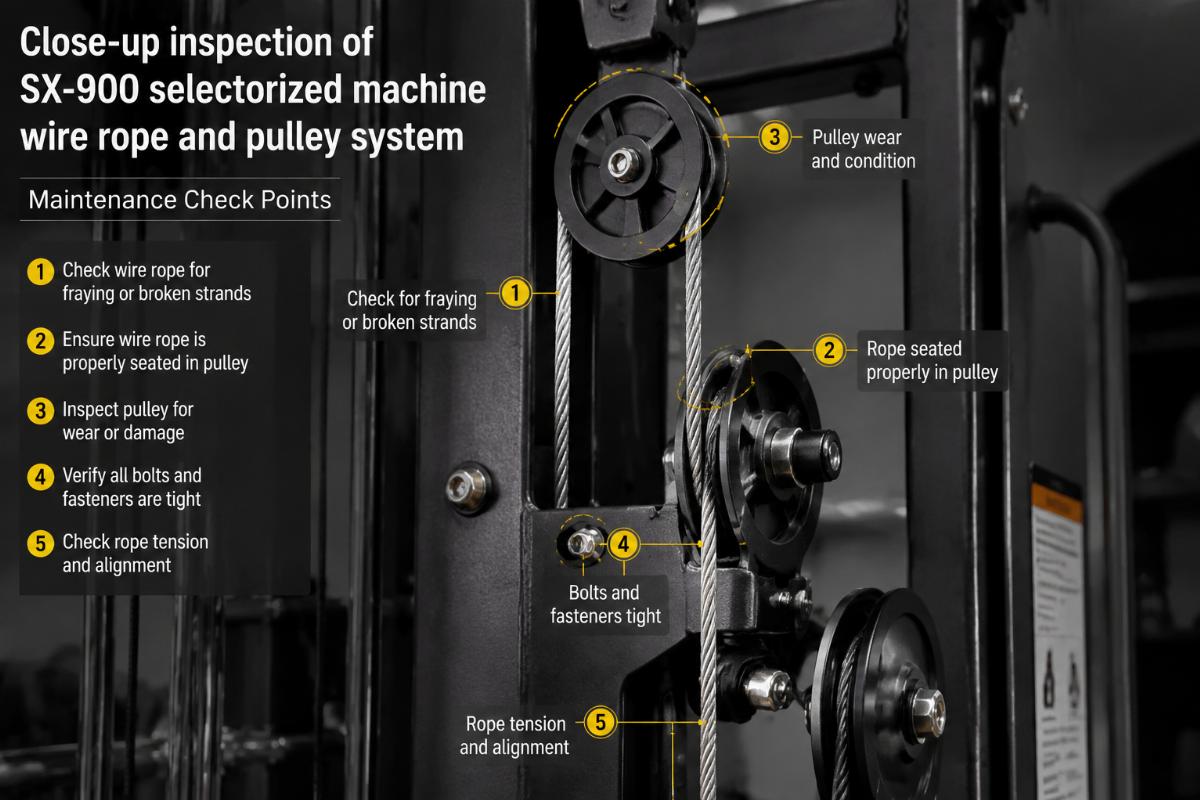
The wire rope is the most critical wear component. It runs over multiple pulleys with every repetition, and the cumulative bending cycles cause internal wire fatigue long before visible fraying appears on the surface. We recommend a visual and tactile inspection of the wire rope at regular intervals based on daily usage volume. In a high-traffic commercial gym, this means checking every few weeks; in a hotel or low-traffic facility, a monthly check is sufficient. Any visible strand break, kink, or section where the rope diameter has compressed means the cable must be replaced immediately — not at the next scheduled service. [NEED_CITE: wire rope inspection criteria and replacement triggers per fitness equipment safety standard]
The pulley system requires attention to two points: bearing smoothness and groove wear. Sealed bearings should spin freely without grinding or lateral play. If a pulley develops resistance or wobble, the bearing needs replacement. The pulley groove itself should be inspected for cable wear tracks — a deep groove worn into the pulley surface will accelerate wire rope degradation and must be addressed.
Guide rods need periodic cleaning and lubrication to ensure the weight stack slides smoothly. Dust, chalk, and sweat residue accumulate on the guide rods over time, creating friction that makes the stack feel rough and uneven. A simple wipe-down with a clean cloth followed by a light application of silicone-based lubricant restores smooth operation. This task takes only a few minutes per machine but has an outsized impact on the user experience and the longevity of the stack bushings.
We supply spare parts kits covering all high-wear components — wire ropes, pulleys, guide rod bushings, and adjustment pins — alongside every bulk order. Having these parts on site means the gym maintenance team can perform replacements immediately rather than waiting for a shipment from overseas. We also provide remote technical guidance for maintenance procedures, so the on-site team knows exactly how to disassemble, inspect, and reassemble each component correctly.
How to Verify the Authenticity of SX-900 Specifications Provided by a Supplier?
Request third-party test reports, steel material certificates, and salt-spray test records — self-declared specifications without supporting documentation are unverifiable and carry real procurement risk. In an industry where dozens of factories produce visually similar selectorized machines, the specification sheet alone proves nothing. Any factory can print any number on a PDF. The question is whether the numbers match the physical product.
Start with the steel material certificate. This document should specify the steel grade, the chemical composition, and the mechanical properties, and it should be traceable to the mill batch. A supplier who cannot provide this — or who offers only a generic "we use high-quality steel" statement — is not giving you what you need to verify the frame specification. [NEED_CITE: fitness equipment frame material certification requirements per ISO standard]
Next, ask for the salt-spray test report. The powder coating finish on commercial gym equipment must withstand sweat, humidity, and constant handling without chipping, peeling, or rusting. A salt-spray test simulates accelerated corrosion exposure, and the report should show the number of hours the coated sample endured before showing any signs of failure. The difference between a basic coating and a properly applied commercial-grade coating is measured in hundreds of hours of salt-spray endurance — and this difference translates directly into how the machines look after a year or two on the gym floor.
For buyers purchasing under CE-marked requirements for the European market, the EN standards specify testing protocols for structural integrity, stability, and user safety. A legitimate test report from an accredited laboratory confirms that the machine has been physically tested against these protocols, not just designed to look compliant. Request the actual test report, not just a certificate logo on a brochure.
Finally, if the order volume justifies it, arrange a pre-shipment inspection — either through a third-party inspection company or through our own quality team with live video verification. This allows you to confirm that the machines being packed match the specifications on paper: tube dimensions, weld quality, stack weight, cable routing, and finish quality.
Conclusion
SX-900 Selectorized Series Specifications are a system, not a spreadsheet — weight stack, frame, footprint, wear components, and documentation must all be evaluated together against the actual installation and usage environment. Matching specs to scenario, planning container loading before the order, and building a preventive maintenance routine from day one are what separate a profitable, long-lasting gym equipment investment from an expensive lesson.