01 / Scenario
STUDIO
P
High-End Pilates Studios
Premium aesthetics meet quiet operation for boutique studio environments.

ISO
9001
CE
Certified
OEM
Available
10YR
Warranty
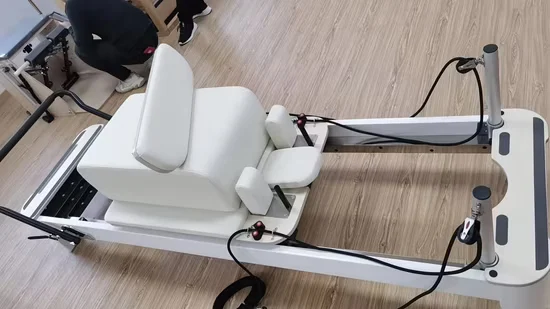
Pilates Reformer Machine, 2460×730×680mm, 100kg Platform Load — solid beech wood frame and carriage rail engineered for dimensional stability and smooth glide under daily studio use; includes long box, jump board, and platform for progressive programming without equipment swaps; solid-color commercial upholstery resists splitting across high-turnover sessions. Each unit undergoes carriage glide load testing and rail straightness inspection before shipment, backed by a 3-year warranty with full accessory compatibility.
// Spec Highlights
• Direct from Manufacturer · No Middlemen · Worldwide Shipping
01
// Material
Imported Solid Wood
Premium hardwood frames sourced for density and visual warmth.
02
// Hardware
Medical-Grade Silent
Whisper-quiet pulleys and springs for clinical environments.
03
// Customization
Appearance OEM
Color, upholstery, and branding tailored to your studio.
04
// Service
Layout Design
Free venue planning for studios and rehab institutions.
Every component is selected for longevity, performance, and aesthetic harmony - from imported hardwood frames to silent medical-grade accessories.
// Features
Solid Beech Core — kiln-dried solid beech resists warping and keeps the carriage rail aligned through daily studio cycles.
| Parameter | Value |
|---|---|
| Product Type | Pilates Reformer Machine |
| Dimensions | 2460 × 730 × 680 mm |
| Net Weight | 100 kg |
| Carriage Frame | Solid beech wood |
| Accessory Kit | Long Box, Jump Board, Platform |
| Upholstery | Solid-color commercial vinyl |
| Logo Customization | Custom logo available on request |
| Transport Package | Standard wood case |
| Production Capacity | 80 units per month |
| Warranty | 3 Years |
| Facility Type | Typical Use |
|---|---|
| Pilates and yoga studio | Daily group classes and one-on-one instruction with repeated carriage cycles |
| Rehabilitation and conditioning center | Controlled eccentric loading and progressive spring-based recovery programming |
| Commercial gym functional zone | Strength and flexibility sessions complementing free weight and rig areas |
| Hotel and resort fitness studio | Guest-access wellness programming with low maintenance requirements |
| Boutique fitness facility | Branded studio environments with customized upholstery and logo integration |
Dimensional stability under studio humidity is non-negotiable for rail alignment.
Many reformers marketed for studio use rely on laminated plywood or unspecified hardwood blanks. These materials absorb moisture unevenly across seasons, and the rail surface develops microscopic waves that translate into carriage play within the first year of daily use. [NEED_CITE: wood moisture content and dimensional stability standards for precision furniture] Solid beech, by contrast, has a tight grain structure and consistent density that holds its machined tolerance when kiln-dried to specification. For a commercial beech wood pilates reformer machine, this means the carriage wheel stays seated in the rail track without the side-to-side drift that forces instructors to compensate during precise spinal articulation work.
The reformer covers the full sagittal and transverse movement planes through spring-loaded resistance, addressing deep stabilizers and eccentric control patterns that free weights alone do not load effectively. On a commercial gym floor, it complements power racks and cable towers by offering controlled, low-impact resistance progressions for members returning from injury or seeking mobility work. It suits facilities running high-frequency group sessions where equipment turnover is constant, and its footprint allows multiple units to be arranged with adequate clearance for instructor circulation. The carriage accommodates users across a wide height range, making the commercial beech wood pilates reformer machine viable for diverse membership demographics.
A reformer in a busy studio endures hundreds of carriage cycles daily, each imposing alternating static holds and dynamic eccentric loads on the frame and rail. [NEED_CITE: cyclic fatigue behavior in hardwood structural members under repeated loading] The carriage-to-rail interface is the primary wear zone: any tolerance gap amplifies under off-center footwork on the platform, accelerating rail surface degradation. The spring anchor points undergo repeated tension and release, demanding secure fastening that resists loosening over thousands of cycles. Upholstery contact surfaces absorb sweat, cleaning chemicals, and compression from body weight, requiring material that resists both splitting and compression set. The solid-color commercial vinyl on this unit is selected to withstand high-turnover sessions without delamination, and the solid beech frame provides a stable substrate that does not flex under platform loading, keeping the spring resistance feel consistent across the full range of motion.
The 2460 mm overall length provides adequate carriage travel for full-range supine and seated work without shortening the stroke, which is critical for taller users performing long-box pulling strap sequences. The 100 kg net weight reflects the mass of solid beech construction, giving the unit inertia stability so it does not shift during explosive jump board repetitions. The accessory kit — long box, jump board, and platform — enables progressive programming from foundational footwork through advanced plyometric conditioning without requiring supplemental equipment purchases. Upholstery in solid-color commercial vinyl maintains visual consistency across a studio fleet, and custom logo placement allows brand integration without compromising material performance. The three-year warranty signals confidence in the structural integrity of the beech frame and carriage rail under commercial use conditions.
Reformers built from laminated plywood or low-density hardwood face predictable failure modes. Plywood layers delaminate at the rail edge where carriage wheels exert concentrated pressure, creating surface irregularities that produce a rough, noisy glide. [NEED_CITE: delamination failure modes in engineered wood under concentrated rolling loads] Low-density hardwood species compress under platform loading, causing the rail to bow and the carriage to bind at mid-stroke. Springs mounted to undersized anchor plates pull through softer wood over time, requiring costly structural reinforcement. Non-commercial upholstery splits at high-wear seams within months, forcing studios to schedule reupholstering downtime. These failures compound: a reformer pulled from service for rail repair is lost revenue and disrupted class scheduling, and replacement parts for non-standard frames are often unavailable.
The solid beech carriage rail is milled from kiln-dried stock, with moisture content controlled to match typical indoor climate conditions, minimizing seasonal movement that throws off rail alignment. The accessory ecosystem — long box, jump board, and platform — is engineered for quick swap-on and swap-off, reducing transition time between class segments. Spring configuration supports resistance progressions from rehabilitation-level light loads through athletic conditioning tension, covering the full spectrum a commercial studio needs. Upholstery is applied over high-density padding to resist compression set across daily use, and the solid-color finish holds up against standard studio cleaning protocols. Production at 80 units per month reflects controlled batch manufacturing rather than mass-line assembly, allowing per-unit inspection of rail straightness and carriage glide before crating. [NEED_CITE: quality control protocols for precision wood fitness equipment]
Provide your studio floor plan and target unit count to receive a 2D layout confirming safe spacing between reformers and clear instructor pathways. Specify your primary use case — group classes, one-on-one rehab sessions, or mixed programming — so spring resistance configuration matches your typical client profile. Indicate any custom logo or upholstery color requirements early in the order process to align with production scheduling.
Q: How can I tell if a reformer uses solid wood versus plywood or laminate?
A: Inspect the rail edge and carriage underside. Solid beech shows continuous end grain across the full cross-section with no visible laminated layers. Plywood reveals alternating grain directions in its layers, and laminate surfaces show a thin decorative veneer over composite substrate. Request a wood species certification from the manufacturer specifying moisture content at time of machining. Solid wood maintains machined rail tolerance longer under humidity variation.
Q: What does carriage weight and rail tolerance mean for daily glide quality?
A: Carriage weight determines the inertia feel during transitions — too light and the carriage feels unstable during jump board work, too heavy and it resists subtle movement cues. Rail tolerance refers to the gap between carriage wheels and the rail channel. Tight tolerance ensures smooth, quiet glide without lateral play, which is essential for controlled eccentric exercises. Over time, poor tolerance allows wobble that accelerates wheel and rail wear unevenly.
Q: How should I choose spring resistance for rehab versus athletic conditioning?
A: Rehabilitation programming typically requires lighter springs for joint-friendly progressive loading, while athletic conditioning demands heavier springs for power and strength development. A versatile commercial beech wood pilates reformer machine should offer a spring range spanning both ends, with clear tension markings so instructors can prescribe precise resistance. Confirm with the manufacturer that replacement springs are available in graduated tensions to expand programming options as client needs evolve.
Q: Are the long box, jump board, and platform interchangeable across units?
A: When accessories are engineered as part of the same product line, they mount to standardized attachment points on the frame. This means a jump board from one unit fits another of the same model, simplifying inventory for multi-unit studios. Verify with the manufacturer that accessory dimensions and mounting hardware are consistent across production batches, and that replacement accessories can be ordered individually without requiring a full unit purchase.
Q: How often does commercial studio upholstery need replacement?
A: Upholstery lifespan depends on session volume, cleaning chemical exposure, and padding density. Commercial-grade vinyl over high-density foam typically outlasts standard materials by resisting seam splitting and surface compression. Studios running six or more classes daily should inspect upholstery quarterly for edge wear and seam integrity. Custom logo placement does not affect durability if applied through heat-transfer or embroidery methods that do not compromise the vinyl surface layer.
Premium aesthetics meet quiet operation for boutique studio environments.
Medical-grade silence and precision for sports & postpartum recovery.
Furniture-grade craftsmanship for premium residential installations.
Compact premium setups for one-on-one and small-group training.
Aesthetic Pilates integration for hybrid wellness studio programming.
Multi-unit deployment with instructor-grade reliability for certification programs.
Tell us about your project. Our team will respond within 24 hours with pricing, customization options, and shipping details.
// Sales Director
William
+86 132 2531 1800
// Export Manager
Bella
+86 198 5412 8032
william@bickfit.com