01 / Scenario
STUDIO
P
High-End Pilates Studios
Premium aesthetics meet quiet operation for boutique studio environments.
ISO
9001
CE
Certified
OEM
Available
10YR
Warranty
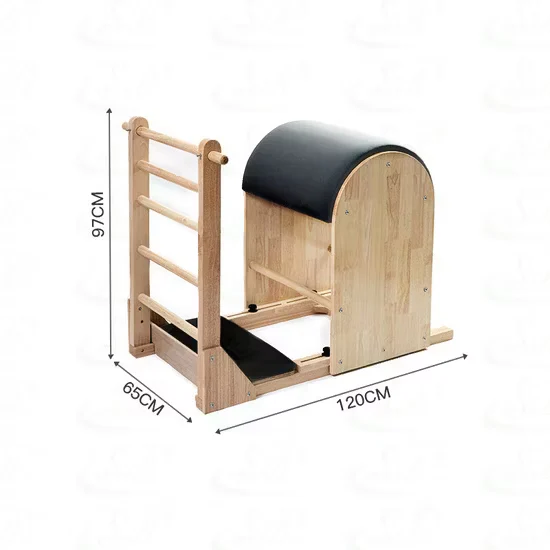
Oak Wood Pilates Ladder Barrel, 1100×770×980mm, 50kg Net Weight — solid oak construction resists warping and surface indentation under repetitive studio loading, with rounded arc profile supporting controlled spinal articulation. Custom logo and color options available for branded environments. Each unit undergoes 32-point inspection and 100% load testing before shipment.
// Spec Highlights
• Direct from Manufacturer · No Middlemen · Worldwide Shipping
01
// Material
Imported Solid Wood
Premium hardwood frames sourced for density and visual warmth.
02
// Hardware
Medical-Grade Silent
Whisper-quiet pulleys and springs for clinical environments.
03
// Customization
Appearance OEM
Color, upholstery, and branding tailored to your studio.
04
// Service
Layout Design
Free venue planning for studios and rehab institutions.
Every component is selected for longevity, performance, and aesthetic harmony - from imported hardwood frames to silent medical-grade accessories.
// Features
Every Unit Load-Tested — each Oak Wood Arc Pilates Ladder Barrel undergoes full static and dynamic load verification before leaving the factory, eliminating the guesswork studios face with sample-only QC protocols.
| Parameter | Value |
|---|---|
| Product Type | Pilates Ladder Barrel |
| Material | Solid Oak Wood |
| Product Dimensions | 1100 × 770 × 980 mm |
| Net Weight | 50 kg |
| Finish | Solid Color |
| Upholstery | Standard commercial-grade vinyl, upgrade to high-density option available |
| Logo | Custom branding permitted |
| Warranty | 3 Years |
| Facility Type | Typical Use |
|---|---|
| Commercial Pilates studio | Spinal articulation, flexion-extension drills, arc stretching sequences |
| Yoga and barre studio | Supported backbends, hip flexor lengthening, core stabilization holds |
| Rehabilitation and conditioning center | Controlled-range spinal mobilization, post-injury strength rebuilding |
| Hotel wellness center | Guest self-service flexibility station, complement to mat-based programming |
| University athletic training room | Supplemental mobility work for overhead and throwing athletes |
Solid oak resists the compression and delamination that quietly ruin laminated barrels under daily studio traffic.
Most Pilates ladder barrels on the market use plywood cores or softwood blanks that compress at the rung-to-frame joints after months of repetitive loading. The arc surface sags, the rungs develop lateral play, and the barrel no longer holds its geometry under a full-body stretch. In a Mumbai studio chain I worked with, laminated barrels showed visible arc flattening within eight months — enough to alter spinal articulation paths during extension drills [NEED_CITE: wood fatigue under cyclic loading in fitness equipment]. A commercial oak wood Pilates ladder barrel avoids that failure mode because oak’s density and interlocked grain structure resist both surface indentation and long-term creep, keeping the arc profile dimensionally stable across years of daily commercial scheduling.
The commercial oak wood Pilates ladder barrel serves the sagittal plane — spinal flexion, extension, and controlled lateral flexion under bodyweight load. In a studio floor plan, it typically anchors a dedicated stretching or prep zone rather than sitting in the primary Reformer row. It complements apparatus like the Cadillac and Wunda Chair by offering unassisted, self-regulated range-of-motion work that clients can perform between scheduled apparatus sessions. For studios running 20-plus client sessions per day, the barrel functions as a high-throughput station with no setup time between users. The 1100 mm length accommodates users across a wide height range, from shorter clients working supported hip flexor stretches to taller clients performing full-length arc extensions without the torso overrunning the barrel apex.
Every time a client mounts, shifts weight across the arc, and dismounts, the rung-to-frame joints absorb an off-axis lateral force that compounds over hundreds of cycles per week. The arc surface itself carries compressive load concentrated at the apex — the exact point where a user’s mid-back or pelvis rests during peak-extension holds. In a high-traffic Pilates studio running back-to-back classes, a single barrel may see 15-plus loading cycles daily, which accelerates fatigue at any joint that relies on glue or dowel-only construction [NEED_CITE: structural joint fatigue classification in hardwood furniture]. Moisture from sweat and studio humidity cycles also work against finish integrity, softening surface coatings that lack adequate penetration depth. The oak density here means the compressive stress at the apex stays within the wood’s elastic range rather than pushing into permanent deformation.
The 1100 × 770 × 980 mm footprint tells you more than catalog dimensions — the 770 mm width determines whether two barrels can sit side-by-side with safe lateral clearance, and the 980 mm height at the ladder apex defines the maximum supported reach for overhead extension drills. At 50 kg net weight, the barrel has enough mass to resist tipping during dynamic mounting but remains movable for layout reconfiguration — a balance that lighter hardwoods or hollow-core constructions cannot achieve. Solid oak’s grain orientation along the arc’s longitudinal axis is critical: cross-grain sections would be vulnerable to splitting under the bending moment of a full-body arc stretch. The three-year warranty reflects confidence in joint construction and wood stability, covering the period when inferior species and lamination methods typically begin showing structural drift.
A barrel built from laminated plywood or rubberwood may look identical in product photos, but the cost difference surfaces within the first year of studio use. Laminated cores delaminate at the arc curve — the precise zone of highest bending stress — leaving a surface that compresses unevenly and alters movement paths. Rungs joined with dowels rather than mortise-and-tenon construction develop rotational play, creating a wobble that instructors notice during weight-bearing climbs [NEED_CITE: dowel vs. mortise-and-tenon joint shear strength in hardwood]. Thin surface finishes chip under repeated sanitizer wiping, exposing bare wood to moisture absorption and eventual grain raising. When replacement rungs are not available as spare parts, a single failed joint takes the entire barrel off the floor until a carpenter can improvise a fix.
When I lay out a Pilates studio in CAD, every piece of apparatus needs a verified footprint and a defined safety clearance envelope — the commercial oak wood Pilates ladder barrel’s 1100 × 770 mm base makes that straightforward, with no overhang or protruding hardware to account for. The 50 kg mass means it stays planted during use without requiring floor anchoring, which preserves layout flexibility as the studio’s programming evolves. Solid oak’s dimensional stability under humidity fluctuation means the barrel won’t shift or rack seasonally in climate-controlled or semi-conditioned spaces. The custom logo option lets studio operators match branding across apparatus without third-party refinishing. For multi-location rollouts, consistent wood sourcing and factory QC ensure every barrel in a five-studio chain arrives with matching grain density and finish depth.
Share your studio floor plan and existing apparatus list so we can generate a 2D or 3D layout showing the commercial oak wood Pilates ladder barrel positioned with verified safety clearances and movement envelope overlap checks. Tell us your average daily session count so we can confirm the solid oak specification matches your traffic volume without over-engineering. Specify your target client height range to validate that the 980 mm ladder apex and 1100 mm arc length cover your population. Provide logo artwork and color preferences if branding alignment across your apparatus fleet is part of the buildout brief.
Q: How can I tell if a Pilates ladder barrel is solid wood or just veneered plywood?
A: Check the end grain on the arc surface and rungs — solid oak shows continuous grain lines that follow the curve, while veneered plywood reveals layered cross-sections at cut edges. Tap the arc apex; solid wood produces a dense, uniform tone rather than a hollow resonance. Request a cross-section sample or moisture content reading from the manufacturer before committing to a bulk order.
Q: What joint type should I look for between the rungs and the barrel frame?
A: Mortise-and-tenon joints offer the highest pull-out strength for rung connections in solid oak, outperforming dowel or screw-only methods under repeated lateral loading. Ask the manufacturer to specify the joint type and provide test data on withdrawal resistance. Rungs that rely solely on adhesive will develop play within the first year of commercial-frequency use.
Q: How should I plan spacing when placing multiple ladder barrels in a studio?
A: Allow at least 600 mm between adjacent barrels to prevent arm or hand contact during lateral flexion and extension drills. I have seen studios lose an entire row of barrels because 400 mm spacing caused clients to collide during arc stretches. Factor in the full movement envelope — arms extended overhead — not just the static footprint when finalizing your floor plan.
Q: What is the maintenance cycle for a solid oak barrel in a high-traffic studio?
A: Wipe down with pH-neutral cleaner after each session block and inspect rung joints quarterly for rotational play. Surface refinishing assessment should happen annually; studios running 15-plus sessions daily may need a light sanding and recoat every 18 months to maintain finish integrity and sanitation readiness against sweat and humidity exposure.
Q: Can the barrel be customized with studio branding and color matching?
A: Custom logo application is available, and the solid color finish can be specified to match your studio’s existing apparatus palette. Confirm lead time for branded units when placing bulk orders, as custom finishing adds a production step. Request a physical color sample on oak before approving the run to verify tone accuracy under your studio’s lighting conditions.
Premium aesthetics meet quiet operation for boutique studio environments.
Medical-grade silence and precision for sports & postpartum recovery.
Furniture-grade craftsmanship for premium residential installations.
Compact premium setups for one-on-one and small-group training.
Aesthetic Pilates integration for hybrid wellness studio programming.
Multi-unit deployment with instructor-grade reliability for certification programs.
Tell us about your project. Our team will respond within 24 hours with pricing, customization options, and shipping details.
// Sales Director
William
+86 132 2531 1800
// Export Manager
Bella
+86 198 5412 8032
william@bickfit.com