01 / Scenario
STUDIO
P
High-End Pilates Studios
Premium aesthetics meet quiet operation for boutique studio environments.
ISO
9001
CE
Certified
OEM
Available
10YR
Warranty
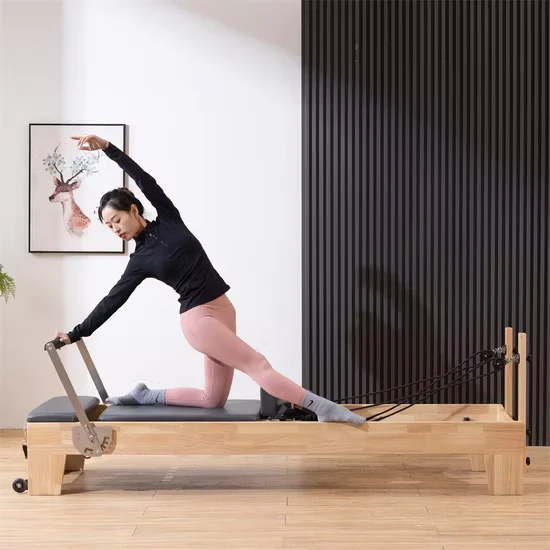
Wood Pilates Reformer, Solid Beech/Maple Timber Frame, 2460×730×680mm Dimensions — engineered with solid hardwood construction and full accessory integration including long box, jump board, and platform for comprehensive studio programming. Spring-based resistance system with color-coded progression supports beginner through advanced client ranges on a single unit. Every unit undergoes load testing before shipment with 10-year frame warranty and floor planning support for safe studio layout.
// Spec Highlights
• Direct from Manufacturer · No Middlemen · Worldwide Shipping
01
// Material
Imported Solid Wood
Premium hardwood frames sourced for density and visual warmth.
02
// Hardware
Medical-Grade Silent
Whisper-quiet pulleys and springs for clinical environments.
03
// Customization
Appearance OEM
Color, upholstery, and branding tailored to your studio.
04
// Service
Layout Design
Free venue planning for studios and rehab institutions.
Every component is selected for longevity, performance, and aesthetic harmony - from imported hardwood frames to silent medical-grade accessories.
// Features
Solid Timber Rigidity — every Wood Pilates Reformer is built from kiln-dried solid beech or maple with traceable grain orientation, not veneer-laminated composite boards that warp under studio humidity cycles.
| Parameter | Value |
|---|---|
| Product Type | Pilates Reformer |
| Frame Material | Solid Beech / Solid Maple |
| Accessory Kit | Long Box, Jump Board, Platform included as standard |
| Product Dimensions | 2460 × 730 × 680 mm |
| Net Weight | 100 kg |
| Color Options | Solid color finishes available in multiple options |
| Customization | Logo and finish customization available |
| Production Capacity | 80 units per month |
| Age Group | Adult |
| Gender | Unisex |
| Warranty | 3 Years |
| Facility Type | Typical Use |
|---|---|
| Commercial Pilates studio | Equipment-based group classes running 8+ hours daily with continuous carriage cycling |
| Rehabilitation and physiotherapy clinic | Low-impact resistance work requiring precise spring tension control for post-injury protocols |
| Boutique fitness and wellness center | Pilates programming paired with yoga, barre, or small-group functional sessions |
| Hotel wellness facility | Guest-accessible reformer sessions with durable finishes that withstand high-turnover cleaning regimens |
| Private home gym | Single-unit installation for dedicated Pilates practice in residential settings |
Solid timber framing is the single most consequential specification in a commercial wood Pilates reformer.
Studio operators routinely encounter reformers built on veneer-laminated particleboard or softwood composite cores. These frames appear dimensionally stable at delivery but begin to warp when exposed to the humidity fluctuations inherent in rooms where multiple bodies generate moisture for hours on end. The carriage rail — which demands straightness tolerances measured in fractions of a millimeter — follows the warp. Within six to nine months of daily class rotation, the carriage develops lateral play, the wheels lose consistent contact with the rail surface, and clients notice the wobble during footwork and long stretch sequences. [NEED_CITE: dimensional stability of solid hardwood versus laminated composites under cyclic humidity exposure]
Replacing a warped reformer frame is not a field repair. The entire unit is effectively scrapped. This is the failure mode that solid beech and maple are selected to prevent.
The Wood Pilates Reformer covers the full spectrum of supine, prone, seated, and standing movement patterns across sagittal, frontal, and transverse planes. In a dedicated Pilates studio layout, reformers anchor the equipment zone and are typically complemented by Cadillac towers, Wunda chairs, and barrel stations for programming variety. The 2460 × 730 mm footprint requires lateral spacing that allows instructors to circulate between units during group classes and provides safe clearance for jump board exercises at full carriage excursion. This commercial wood pilates reformer accommodates the anthropometric range from shorter clients working short-box series to taller practitioners performing full long-stretch and knee-stretch progressions without platform-end compromise.
Reformer carriage systems endure a specific loading profile: repeated eccentric deceleration at the end of each spring contraction, thousands of cycles per day in high-traffic studios. Every commercial class block generates hundreds of carriage excursions. The rail-wheel interface absorbs this cyclic stress, and the bearing seal must prevent sweat and cleaning-solution infiltration that degrades lubrication over time. Spring anchor points experience alternating tension peaks — particularly during advanced jump board work and single-leg footwork at heavy spring settings — and must be through-bolted or dowel-reinforced into the solid timber frame rather than surface-screwed. The long box and jump board attachment points face similar concentrated loads at each mounting event, and loose-fitting hardware accelerates wear at the timber contact faces. [NEED_CITE: cyclic fatigue performance in wood-to-metal fastened joints under repeated dynamic loading]
The choice between beech and maple is not cosmetic. Beech offers a tighter, more uniform grain structure that machines cleanly for precise rail channels, while maple provides greater hardness at the contact surfaces where carriage wheels bear load. Both species, when kiln-dried to appropriate moisture content, resist the seasonal swelling and contraction that compromises lesser hardwoods in climate-controlled studio environments. The 100 kg net weight of the assembled unit reflects the mass of solid timber rather than hollow-core composite — this mass contributes to floor stability during vigorous exercises, reducing the frame-shift that lighter reformers exhibit during standing series and jump board sequences. Accessory integration follows bolt-on mounting for the long box, jump board, and platform, which permits field replacement of individual components without requiring frame disassembly. Color and finish customization is available to align with studio interior design requirements, and logo placement can be specified during the order process.
Reformers priced significantly below solid-timber equivalents almost always achieve that margin through frame material substitution. Veneer-laminated MDF or finger-jointed softwood cores hold rail hardware adequately at first installation but lack the internal fiber continuity to distribute carriage load across the frame length. Under daily commercial use, the rail fasteners gradually loosen as the surrounding composite material compresses and crumbles — a failure mode that presents as mysterious carriage drift that no amount of wheel adjustment can correct. Non-sealed bearings on economy units allow ambient studio humidity and perspiration aerosol to infiltrate the race, producing audible grinding and visible lateral play within the first year. Spring hooks fabricated from non-standard wire gauges fatigue at the bend radius and snap under advanced client loads, creating a liability event mid-class. When these springs cannot be sourced as replacement parts because the manufacturer uses proprietary or undocumented hardware, the entire unit becomes a floor ornament. [NEED_CITE: bearing seal classification and contamination resistance in fitness equipment environments]
The 11-gauge steel approach that defines our strength equipment philosophy translates to reformer procurement as verifiable solid-timber specification with mill documentation — no veneer-laminated frames marketed ambiguously as wood. Our robotic MIG welding standard carries over to the hardware: every spring anchor and accessory mount on this commercial wood pilates reformer is reinforced for fatigue resistance rather than assembled with minimum-spec fasteners. Each unit undergoes full load testing before shipment rather than sample-based QC on a production batch, meaning the carriage glide, spring tension calibration, and accessory fitment are verified on the specific reformer that ships to your facility. The 200μm industrial powder coating standard applied to our strength frames informs our reformer finish specifications as well — surface treatments selected for resistance to sweat acidity and studio cleaning agents. Our facility planning support extends to reformer room layouts, providing CAD-accurate spacing recommendations that account for instructor circulation paths and safe clearance for jump board and standing exercises across the full reformer count.
Provide your studio floor dimensions and target reformer count to receive a 2D layout with circulation and safety clearance recommendations. Specify your daily class volume and client demographic to confirm that the spring configuration covers your programming range from rehabilitation through advanced sessions. Communicate finish and logo customization requirements during the specification phase to align equipment aesthetics with your interior design direction.
Q: How to distinguish solid wood reformers from veneer-laminated or composite alternatives?
A: Request mill documentation specifying timber species, grade, and kiln-drying protocol. Solid beech or maple frames show continuous grain through any cross-section cut, while veneer-laminated units reveal a particleboard or MDF core beneath a thin surface layer. Inspect exposed frame edges and rail channels — genuine solid timber has uniform fiber density with no visible lamination lines or glue seams separating the surface from the core.
Q: What carriage wheel and rail specifications ensure long-term glide smoothness in high-traffic studios?
A: Sealed bearings are essential in studio environments where perspiration aerosol and cleaning solutions contaminate exposed bearing races. The rail surface must be machined flat with consistent tolerances along the full travel length. Wheel material should resist flat-spotting under sustained static loads — reformers left parked at one end of travel overnight develop flat spots on softer wheel compounds that produce audible vibration during the next session.
Q: How does spring configuration affect client range and class programming flexibility?
A: A reformer must offer graduated resistance levels — typically color-coded by tension — to serve beginners requiring light assistance through advanced clients demanding heavy eccentric overload. The spring anchor points must maintain consistent resistance curves across thousands of compression cycles. If springs lose calibration or develop permanent set under sustained tension, the instructor loses the ability to prescribe precise resistance for rehabilitation protocols or progressive overload programming.
Q: What maintenance does a wood reformer require compared to aluminum-frame models?
A: Solid timber frames require environmental awareness — maintaining stable humidity in the studio space prevents seasonal swelling and contraction that affects rail alignment. The timber finish should be cleaned with pH-neutral agents compatible with the specified coating. Hardware at spring anchors and accessory mount points requires periodic torque verification. Aluminum frames eliminate humidity sensitivity but introduce different resonance characteristics and typically rely on mechanical fastener joints rather than the continuous structural integrity of solid timber joinery.
Q: How to plan studio floor layout with correct reformer spacing for safe class instruction?
A: Allow minimum clearance between reformer units for instructor passage during group sessions, with additional lateral space on each side for exercises where clients extend limbs beyond the carriage width. Jump board work requires clear space at the spring end for full carriage excursion plus client body length. Standing series performed beside the reformer demand unobstructed floor area. Submitting your room dimensions allows generation of a scaled layout that accounts for all programming scenarios.
Premium aesthetics meet quiet operation for boutique studio environments.
Medical-grade silence and precision for sports & postpartum recovery.
Furniture-grade craftsmanship for premium residential installations.
Compact premium setups for one-on-one and small-group training.
Aesthetic Pilates integration for hybrid wellness studio programming.
Multi-unit deployment with instructor-grade reliability for certification programs.
Tell us about your project. Our team will respond within 24 hours with pricing, customization options, and shipping details.
// Sales Director
William
+86 132 2531 1800
// Export Manager
Bella
+86 198 5412 8032
william@bickfit.com