
01 / Scenario
STUDIO
P
High-End Pilates Studios
Premium aesthetics meet quiet operation for boutique studio environments.
ISO
9001
CE
Certified
OEM
Available
10YR
Warranty
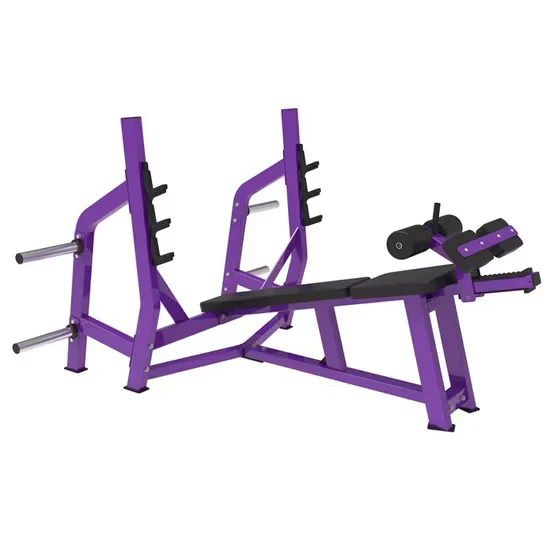
Plate Loaded Decline Press, 3×3 Inch Frame Tube, 1500×1150×1280mm Dimensions — engineered with 11-gauge steel and robotic MIG continuous welding to eliminate spot-weld fatigue under heavy cyclic loading. Sealed bearings guide smooth plate-loaded movement through high-traffic commercial use, while 200μm powder coating resists chipping at contact zones. Every unit undergoes load testing before shipment, backed by a 10-year frame warranty and factory-direct floor planning support.
// Spec Highlights
• Direct from Manufacturer · No Middlemen · Worldwide Shipping
01
// Material
Imported Solid Wood
Premium hardwood frames sourced for density and visual warmth.
02
// Hardware
Medical-Grade Silent
Whisper-quiet pulleys and springs for clinical environments.
03
// Customization
Appearance OEM
Color, upholstery, and branding tailored to your studio.
04
// Service
Layout Design
Free venue planning for studios and rehab institutions.
Every component is selected for longevity, performance, and aesthetic harmony - from imported hardwood frames to silent medical-grade accessories.
// Features
Traceable Mill Steel — Every frame tube on this decline press traces back to its coil batch, eliminating vague "commercial grade" claims.
| Parameter | Value |
|---|---|
| Product Type | Plate Loaded Chest Press |
| Frame Steel Gauge | 11-gauge |
| Frame Tube Size | 3×3 inch |
| Steel Grade | Q235 / Q345 mill-certified |
| Welding Type | Robotic MIG continuous weld |
| Loading Type | Plate loaded |
| Bearing Type | Sealed industrial bearings |
| Pulley System | Aircraft-cable pulley |
| Powder Coating | 200μm scratch-resistant, sandblast pre-treated |
| Upholstery | Available in standard or high-density options |
| Product Dimensions | 1500×1150×1280mm |
| Net Weight | 65kg |
| Main Frame Color | According to customer requirements |
| Cushion Color | According to customer requirements |
| Certification | ISO 9001, CE |
| OEM/ODM | Acceptable |
| Warranty | 10-year frame |
| Facility Type | Typical Use |
|---|---|
| Commercial gym strength floor | Primary decline pressing station in a high-traffic chest zone |
| Hotel and resort fitness center | Durable, low-maintenance pressing option for unsupervised environments |
| University strength and conditioning room | Heavy loading station for athletic program pressing progressions |
| Professional fitness club | Dedicated decline angle complement to flat and incline press stations |
| Community fitness center | Single-station chest pressing for diverse membership body types |
Continuous robotic MIG welds remove the single most common failure point on plate loaded equipment.
Suppliers often describe frames as "commercial grade" without disclosing wall thickness or welding method. The result is predictable: spot welds at the pivot arm junction develop hairline cracks under repeated eccentric loading, and the failure goes unnoticed until a member hears a pop during a heavy set. On a decline press, the angled frame geometry concentrates stress at the base-to-upright junction — exactly where spot welds tend to give way first. We cut that risk out by running robotic MIG passes along every structural joint, producing continuous weld lines with no cold joint gaps. [NEED_CITE: weld classification and fatigue performance in structural steel frames]
This plate loaded decline press covers the lower sternal and costal fiber orientation of the pectoralis major through a fixed-angle pressing path. In a commercial chest zone, it sits alongside flat and incline press stations to complete the full pressing triangle without requiring adjustable bench changes between sets. The converging arm geometry suits lifters from lighter recreational users to heavier athletic builds, and the plate loaded format allows incremental loading that weight-stack machines cannot match. Facilities with moderate to high daily traffic benefit most from this fixed-angle design because it removes adjustment complexity while maintaining a clear, single-purpose station.
Each repetition on a decline press generates both concentric and eccentric loading through the pivot arms, with peak stress occurring at the bottom of the range where the moment arm is longest. In a busy commercial gym, a single station may see hundreds of sets per day, accumulating fatigue cycles at the weld joints and pivot bearings. Unsealed bearings in dusty or humid environments develop radial play within months, causing the arm to wobble and accelerating bushing wear. The powder coating at grip contact points and plate horn edges faces constant abrasion from loaded plates and chalked hands, demanding a coating thickness and pre-treatment process built for that reality. [NEED_CITE: EN 957 structural requirements for stationary training equipment]
Frame tube gauge and cross-section dimensions together determine how much the structure deflects under load. An 11-gauge wall on a 3×3 inch tube provides a deformation threshold that thinner light-commercial tubing cannot approach, keeping the press stable when loaded heavily on one side. Robotic MIG welding produces consistent penetration depth across every joint, whereas manual spot welding leaves variable heat-affected zones that become fatigue initiation sites. Sealed industrial bearings prevent sweat, chalk dust, and cleaning chemicals from reaching the raceway, which is critical in environments where maintenance intervals stretch longer than ideal. The 200μm powder coating applied over sandblast pre-treatment bonds mechanically to the steel surface, resisting chips at the plate horn and seat rail contact zones where bare steel would otherwise corrode within weeks.
Thinner-walled tubing flexes visibly under heavy plate loads, and that flex transfers into the weld joints where micro-cracks propagate with each session. Spot-welded frames may pass a visual inspection at the factory, but the gap between weld spots becomes a stress concentrator that fails unpredictably. Non-sealed bearings require scheduled replacement that most gym operators skip until the arm develops enough play to feel unstable during a set. Low-density upholstery compresses permanently within months of commercial use, exposing the plywood substrate and creating a replacement cycle that costs more in labor and downtime than higher-density foam would have upfront. Thin powder coating chips at the first dropped plate, exposing untreated steel that rusts outward beneath the remaining finish. [NEED_CITE: powder coating adhesion and corrosion resistance in fitness equipment environments]
The 11-gauge 3×3 inch frame steel with mill traceability means every tube in this decline press can be verified back to its source coil, not just described as commercial grade. Robotic MIG continuous welding runs through every structural joint without the spot-weld gaps that create field failures. Each unit undergoes load testing before shipment — not sample-based batch testing, but individual unit verification. The 200μm industrial powder coating with sandblast pre-treatment holds up against dropped plates and daily cleaning chemicals. A 10-year frame warranty backs the structural claims with a commitment that matters when planning long-term facility investments. Floor planning CAD support ensures this station gets placed with proper safety clearance from adjacent pressing equipment and traffic lanes.
Provide your strength floor area and target station count to receive a 2D or 3D layout that positions this decline press with correct clearance from flat and incline stations. Specify your expected daily user volume so the structural grade matches your traffic pattern. Share the body type range of your membership to confirm the seat and pad geometry accommodates your population. Communicate any custom color, logo, or upholstery requirements early in the specification process to align production lead times with your opening or renovation schedule.
Q: How can I verify the frame steel specification beyond a "commercial grade" label?
A: Request mill-certified test reports that trace each tube batch back to the steel coil. These documents list the chemical composition, yield strength, and wall thickness of the actual material used. Without traceable certification, "commercial grade" is an unverified marketing term that provides no basis for comparing structural capacity between suppliers.
Q: What difference does robotic MIG welding make compared to manual spot welding on a decline press?
A: Robotic MIG welding produces continuous weld lines with consistent penetration depth across every joint, eliminating the gaps between spot welds where stress concentrates and fatigue cracks initiate. On a decline press with angled frame geometry, continuous welds at the base-to-upright junction prevent the joint failures that spot-welded frames experience under repeated heavy eccentric loading.
Q: How should I plan floor spacing around a plate loaded decline press station?
A: Account for the machine footprint plus clearance for plate loading on both horns, user entry and exit, and safe traffic flow between adjacent stations. Requesting CAD floor planning from the equipment supplier ensures that spacing meets safety standards and avoids unusable gaps or congested zones in the pressing area.
Q: What powder coating thickness is needed for equipment in a high-traffic commercial gym?
A: A 200μm coating applied over sandblast pre-treatment provides the mechanical bond and thickness needed to resist chipping at plate contact points and grip zones. Thinner coatings fail at these high-wear areas within months, exposing bare steel to sweat and cleaning chemicals that accelerate corrosion beneath the remaining finish.
Q: Why does each unit need individual load testing rather than sample-based batch testing?
A: Sample testing catches systemic defects but misses unit-specific issues like a single under-penetrated weld or a misaligned pivot bearing. Individual load testing on every decline press before shipment verifies that each frame meets the structural standard, reducing the risk of a field failure that could cause member injury and facility liability.
Premium aesthetics meet quiet operation for boutique studio environments.
Medical-grade silence and precision for sports & postpartum recovery.
Furniture-grade craftsmanship for premium residential installations.
Compact premium setups for one-on-one and small-group training.
Aesthetic Pilates integration for hybrid wellness studio programming.
Multi-unit deployment with instructor-grade reliability for certification programs.
Tell us about your project. Our team will respond within 24 hours with pricing, customization options, and shipping details.
// Sales Director
William
+86 132 2531 1800
// Export Manager
Bella
+86 198 5412 8032
william@bickfit.com


