
Exercise Bike Manufacturer Direct Factory Price 2026 | Bick
Most buyers think exercise bike price gaps come from brand premiums. The real cost drivers sit inside the flywheel casting process and frame tube wall thickness.
The realistic exercise bike price guide for 2026 shows factory direct pricing splits into three tiers: entry-level home models, mid-range commercial-lite, and full commercial-grade units. Flywheel material, frame steel gauge, and bearing specification account for the majority of cost variance between tiers. Factory direct sourcing eliminates brand markups, but verifying real commercial durability—not just comparing quotes—is what separates a profitable procurement from a售后 money pit.
I learned this the hard way. A few years back, I was flying into a hotel project on the outskirts of Riyadh. The developer had sourced the cheapest spin bikes available, chasing the lowest per-unit quote across multiple trading companies. Within months, the flywheels started warping under continuous use in a high-temperature, high-humidity environment. I ended up tearing apart dozens of units in a desert-edge warehouse, replacing components that should never have failed. The after-sales cost eclipsed whatever was saved on the initial purchase. That project reshaped how I evaluate every exercise bike price guide I encounter. [NEED_CITE: flywheel deformation failure modes under thermal stress in commercial cycling equipment]

Let me walk you through what actually determines pricing, how commercial and home models compare over their usable lifespan, what realistic factory direct numbers look like this year, and how to verify quotes without falling into common traps.
What Determines Exercise Bike Pricing?
Three structural elements dominate the cost architecture of any exercise bike: flywheel material and manufacturing process, frame steel specification and welding quality, and the bearing and drivetrain component grade.
Most procurement conversations fixate on flywheel weight alone—heavier sounds better. But weight without material integrity is meaningless. A flywheel cast from low-grade recycled iron may hit the target weight on a scale, yet lack the density uniformity and structural consistency needed to maintain rotational stability over extended use. The manufacturing process matters enormously: sand-cast flywheels are cheaper but prone to internal voids and imbalance, while CNC-machined or precision-molded flywheels carry higher production costs but deliver noticeably smoother inertia and longer fatigue life. [NEED_CITE: flywheel casting process impact on rotational balance and structural integrity in indoor cycling equipment]
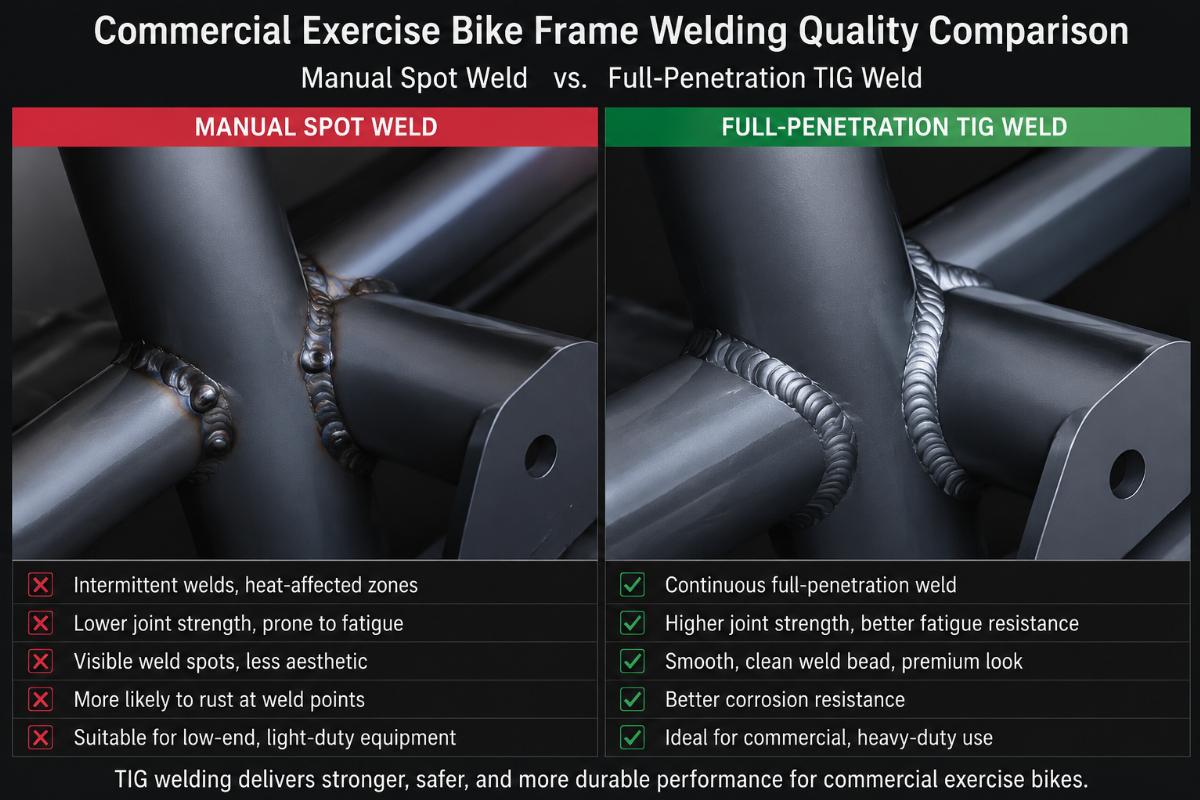
Frame construction is the second major cost variable. Commercial-grade frames use steel tubes with substantially thicker wall gauges compared to home-use frames. This isn’t about adding weight for perceived quality—it’s about load-bearing capacity and resistance to flex under repetitive high-intensity use. Thicker wall tubing requires more raw material, more robust welding jigs, and longer welding cycles. The welding process itself separates tiers: manual spot welding is fast and cheap but creates inconsistent penetration, while robotic or TIG welding along full joint lengths produces structurally superior connections that withstand years of dynamic loading. [NEED_CITE: frame tube wall thickness and welding method correlation with commercial fitness equipment durability standards]
The third element—bearings, belt or chain drive, and resistance mechanism—operates at a different cost scale but has outsized impact on maintenance frequency. Sealed cartridge bearings rated for commercial duty cycles cost multiples of open bearings used in budget units. The resistance system (magnetic, brake pad, or electromagnetic) introduces its own component cost layers.
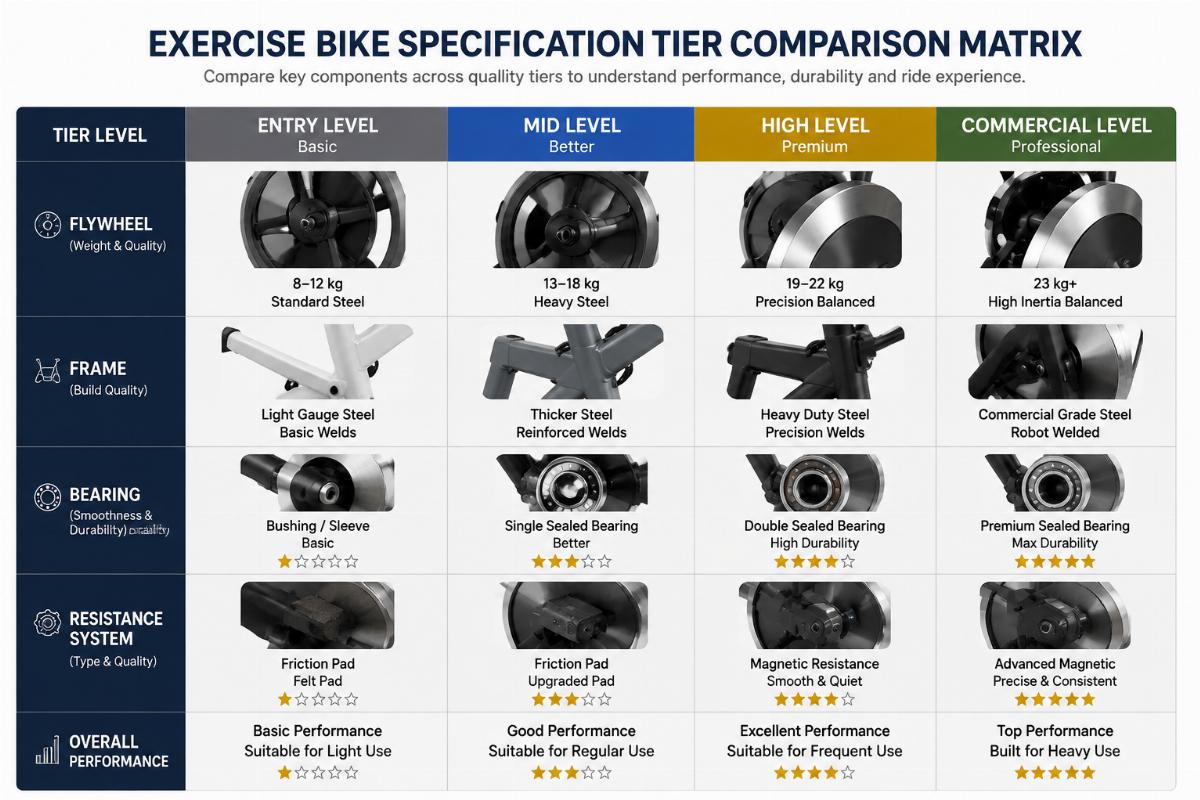
| Cost Driver | Entry-Level Home | Mid-Range Commercial-Lite | Full Commercial-Grade |
|---|---|---|---|
| Flywheel Process | Sand-cast recycled iron | Gravity-cast with basic balancing | CNC-machined or precision-molded |
| Frame Tube Wall | Thin-gauge, manual welded | Medium-gauge, mixed welding | Heavy-gauge, full-penetration welded |
| Bearing Spec | Open bearings, basic rating | Sealed bearings, standard rating | Sealed cartridge, commercial duty rating |
| Resistance System | Basic brake pad | Standard magnetic | Electromagnetic or advanced magnetic |
| Certification | None or self-declared | Partial testing | Full CE/EN957 compliance |
A gym chain buyer once compared two exercise bike price guide quotes side by side—the difference looked negligible on paper. But one quote specified open bearings and sand-cast flywheels while the other included sealed commercial bearings and precision-machined flywheels. The maintenance trajectory over five years diverged dramatically. [NEED_CITE: bearing failure rate comparison between open and sealed cartridge bearings in commercial cycling equipment]
Commercial vs Home Exercise Bike: Price vs Performance Matrix
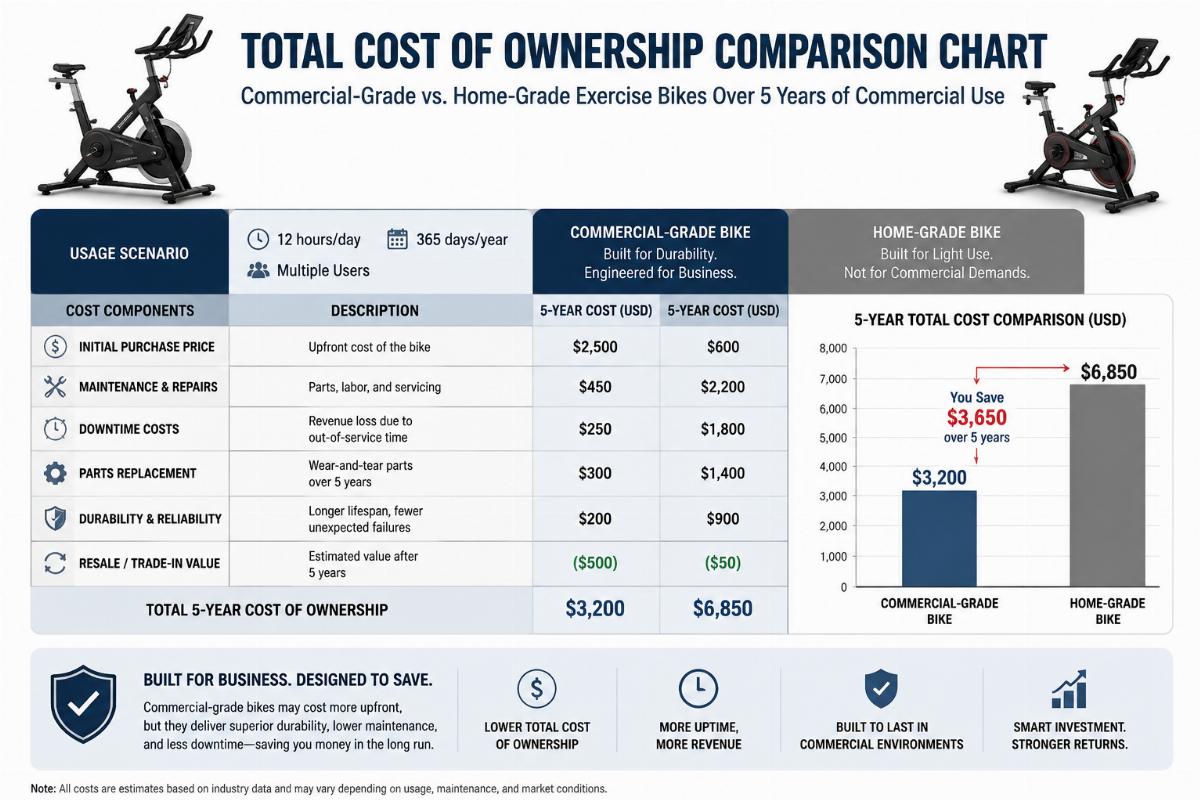
Commercial-grade exercise bikes carry a higher initial unit cost, but their five-year total cost of ownership drops noticeably compared to home-grade units deployed in commercial environments.
This is where the exercise bike price guide becomes misleading if you only look at the purchase invoice. The real comparison requires calculating total cost of ownership across the equipment’s usable service life in a high-traffic setting.
Commercial environments subject equipment to fundamentally different stress profiles than home use. A hotel fitness center or commercial gym sees continuous sequential use—multiple users per day, extended operating hours, and minimal downtime tolerance. Home-grade equipment engineered for one to two hours of daily use by a single household simply cannot sustain this load profile. The components fatigue faster, bearings degrade sooner, and structural flex accumulates.
| Performance Dimension | Home-Grade in Commercial Setting | Commercial-Grade in Commercial Setting |
|---|---|---|
| Maintenance Frequency | Substantially higher | Noticeably reduced |
| Component Replacement Interval | Frequent, often within first year | Extended service life meaningfully |
| Structural Flex Under Load | Noticeable under heavy riders | Minimal, robust frame geometry |
| Downtime Impact | High—units pulled from service | Low—designed for continuous operation |
| Five-Year TCO | Significantly elevated | Substantially lower |
I worked with a fitness chain that ran a side-by-side deployment across multiple locations. One site used commercial-lite bikes sourced from a trading company chasing low exercise bike price guide numbers, while another site deployed full commercial-grade units from a direct manufacturer. Within the first year, the commercial-lite site was scheduling maintenance visits at multiples of the frequency at the commercial-grade site. Replacement parts consumption told the same story. By year three, the cumulative maintenance expenditure at the budget site had erased most of the initial purchase savings. [NEED_CITE: total cost of ownership analysis commercial versus residential fitness equipment in high-usage environments]
The critical insight: deploying home-grade equipment in a commercial setting doesn’t save money—it defers cost into maintenance budgets and member dissatisfaction. The exercise bike price guide only tells half the story if it ignores deployment context.
China Factory Direct Pricing: What’s Realistic in 2026?
Realistic factory direct exercise bike pricing in 2026 correlates directly with specification tier—quotes substantially below industry norms for commercial-grade units should trigger immediate scrutiny rather than excitement.
Shandong Province remains the epicenter of commercial fitness equipment manufacturing in China. The concentration of steel supply chains, component suppliers, and experienced welding and assembly workforces creates genuine cost advantages. But this ecosystem also produces a wide spectrum of quality tiers, and the exercise bike price guide landscape reflects this spread.
For full commercial-grade spin bikes with CNC-machined or precision-molded flywheels, heavy-gauge welded frames, sealed commercial bearings, and electromagnetic or advanced magnetic resistance systems, factory direct FOB pricing occupies a defined range. When quotes fall substantially below this range for supposedly equivalent specifications, the cost reduction typically comes from one or more of these areas: downgraded flywheel material or process, thinner frame tube walls, open or low-grade bearings, or substitution of cheaper resistance components.
The pricing structure generally follows this pattern:
| Specification Tier | Flywheel | Frame | Bearings | Resistance | Relative FOB Position |
|---|---|---|---|---|---|
| Entry Home | Sand-cast | Thin-gauge | Open basic | Brake pad | Baseline lowest |
| Mid Commercial-Lite | Gravity-cast | Medium-gauge | Sealed standard | Standard magnetic | Moderate increment |
| Full Commercial | Precision-machined | Heavy-gauge full-weld | Sealed commercial duty | Electromagnetic | Premium tier |
A distributor in the Middle East once showed me three exercise bike price guide quotes for what all three suppliers described as "commercial grade." The spread was striking. When I requested material certificates and bearing specification sheets, only one supplier could provide verifiable documentation matching their claims. The other two had specified lower-grade materials internally while quoting against higher-grade descriptions. [NEED_CITE: specification misrepresentation frequency in commercial fitness equipment sourcing from manufacturing hubs]
The lesson: the exercise bike price guide is only as reliable as the specification verification behind it. A low quote without supporting documentation is not a bargain—it’s an unpriced risk.
How to Verify Factory Quotes Without Getting Trapped
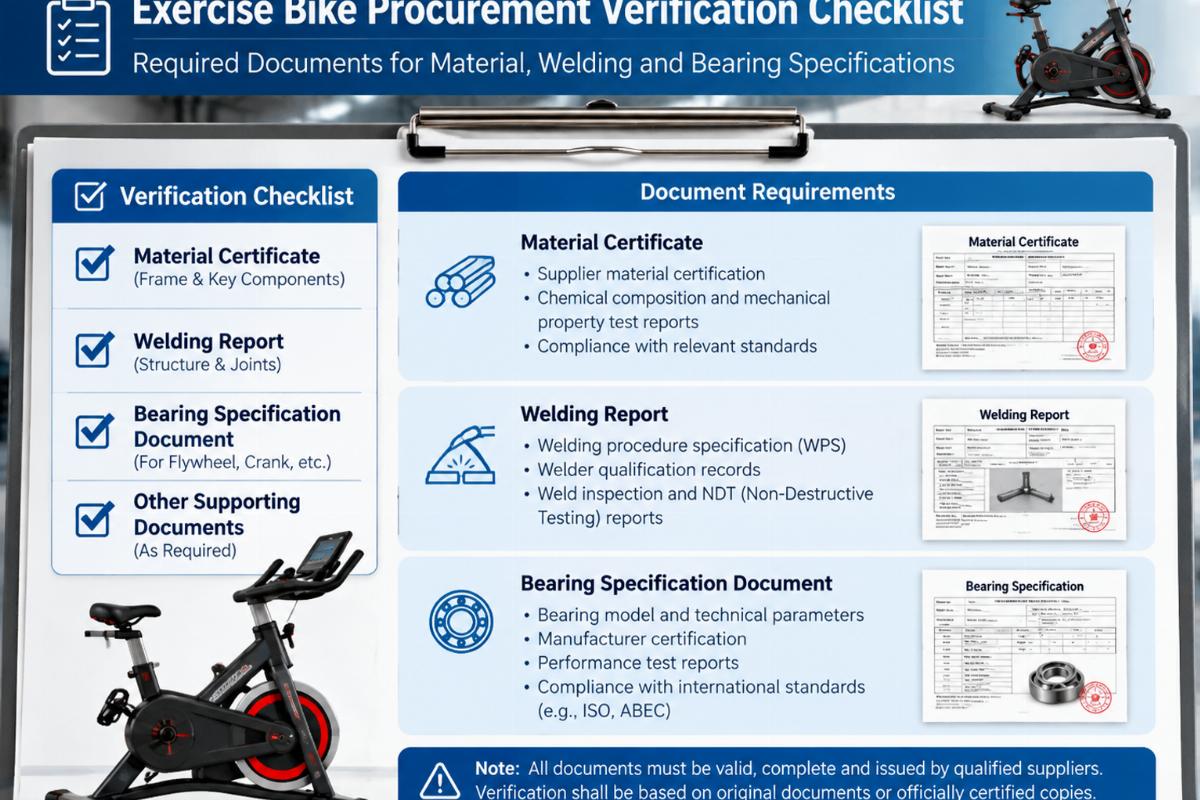
Requesting material certificates, welding inspection reports, and bearing specification sheets before placing an order separates verifiable commercial-grade equipment from paper-specification claims.
Verification is the step most buyers skip, and it’s where the exercise bike price guide becomes practically useful rather than theoretically interesting. The process is straightforward but requires knowing exactly what to ask for.
Step One: Flywheel Material and Process Documentation. Request the factory’s flywheel material certificate specifying the iron or steel grade used. Ask whether the flywheel is sand-cast, gravity-cast, or CNC-machined. If the quote claims precision machining but the factory cannot provide process documentation or allow a third-party inspection of the flywheel production line, the claim is unverified. [NEED_CITE: flywheel material certification requirements for commercial indoor cycling equipment]
Step Two: Frame Steel Specification and Welding Reports. Ask for the steel tube specification including grade and wall thickness. Request welding inspection documentation—visual inspection reports, and ideally penetrant testing or ultrasonic testing results for critical structural joints. Factories running robotic or full-penetration TIG welding processes typically maintain detailed welding logs. Those relying on manual spot welding often cannot produce equivalent documentation because the process variability makes consistent documentation difficult.
Step Three: Bearing and Drivetrain Component Sheets. Request the bearing specification sheet including seal type, load rating, and expected service life under defined conditions. Commercial-grade sealed cartridge bearings come with manufacturer specification sheets detailing these parameters. If a factory sources generic open bearings and cannot provide component-level documentation, the bearing specification in their exercise bike price guide is aspirational rather than factual.
Step Four: Certification Verification. CE certification to EN957 standards is the baseline for commercial equipment entering most international markets. Request the actual test report—not just a certificate cover page—and verify that the report covers the specific model configuration being quoted, not a different variant. [NEED_CITE: EN957 certification scope and model coverage requirements for stationary cycling equipment]
A buyer in North Africa learned this process the expensive way. They placed a large order based on a compelling exercise bike price guide quote with impressive specification descriptions. When the shipment arrived and a third-party inspector was engaged, the flywheel material did not match the certificate provided during quotation, the frame tube wall thickness measured below the quoted specification, and the bearings were open-type rather than the sealed commercial units described. The order had to be renegotiated under significant time pressure. [NEED_CITE: third-party inspection discrepancy rates in commercial fitness equipment imports]
Volume Discounts and Container Loading Strategy
Full container load procurement reduces per-unit exercise bike pricing substantially compared to less-than-container consolidation, but the logistics math requires careful calculation rather than assumption.
The exercise bike price guide conversation shifts meaningfully when volume enters the equation. Factory direct pricing operates on a tiered structure where per-unit cost decreases as order volume increases—up to a point. The most significant cost reduction comes not from the factory’s volume discount alone, but from the logistics efficiency of full container loading.
Exercise bikes are bulky items. A standard ocean shipping container holds a finite number of units depending on how efficiently they’re packed. Factories experienced in export packaging design their product dimensions and disassembly points to maximize container utilization. When you order a full container of a single model or a carefully planned mixed model load, the per-unit shipping cost drops sharply compared to consolidating smaller quantities across multiple shipments or sharing container space with unrelated goods.
The volume pricing structure typically follows this pattern:
| Order Volume | Factory Unit Price Position | Per-Unit Logistics Cost | Combined Per-Unit Landed Cost |
|---|---|---|---|
| Sample or Low MOQ | Baseline highest | Substantially elevated | Significantly highest |
| Partial Container | Moderate discount | Elevated | Moderately high |
| Full Container Single Model | Noticeable discount | Optimized lowest | Substantially reduced |
| Full Container Mixed Models | Moderate discount | Well-optimized | Noticeably reduced |
A distributor planning to enter a new market often starts with a partial container to test demand. This approach makes sense for market validation, but the exercise bike price guide numbers at partial-container volume should not be treated as the long-term cost baseline. Once demand is confirmed, restructuring orders to full container loads produces a meaningful per-unit cost reduction that directly improves margin or competitive pricing position.
The trap: some buyers focus exclusively on the factory’s quoted unit price and ignore the logistics component. A slightly higher factory unit price on a full container load can produce a lower total landed cost than a lower factory unit price on a partial container with elevated shipping expense. The exercise bike price guide must account for the complete landed cost picture. [NEED_CITE: container loading optimization and per-unit logistics cost reduction in fitness equipment export]

Conclusion
The exercise bike price guide that matters is the one backed by verifiable specifications, not the one with the lowest headline number. Flywheel material integrity, frame construction quality, and commercial-grade component selection determine real cost structure. Factory direct sourcing from established manufacturing regions delivers genuine value, but only when specifications are independently verified through material certificates, welding documentation, and component specification sheets. Volume procurement and container loading optimization further reduce landed costs for committed buyers. The cheapest quote is rarely the lowest total cost—the exercise bike price guide must be read through the lens of deployment context, specification verification, and total cost of ownership.


