01 / Scenario
STUDIO
P
High-End Pilates Studios
Premium aesthetics meet quiet operation for boutique studio environments.
ISO
9001
CE
Certified
OEM
Available
10YR
Warranty
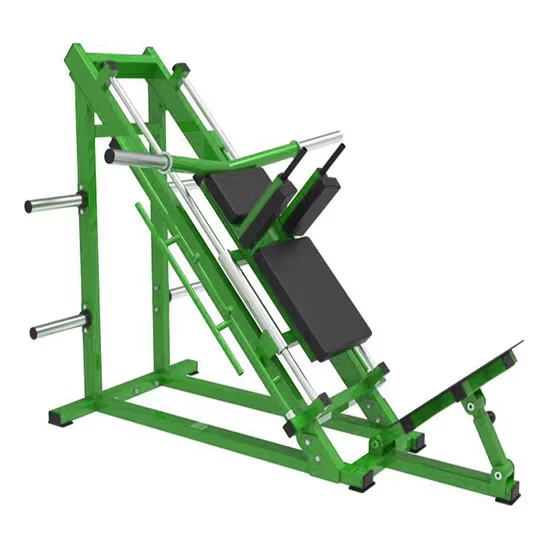
Commercial Linear Hack Press Machine, 2375×1500×1475mm, 250kg Net Weight — plate loaded leg training equipment built with steel frame construction for progressive resistance under heavy eccentric loads. Engineered with manual power source and unfolded configuration for commercial gym and community fitness center environments. Every unit undergoes load testing before shipment to verify structural integrity for high-traffic use.
// Spec Highlights
• Direct from Manufacturer · No Middlemen · Worldwide Shipping
01
// Material
Imported Solid Wood
Premium hardwood frames sourced for density and visual warmth.
02
// Hardware
Medical-Grade Silent
Whisper-quiet pulleys and springs for clinical environments.
03
// Customization
Appearance OEM
Color, upholstery, and branding tailored to your studio.
04
// Service
Layout Design
Free venue planning for studios and rehab institutions.
Every component is selected for longevity, performance, and aesthetic harmony - from imported hardwood frames to silent medical-grade accessories.
// Features
Steel Traceability — Every tube in this Linear Hack Press traces back to the Q235/Q345 mill coil certificate, not a vague "commercial grade" label.
| Parameter | Value |
|---|---|
| Product Type | Linear Hack Press Machine |
| Frame Steel Gauge | 11-gauge |
| Frame Tube Size | 3×3 inch |
| Steel Grade | Q235 / Q345 industrial steel |
| Welding Type | Robotic MIG continuous weld |
| Loading Type | Plate loaded |
| Bearing Type | Sealed industrial bearings |
| Powder Coating | 200μm scratch-resistant |
| Product Dimensions | 2375×1500×1475mm |
| Net Weight | 250kg |
| Certification | ISO 9001, CE |
| Warranty | 10-year frame warranty |
| Facility Type | Typical Use |
|---|---|
| Commercial gym strength floor | Primary bilateral leg press station for general membership |
| University strength and conditioning room | Off-season lower-body hypertrophy and strength cycles for athletes |
| Hotel fitness center | Space-efficient plate loaded leg station for traveling guests |
| Rehabilitation and performance center | Controlled linear-path knee extension loading under supervision |
| CrossFit box functional zone | Heavy single-leg and bilateral press work between WODs |
Tube wall thickness dictates whether the carriage rails stay parallel when a member unloads plates on one side.
Many machines on the market carry a "commercial grade" tag without publishing the actual gauge of the mainframe tubing. When the wall is thin, eccentric loading — a common scenario when users load unevenly or shift during the press — introduces lateral flex into the carriage guide system. That flex translates into binding on the guide rods and premature wear on whatever bearing is riding the rail [NEED_CITE: structural tube gauge and deflection thresholds under eccentric loading]. On the commercial linear hack press machine you are evaluating, the 11-gauge frame with 3×3 inch square tubing is designed so the deformation threshold sits well above the maximum realistic plate load a single user would apply, keeping the carriage tracking straight through the full range.
The linear hack press targets the quadriceps, glutes, and adductor magnus through a fixed sagittal-plane path, filling the gap between free-weight barbell squats and isolated leg extensions. In a commercial floor plan, it pairs naturally with a leg press sled and a seated leg curl to cover the major lower-body movement patterns without redundant footprint overlap. The 2375×1500mm footprint requires clearance on at least three sides for safe plate loading and user entry, making it suitable for mid-density strength floors where dedicated plate loaded bays are configured. Users ranging from shorter to taller statures can position themselves on the footplate to adjust the effective knee angle at the bottom of the travel, accommodating a broad membership base on a single commercial linear hack press machine without additional adjustable components.
Each repetition generates a combined axial and bending load on the carriage rail mounts and the lower frame gussets, with peak stress arriving at the transition welds where the angled press rails meet the base frame. In a high-traffic gym running eight or more operating hours daily, those welds may endure thousands of load-unload cycles per week, accumulating fatigue at any discontinuity in the weld bead [NEED_CITE: fatigue crack propagation at welded joints in cyclically loaded fitness equipment]. Sealed industrial bearings on the carriage are specified to exclude chalk dust, sweat aerosol, and floor cleaner residue that would otherwise infiltrate the race and create play within the first year of operation. The 200μm powder coating at the footplate contact edges and shoulder pad mounting bolts resists the chipping that exposes bare steel to corrosion from accumulated perspiration and disinfectant spray.
The 11-gauge wall thickness combined with the 3×3 inch square cross-section produces a moment of inertia that limits lateral deflection under asymmetric loads, which is the primary cause of carriage binding in linear press designs. Robotic MIG continuous welding eliminates the start-stop cold joints inherent in manual spot welding; a continuous bead distributes stress across the full joint length rather than concentrating it at discrete weld points. Sealed bearings differ from open bushings in that the sealed race retains factory lubrication and excludes particulate contamination, directly extending the interval before carriage play develops and guide rod scoring begins. The 200μm powder coat, applied over a sandblasted substrate, achieves mechanical adhesion that thin decorative coatings cannot match at high-contact zones like the plate horn sleeves and footplate edges where steel-on-steel contact occurs during plate changes [NEED_CITE: powder coating adhesion and thickness standards for commercial fitness equipment].
Thinner tube walls that save material cost upfront will flex under heavy plate loads, shifting the carriage off its intended path and accelerating wear on guide rods and bearings until the machine develops audible play and requires carriage rebuilds. Spot-welded joints at the base gussets may hold during initial QC inspection but propagate fatigue cracks under months of cyclic loading, creating a liability event if a weld fails with a member under load. Unsealed bearings in the carriage system demand periodic inspection and replacement as chalk and sweat penetrate the race, generating maintenance labor costs that compound across every plate loaded station on the floor. Thin powder coatings chip at the plate horn and footplate contact zones within months, exposing untreated steel to sweat corrosion that spreads beneath the remaining coating and forces a full strip-and-recoat far earlier than a properly specified commercial linear hack press machine would require.
The 11-gauge Q235/Q345 steel sourcing includes mill certification traceable to the original coil, so the gauge claim is verifiable rather than marketing language. Robotic MIG welding on this machine produces continuous weld lines at every structural joint, removing the operator-dependent inconsistency of manual welding from the fatigue equation. Every unit undergoes a full load test before crating, confirming carriage travel and frame alignment under actual weight rather than relying on sample-based batch testing. The 200μm scratch-resistant powder coating is applied after sandblasting to ensure adhesion survives years of plate contact and cleaning chemical exposure. The 10-year frame warranty reflects confidence in the steel specification and weld protocol. Floor planning CAD support accounts for the 2375×1500mm footprint plus required safety clearances on the plate loading side and user exit path, preventing the unusable gaps that appear when equipment is ordered without spatial coordination.
Provide the total square footage of your strength zone along with your planned equipment list so we can generate a 2D or 3D floor plan showing this machine’s clearance envelope in context. Specify the expected daily user volume and average member profile so the structural grade and bearing specification can be confirmed as appropriate for your traffic level. Communicate any custom color, logo, or upholstery requirements at the inquiry stage to ensure the powder coating and pad materials are matched to your facility’s branding and cleaning protocol.
Q: How can a buyer verify that a hack press is genuinely commercial grade rather than light commercial?
A: Request the mill certificate for the frame steel, which documents the gauge, grade, and originating coil number. Inspect the welding at high-stress joints for continuous beads rather than discrete spot welds. Confirm that the manufacturer load-tests every unit individually before shipment, not just a sample from each production batch. These three data points separate verifiable commercial construction from marketing claims.
Q: What steel tube dimensions prevent frame flex during heavy plate loaded leg presses?
A: The combination of wall thickness and cross-section size determines resistance to bending. An 11-gauge wall in a 3×3 inch square tube provides a moment of inertia that limits lateral deflection when loads are applied asymmetrically. This keeps the carriage rails parallel and prevents the guide rod binding that thinner or smaller-section tubes develop under repeated eccentric loading in a commercial environment.
Q: How does welding quality influence the service life of a linear hack press?
A: Continuous robotic MIG welds distribute stress evenly along the full joint length, whereas spot welds create localized stress concentrations where fatigue cracks initiate under cyclic loading. On a hack press, the critical joints are where the angled carriage rails meet the base frame and where gussets reinforce the lower uprights. Continuous welds at these points maintain structural alignment through thousands of weekly load cycles.
Q: What floor clearance is needed around a linear hack press for safe operation?
A: Beyond the machine’s own footprint of 2375×1500mm, allocate clearance on the plate loading side for a user to stand and handle bumper plates, space behind the carriage for full travel without wall contact, and a lateral exit path. A detailed floor plan CAD layout accounts for these zones alongside adjacent equipment to prevent unsafe congestion in the strength training area.
Q: What maintenance does the sliding carriage system require under commercial use?
A: Sealed industrial bearings on the carriage require periodic visual and tactile inspection for lateral play and smooth travel, typically on a quarterly schedule in high-traffic facilities. Guide rods should be wiped clean of chalk and dust accumulation. Unlike open bushings, sealed bearings retain factory lubrication and exclude contaminants, substantially extending the interval between carriage component replacements.
Premium aesthetics meet quiet operation for boutique studio environments.
Medical-grade silence and precision for sports & postpartum recovery.
Furniture-grade craftsmanship for premium residential installations.
Compact premium setups for one-on-one and small-group training.
Aesthetic Pilates integration for hybrid wellness studio programming.
Multi-unit deployment with instructor-grade reliability for certification programs.
Tell us about your project. Our team will respond within 24 hours with pricing, customization options, and shipping details.
// Sales Director
William
+86 132 2531 1800
// Export Manager
Bella
+86 198 5412 8032
william@bickfit.com