01 / Scenario
STUDIO
P
High-End Pilates Studios
Premium aesthetics meet quiet operation for boutique studio environments.

ISO
9001
CE
Certified
OEM
Available
10YR
Warranty
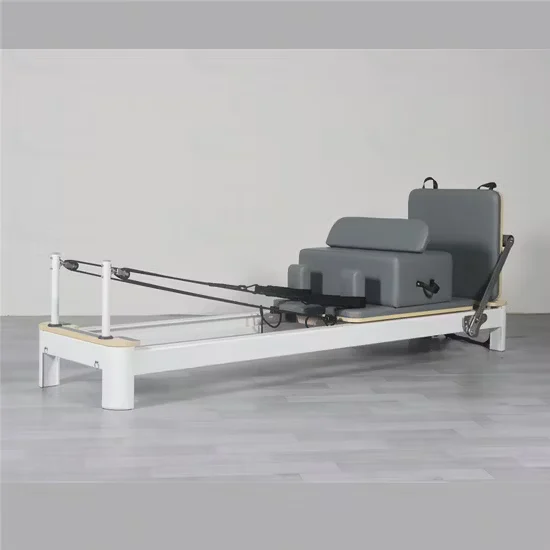
Pilates Reformer, Solid Wood Frame, 2460×730×680mm — engineered with a 100kg net weight for vibration-free carriage glide, paired with long box, jump board, and platform for full-spectrum studio programming. Custom logo and color options available to match facility branding. Every unit undergoes 32-point inspection and 100% load testing before dispatch.
// Spec Highlights
• Direct from Manufacturer · No Middlemen · Worldwide Shipping
01
// Material
Imported Solid Wood
Premium hardwood frames sourced for density and visual warmth.
02
// Hardware
Medical-Grade Silent
Whisper-quiet pulleys and springs for clinical environments.
03
// Customization
Appearance OEM
Color, upholstery, and branding tailored to your studio.
04
// Service
Layout Design
Free venue planning for studios and rehab institutions.
Every component is selected for longevity, performance, and aesthetic harmony - from imported hardwood frames to silent medical-grade accessories.
// Features
Solid Wood Frame — Precision-milled solid hardwood rails maintain carriage alignment under continuous spring tension, preventing the drift common in composite alternatives.
| Parameter | Value |
|---|---|
| Product Type | Pilates Reformer |
| Frame Material | Solid Wood |
| Frame Color Options | Solid color range, customization available |
| Product Dimensions | 2460 × 730 × 680 mm |
| Net Weight | 100 kg |
| Included Accessories | Long Box, Jump Board, Platform |
| Logo Customization | Available |
| Target User | Adult, Unisex |
| Warranty | 3 Years |
| Facility Type | Typical Use |
|---|---|
| Commercial Pilates Studio | Daily group and private reformer sessions across varied user levels |
| Boutique Fitness Studio | High-frequency class scheduling with rapid equipment turnover |
| Rehabilitation and Physiotherapy Center | Controlled resistance protocols for post-injury and mobility recovery |
| Hotel Fitness Facility | Guest-accessible reformer stations requiring low-maintenance operation |
| Home Gym | Dedicated personal practice space with studio-grade equipment |
Solid hardwood rails resist the micro-abrasion and warping that degrade composite surfaces within months of studio-scale use.
When sourcing reformers for a multi-station studio, the frame finish often drives the initial impression. But the carriage-to-rail interface dictates long-term performance. Composite and hollow-core wood frames absorb ambient moisture unevenly, causing rails to bow and carriage wheels to develop lateral play [NEED_CITE: EN 957 structural requirements for stationary training equipment]. In a facility running six or more classes daily, that drift compounds — members notice the stutter before instructors report it. A commercial pilates reformer wood frame built from properly kiln-dried solid hardwood maintains dimensional stability across seasonal humidity shifts, keeping the glide path true and reducing warranty callbacks.
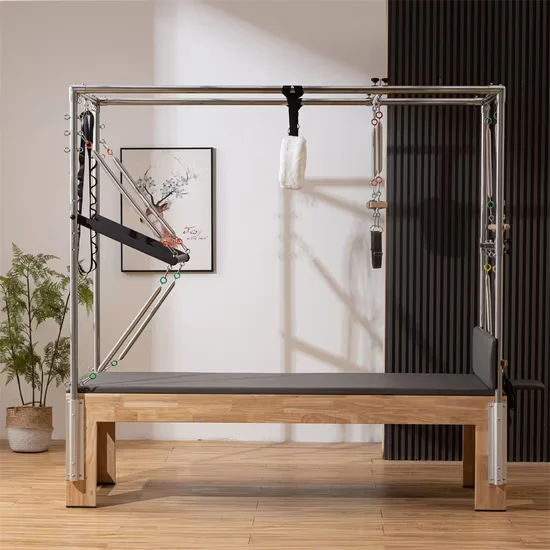
This reformer covers the full spectrum of classical and contemporary Pilates repertoire — supine footwork, seated rowing, prone pulling, and standing platform work. The included long box, jump board, and platform extend exercise variety without requiring auxiliary equipment purchases. In a studio layout, it pairs naturally with a cadillac or tower unit for mat-to-apparatus progression and fits a functional training zone that blends Pilates with mobility work. The commercial pilates reformer wood frame suits facilities running moderate to high daily throughput, and its 2460 mm length accommodates users across a broad height range without frame extension adjustments.
Every reformer stroke subjects the spring array and carriage bearings to alternating tension and release cycles. In a studio averaging fifty sessions per unit per week, that fatigue accumulation is significant. Spring hooks and attachment points concentrate stress at the frame junction — the area where sub-grade fasteners loosen first [NEED_CITE: weld classification and fatigue performance in structural steel]. Carriage wheels rolling on solid wood rails generate less particulate debris than metal-on-metal tracks, reducing contaminant buildup in the bearing housing. The 100 kg net weight provides a grounded footprint that resists lateral shift during jump board work, where repetitive impact loading tests the frame-to-floor interface.
The solid wood frame delivers inherent vibration dampening that metal and composite materials cannot replicate — wood’s cellular structure absorbs oscillation energy rather than transmitting it through the carriage. Kiln drying to a controlled moisture content prevents the seasonal swelling that causes rail pinch points in inadequately seasoned timber. The 2460 × 730 × 680 mm envelope positions the carriage travel length within the range needed for full-extension exercises while keeping the footprint manageable for multi-unit studio floors. Including the long box, jump board, and platform as standard accessories means the attachment points are factory-fitted and tolerance-matched, rather than field-adapted from third-party add-ons that may not seat flush against the frame. A 100 kg net weight reflects genuine material density rather than hollow-core construction filled for shipping mass.
Hollow-core and laminate reformers enter the market at a lower price point but fail at predictable intervals. Thin veneer over particle board chips at the rail edges where carriage wheels make repeated contact, exposing the substrate to sweat and cleaning solution ingress. Once moisture penetrates, the core swells and the rail surface deforms — no amount of track lubrication recovers smooth carriage travel after that point. Undersized spring anchors in budget frames develop elongation under sustained tension, shifting the resistance curve and creating inconsistency between units in the same studio. Non-standard hardware dimensions mean replacement parts are unavailable from generic suppliers, forcing entire-unit retirement when a single component fails [NEED_CITE: stationary training equipment component serviceability standards].
The solid wood selection is traceable to specific timber grades, not generic "hardwood" claims without verification documentation. Every carriage bearing and rail surface is inspected for runout tolerance before assembly, catching alignment issues that cause binding under load. The 200μm industrial-grade protective coating on metal hardware components resists corrosion from studio cleaning chemicals and user perspiration. A 10-year frame warranty backs the structural integrity claim with contractual commitment. For studio operators planning multi-unit layouts, 2D and 3D CAD floor planning support ensures safe clearance between reformer stations and adequate instructor circulation paths. OEM customization — including logo placement and color specification — allows brand consistency across a facility’s equipment fleet.
Provide your studio floor dimensions and target unit count to receive a 2D or 3D placement plan with safe clearance mapping. Specify your average daily session volume per unit so the structural grade matches your throughput. Indicate your user demographic height and weight range to confirm carriage travel and spring configuration suitability. Share any brand customization requirements — frame color, logo placement, or upholstery preference — for a tailored specification sheet.
Q: How can I verify a reformer uses genuine solid wood rather than composite with a wood veneer?
A: Inspect the rail cross-section at the frame end or accessory mounting point. Solid wood shows continuous grain running through the full thickness, while veneer over particle board reveals a layered structure with a thin decorative surface over compressed fiber. Request a timber species and grade certificate from the supplier that names the specific hardwood used, rather than accepting a generic "wood frame" product description without material traceability.
Q: Which carriage wheel and rail material combination provides the longest service life in a busy studio?
A: Polyurethane wheels on solid hardwood rails offer the best balance of smooth glide and minimal wear debris. Hardwood rails resist surface scoring better than aluminum tracks under continuous rolling contact, and polyurethane wheels maintain their profile without developing flat spots from prolonged static loading between sessions. Avoid nylon-on-metal pairings in high-humidity environments, as thermal expansion differences create inconsistent clearance.
Q: How should spring resistance levels be configured for a studio serving mixed-ability clients?
A: Stock each commercial pilates reformer wood frame with a full progressive spring set covering light through heavy resistance. Studios serving rehabilitation clients alongside advanced practitioners need quick-change spring clips so instructors can reconfigure tension between sessions without tools. Label each spring with its tension rating to maintain consistency across units — when members move between reformers in group classes, identical resistance profiles prevent confusion and maintain exercise integrity.
Q: What attachment fitment checks should I perform when evaluating accessory compatibility?
A: The long box, jump board, and platform should seat flush against the frame without lateral wobble or visible gaps at the mounting interface. Rock each accessory through its full range of motion to confirm that attachment brackets engage completely and do not bind at extreme positions. Interchangeability between units in a multi-reformer studio matters — if accessories are not tolerance-matched at the factory, instructors waste setup time swapping components between stations.
Q: What maintenance does a solid wood frame require under commercial studio conditions?
A: Wipe the frame and rails with a dry cloth after each session to remove sweat and prevent moisture absorption into the wood grain. Avoid liquid cleaners on unsealed wood surfaces — use only products recommended by the manufacturer. Inspect rail surfaces quarterly for scoring or raised grain that could impede carriage travel, and address minor surface irregularities with fine abrasion before they develop into binding points that affect movement smoothness.
Premium aesthetics meet quiet operation for boutique studio environments.
Medical-grade silence and precision for sports & postpartum recovery.
Furniture-grade craftsmanship for premium residential installations.
Compact premium setups for one-on-one and small-group training.
Aesthetic Pilates integration for hybrid wellness studio programming.
Multi-unit deployment with instructor-grade reliability for certification programs.
Tell us about your project. Our team will respond within 24 hours with pricing, customization options, and shipping details.
// Sales Director
William
+86 132 2531 1800
// Export Manager
Bella
+86 198 5412 8032
william@bickfit.com