
01 / Scenario
STUDIO
P
High-End Pilates Studios
Premium aesthetics meet quiet operation for boutique studio environments.
ISO
9001
CE
Certified
OEM
Available
10YR
Warranty
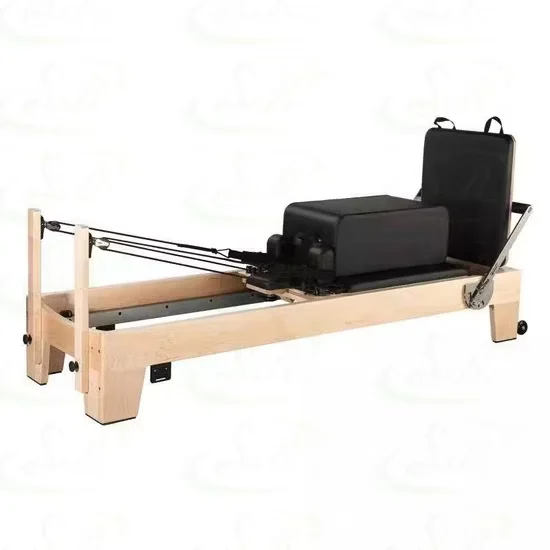
Portable Pilates Reformer, Solid Timber Frame, 2460×730×680mm, 100kg Net Weight — engineered with solid timber carriage construction for dimensional stability under daily studio sliding loads, including long box, jump board, and platform accessories for full-spectrum training. Each unit undergoes load testing before shipment, backed by a 3-year frame warranty and custom logo capability for studio branding.
// Spec Highlights
• Direct from Manufacturer · No Middlemen · Worldwide Shipping
01
// Material
Imported Solid Wood
Premium hardwood frames sourced for density and visual warmth.
02
// Hardware
Medical-Grade Silent
Whisper-quiet pulleys and springs for clinical environments.
03
// Customization
Appearance OEM
Color, upholstery, and branding tailored to your studio.
04
// Service
Layout Design
Free venue planning for studios and rehab institutions.
Every component is selected for longevity, performance, and aesthetic harmony - from imported hardwood frames to silent medical-grade accessories.
// Features
Solid Timber Frame Stability — verified dimension stability under daily sliding cycles without carriage drift or humidity warping.
| Parameter | Value |
|---|---|
| Product Type | Pilates Reformer |
| Model NO. | SRY-02 |
| Product Dimensions | 2460×730×680mm |
| Net Weight | 100kgs |
| Frame Material | Solid Timber |
| Carriage System | Sliding rail with wheel interface |
| Spring Configuration | Multiple anchor points for resistance progression |
| Accessories Included | Long Box / Jump Board / Platform |
| Color | Solid Color |
| Logo | Customized Is Allowed |
| Warranty | 3 Years |
| Age Group | Adult |
| Gender | Unisex |
| Facility Type | Typical Use |
|---|---|
| Boutique Pilates Studio | Group reformer classes and private sessions |
| Rehabilitation Center | Post-injury mobility and core stabilization protocols |
| Hotel Wellness Suite | Guest-accessible low-impact movement equipment |
| Home Studio | Dedicated personal practice space with portable footprint |
| Physiotherapy Clinic | Controlled resistance work for joint recovery |
A commercial portable wooden pilates reformer that develops lateral carriage play within the first year forces studios into a cycle of wheel replacements and client complaints. Solid timber construction with verified grain orientation resists the humidity-induced warping that hollow-core plywood and MDF carriages suffer in climate-controlled studio environments. When the carriage no longer tracks true along the rail, every footwork sequence and long-box exercise introduces lateral deviation that instructors must compensate for verbally — degrading the session quality that clients pay premium rates to receive. [NEED_CITE: dimensional stability standards for solid timber vs engineered wood in fitness equipment]
The joint construction where the rail meets the frame endures repeated eccentric loading during jump board work and standing series. Mortise-and-tenon or reinforced block joints maintain lateral rigidity where simple butt joints with adhesive-only bonding develop micro-movement. That micro-movement accelerates rail wear unevenly, creating a maintenance escalation that compounds across a studio’s entire reformer fleet.
This reformer serves as the primary resistance apparatus in boutique studios running group classes of four to twelve units. The 2460×730mm footprint allows standard studio spacing with adequate clearance for long-box work and platform transitions on either side. It complements cadillac and chair apparatus by handling the majority of supine, seated, and standing spring-loaded movements. The solid timber frame suits environments where visual warmth aligns with studio design intent, and the 100kg net weight holds the unit stable on flooring without permanent anchoring while remaining movable for layout reconfiguration. The commercial portable wooden pilates reformer accommodates users across a wide height range through adjustable spring anchor points and strap configurations.
Each reformer in a busy studio endures dozens of daily sessions where the carriage reverses direction under load — creating impact stress at rail endpoints and fatigue cycling on spring attachment points. The spring anchor configuration determines how resistance progresses through the carriage stroke, and poorly placed anchors concentrate fatigue at specific spring coils rather than distributing wear evenly. Wheel-to-rail interface tolerances degrade fastest when sweat and cleaning solutions penetrate unsealed bearing surfaces, introducing grit that scores both wheel and track. The upholstery on the carriage and long box faces compression cycling that low-density foam cannot survive beyond a few hundred sessions, and replacement schedules depend on whether the cover system allows field servicing or requires factory return. [NEED_CITE: fatigue cycling requirements for sliding carriage fitness equipment]
Solid timber selected for reformer frames must maintain dimensional tolerance through seasonal humidity shifts — a property that varies significantly between species and cut orientation. Quarter-sawn stock resists cupping better than flat-sawn boards, and this distinction determines whether the rail surface stays true over years of carriage travel. The wheel material paired against the rail creates a wear couple: harder wheel compounds last longer but transfer more vibration to the carriage, while softer compounds absorb vibration but require more frequent replacement. Spring steel grade and coil geometry govern the feel of resistance progression and the interval before springs lose their rated tension. Joint construction visible at frame corners reveals whether lateral forces during standing series and single-leg footwork will gradually loosen the structure or hold fast through thousands of cycles.
Reformers built on plywood or MDF cores absorb ambient moisture unevenly, causing the carriage to track off-center and forcing instructors to adjust spring tension asymmetrically as compensation. Thin rail surfaces worn through by high-frequency carriage travel expose substrate material that cannot be resurfaced, requiring full rail replacement rather than simple wheel service. Springs rated for fewer cycles than studio use demands lose their linear resistance curve within months, giving advanced practitioners an inconsistent feel that undermines exercise precision. Non-standard hardware in spring anchors and strap attachment points means replacement parts must be sourced from the original supplier at premium pricing, with downtime extending through shipping delays rather than resolved from local stock. [NEED_CITE: maintenance cost comparison for sealed vs unsealed bearings in studio equipment]
The solid timber sourcing follows the same traceability discipline applied to steel procurement — documented species, grade, and cut orientation verified before frame assembly enters production. Robotic welding protocols from the strength equipment line inform the fixture design and tolerance standards for timber joint reinforcement hardware. Every unit receives load testing on the carriage system under offset loading conditions before packaging, not sample-based QC that lets defects reach studio floors. The 200μm powder coating standard applied to metal components on accessories and hardware ensures corrosion resistance in high-humidity studio environments. The 3-year warranty on this reformer reflects structural confidence, backed by the same facility planning support — including 2D-3D CAD layouts — that maps reformer spacing for safe movement clearance in group class configurations. OEM logo customization integrates into the production run without compromising structural specifications.
Provide your studio floor dimensions and planned reformer count to receive 2D-3D layout planning that accounts for safe clearance during group class choreography. Specify anticipated daily session volume per unit to confirm spring and wheel specification matches your throughput requirements. Indicate target user demographics to verify strap length and spring progression suitability across your client base. Detail any customization requirements including logo placement, frame color, or upholstery selection to integrate these into the production schedule.
Q: How can I verify a reformer uses solid timber rather than plywood or MDF core?
A: Request timber species and grade documentation from the manufacturer. Solid timber shows consistent grain pattern through cut edges, while plywood reveals laminated layers and MDF shows uniform fiber with no grain structure. Solid timber maintains dimensional stability through humidity changes, whereas engineered cores can swell at exposed edges and compromise carriage tracking accuracy over time.
Q: What rail and wheel materials minimize long-term play and noise?
A: The optimal pairing depends on use frequency. Hardened polymer wheels on aluminum or hardwood rails provide quiet operation with acceptable wear intervals for studio use. Sealed wheel bearings prevent sweat and cleaning solution contamination that accelerates play development. Request the manufacturer’s specification on wheel material, bearing type, and rated replacement interval based on daily session counts.
Q: How does spring anchor placement affect resistance feel and replacement intervals?
A: Anchor points positioned to distribute load evenly across spring coils produce a linear resistance curve that advanced practitioners expect. Concentrated loading on fewer coils causes uneven fatigue and earlier loss of rated tension. Ask manufacturers for spring cycle-life ratings and whether anchor geometry is engineered to equalize coil stress rather than simply attaching springs at convenient frame locations.
Q: What are the stability trade-offs between portable and fixed reformers in commercial studios?
A: A 100kg portable reformer holds position during use without floor anchoring and allows layout reconfiguration for different class formats. Fixed reformers eliminate any micro-movement during aggressive jump board work but permanently commit floor space. Studios prioritizing class variety and event flexibility typically prefer portable units, while dedicated reformer-only facilities may choose fixed installation for absolute rigidity.
Q: What warranty components matter most for daily studio reformer use?
A: Frame warranty length reflects manufacturer confidence in joint construction and timber stability under repeated load cycles. Separate coverage terms for springs, wheels, and upholstery acknowledge these are wear items with predictable replacement schedules. Clarify whether warranty service includes field-replaceable parts or requires shipping the unit back, as downtime directly impacts studio revenue and class scheduling.
Premium aesthetics meet quiet operation for boutique studio environments.
Medical-grade silence and precision for sports & postpartum recovery.
Furniture-grade craftsmanship for premium residential installations.
Compact premium setups for one-on-one and small-group training.
Aesthetic Pilates integration for hybrid wellness studio programming.
Multi-unit deployment with instructor-grade reliability for certification programs.
Tell us about your project. Our team will respond within 24 hours with pricing, customization options, and shipping details.
// Sales Director
William
+86 132 2531 1800
// Export Manager
Bella
+86 198 5412 8032
william@bickfit.com
![Foldable Pilates Reformer White Maple Wood for Yoga Studio [WARN] draft identifier mismatch](https://bickgym.com/wp-content/uploads/2026/08/foldable-pilates-reformer-white-maple-wood-for-yoga-studio-warn-draft-identifier-mismatch-d14b7f.webp)


