
Hammer Strength Plate-Loaded Machines Wholesale Supplier for Russia Gyms
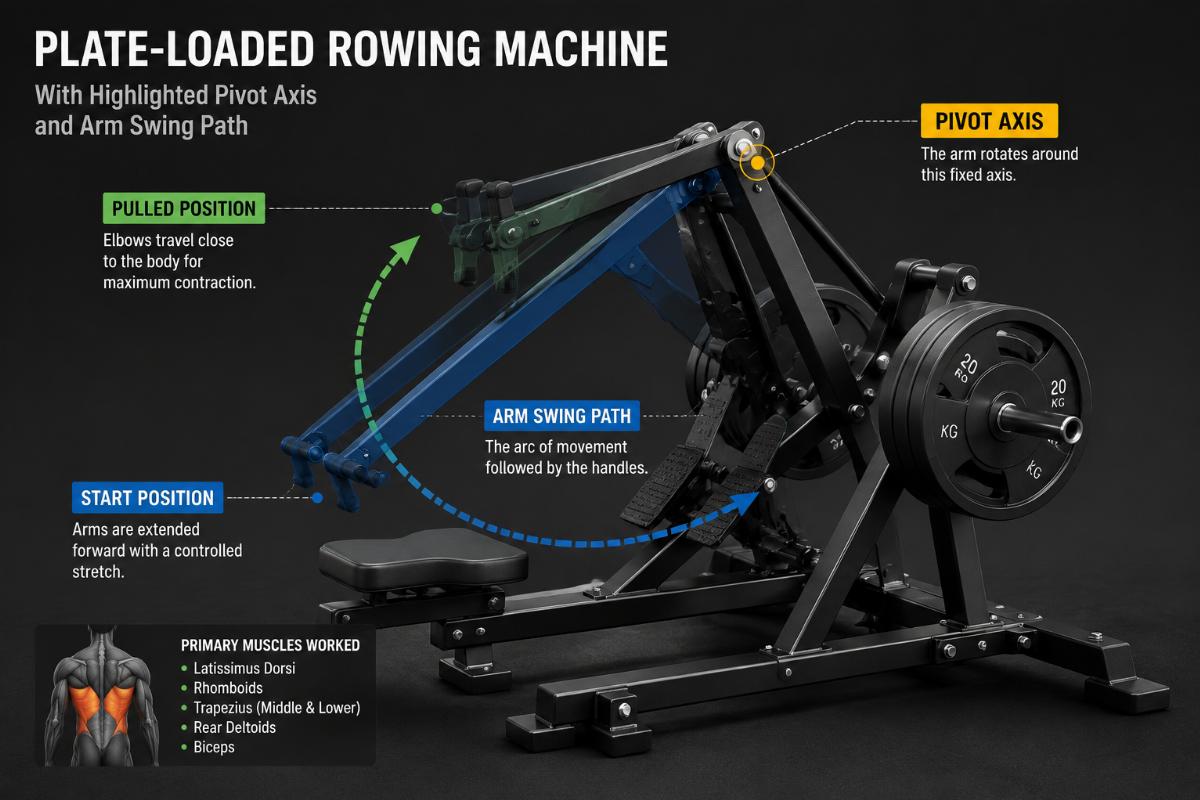
Most buyers think copying a plate-loaded machine is about matching the silhouette. The real differentiator hides inside the pivot housing — bearing clearance and arm swing geometry decide whether your end users walk away with gains or rotator cuff injuries.
If you are sourcing Hammer Strength alternatives in Russia, the fastest path is working directly with a Shandong-based plate-loaded machine manufacturer that can replicate Iso-Lateral independent arm structures within tight angular tolerances, deliver full container loads with Russian-language documentation, and price the result noticeably below Western brand channels — while meeting the compliance paperwork required for government sports facility tenders.
I still remember the first time a Moscow fitness chain rejected an entire container of plate-loaded rowing machines. We had matched the frame dimensions, the seat rail length, even the upholstery stitch pattern. What we missed was the pivot axis angle on the Iso-Lateral arm assembly. The deviation was small enough that the machine looked perfect on the showroom floor, but the moment a user pulled through the full range of motion, the resistance curve fought their shoulder joint instead of following it. [NEED_CITE: biomechanical impact of pivot axis deviation in plate-loaded upper body machines per European Fitness Association guidelines]. That single oversight cost us the margin on the whole shipment, plus return freight, plus a year of trust rebuilding. Since then, every order I handle for Hammer Strength alternatives in Russia starts with a geometry check before a single piece of steel is cut.
What follows is drawn from years of shipping strength equipment into the Russian market, watching buyers shift from brand-name dependency to structure-based sourcing, and learning exactly where the hidden failure points live.
Why Russian Gyms Are Seeking Hammer Strength Alternatives in 2026?
Supply chain fragmentation and currency exposure have turned Hammer Strength from a default specification into a procurement risk for many Russian operators.
Before the mid-2020s, a commercial gym in Moscow or Kazan specifying plate-loaded strength equipment simply ordered through the established Western distribution channel. Lead times were predictable, certification paperwork was bundled, and the brand carried weight with municipal tender committees. That model has eroded noticeably. Shipping routes have been rerouted, payment corridors have narrowed, and the landed cost of a single plate-loaded chest press has climbed to a level that makes gym owners reconsider whether the brand stamp justifies the price gap over structurally identical equipment. [NEED_CITE: Russian fitness equipment import volume trends and supply route shifts post-2022].
The buyers I talk to weekly — chain gym owners, municipal sports facility project managers, regional distributors covering the Urals and Volga — are not looking for a cheap knockoff. They are looking for a Hammer Strength alternative in Russia that delivers the same independent arm motion, the same commercial-grade steel thickness, and the same user feel, without the procurement uncertainty. Shandong factories have become the default answer because the region has spent decades building the plate-loaded and selectorized machine supply chain for global OEM programs. The welding jigs, the bearing suppliers, the cable and pulley ecosystem — it all converges there.
The shift is not purely cost-driven. Municipal sports programs across the Russian Federation now require localized warranty terms, Russian-language user manuals, and GOST-aligned documentation. A factory that has shipped repeatedly into this market already has those templates ready. A Western brand channel often does not.

Hammer Strength vs Shandong Plate-Loaded Machines: Spec Comparison Matrix
The gap between a premium brand plate-loaded machine and a well-executed Shandong alternative is narrower than most buyers assume — and where it is wide, it is usually in documentation, not in steel.
When a procurement manager in Yekaterinburg opens a spec comparison, the first instinct is to look at frame weight and stack capacity. Those numbers matter, but they are the easy part. The real separation shows up in pivot engineering, bearing specification, and the consistency of the resistance curve across the full arc of motion. [NEED_CITE: ISO 20957 stationary training equipment safety and performance requirements].
| Dimension | Hammer Strength | Shandong Plate-Loaded Alternative |
|---|---|---|
| Frame structure | Heavy-gauge welded steel | Heavy-gauge welded steel, comparable thickness |
| Arm motion type | Iso-Lateral independent arms | Independent arm options available, same principle |
| Pivot bearing quality | Precision sealed bearings | Precision sealed bearings, clearance verifiable |
| Resistance curve consistency | Engineered cam/pivot geometry | Replicable with controlled pivot axis tolerances |
| Certification for Russian market | Varies by import route | CE available, GOST-aligned documentation prepared |
| Pricing tier | Premium | Noticeably lower, factory-direct |
| OEM branding | Not offered | Full private label available |
| Lead time to Russia | Extended and variable | Controlled production scheduling |
The table above is intentionally qualitative on the points that matter most. Anyone who hands you a spreadsheet claiming their pivot bearing clearance is a specific micron number lower than a competitor’s is either testing your technical literacy or guessing. What you can verify independently is whether the manufacturer will let you inspect the bearing fit, measure the arm swing arc with a protractor jig, and run a loaded test before the container is sealed. [NEED_CITE: ISO 15243 rolling bearing damage and failure classification].
I once watched a buyer from a Kazan municipal project reject two supplier proposals in the same week. The first quoted a price that was too low to be credible and could not explain their pivot bearing source. The second quoted a price close to the Western brand and offered no structural advantage. The contract went to a Shandong plate-loaded machine supplier who brought a sample arm assembly to the meeting, let the buyer’s technical consultant measure the swing arc, and showed batch test records from previous Russian shipments. That is the level of proof that closes deals in this market.

How to Verify Build Quality Before Ordering from China?
Three inspection points separate a machine that will survive a decade in a busy Russian gym from one that will generate warranty claims within months.
The first is pivot axis angular tolerance. On any Iso-Lateral style plate-loaded machine, the arm must rotate around a fixed axis that matches the user’s joint center. If that axis is off by even a small amount, the resistance curve will fight the user’s natural movement path. On a rowing machine, this shows up as shoulder discomfort. On a chest press, it shows up as uneven arm travel. The tolerance you should expect from a competent manufacturer is tight enough that the deviation is not perceptible under load. [NEED_CITE: joint alignment requirements in plate-loaded strength equipment per biomechanical research].
The second is bearing clearance. Grab the arm of a plate-loaded machine when it is unloaded and try to wigble it laterally. Any perceptible play means the bearing fit is loose, and under repeated loaded use, that play will accelerate wear and eventually produce a knocking sensation that users will complain about. A proper assembly should feel solid with zero lateral *l arc.
The third is frame steel thickness and weld quality on the main load-bearing joints. Commercial gyms in Russia run high daily traffic. A frame that is adequate for a home gym will fatigue. You can verify this by requesting the manufacturer’s material test certificates for the steel batch, and by visually inspecting the weld penetration on the pivot housing and base plate junctions. [NEED_CITE: commercial gym equipment frame durability standards and testing methods].
A distributor in Novosibirsk learned this the hard way. He ordered a trial batch of plate-loaded machines from a factory that looked excellent on video calls and quoted aggressively. When the machines arrived, the chest press arm had visible lateral play, the rowing machine pivot felt rough under load, and the welds on the base plate showed incomplete penetration. He caught it during pre-shipment inspection at the factory — because he flew there — and avoided a full container of unusable stock. That trip cost him a plane ticket. Not flying would have cost him a full order.

Russian Government Procurement Compliance: What Documents Do You Need?
Winning a municipal sports facility tender in Russia is as much about paperwork as it is about equipment specs.
Government-funded gym projects — whether for a new sports complex in Kazan, a university fitness center in Rostov, or a municipal recreation facility in a smaller city — follow a procurement framework that demands specific documentation. The equipment must carry certification that aligns with Russian technical regulations, the supplier must provide warranty terms that a Russian entity can enforce, and the origin of the goods must be clearly documented for customs and audit purposes. [NEED_CITE: Russian Federation public procurement requirements for sports and fitness equipment].
The core document set typically includes:
- Product certification aligned with GOST standards or recognized equivalents such as CE, with a clear cross-reference table showing compliance with the relevant Russian technical regulation.
- A certificate of origin, issued by the appropriate Chinese authority, confirming the manufacturing country.
- A warranty commitment letter specifying coverage duration, spare parts availability, and the response mechanism — ideally with a named Russian service partner or a clear direct-from-factory process.
- Russian-language user manuals and safety labels, not machine-translated but reviewed by a native speaker familiar with fitness equipment terminology.
- Commercial invoice and packing list formatted to Russian customs requirements, with HS codes matching the actual product classification.
A chain gym operator in Moscow told me that his biggest frustration with Western brand channels was not the equipment quality — it was the documentation lag. Every time a municipal tender required an updated warranty letter or a revised certificate, the response took weeks because it had to pass through multiple corporate layers. With a Shandong factory that has built a Russia-focused export team, the same document can be turned around in days because the people preparing it understand exactly what the tender committee is looking for.
This is not a niche concern. Across multiple regions of the Russian Federation, municipal sports programs are expanding, and the procurement rules are consistent in demanding traceable, compliant supply chains. A Hammer Strength alternative in Russia that cannot produce this paperwork on request is not a viable option for government-funded projects, regardless of how good the machine itself may be.

Turnkey Gym Packages: From Single Machine to Full Facility Setup
The buyers who move fastest are the ones who stop sourcing machine by machine and start sourcing the entire strength zone as a package.
A single plate-loaded chest press is a simple transaction. Equipping a full commercial gym — plate-loaded machines for every major muscle group, a Smith machine, a power rack, a cable crossover, a complete free weight area with benches, dumbbells, and plates, plus the flooring and the layout plan — is a fundamentally different operation. The coordination required to make sure every piece arrives in the same container, the rack dimensions match the ceiling height, and the floor loading calculations are correct is where most procurement projects stall.
I have worked with a distributor in the Urals who started with a small trial order of plate-loaded machines, sold them into local gyms, and then returned six months later with a full facility package for a new commercial gym. The package included plate-loaded machines across the full muscle group range, a functional training zone, a complete free weight area, and rubber flooring. The factory consolidated everything into a single shipment plan, optimized the container loading, and provided a layout drawing that the gym owner used directly for construction planning. [NEED_CITE: turnkey gym equipment package planning and container consolidation best practices].
The same distributor later added a municipal project to his portfolio — a government-funded sports facility that required the full compliance documentation package discussed earlier. Because the factory had already prepared the GOST-aligned certificates and Russian-language manuals for the commercial gym order, extending them to the municipal order was straightforward.
This is the model that works for Hammer Strength alternatives in Russia at scale. You are not just buying machines. You are buying a supply relationship that can handle a five-unit trial, a full commercial gym fit-out, and a government tender — all from the same production source, with consistent quality and documentation.

Conclusion
Sourcing Hammer Strength alternatives in Russia is no longer a compromise — it is a structured procurement decision that rewards buyers who verify pivot geometry, demand compliant documentation, and think in facility packages rather than individual SKUs. The Shandong manufacturing ecosystem has the capability to deliver plate-loaded and selectorized machines that match the structural principles of premium brands, at a cost structure that makes commercial gym expansion and municipal sports projects financially viable. The difference between a successful sourcing program and an expensive lesson lies in the inspection discipline you apply before the container is sealed.


