
Hoist Fitness Alternatives for Bahrain Rehab Clinic Directors | Bick OEM Supplier
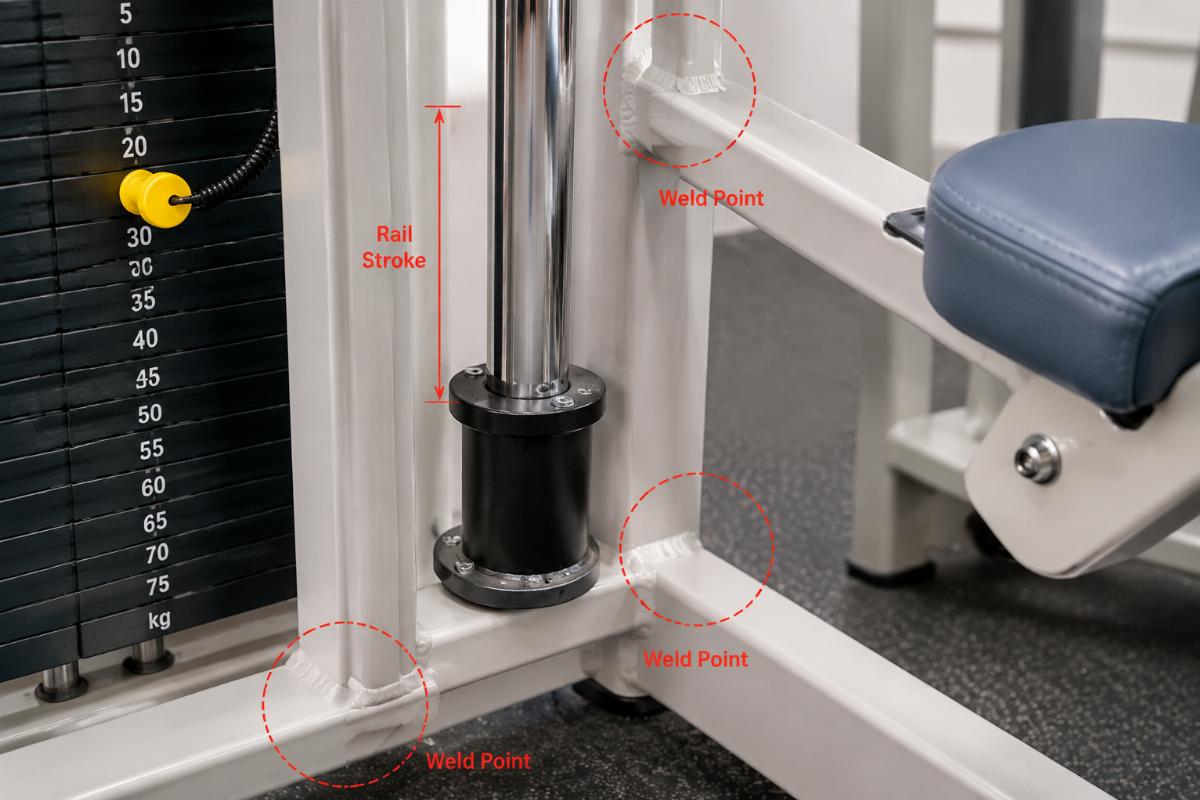
Replacing Hoist Fitness equipment in a Bahrain rehab clinic is not about finding a cheaper lookalike; it is about matching rail stroke, resistance curve, and weld-point geometry so the therapist’s muscle memory stays intact.
When clinic directors in Bahrain search for Hoist Fitness alternatives, the real answer is: source from a Shandong-based OEM factory that performs millimeter-level parameter matching against original Hoist specs, holds CE certification, and delivers unit costs noticeably below the American brand while maintaining commercial-grade weld integrity. [NEED_CITE: Middle East medical device import compliance requirements for rehabilitation equipment]
I spent years handling export documentation and customs clearance out of Ningbo before moving into trade operations, and I still remember the shipment that changed how I handle every rehab equipment inquiry. A Bahrain rehabilitation center ordered a full container of plate-loaded strength machines meant to replace their aging Hoist units. When the container arrived at the port, the clinic’s head therapist tested the leg press, felt the rail travel was shorter than what he was used to, and refused the entire shipment. The gear sat in a Jebel Ali warehouse for weeks, racking up demurrage fees that nearly wiped out any price advantage we had offered. That single incident taught me to never trust visual similarity alone—every replacement order now starts with a parameter-by-parameter comparison sheet before a single prototype is welded.

The rest of this article walks through exactly which parameters matter, how to verify that a Chinese OEM can replicate them, and what the real landed-cost picture looks like when you move beyond unit price.
Why Bahrain Rehab Clinics Are Replacing Hoist Fitness Equipment?
Extended procurement cycles, spare-parts shortages, and rising maintenance overhead are pushing Bahrain clinic directors toward Hoist Fitness alternatives that offer shorter lead times and local supply-chain support.
Hoist Fitness, founded in California and distributed globally through partners such as Shanghai Weikang Sports, has long been a default choice for rehabilitation facilities across the Gulf. [NEED_CITE: Hoist Fitness brand history and global distribution network] However, clinic operators in Bahrain and the wider GCC region have reported growing frustration with lead times that stretch across multiple months, especially when custom upholstery or specific stack weights are involved. Spare parts for older RS series or RPL plate-loaded models can take equally long to arrive, leaving machines out of service and disrupting patient therapy schedules.
A rehabilitation center director in the Gulf once told me that a single broken cable pulley on a Hoist chest press kept the machine idle for an extended period because the replacement part had to be shipped from the United States. The cost of that downtime—measured in missed therapy sessions and therapist idle time—far exceeded any upfront savings from buying the original brand.
Beyond logistics, Bahrain’s growing emphasis on Vision-style health and wellness programs has expanded the number of private physiotherapy clinics and sports rehab facilities. [NEED_CITE: Bahrain healthcare expansion and private clinic growth trends] These new facilities need fully equipped strength zones but cannot always justify the premium pricing of American-made equipment when credible Hoist Fitness alternatives exist with comparable build quality.
The shift is not about rejecting the Hoist brand out of hand. It is about recognizing that a well-specified OEM alternative, backed by CE certification and responsive after-sales support, can deliver the same clinical outcomes without the supply-chain vulnerabilities.
What Parameters Must Match When Switching from Hoist?
Rail stroke, resistance curve profile, and weld-point positioning are the three non-negotiable parameters that determine whether a Hoist Fitness alternative will feel acceptable to the end-user therapist.
Many buyers assume that if a machine looks similar and uses the same weight stack, it will perform the same. That assumption is dangerously wrong. The therapist’s body—the person who uses the machine eight hours a day, five days a week—is the final quality inspector. If the rail travel is even slightly shorter, the exercise feels cramped. If the resistance curve peaks at a different joint angle, the therapeutic loading pattern changes. And if the welds are positioned differently, the machine’s long-term structural behavior under repetitive clinical use becomes unpredictable.
| Parameter | What to Check | Acceptable Standard |
|---|---|---|
| Rail stroke | Measure full travel distance on guide rods | Must match original within controlled tolerance |
| Resistance curve | Map peak and valley positions through full range | Curve shape must replicate original profile |
| Weld-point location | Inspect frame joint geometry and gusset placement | Structural integrity must meet commercial-grade norms |
| Upholstery density | Check foam thickness and vinyl gauge | Clinical-grade durability expected |
| Stack pin mechanism | Test selectorized pin engagement smoothness | Clean, repeatable engagement required |
[NEED_CITE: Rehabilitation equipment biomechanical testing standards for resistance curve validation]
I once worked with a Middle East distributor who received a sample from a factory that claimed to match a popular Hoist leg extension. The visual resemblance was striking. But when the distributor’s technician measured the rail stroke, it was noticeably shorter than the original. The cam profile was also different, meaning the peak resistance occurred earlier in the range of motion. The therapist who tested it said it felt like a different exercise entirely. That sample was rejected, and the factory had to rework the cam and guide rail before a second sample passed.
The lesson is straightforward: never approve a Hoist Fitness alternative based on photographs or a spec sheet alone. Require physical sample verification with calibrated measurement tools, and have the end-user therapist sign off on the feel before the full production run begins.
How to Verify a Chinese OEM Factory Can Replicate Hoist Specs?
Request a side-by-side parameter comparison report, conduct a physical sample test, and confirm CE certification before committing to a production order.
China’s Shandong Province has developed a dense cluster of commercial fitness equipment manufacturers capable of producing Hoist Fitness alternatives that meet international quality benchmarks. [NEED_CITE: Shandong Province fitness equipment manufacturing cluster capabilities] However, capability varies widely. Some factories excel at cardio equipment but lack the welding precision required for heavy-duty plate-loaded machines. Others have strong welding but use inferior bearings or cable systems that degrade quickly under clinical use.
The verification process should follow a clear sequence:
- Parameter comparison report: Ask the factory to produce a document that lists each critical dimension—rail length, cam profile measurements, seat adjustment range, stack weight increments—and compares it directly against the original Hoist specification. [NEED_CITE: OEM fitness equipment parameter matching methodology]
- Physical sample testing: Before placing a full container order, request a pre-production sample. Have your therapist or technical team measure rail stroke with a calibrated tape, test the resistance curve by hand, and inspect all weld joints for penetration and finish.
- CE certification verification: Confirm that the factory holds valid CE certification for the specific machine categories you are ordering. This is not just a regulatory formality; CE certification signals that the factory’s production processes and quality control systems have been audited by a notified body.
- Weld quality audit: Request photos or video of the welding process. Commercial-grade rehab equipment should show consistent, full-penetration welds at all structural joints. Porosity, undercut, or incomplete fusion are unacceptable.
- Component sourcing transparency: Ask where the factory sources its bearings, cables, pulleys, and upholstery. Reputable OEM factories will disclose component suppliers and can provide certificates for critical parts.
A clinic director in the Gulf once told me that he evaluated three different Chinese factories before selecting one for his Hoist Fitness alternatives. The first factory refused to provide a parameter comparison report. The second provided one but the sample failed the rail-stroke test. The third factory delivered a thorough report, a passing sample, and valid CE documentation—and that is the factory that received the full order.

What Is the Real Cost Comparison: Hoist vs Shandong OEM Alternative?
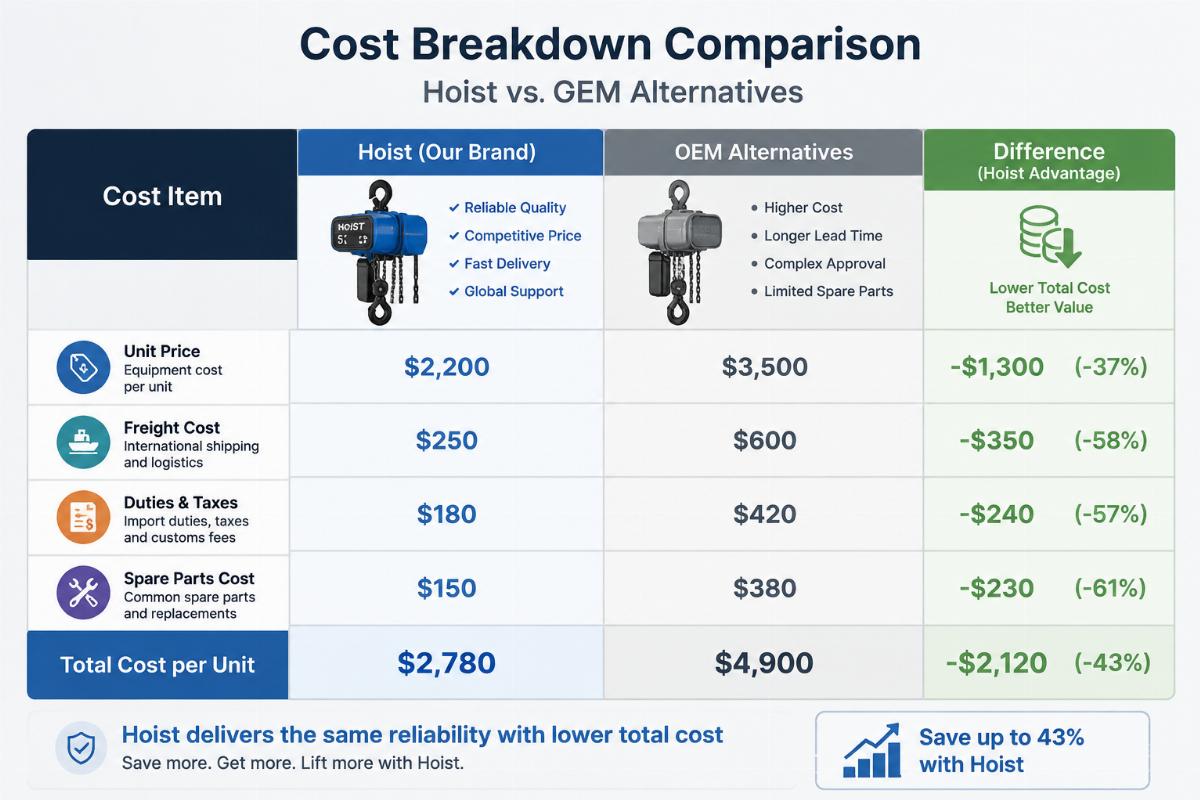
Unit prices for Hoist Fitness alternatives from Shandong OEM factories are substantially lower than the original brand, and even after adding ocean freight, customs duties, and port handling, the total landed cost remains noticeably below what clinic directors would pay for genuine Hoist equipment.
The upfront unit price is only one component of the total cost equation. When evaluating Hoist Fitness alternatives, clinic directors must consider the full landed cost, which includes ocean freight, import duties, port handling charges, inland transportation, and any potential demurrage or storage fees if documentation is not prepared correctly.
Bahrain’s import regulations for medical and rehabilitation equipment require specific documentation, including CE certificates and conformity declarations. [NEED_CITE: Bahrain customs requirements for rehabilitation and medical equipment imports] Factories experienced in exporting to the Gulf will provide complete documentation packages, reducing the risk of delays at the port.
The real cost advantage of sourcing Hoist Fitness alternatives from a Shandong OEM factory becomes even clearer when you factor in spare-parts availability. Original Hoist spare parts can be expensive and slow to deliver. A responsive OEM factory will supply spare parts—cables, pulleys, upholstery, selector pins—at a fraction of the cost, often with shorter lead times because the factory holds inventory of its own components.
I worked with a Bahrain clinic that replaced its entire Hoist strength zone with OEM alternatives. The unit cost savings were substantial. But the bigger financial win came over the following years, when the clinic could order replacement cables and pulleys directly from the factory at prices that were a small fraction of what genuine Hoist parts would have cost. The total cost of ownership over a multi-year period was dramatically lower.
How to Structure a Turnkey Rehab Clinic Equipment Order from China?
From single-machine replacements to full-gym turnkey packages, flexible MOQ policies and container-load consolidation services allow Bahrain clinic directors to source Hoist Fitness alternatives in whatever quantity matches their project scope.
Not every rehab clinic needs to replace its entire equipment fleet at once. Some directors start with a single machine—a leg press or a cable crossover—to test whether the OEM alternative meets their therapists’ standards. Others are outfitting a new facility from scratch and need a complete package covering strength machines, free weights, functional training gear, and cardio equipment.
A professional Shandong OEM factory serving the global market should offer:
- Single-unit MOQ for testing: Allow clinic directors to order one or two machines as samples before committing to a larger order.
- Mixed-container loading: Combine different machine types—plate-loaded, selectorized, functional trainers, free-weight accessories—into a single container to maximize shipping efficiency. [NEED_CITE: Container load optimization strategies for fitness equipment exports]
- Full turnkey packages: Provide complete equipment lists with space-planning support for new clinics, covering every zone from rehabilitation-specific machines to general strength and cardio.
- Spare-parts supply agreement: Include a spare-parts package with the initial order, covering high-wear items like cables, pulleys, and upholstery, so the clinic never faces extended downtime.
- Technical support access: Provide remote technical support for installation guidance and troubleshooting, ensuring the clinic’s maintenance team can handle routine adjustments.
A physiotherapy center in the Middle East recently ordered a full turnkey package from a Shandong factory. The order included selectorized machines for every major muscle group, plate-loaded equipment for rehabilitation-specific movements, a complete free-weight zone, and commercial-grade cardio equipment. The factory provided a loading plan that maximized container utilization, and the entire shipment arrived with complete CE documentation and a spare-parts kit. The clinic director reported that the therapists adapted to the equipment quickly because the parameter matching had been done rigorously during the sampling phase.

Conclusion
Hoist Fitness alternatives from qualified Shandong OEM factories offer Bahrain rehab clinic directors a viable path to reduce equipment costs without sacrificing the biomechanical precision that therapists depend on. The key is rigorous parameter matching, physical sample verification, and a clear understanding of total landed cost—not just unit price. When these steps are followed, clinic directors can equip their facilities with commercial-grade rehabilitation equipment that performs reliably, ships efficiently, and costs substantially less over its full service life.


