Monkey Bar Rig Bulk Order Manufacturer | Factory Direct Pricing
Stuffing more boxes into a container does not cut freight cost per unit—it is the disassembly strategy and CBM optimization that do.
A standard 40HQ can accommodate a significantly higher number of monkey bar rigs when uprights are flat-stacked and accessories serve as fillers, compared to shipping fully assembled units. The loading capacity gap between assembled and knock-down configurations often exceeds thirty percent, and destination-specific documentation alignment prevents customs clearance failures that dwarf the freight savings.
I still remember my early days standing on the dock at Qingdao Port, watching containers get loaded piece by piece. Barbell plates, squat racks, functional rigs—every cubic centimeter mattered. Later, when I shifted to dealing directly with Latin American buyers, I learned that loading optimization is only half the battle. A buyer in São Paulo once had an entire container of strength equipment held at Santos Port for over a month because a single letter on the CE certificate did not match the bill of lading. The demurrage charges ended up costing several times the original freight savings from that shipment. Since then, I verify packing lists, certificates, and commercial invoices against each other multiple times before any container leaves the factory floor. When buyers ask me about container loading configuration monkey bar rig plans, my first question is never about price—it is about destination port customs requirements and whether they need certificate-of-origin preferences applied. [NEED_CITE: ISO 668 series container internal dimensions and maximum payload specifications]
Getting the loading math right from the start changes everything about landed cost. Let me walk through the key areas where most importers leave money on the table.
How Many Monkey Bar Rigs Fit in a 40HQ Container?
The answer depends entirely on whether the rigs ship assembled or knock-down, and the difference in unit count is substantial.
A fully assembled monkey bar rig occupies a fixed footprint dictated by its height and width dimensions. Once you stand those uprights vertically inside a container, you are paying to ship air. The internal height of a 40HQ container is generous, but rig height rarely uses it efficiently when standing upright because the cross-beam structure creates unusable void space above and around the unit. [NEED_CITE: standard 40HQ internal dimensions per ISO container specification standards]
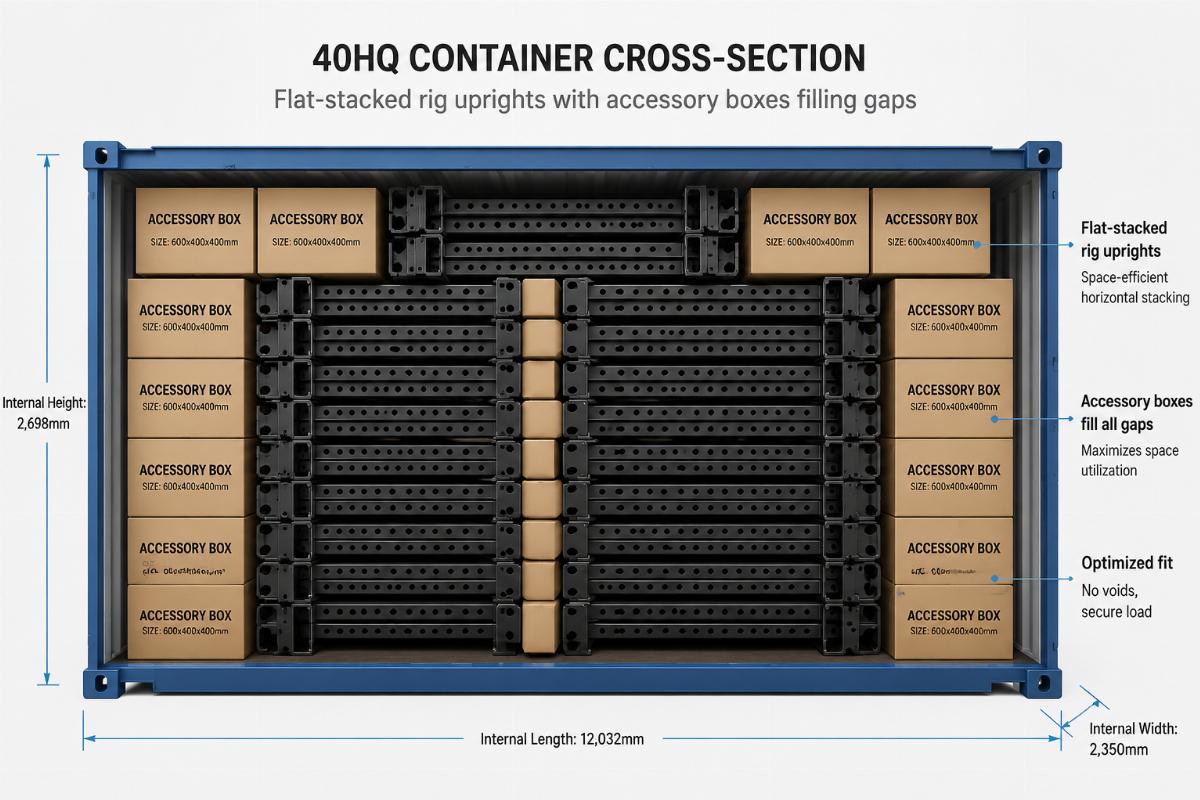
When the same rig is designed for knock-down shipment—uprights detached from cross-members, pull-up bars separated, J-cups and safety straps packed separately—the geometry changes completely. Uprights can be laid flat and stacked, with accessory boxes nested between layers to eliminate dead space. In my experience coordinating bulk shipments, this approach consistently fills the container to a noticeably higher volume utilization rate than assembled loading.
Consider a typical scenario: a distributor in the Middle East ordering a full container of commercial-grade rigs. If the rigs ship assembled, the container reaches weight capacity before volume capacity is exhausted. Switch to knock-down configuration, and the same container carries a significantly larger unit count while staying within axle weight limits. The per-unit freight cost drops accordingly.
However, there is a trade-off that buyers must evaluate honestly. Knock-down rigs require end-assembly at the destination facility. If your customers are commercial gym owners with in-house maintenance teams, this is a non-issue. If they are retail buyers or smaller studios without technical staff, the assembly burden shifts to them, and you must factor in whether your target market can handle that. [NEED_CITE: end-user assembly capability expectations in commercial fitness equipment distribution]
The Bick monkey bar rig line uses a knock-down structural design specifically engineered for container-load consolidation. Uprights, cross-members, and attachment points are engineered for flat-pack shipping without compromising the structural integrity once assembled on-site. This design philosophy directly serves importers who need to maximize units per container.

What Is the Best Loading Pattern for Mixed Rig Bulk Orders?
Flat-stacked uprights with accessory cartons as inter-layer filler delivers the highest CBM utilization, but weight distribution must be verified against container axle limits before sealing.
Mixed bulk orders are the norm rather than the exception. A distributor rarely orders only monkey bar rigs—they want power racks, cable crossovers, free weight sets, and functional training accessories in the same container. This is where loading pattern strategy becomes critical.
The fundamental principle is simple: heavy items go on the bottom, light items fill the voids, and weight must be distributed evenly across the container floor to avoid axle overload at destination ports. Many importers focus exclusively on volume fill and ignore weight distribution entirely, only to face rejection at the destination weigh station or unexpected surcharges. [NEED_CITE: container weight distribution guidelines per international freight standards]
Here is the loading sequence I recommend for mixed rig and free-weight containers:
- Bottom layer: Flat-stacked rig uprights and power rack frames. These are the heaviest steel components and form a stable base.
- Second layer: Cross-members, pull-up bars, and plate-loaded machine frames. These are lighter but still substantial, and they nest into the gaps between upright stacks.
- Third layer: Accessory cartons—J-cups, safety straps, weight pegs, cable pulley assemblies, and small hardware bags. These fill every remaining void and prevent shifting during ocean transit.
- Top layer: Lightest items such as resistance bands, foam rollers, gym flooring rolls, or packaged dumbbells if included in the order.
For a recent order destined to a Latin American distributor, we consolidated monkey bar rigs alongside free weight sets and adjustable benches in a single 40HQ. The rig uprights formed the structural base, free weight plates were packed in the mid-section to balance weight, and bench frames plus accessory hardware filled the upper volume. The result was a container that carried a significantly broader SKU range without exceeding weight limits, and the buyer avoided the cost of a second less-than-container-load shipment.
One critical point: always confirm the total gross weight against the maximum payload of a 40HQ before finalizing the loading plan. Volume utilization and weight utilization are two different metrics, and optimizing one at the expense of the other leads to either wasted space or rejected containers. [NEED_CITE: maximum payload specifications for 40HQ containers per ISO standards]

Which Documents Prevent Customs Delays for Rig Shipments?
Exact model number alignment across the CE certificate, commercial invoice, packing list, and bill of lading is non-negotiable—even a single-character mismatch can trigger weeks of port detention.
This is where I have seen more bulk orders go wrong than anywhere else in the export process. Buyers spend months negotiating pricing, finalizing specifications, and optimizing container loading—then lose all the savings to customs delays caused by documentation errors that could have been caught in minutes.
Let me be specific about what goes wrong. The CE certificate for a monkey bar rig lists the model number as, for example, "BK-MR200A." The commercial invoice says "BK-MR200A." But the packing list, prepared by a different department, says "BK-MR20O" with the letter O instead of the number zero. Or the bill of lading abbreviates the model to "MR200" without the prefix. At origin, nobody notices. At destination, the customs officer cross-references documents, finds the discrepancy, and flags the entire container for inspection.
The consequences are severe. Port storage fees accumulate daily. Demurrage charges apply. In some countries, the container may be held for physical inspection, which adds further delays and costs. I have seen cases where the total detention cost reached a mid-six-figure figure in local currency—completely erasing the margin on the entire order. [NEED_CITE: customs documentation compliance requirements for fitness equipment imports in major destination markets]
The document checklist for rig shipments should include:
- CE certificate with model numbers exactly matching the invoice and packing list
- Commercial invoice with complete product descriptions, HS codes, unit prices, and total value
- Packing list with carton dimensions, gross/net weights, and carton count—model numbers must mirror the CE certificate character-for-character
- Bill of lading with consignee details, shipping marks, and product descriptions aligned to the invoice
- Certificate of origin if the destination country offers tariff preferences under a trade agreement
- Fumigation certificate if wooden packaging materials are used
For every bulk order we ship, the documentation goes through multiple verification rounds before the container departs. Each document is cross-checked against the others by different team members. This process catches the kind of single-character errors that cause port holds. It is not glamorous work, but it protects the buyer’s investment.
Buyers importing into Brazil should pay particular attention. Brazilian customs procedures are among the most stringent in the world, and the INMETRO certification requirements for fitness equipment add another layer of document verification. A mismatch between the CE certificate model and the INMETRO registration can halt clearance entirely. [NEED_CITE: INMETRO certification requirements for imported fitness equipment in Brazil]

How to Calculate Landed Cost Beyond FOB Price?
Freight, insurance, port charges, customs duties, and potential detention penalties can add a substantial percentage on top of FOB—loading optimization directly reduces the per-unit share of every fixed cost component.
Most buyers start their cost analysis with the FOB price and treat freight as a separate line item. This approach misses the full picture. The true landed cost of a monkey bar rig at the destination warehouse includes every expense from factory gate to final delivery, and several of those expenses are directly influenced by how well you optimize the container loading configuration monkey bar rig plan.
Here are the cost components that sit on top of FOB:
- Ocean freight: Calculated per container, not per unit. A container carrying more rigs spreads the freight cost across more units, reducing the per-unit freight share.
- Marine insurance: Typically a small percentage of cargo value, but it scales with declared value. Proper valuation avoids both under-insurance risk and overpayment.
- Destination port charges: Terminal handling charges, wharfage, and documentation fees are generally fixed per container regardless of how many units are inside. More units per container means lower per-unit port charges.
- Customs duties: Calculated as a percentage of CIF value. If your loading optimization reduces the per-unit CIF cost, the duty per unit drops proportionally.
- Detention and demurrage: These are the wildcard costs. A documentation error or customs hold can generate charges that dwarf every other cost component combined. As I mentioned earlier, a single-letter mismatch on a CE certificate once generated detention costs that exceeded the freight savings for the entire shipment.
The calculation logic is straightforward: sum all cost components from FOB to destination warehouse, then divide by the total unit count in the container. Every decision that increases unit count without increasing total cost—such as switching from assembled to knock-down configuration, or filling void space with accessories—reduces the per-unit landed cost.
Conversely, every decision that triggers delays or penalties increases the per-unit cost dramatically. This is why documentation accuracy is not a back-office concern—it is a direct input to your landed cost model.
Buyers who treat container loading configuration monkey bar rig optimization and documentation compliance as strategic procurement activities, rather than afterthoughts, consistently achieve lower per-unit costs than those who focus solely on FOB price negotiation.

Conclusion
Container loading configuration for monkey bar rig bulk orders is a discipline that combines structural disassembly strategy, CBM optimization, weight distribution management, and destination-specific documentation compliance. Getting these elements right reduces per-unit freight cost, maximizes container utilization, and prevents the customs clearance failures that turn freight savings into losses. The difference between a well-planned shipment and a poorly planned one is measured not in percentages of FOB price, but in whether the cargo reaches the buyer’s warehouse on time and within budget.