
Prone Leg Curl vs Life Fitness Signature – Chinese Wholesale Supplier
Chinese prone leg curl manufacturers routinely match premium build standards at a fraction of the cost—provided buyers know exactly which specs to lock in the purchase contract.
A well-specified Chinese prone leg curl machine delivers comparable frame rigidity, cushion longevity, and pulley smoothness to Life Fitness Signature series equipment, while reducing per-unit procurement cost substantially and cutting lead times to a fraction of the typical branded supply cycle.
I still remember a container of strength machines bound for a West African distributor that nearly got held up at the port because the buyer assumed all "leg curl machines" were classified the same way. The HS code difference between a standalone selectorized unit and a plate-loaded frame changed the duty rate entirely. That kind of detail is where sourcing from a Chinese prone leg curl manufacturer either saves you a small fortune or costs you one—depending on how tightly you control the paperwork and the spec sheet before production begins. [NEED_CITE: HS code classification rules for commercial strength training equipment under WCO Harmonized System]
The truth most gym owners and distributors discover too late is that the gap between a top-tier Chinese factory output and a Life Fitness Signature unit is not about capability—it is about specification enforcement. The same welding robots, the same foam molding lines, and the same electrostatic coating ovens can produce machines that last a decade or machines that fail in months. The difference lives in the contract, not the country of origin.

Let me walk you through the measurable differences, the real cost structure, the verification steps that separate reliable sourcing from costly gambles, and the operational realities of lead time and after-sales support—so you can decide whether a Chinese prone leg curl manufacturer is the right move for your next procurement cycle.
What Are the Key Spec Differences Between Chinese Prone Leg Curl Machines and Life Fitness?
The measurable gaps narrow down to three areas: frame steel wall thickness, cushion foam density, and pulley bearing grade—and when buyers specify correctly, most Chinese factory outputs fall within a tight range of Life Fitness benchmarks.
Here is what a side-by-side spec comparison actually looks like when you pull the data sheets:
| Parameter | Life Fitness Signature | Specified Chinese Factory Output | Unspecified Chinese Factory Output |
|---|---|---|---|
| Frame Steel Wall Thickness | Heavy-gauge rectangular tubing | Controlled to match target gauge | Noticeably thinner, inconsistent batch-to-batch |
| Cushion Foam Density | High-density closed-cell | Verifiable high-density certified | Basic density, compresses within months |
| Pulley System | Sealed bearing, aircraft cable | Sealed bearing with nylon sheath | Open bearing, uncoated cable |
| Surface Treatment | Multi-stage electrostatic powder coat | Electrostatic powder coat with salt-spray endurance | Basic spray paint, poor adhesion |
| Weld Quality | Robotic continuous weld | Robotic or certified manual continuous weld | Spot weld, visible porosity |
| Adjustment Mechanism | Precision pin-lock with reinforced housing | Reinforced pin-lock housing | Basic pin-lock, loose tolerance |
[NEED_CITE: EN ISO 20957 stationary training equipment safety requirements and test methods]
A hotel developer in the Middle East once asked me to review two prone leg curl options for a new fitness center buildout. The Life Fitness quote was roughly double the per-unit price of the Chinese alternative. When I pulled the spec sheets side by side, the frame tube dimensions were nearly identical, and the cushion foam density on the Chinese unit was certified to the same range. The real difference was in the pulley cable sheathing—one used a nylon-lined guide, the other left the cable exposed. That single detail would have determined whether the machine needed cable replacement within two years or ran smoothly for a decade.
The takeaway is straightforward: if you do not write the foam density, the steel gauge, and the bearing seal type into your purchase agreement, you will receive the lowest compliant version of each. A Chinese prone leg curl manufacturer will build to Life Fitness parity—the question is whether you asked for it.

How Much Can You Actually Save Sourcing from a Chinese Manufacturer?
Factory-direct pricing from a Chinese prone leg curl manufacturer typically sits well below Life Fitness retail or distributor pricing, but the actual landed savings depend entirely on order volume, container consolidation strategy, and Incoterm selection.
Let me break down the cost structure with a real sourcing scenario. A distributor in West Africa was comparing a single Life Fitness prone leg curl unit at retail-adjacent pricing against a mixed container order from a Shandong-based factory. The per-unit machine price from the Chinese factory was substantially lower—roughly the range you would expect from direct factory pricing versus branded distribution markup. But the real savings came from container consolidation: loading multiple strength machines, free weight racks, and cardio units into a single forty-foot container spread the freight cost across dozens of SKUs, bringing the per-unit landed cost down dramatically.
[NEED_CITE: commercial gym equipment container loading optimization and freight cost allocation methods]
Here is what the cost comparison landscape looks like in practice:
| Cost Component | Life Fitness Branded Channel | Chinese Factory Direct |
|---|---|---|
| Per-Unit Machine Price | Premium branded pricing | Substantially lower factory-direct |
| Minimum Order Requirement | Single unit available | Single unit to full container flexible |
| Container Consolidation | Not applicable | Mixed SKU loading available |
| OEM Branding Cost | Not available | Included or low surcharge |
| Spare Parts Shipment | Regional distributor dependency | Shipped alongside production container |
| Customs Documentation Flexibility | Fixed brand declaration | Adaptable to destination market requirements |
A gym chain operator in Southeast Asia replaced aging branded leg curl units with Chinese-manufactured equivalents and reported that the procurement cycle dropped from the typical branded lead time to a fraction of that window. The capital freed up went directly into additional functional training equipment for the same budget.
The critical point: the headline machine price is only the starting line. A Chinese prone leg curl manufacturer that offers full container consolidation, mixed-SKU loading, and spare parts co-shipment delivers total procurement economics that branded channels simply cannot match for multi-unit buyers.

What Should You Verify Before Placing an Order?
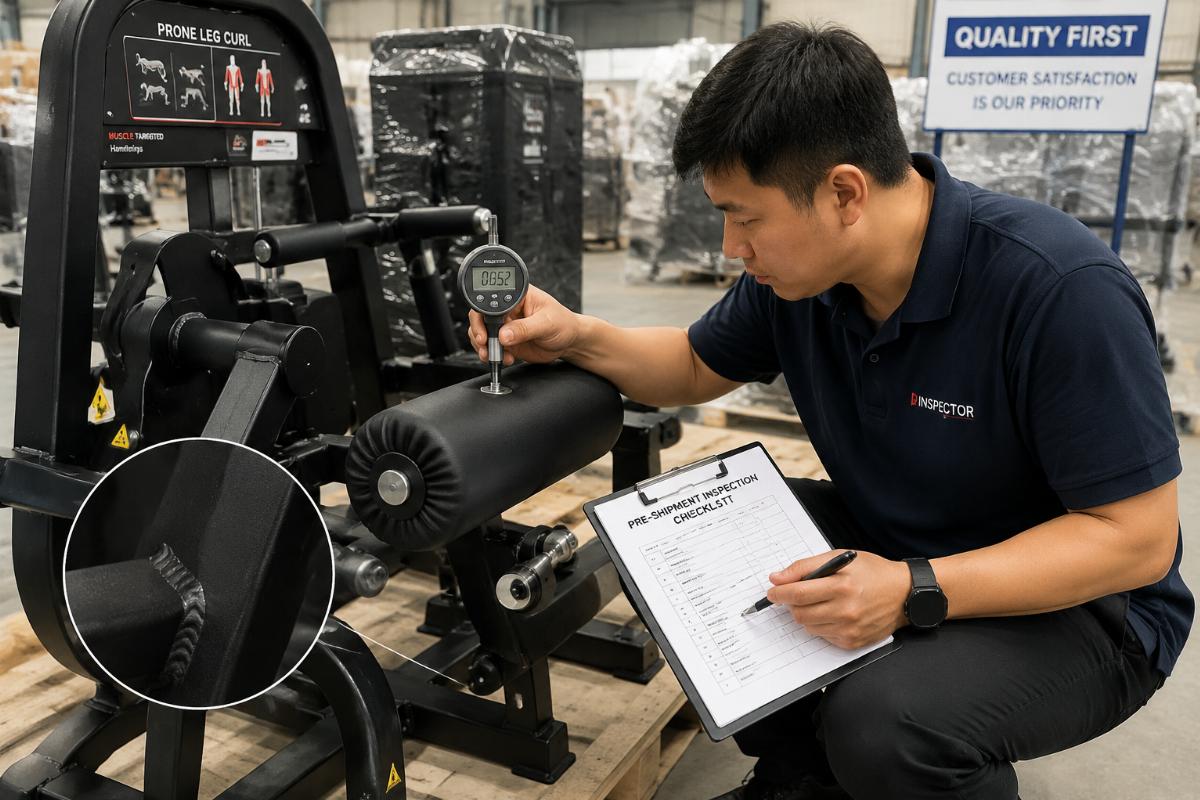
Request weld inspection documentation, cushion foam density certificates, and surface treatment salt-spray test reports—these three documents separate factories that deliver consistent commercial quality from those that cut corners invisibly.
I have seen buyers receive machines that looked perfect in product photos and arrived with foam that compressed to half its original height within months, or frames where the powder coat peeled after a single humid season. The difference between those outcomes and a machine that performs for years is never visible in a catalog—it is visible in the test documentation.
Here is the verification checklist I recommend for any Chinese prone leg curl manufacturer evaluation:
- Weld Inspection Photos or Reports: Request images of internal weld seams on the frame, not just exterior finishes. Continuous robotic welds should show uniform bead patterns without porosity or undercutting. [NEED_CITE: AWS D1.1 structural welding code visual inspection criteria]
- Cushion Foam Density Certificate: Ask for the specific density rating and whether the foam is closed-cell. High-density closed-cell foam resists compression set and maintains shape under repeated commercial use.
- Salt-Spray Test Report: The electrostatic powder coat should have documented salt-spray endurance hours. This test simulates long-term corrosion resistance and coating adhesion. [NEED_CITE: ASTM B117 salt spray testing standard for coated metal surfaces]
- Bearing and Cable Specification: Confirm sealed bearings in all pulley stations and nylon-sheathed aircraft cable. Open bearings and bare cables are the first failure points in high-use environments.
- Frame Steel Mill Certificate: Request the material grade and wall thickness certification for the main frame tubing. This is the structural backbone of the machine.
A European distributor once shared that their first trial order from an unspecified factory arrived with cushions that felt firm initially but collapsed within months. The factory had used basic open-cell foam instead of the high-density closed-cell specification the buyer assumed was standard. The replacement cushion cost, combined with the customer complaints, erased any initial price savings.
When you work with a manufacturer that treats documentation as standard practice rather than an afterthought—providing CE certification, material test reports, and pre-shipment inspection photos as routine deliverables—you eliminate the guesswork entirely. A Chinese prone leg curl manufacturer that volunteers these documents before you ask is signaling that their production quality is consistent enough to stand behind.
How Do Lead Time and After-Sales Support Compare?
Chinese manufacturers typically deliver production in a fraction of the time required by branded supply chains, and after-sales support operates through direct factory coordination rather than regional distributor dependencies.
The lead time difference is one of the most operationally significant advantages for buyers managing gym buildouts, hotel fit-outs, or distributor inventory replenishment. A typical branded equipment order runs through a multi-layer distribution chain—manufacturer to regional headquarters to local distributor to end buyer—each layer adding processing time and inventory buffering. A direct order to a Chinese prone leg curl manufacturer collapses that chain into a single production-to-shipment pipeline.
[NEED_CITE: commercial fitness equipment supply chain lead time comparison between direct factory and branded distribution models]
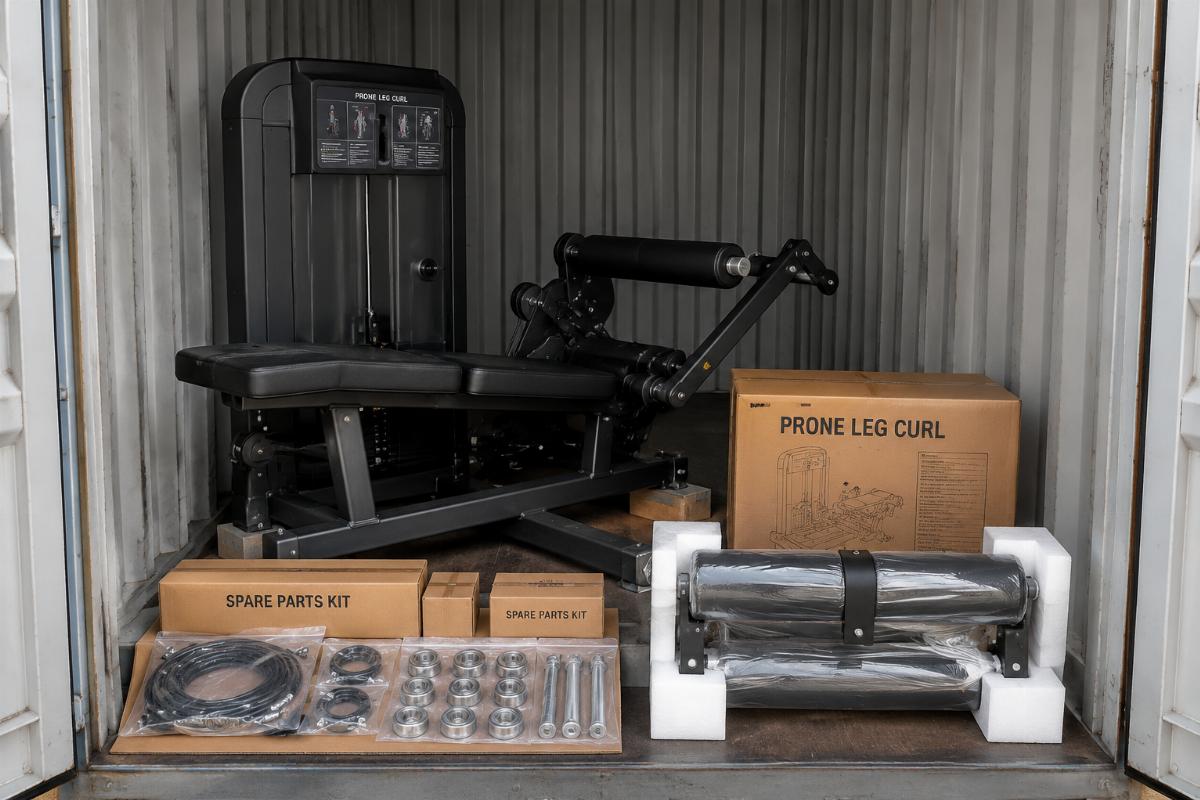
Consider a连锁 gym operator that needed to supplement their existing branded fleet with additional units during a peak expansion quarter. The branded channel quoted a lead time measured in multiple months. The Chinese factory alternative had machines produced, inspected, and loaded into a container within weeks. The spare parts—replacement cables, pedal pads, adjustment pins—were packed in the same container, not ordered separately through a regional parts desk weeks later.
| Operational Factor | Branded Channel | Chinese Factory Direct |
|---|---|---|
| Production Lead Time | Extended multi-month cycle | Noticeably shorter direct production |
| Spare Parts Availability | Regional distributor stock dependent | Co-shipped with production order |
| Custom Branding Lead Time | Not available or heavily restricted | Integrated into production schedule |
| Communication Chain | Multi-layer distributor relay | Direct factory engineering contact |
| Order Modification Flexibility | Restricted after order confirmation | Accommodating within production window |
The after-sales model difference is equally important. With branded equipment, a failed bearing or torn cable means contacting a regional distributor, waiting for stock availability, and scheduling a service visit. With direct factory sourcing, the same replacement part ships from the same facility that built the machine—often arriving before the next container load. A Chinese prone leg curl manufacturer that maintains spare parts inventory and provides technical support documentation in English removes the operational friction that typically plagues cross-border equipment procurement.
Is a Chinese Prone Leg Curl Right for Your Business?
For distributors building private-label inventory, hotel developers outfitting fitness centers, and gym chains managing capital expenditure across multiple locations, Chinese alternatives deliver compelling economic and operational advantages—provided specifications are locked in writing before production begins.
The decision framework is not about whether Chinese manufacturing can match branded quality—it demonstrably can when the spec sheet is enforced. The decision is about whether your procurement model aligns with the direct factory sourcing structure.
If you are a distributor sourcing container loads for private-label resale, the OEM flexibility and per-unit economics from a Chinese prone leg curl manufacturer are difficult to replicate through branded channels. Full branding customization, flexible minimum order quantities, and container consolidation across multiple product categories create a procurement model built for margin optimization.
If you are a hotel or apartment developer building a fitness center as part of a larger project, the ability to source complete strength, cardio, and free weight packages from a single factory—coordinating delivery timelines and consolidating freight—simplifies project management substantially.
If you are a gym chain replacing aging equipment or expanding into new locations, the lead time advantage and spare parts co-shipment model keep your facilities operational without extended downtime waiting for branded supply chains.
The common thread: buyers who succeed with Chinese sourcing treat the specification document as the contract’s most critical attachment. Every foam density, every steel gauge, every bearing type—written, verified, and documented. The factory that treats that documentation as routine rather than exceptional is the factory that delivers.

Conclusion
The specification gap between Chinese factory output and branded equipment is narrower than most buyers assume—and the procurement economics are substantially more favorable for volume buyers. A Chinese prone leg curl manufacturer operating with documented quality controls, flexible OEM capability, and direct spare parts supply offers a viable alternative for distributors, hotel developers, and gym operators who enforce their specifications in writing and manage their documentation with the same rigor they apply to their financial terms.


