
Commercial Weight Plates Manufacturer | Bulk OEM for Sale
Most buyers think weight deviation comes from a faulty scale — the real culprit is a worn stamping mold that was never recalibrated.
When sourcing commercial weight plates in bulk, unit price is the easiest number to get wrong. A reliable commercial weight plates manufacturer must be evaluated across four dimensions: material formulation, mold precision, printing工艺, and packaging protection — otherwise a full container can be rejected at the destination port due to odor complaints, peeling coating, or weight tolerance drift.
I grew up next to Ningbo Port. As a teenager I helped a workshop master adjust stamping dies for barbell plates, and later I ran installation sites for overseas gyms with an after-sales team. One shipment that still stings: a full container of rubber-coated plates sent to a Middle East fitness chain. When the containers were opened, the rubber odor was overwhelming and the weight markings were already smudged. The buyer refused the entire lot. We paid return freight, re-manufactured, and lost roughly two months of lead time. That single order taught me to scrutinize raw-material recipes, die calibration logs, and ink-adhesion tests before a single plate leaves the factory floor. Picking a commercial weight plates manufacturer is never as simple as comparing a quotation sheet. [NEED_CITE: VOC emission limits for rubber fitness equipment per ISO 16000 series]

Once you know which checkpoints matter, the rest of the sourcing process becomes a matter of verification rather than guesswork.
What Material Should You Choose for Commercial Weight Plates?
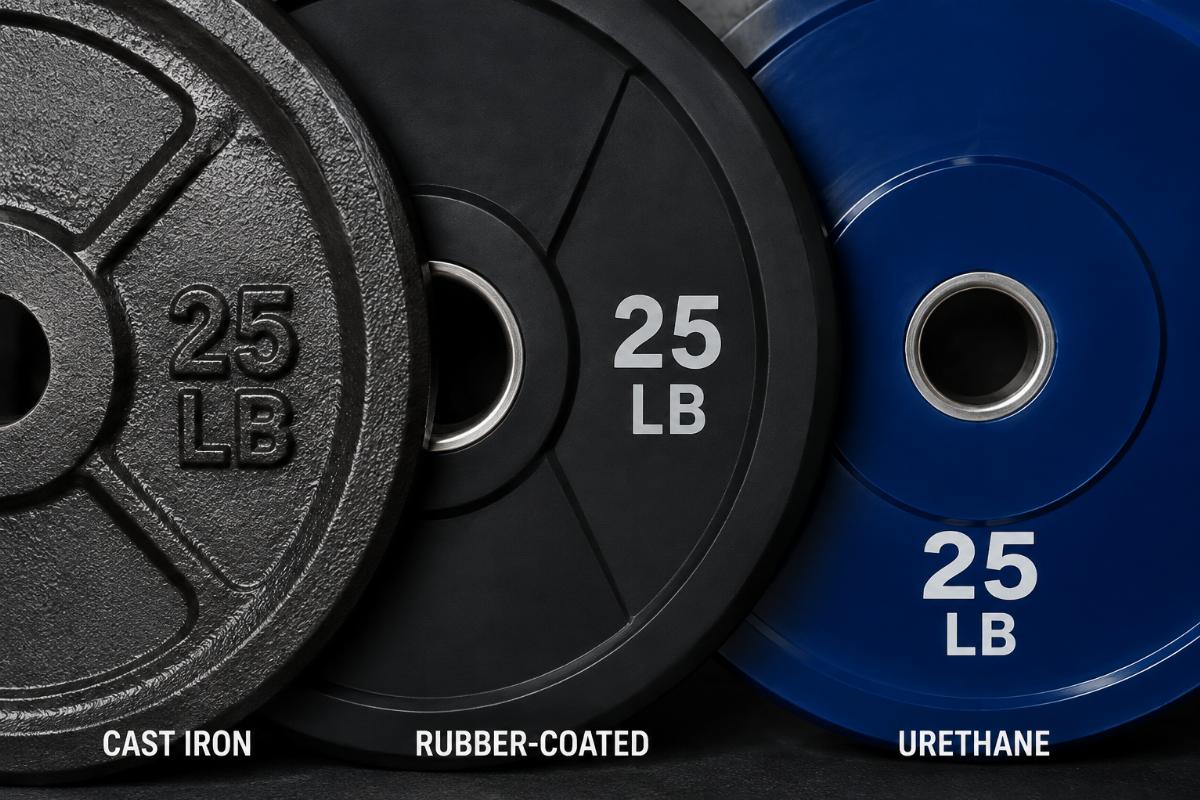
Cast iron, rubber-coated, and urethane plates serve different business models — mixing them up is the most common sourcing mistake.
A commercial weight plates manufacturer that offers all three material families can usually guide you to the right tier. Below is a qualitative comparison that gym owners and importers use internally before requesting a quote.
| Material | Density Feel | Drop Resistance | Odor Level | Unit Cost Tier | Best-Fit Venue |
|---|---|---|---|---|---|
| Cast Iron | Hard, compact | Moderate — chips on concrete | None | Budget | Old-school iron gyms |
| Rubber-Coated | Solid, slightly dampened | Good — absorbs impact | Noticeable at first | Mid-range | Mid-tier commercial gyms |
| Urethane | Dense, premium | Excellent — minimal bounce | Virtually none | Premium | High-traffic chains, hotels |
The middle row is where most disputes happen. A Southeast Asian CrossFit box I consulted for was dropping plates hundreds of times per day. Within a short cycle the rubber coating started peeling around the collar, and the replacement frequency ate into their operating margin. The root cause was not the coating thickness alone — it was the recycled-rubber ratio in the compound. Higher recycled content lowers cost but accelerates surface breakdown under repeated impact. [NEED_CITE: abrasion resistance comparison between virgin and recycled rubber compounds in fitness equipment]
Cast iron plates remain the default for budget-focused strength gyms. They do not smell, they do not decompose, and any surface rust is cosmetic rather than structural. The trade-off is noise and floor damage, which matters in a hotel or apartment complex gym. Urethane plates solve both problems, but the raw-material cost is meaningfully higher, so they are typically specified for flagship locations rather than rollout chains.
When a commercial weight plates manufacturer quotes you, ask explicitly what percentage of recycled material is used in rubber-coated SKUs. A transparent supplier will give you a range; a risky one will dodge the question.
How to Verify Weight Accuracy and Mold Precision from a Supplier?
A tolerance claim of "±2 percent" means nothing unless you see the calibration log behind it.
Most buyers assume weight deviation is a scale problem. In reality, the deviation originates at the stamping press. Once a mold has run several thousand cycles, the cavity wears and the plate thickness drifts downward — meaning every plate becomes slightly lighter than its nominal value. If the manufacturer does not pull the die for recalibration on a scheduled basis, entire batches will ship underweight without anyone on the line noticing. [NEED_CITE: mold wear impact on dimensional tolerance in metal stamping per ISO 12783]
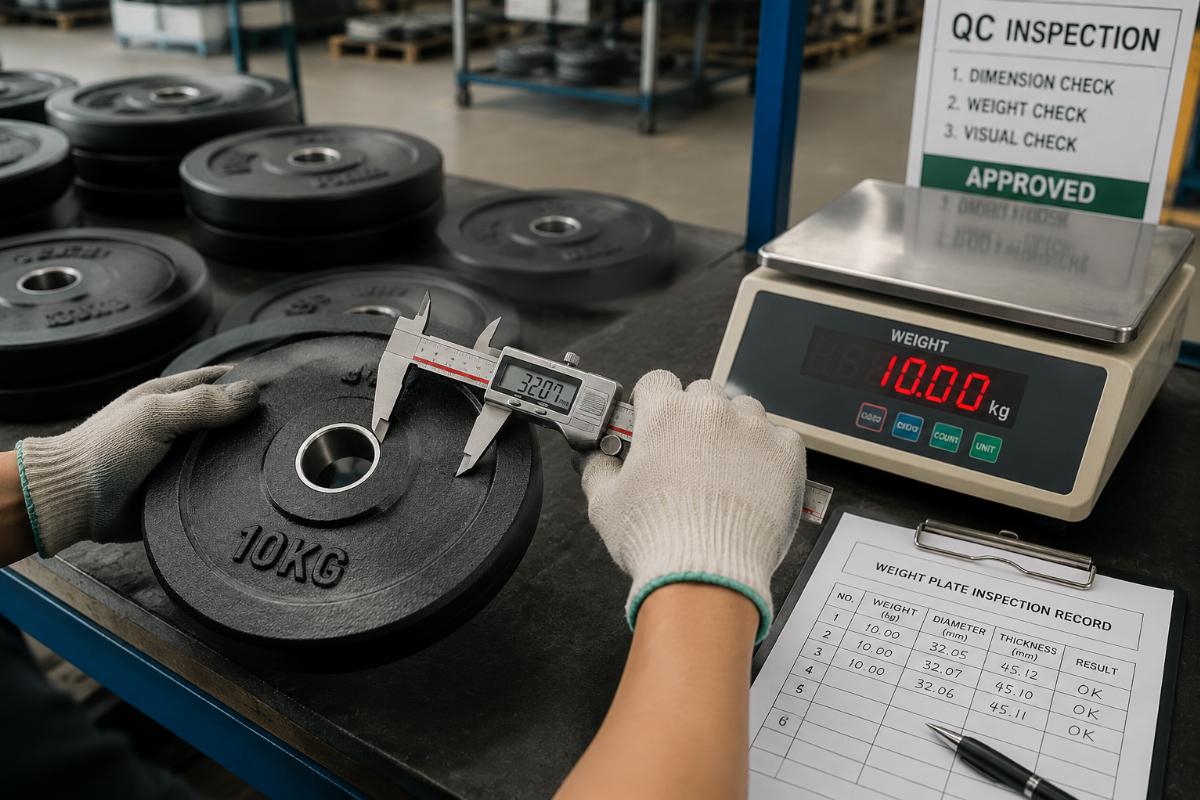
Here is what a serious commercial weight plates manufacturer should be able to show you before you sign a purchase order:
- A sampling weigh-in report covering at least one plate from every cavity in the mold, not just the front-of-line piece.
- A die-maintenance log showing the last calibration date and the projected cycle count before the next scheduled service.
- Caliper measurement records for outer diameter and center-hole diameter, because a plate that is light but oversized will still jam on a competition barbell sleeve.
I once reviewed a batch where the supplier’s own QC sheet showed every plate within tolerance — but they had weighed only the first piece off the press. The last pieces in the pallet were noticeably light. A spot-check with a reference scale told the real story.
For rubber-coated and urethane plates, add one more check: measure the finished diameter after coating, not before. Coating thickness variation can push an otherwise accurate iron core outside the diameter band that gym users expect, especially on smaller denomination plates.
What OEM Branding Options Are Available for Bulk Orders?
Printing is not decoration — it is a liability shield.
When a gym member grabs a plate during a heavy set, the weight marking is a safety-critical label. Faded or ambiguous markings can lead to underloading or overloading, and in a litigious market that becomes a product-liability claim. A competent commercial weight plates manufacturer treats branding as an engineering step, not an afterthought.
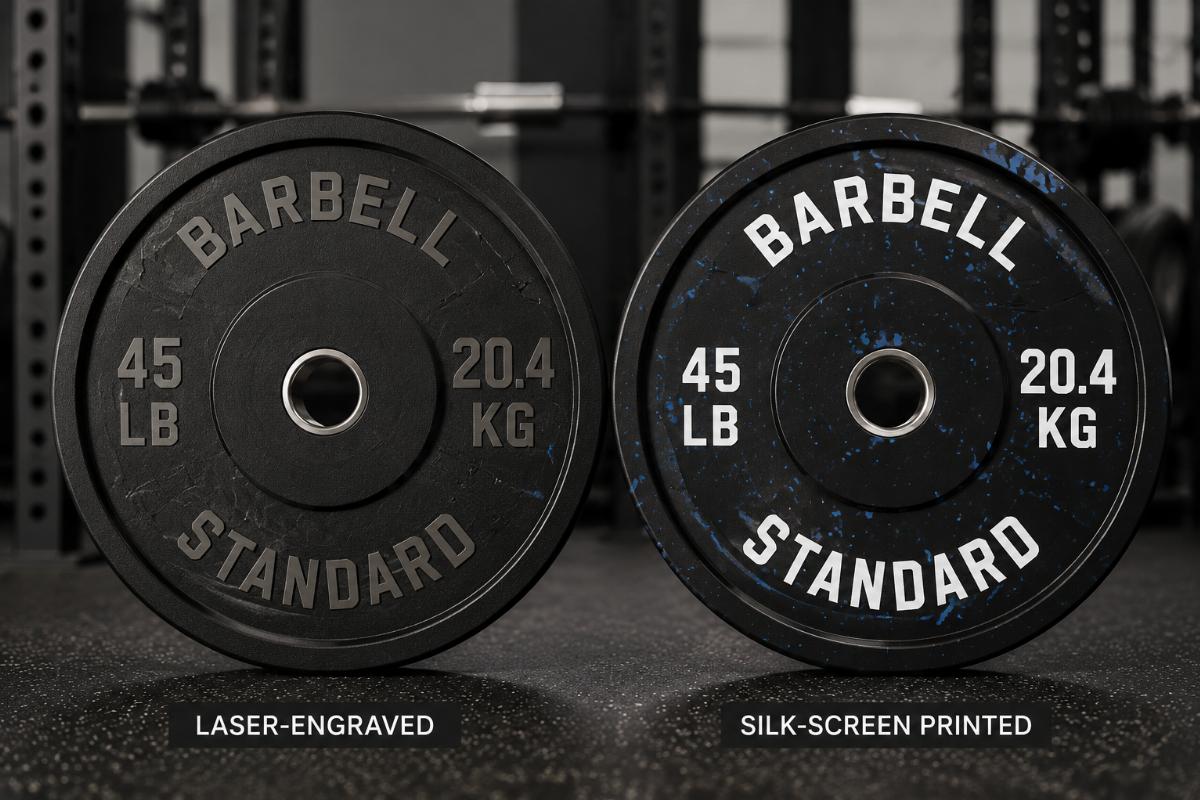
Three mainstream OEM methods are available, and they differ sharply in durability, minimum order, and tooling cost.
| Method | Durability | Setup Cost | MOQ Flexibility | Best Use Case |
|---|---|---|---|---|
| Silk-screen printing | Moderate — wears with chalk and sweat | Low | High — suits small batches | Short-run private label |
| Laser engraving | High — permanent mark | Medium | Medium | Mid-size orders, steel and iron |
| Mold-embedded lettering | Highest — part of the plate itself | High — requires custom die | Low — suits full-container runs | Premium urethane and long-term programs |
A South American distributor I worked with started with silk-screen logo plates in small batches to test the market. Once volume justified it, they moved to mold-embedded branding on urethane plates, eliminating any risk of logo wear. The transition took a few months of mold lead time, but the complaint rate on markings dropped to essentially zero afterward.
Ask the commercial weight plates manufacturer for ink-adhesion test results — a simple cross-hatch tape test per ASTM D3359 is the industry baseline. If the supplier cannot produce that report, assume the print will fade within a year in a busy gym environment. [NEED_CITE: coating adhesion test method per ASTM D3359 for fitness equipment surfaces]
How to Prevent Damage and Odor Issues During Shipping?
Raw-material配方 sets the odor ceiling; packaging sets the damage floor — both must be locked before production starts.
The Middle East rejection I mentioned earlier was not a one-off. Rubber odor complaints are the single most common reason for container refusal on fitness accessories, and the mechanism is straightforward. When recycled rubber content is high, volatile organic compounds continue to off-gas for weeks. In a sealed container sitting under tropical sun during ocean transit, those compounds concentrate. Open the doors at destination and the odor hits like a wall. [NEED_CITE: VOC off-gassing behavior of recycled rubber compounds in enclosed environments]
The fix is upstream, not downstream. A reputable commercial weight plates manufacturer will:
- Specify the virgin-to-recycled rubber ratio in writing before production.
- Allow a curing period after molding so that the initial off-gassing peak passes before plates are wrapped and palletized.
- Use ventilated packaging — perforated poly bags rather than sealed shrink wrap — so that any residual vapor can escape during transit.
On the damage side, the weak point is almost never the plate itself; it is the pallet pattern and the container load plan. Plates stacked flat on a standard pallet and stretch-wrapped tightly survive ocean freight well. Plates loaded loose or stacked in mismatched columns shift during vessel motion, and the resulting edge-on-edge contact chips rubber coatings and dents iron edges.
Request a loading diagram from your commercial weight plates manufacturer before the container is sealed. A simple sketch showing pallet positions, dunnage placement, and lash points will save you far more money than a last-minute insurance claim.

What MOQ and Lead Time Should You Expect from a Chinese Manufacturer?
Standard SKUs can be mixed into a shared container; custom SKUs need a mold timeline built into your plan.
Buyers new to sourcing from China often assume that every order must be a full container of one item. In practice, a flexible commercial weight plates manufacturer will let you mix plate denominations — 5 kg, 10 kg, 15 kg, 20 kg — into a single container to match your gym layout or distribution plan. This is especially useful for boutique studios and hotel fitness rooms that need a balanced set rather than pallets of 20 kg plates.
For OEM-branded plates with custom mold-embedded logos, the mold itself must be manufactured first. Mold lead time is a fixed block that cannot be compressed without risking die quality, so plan your launch calendar around it rather than trying to negotiate it away.
A practical sequencing approach:
- Start with a small trial order of standard plates in your brand’s color and silk-screen logo to validate market response.
- Once volume supports it, open custom molds for your flagship denominations and move to mold-embedded branding.
- Consolidate full-container orders to unlock better unit pricing and reduce per-piece freight cost.
A European hotel-group developer I advised used exactly this path. Their first order was a few mixed pallets of rubber-coated plates for a pilot property. After guest feedback confirmed the spec, they rolled out urethane plates with embedded branding across multiple properties in a single program, with the mold cost amortized over a meaningful volume.

Conclusion
Unit price is the cheapest part of a commercial weight plates purchase; material integrity, mold precision, branding durability, and shipping protection are where real cost is won or lost.
Verify the supplier on formulation transparency, demand calibration and coating-adhesion evidence, and lock packaging standards before the container is sealed. A commercial weight plates manufacturer that welcomes those requests is usually one worth building a long-term program with.


