01 / Scenario
STUDIO
P
High-End Pilates Studios
Premium aesthetics meet quiet operation for boutique studio environments.

ISO
9001
CE
Certified
OEM
Available
10YR
Warranty
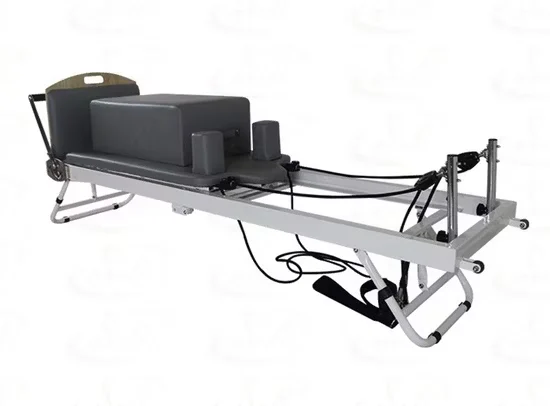
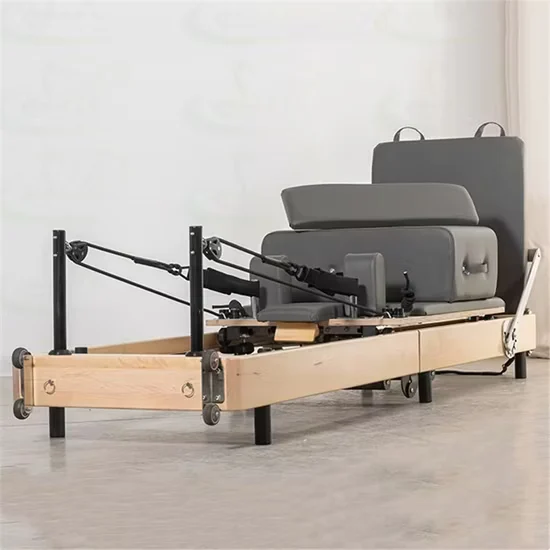
Folding Pilates Reformer Bed, Solid Wood Frame, 2400×600×350mm — engineered with solid wood construction to resist deformation under repeated spring tension, featuring a foldable hinge mechanism with reinforced locking hardware for reliable storage without compromising rigidity. Includes long box, jump board, and platform with reinforced attachment points for dynamic loading. Backed by 3-year warranty and 32-point inspection with 100% load testing before shipment.
// Spec Highlights
• Direct from Manufacturer · No Middlemen · Worldwide Shipping
01
// Material
Imported Solid Wood
Premium hardwood frames sourced for density and visual warmth.
02
// Hardware
Medical-Grade Silent
Whisper-quiet pulleys and springs for clinical environments.
03
// Customization
Appearance OEM
Color, upholstery, and branding tailored to your studio.
04
// Service
Layout Design
Free venue planning for studios and rehab institutions.
Every component is selected for longevity, performance, and aesthetic harmony - from imported hardwood frames to silent medical-grade accessories.
// Features
Mill-Certified Solid Wood — Every timber component is traceable to the source mill with species and grade documentation, ensuring structural consistency across high-volume studio deployments.
| Parameter | Value |
|---|---|
| Product Type | Pilates Reformer |
| Frame Material | Solid Wood |
| Specification | 2400×600×350mm |
| Net Weight | 100kgs |
| Included Accessories | Long Box / Jump Board / Platform |
| Color Options | Solid color finishes available |
| Logo | Customized logo allowed |
| Customization | Available upon request |
| Warranty | 3 Years |
| Facility Type | Typical Use |
|---|---|
| Commercial Pilates Studio | Daily group and private reformer classes with frequent reconfiguration |
| Multi-Purpose Fitness Center | Dedicated mind-body zone supplementing strength and cardio floors |
| Rehabilitation and Physical Therapy Clinic | Controlled resistance exercises for post-injury recovery programs |
| Hotel Wellness Facility | Guest-accessible Pilates sessions in limited-footprint spa areas |
| University Athletic Department | Supplementary flexibility and core conditioning for student athletes |
Solid wood resists warping where engineered composites quietly fail under cyclic loading.
Studio owners replacing reformer beds every eighteen months rarely trace the failure back to the frame material itself. Hollow-core boards and thin-laminate constructions absorb moisture unevenly, and the repeated pull from spring tension exploits any density inconsistency in the wood. Over hundreds of compression and release cycles, the carriage rail mounting points shift just enough to create binding — a problem that looks like a wheel issue but originates in the frame [NEED_CITE: wood fatigue behavior under cyclic tensile and compressive loading].
A commercial folding pilates reformer bed built from solid stock holds its geometry because the grain runs continuously through the stress zones, not in glued layers that can delaminate when exposed to studio humidity and cleaning chemicals.
This reformer serves as the anchor piece in any dedicated Pilates or functional movement area, covering the full spectrum of supine, prone, seated, and standing movement patterns. It pairs logically with mat stations and smaller apparatus like stability chairs or barrels, creating a training zone that accommodates beginners through advanced practitioners. The commercial folding pilates reformer bed fits facilities where floor space must serve multiple programming formats throughout the day, and its user weight range supports the broad demographic that walks into commercial studios and rehabilitation centers alike.
Every reformer session subjects the frame to hundreds of tension cycles — the springs pull, release, and pull again while the carriage travels the full rail length under varying loads. The fold joint represents a secondary stress concentration point that non-folding reformers simply do not have, and it must transfer load without introducing play or deflection during use. The accessory attachment points for the long box, jump board, and platform experience impact loading during dynamic exercises, which means those connection areas see forces that exceed static body weight significantly [NEED_CITE: dynamic load factors in exercise equipment structural design]. Upholstery contact zones on the carriage and platform compress and recover with every repetition, making material density and stitching quality the difference between an eighteen-month and a multi-year service life.
The 2400×600×350mm footprint defines not just the user’s range of motion but also the rail length that governs carriage travel — shorter rails limit exercise variety and compress the resistance curve into a tighter range. Solid wood as a frame material brings dimensional stability that engineered alternatives cannot match when humidity fluctuates between seasons and HVAC cycles. The 100kg net weight reflects the mass of genuine solid stock rather than a lightweight composite shell, which translates directly to stability during standing exercises performed on the platform. Spring compatibility and tension range determine whether the reformer can serve both rehabilitation clients needing light resistance and advanced practitioners loading heavy eccentric patterns. Accessory integration at the long box, jump board, and platform mounting points must be reinforced with hardware rated for repeated attachment and detachment cycles without stripping or loosening.
A reformer built on veneer-wrapped particle board may pass a visual inspection but cannot sustain the torsional loads that spring tension places on the frame over months of daily classes. Fold joints that use lightweight hinges rather than load-rated hardware develop play that users feel as wobble during legwork and footwork sequences. Non-reinforced accessory mounting points crack under jump board impact, forcing studios into a cycle of repair and downtime. Low-density upholstery on the carriage compresses permanently within months, creating uneven surfaces that compromise exercise form and client comfort. When springs, carriage wheels, or pulley cords wear out on a reformer with no replacement supply chain, the entire unit becomes disposable rather than serviceable [NEED_CITE: lifecycle cost analysis of commercial fitness equipment maintenance].
Solid wood sourcing with mill certification ensures every frame component meets a verifiable grade standard rather than an unmarked composite. Load testing on each unit before shipment catches joint and rail alignment issues that sample-based QC programs miss entirely. The 200μm powder coating applied to all metal hardware protects hinge mechanisms and spring anchors from sweat corrosion in high-humidity studio environments. A 3-year warranty on the reformer structure signals confidence in the wood species selection and joint engineering. Floor planning support accounts for the reformer’s 2400×600mm deployed footprint plus safe clearance for carriage travel and instructor access, while the folded configuration is factored into multi-use room layouts where space transitions between classes.
Provide your studio floor dimensions and current equipment list to receive a 2D or 3D placement plan that accounts for the reformer’s deployed and folded footprint. Specify your average daily user count so the structural grade and replacement cycle expectations align with your volume. Indicate whether your clientele skews toward rehabilitation, general fitness, or advanced athletic conditioning to confirm the spring tension range and accessory configuration suits your programming. Share any color, logo, or upholstery customization requirements for a tailored specification sheet.
Q: How do I verify the frame is solid wood rather than engineered composite?
A: Request a cross-section photo or mill certificate that identifies the wood species and grade. Solid wood shows continuous grain through the full thickness, while veneer or laminate constructions reveal layered cores. Ask the manufacturer to specify the exact species used and whether structural components are milled from single stock or edge-glued panels.
Q: What load capacity should a commercial reformer support?
A: Commercial reformers in high-traffic studios must accommodate users across a wide weight range plus the dynamic forces generated during jump board and standing exercises. Confirm the rated static load with the manufacturer and ask whether the carriage rail and spring anchor points are tested under eccentric and impact loading conditions, not just static weight.
Q: Does the foldable mechanism compromise long-term structural integrity?
A: A properly engineered fold joint uses load-rated hinges and locking hardware designed for repeated deployment and collapse cycles. The critical factor is whether the manufacturer tests the hinge under operational load — not just folding and unfolding — to confirm that no play or deflection develops at the joint during actual reformer exercises over extended use.
Q: What is the typical replacement cycle for springs and carriage wheels in commercial use?
A: Springs lose tension consistency and carriage wheels develop flat spots at rates directly tied to daily session volume and maintenance practices. In a busy studio running group classes, plan for spring inspection every quarter and wheel replacement based on observed wear rather than a fixed calendar schedule. Confirm that replacement parts are stocked and available from the manufacturer.
Q: How much floor space does the folded unit save compared to a fixed reformer?
A: The folded configuration reduces the footprint significantly for storage between classes, but exact dimensions depend on the fold direction and whether accessories remain attached. Request the folded length, width, and height from the manufacturer, and plan storage clearance that allows staff to deploy and collapse the unit without lifting or dragging it across the studio floor.
Premium aesthetics meet quiet operation for boutique studio environments.
Medical-grade silence and precision for sports & postpartum recovery.
Furniture-grade craftsmanship for premium residential installations.
Compact premium setups for one-on-one and small-group training.
Aesthetic Pilates integration for hybrid wellness studio programming.
Multi-unit deployment with instructor-grade reliability for certification programs.
Tell us about your project. Our team will respond within 24 hours with pricing, customization options, and shipping details.
// Sales Director
William
+86 132 2531 1800
// Export Manager
Bella
+86 198 5412 8032
william@bickfit.com