01 / Scenario
STUDIO
P
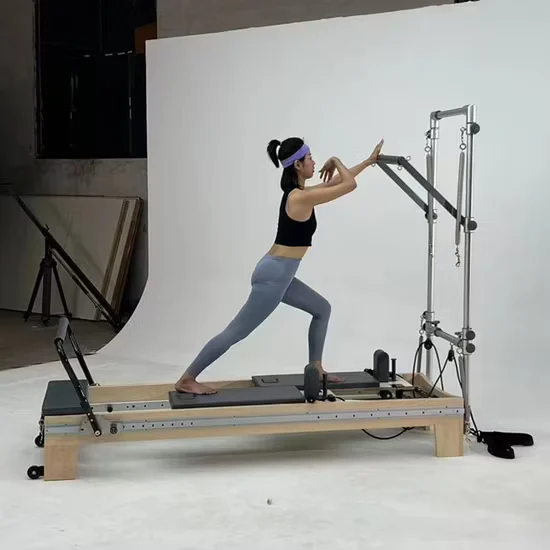
High-End Pilates Studios
Premium aesthetics meet quiet operation for boutique studio environments.

ISO
9001
CE
Certified
OEM
Available
10YR
Warranty
Maple Wood Pilates Spine Corrector, 960×470×360mm, 20kg Net Weight — solid maple construction resists warping and surface cracking under sustained compressive loads, with reinforced mounting points for long box, jump board, and platform accessories. Compatible with commercial studio and rehabilitation environments requiring 3-year structural coverage. Each unit undergoes 32-point inspection and 100% load testing before dispatch.
// Spec Highlights
• Direct from Manufacturer · No Middlemen · Worldwide Shipping
01
// Material
Imported Solid Wood
Premium hardwood frames sourced for density and visual warmth.
02
// Hardware
Medical-Grade Silent
Whisper-quiet pulleys and springs for clinical environments.
03
// Customization
Appearance OEM
Color, upholstery, and branding tailored to your studio.
04
// Service
Layout Design
Free venue planning for studios and rehab institutions.
Every component is selected for longevity, performance, and aesthetic harmony - from imported hardwood frames to silent medical-grade accessories.
// Features
Solid Maple Wood Construction — Eliminates the delamination and surface cracking failure modes inherent in laminated or veneered Pilates equipment under daily commercial loading.
| Parameter | Value |
|---|---|
| Product Type | Pilates Spine Corrector |
| Material | Solid Maple Wood |
| Color | Solid Color |
| Accessory Compatibility | Long Box / Jump Board / Platform |
| Product Dimensions | 960×470×360mm |
| Net Weight | 20kg |
| Warranty | 3 Years |
| Logo | Customized Is Allowed |
| Facility Type | Typical Use |
|---|---|
| Commercial Pilates Studio | Group class and private session spinal articulation work |
| Rehabilitation and Physical Therapy Center | Post-injury spinal mobility and core stabilization protocols |
| Boutique Fitness and Wellness Facility | Pilates mat circuit integration and flexibility stations |
| Hotel and Resort Wellness Center | Guest-accessible Pilates equipment for supervised sessions |
| Personal Training Studio | One-on-one corrective exercise and movement screening |
Solid maple resists the shear and compressive fatigue cycles that cause veneered and laminated spine correctors to delaminate in high-traffic studios.
When a Pilates studio schedules back-to-back classes six days a week, the spine corrector absorbs repetitive spinal loading, lateral shifting, and sweat exposure on every session. Laminated or veneered wood constructions rely on adhesive bonds between layers — bonds that degrade under sustained moisture ingress and cyclic compressive stress. Within months, edge delamination becomes visible, splinter risk increases, and the unit must be pulled from rotation. A commercial maple wood Pilates spine corrector eliminates this failure mode at the material level because solid hardwood maintains uniform density and grain continuity throughout its entire cross-section. [NEED_CITE: ASTM standards for wood species identification and grading in fitness equipment]
This unit occupies a specific role in Pilates programming: facilitating spinal articulation, thoracic extension, and hip flexor stretching across supine and prone positions. In a commercial studio configuration, it complements reformers, Cadillac units, and Wunda chairs by providing a dedicated spinal mobility station that does not require spring or pulley rigging. The 960×470mm footprint allows placement along perimeter walls or between reformer bays without consuming floor space needed for mat work. The commercial maple wood Pilates spine corrector accommodates adult users across a wide anthropometric range because its contoured surface geometry supports both shorter and longer torsos during extension and flexion sequences. Studios running four or more classes daily benefit from having multiple units available so members are not waiting between rotations.
The primary structural demand on this unit comes from static bodyweight compression combined with dynamic repositioning as users mount, dismount, and adjust their position across the curved surface. In a studio running eight or more sessions daily, each unit may see thirty to fifty loading cycles per day. The solid maple construction distributes compressive stress through continuous grain fibers rather than relying on adhesive bond lines that gradually weaken. The surface finish must withstand repeated contact with skin, clothing friction, and exposure to studio humidity without raising grain or developing micro-cracks. Edge treatment quality determines whether the unit remains splinter-free through years of high-frequency mounting and dismounting. [NEED_CITE: EN 957 structural requirements for stationary training equipment surface durability]
Maple is a closed-grain hardwood with high Janka hardness, meaning it resists surface denting from concentrated contact points like elbows, heels, and equipment accessories. The dimensional stability of solid maple under fluctuating studio humidity is significantly better than open-grain species or engineered wood composites, which expand and contract at different rates across their layers. When accessory mounting points for long boxes, jump boards, or platforms are cut into solid maple, the fastener threads engage continuous wood fiber rather than particle layers that strip under repeated installation and removal. The 20kg mass provides sufficient floor stability during use without making the unit impractical to reposition between classes. Surface sanding grade and coating specification determine both initial grip friction and long-term resistance to sweat absorption.
A lower initial purchase price on veneered or composite-core spine correctors does not account for the replacement cycle in commercial environments. Delamination at the edges is typically the first visible failure, followed by surface veneer cracking along high-contact zones where bodyweight concentrates. Once the veneer layer is compromised, moisture penetrates the substrate, accelerating structural degradation and creating hygiene concerns in shared studio settings. Units pulled from rotation for repair or replacement generate both direct replacement cost and lost class capacity. Solid maple units carry a higher upfront cost but maintain structural and surface integrity through a service life measured in years rather than months. [NEED_CITE: comparative lifecycle cost analysis of solid wood versus laminated fitness equipment]
A commercial maple wood Pilates spine corrector built from solid maple with mill-verifiable wood species documentation removes the ambiguity that allows laminated products to be marketed as wood equipment. The 3-year structural warranty reflects confidence in the material’s fatigue performance under daily studio loading. Accessory compatibility with long boxes, jump boards, and platforms requires reinforced mounting points that only continuous wood fiber can sustain through repeated attachment cycles. For studios planning floor layouts, the 960×470×360mm dimensions allow precise spacing calculations for safe user clearance on all sides. OEM customization including logo application is available for studios and distributors requiring brand consistency across equipment fleets.
Provide your studio floor area and current equipment list to receive a 2D or 3D layout plan showing optimal spine corrector placement relative to reformers and open mat zones. Specify your average daily class volume and member count so the unit quantity recommendation matches actual throughput requirements. Confirm whether long box, jump board, or platform accessories are needed so mounting specifications are prepared at production. Note any custom logo or color requirements for brand alignment across your equipment fleet.
Q: How can I confirm the wood is solid maple rather than laminated or veneered?
A: Request mill documentation specifying the wood species and grade. On physical inspection, solid maple shows continuous grain patterns across edges and end cuts, whereas veneered products display a thin decorative layer over a different substrate material. Joint lines and fastener holes in solid maple reveal uniform wood fiber throughout, while laminated units show distinct layer boundaries.
Q: What joint construction methods indicate commercial-grade durability?
A: Mortise-and-tenon joinery provides the strongest mechanical interlock for solid wood fitness equipment because it maximizes glue surface area and creates a structural connection that resists racking forces. Dowel joints offer moderate strength but depend entirely on adhesive bond integrity. Biscuit joints are suitable for alignment but should not be the sole structural connection in equipment subject to repeated loading.
Q: What maintenance does solid maple equipment require in a humid studio environment?
A: Maintain studio humidity within the range recommended for hardwood equipment to prevent seasonal expansion or contraction. Clean surfaces with pH-neutral products that do not strip the protective coating. Inspect edges and high-contact zones monthly for any finish wear that could expose raw wood to moisture. Reapply protective coating as needed based on usage volume and visible wear patterns.
Q: How are the accessory mounting points reinforced for long box and jump board use?
A: Accessory mounting points in solid maple engage continuous wood fiber, which holds fastener threads securely through repeated installation and removal cycles. The mounting interface should include metal inserts or reinforced threading to distribute dynamic loads and prevent wood fiber stripping over time. Verify that the mounting standard matches the accessory hardware specifications provided by the manufacturer.
Premium aesthetics meet quiet operation for boutique studio environments.
Medical-grade silence and precision for sports & postpartum recovery.
Furniture-grade craftsmanship for premium residential installations.
Compact premium setups for one-on-one and small-group training.
Aesthetic Pilates integration for hybrid wellness studio programming.
Multi-unit deployment with instructor-grade reliability for certification programs.
Tell us about your project. Our team will respond within 24 hours with pricing, customization options, and shipping details.
// Sales Director
William
+86 132 2531 1800
// Export Manager
Bella
+86 198 5412 8032
william@bickfit.com