01 / Scenario
STUDIO
P
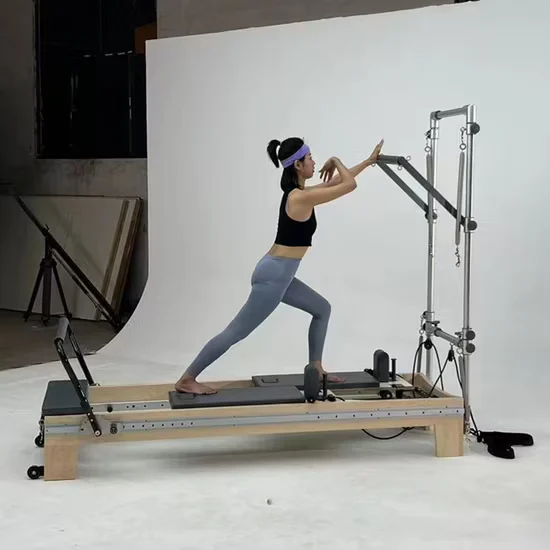
High-End Pilates Studios
Premium aesthetics meet quiet operation for boutique studio environments.

ISO
9001
CE
Certified
OEM
Available
10YR
Warranty
Commercial Pilates Reformer Bed, Solid White Beech Wood Frame, 2460×730×680mm — built with high-density hardwood carriage rails that resist warping under daily sliding loads, paired with a full accessory kit including long box, jump board, and platform for multi-discipline studio programming. The 100kg net weight structure ensures stability during dynamic reformer and plyometric transitions. Each unit undergoes rail straightness verification and spring anchor load testing before shipment.
// Spec Highlights
• Direct from Manufacturer · No Middlemen · Worldwide Shipping
01
// Material
Imported Solid Wood
Premium hardwood frames sourced for density and visual warmth.
02
// Hardware
Medical-Grade Silent
Whisper-quiet pulleys and springs for clinical environments.
03
// Customization
Appearance OEM
Color, upholstery, and branding tailored to your studio.
04
// Service
Layout Design
Free venue planning for studios and rehab institutions.
Every component is selected for longevity, performance, and aesthetic harmony - from imported hardwood frames to silent medical-grade accessories.
// Features
Solid Beech Core — Carriage alignment holds within tolerance after thousands of sliding cycles because solid white beech resists the warping that ruins laminated rails.
| Parameter | Value |
|---|---|
| Product Type | Pilates Reformer |
| Product Dimensions | 2460×730×680mm |
| Frame Material | Solid White Beech Wood |
| Net Weight | 100kgs |
| Accessory Kit | Long Box / Jump Board / Platform |
| Color Options | Solid Color |
| Logo | Customized Is Allowed |
| Warranty | 3 Years |
| Production Capacity | 80 Pieces/Month |
| Age Group | Adult |
| Gender | Unisex |
| Facility Type | Typical Use |
|---|---|
| Commercial Pilates Studio | High-rotation group and private sessions requiring durable rail surface and stable carriage |
| Rehabilitation and Physiotherapy Center | Low-impact controlled resistance for post-injury recovery with precise spring progression |
| Boutique Fitness Studio | Premium solid beech finish matching upscale aesthetics while sustaining daily commercial duty cycle |
| Hotel and Resort Wellness Facility | Mind-body zone equipment handling guest turnover with minimal maintenance downtime |
| Commercial Gym Mind-Body Zone | Complementary reformer station integrated into broader strength and conditioning floor plan |
Solid white beech maintains carriage alignment under humidity fluctuation because its density and grain orientation resist the warping that destroys laminated substitutes.
Many reformers marketed as studio grade use plywood cores or thin veneer rails that look correct on day one but develop visible bow within months of daily commercial use. When the rail warps even slightly, the carriage wheels lose consistent contact — friction becomes uneven, noise increases, and the smooth transition between eccentric and concentric phases degrades. Studio owners then face a choice between constant wheel adjustment or full rail replacement [NEED_CITE: wood dimensional stability standards for repetitive sliding load applications]. The commercial white beech wood Pilates reformer bed eliminates this failure mode through species selection and moisture content control at the mill level, not through surface treatments that mask structural compromise.
This unit covers the full range of classical and contemporary Pilates repertoire — supine, prone, seated, and standing work — through the integrated long box, jump board, and platform. In a commercial gym mind-body zone, it pairs with mat stations and Cadillac units to complete the equipment triangle instructors expect. The 2460mm length accommodates users across a wide height range without requiring carriage extension modifications. For studios running back-to-back private sessions, the accessory modularity means instructors swap between reformer work and plyometric jump board sequences without moving to a different station.
Every reformer session involves hundreds of carriage transitions under variable spring tension, creating repetitive impact at the wheel-to-rail interface and cyclic tension at the spring anchor points [NEED_CITE: fatigue loading patterns in commercial Pilates equipment]. The jump board introduces plyometric shock that transfers through the platform locking mechanism into the main frame. Solid white beech handles this mixed loading — static spring tension, dynamic carriage travel, and impact from jump work — because its interlocked grain structure distributes stress along the rail length rather than concentrating it at hardware attachment points. The carriage wheels and rail finish together determine whether friction stays consistent through thousands of daily cycles or degrades into play and noise within the first year.
The selection of white beech over cheaper hardwoods is not aesthetic — it is a structural decision driven by density and grain behavior. White beech sits at a density range that provides sufficient mass to resist vibration during rapid carriage movement while maintaining the machinability needed for precise rail channel cutting. Grain orientation in solid stock runs continuously along the rail length, meaning the carriage wheels track a surface that will not delaminate or develop ridges at glue lines. This is where laminated construction fails: each ply boundary represents a potential separation point under the cyclic compression of wheel contact. Moisture content control during manufacturing determines whether the rail stays straight after it acclimates to studio humidity levels that fluctuate with HVAC cycles and occupant load [NEED_CITE: hardwood moisture equilibrium requirements for indoor fitness environments]. The spring anchor points are positioned to allow progressive resistance scaling — lighter springs for rehabilitation protocols, heavier configurations for athletic conditioning — all on the same frame without structural modification.
When manufacturers substitute laminated plywood or MDF-core veneer for solid hardwood, the cost savings appear on the invoice but the structural debt shows up within the first year of commercial operation. Laminated rails warp as individual plies absorb moisture at different rates, creating uneven carriage travel that instructors notice immediately but cannot correct through adjustment. Veneer surfaces chip at the carriage contact zone, exposing the composite core to sweat and cleaning solutions that accelerate breakdown. The studio then faces carriage replacement, rail resurfacing, or full unit retirement — costs that exceed the original savings on the laminated unit. Solid white beech avoids every one of these failure modes because there is no glue line to separate, no veneer to chip, and no composite core to swell.
Every solid beech frame we ship is verified against moisture content certificates — we do not accept stock that has not been properly kiln-dried and acclimated before machining. Rail straightness tolerance is measured per unit before packing, not sampled from a production batch. Spring resistance grading is documented so studio operators can match spring sets to their programming requirements. Accessory locking mechanisms are cycle-tested to confirm they hold secure under jump board impact and repeated attachment and removal. Custom logo application and color finishing options are available, with lead time and finish type confirmed before production begins. Our team provides floor layout guidance specific to reformer clearance — the 2460×730mm footprint plus instructor walking space and accessory exchange zone — so studios plan usable capacity rather than discovering dead space after installation.
Provide your studio floor dimensions and current equipment list so we can confirm reformer placement and clearance requirements for safe instructor circulation. Specify your average daily session count so we can match spring configuration and accessory durability to your actual usage volume. Indicate any custom color or logo requirements along with preferred finish type for long-term maintenance planning.
Q: How do I confirm a reformer uses solid hardwood rather than laminated or veneer construction?
A: Request a wood species certificate from the manufacturer specifying solid beech with moisture content data. Inspect the rail cross-section at an end grain — solid hardwood shows continuous grain through the full thickness, while laminated construction reveals visible ply layers. Veneer over MDF or plywood shows a uniform composite core beneath a thin surface layer that chips easily at contact edges under commercial use.
Q: What rail straightness tolerance should a commercial reformer maintain?
A: Commercial-grade reformer rails should hold straightness within a tight machining tolerance verified per unit before shipment. Ask the manufacturer for carriage run-out measurement records. Any visible carriage drift during unloaded travel or inconsistent friction during spring-loaded movement indicates rail deviation beyond acceptable limits that will worsen with humidity cycling in studio environments.
Q: How does spring configuration serve both rehabilitation and advanced training on one unit?
A: Multiple spring anchor points allow instructors to scale resistance progressively — lighter springs for controlled post-injury movement, heavier combinations for athletic conditioning. The solid beech frame must remain rigid across this full resistance range so carriage travel stays consistent regardless of spring load. Ask for spring resistance grading documentation to confirm the progression matches your programming requirements.
Q: What maintenance extends wood rail and carriage wheel life in a busy studio?
A: Wipe rails after high-use periods with wood-safe cleaning products — solvent-based cleaners strip finish and expose bare wood to moisture. Inspect wheels quarterly for flat spots or bearing play that transfers uneven load to the rail surface. Maintain stable studio humidity through HVAC control to minimize seasonal wood expansion and contraction that accelerates rail wear.
Q: How should I plan studio layout around reformer stations for safe operation?
A: Account for the full reformer footprint plus clearance on all sides for instructor positioning and accessory exchange. Jump board use requires additional overhead and rear clearance. Map traffic flow between reformer stations so clients moving between equipment do not pass through active work zones. Confirm that long box and platform attachment and removal can occur without moving the unit.
Premium aesthetics meet quiet operation for boutique studio environments.
Medical-grade silence and precision for sports & postpartum recovery.
Furniture-grade craftsmanship for premium residential installations.
Compact premium setups for one-on-one and small-group training.
Aesthetic Pilates integration for hybrid wellness studio programming.
Multi-unit deployment with instructor-grade reliability for certification programs.
Tell us about your project. Our team will respond within 24 hours with pricing, customization options, and shipping details.
// Sales Director
William
+86 132 2531 1800
// Export Manager
Bella
+86 198 5412 8032
william@bickfit.com