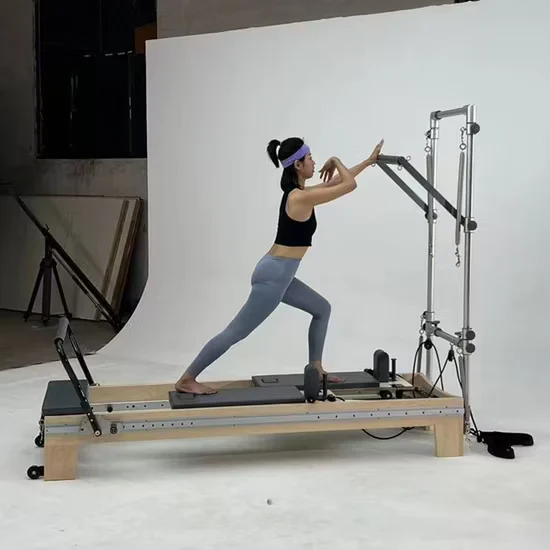
01 / Scenario
STUDIO
P
High-End Pilates Studios
Premium aesthetics meet quiet operation for boutique studio environments.

ISO
9001
CE
Certified
OEM
Available
10YR
Warranty
Commercial Pilates Combo Chair, Wood Frame, 800×620×1100mm, 45kg Net Weight — engineered with a reinforced wood chassis and sealed spring system for consistent resistance across high-repetition studio sessions. Includes long box, jump board, and platform accessories with precision-machined mounting interfaces to eliminate play under daily commercial use. Every unit undergoes 32-point inspection and full load testing before shipment.
// Spec Highlights
• Direct from Manufacturer · No Middlemen · Worldwide Shipping
01
// Material
Imported Solid Wood
Premium hardwood frames sourced for density and visual warmth.
02
// Hardware
Medical-Grade Silent
Whisper-quiet pulleys and springs for clinical environments.
03
// Customization
Appearance OEM
Color, upholstery, and branding tailored to your studio.
04
// Service
Layout Design
Free venue planning for studios and rehab institutions.
Every component is selected for longevity, performance, and aesthetic harmony - from imported hardwood frames to silent medical-grade accessories.
// Features
Load-Tested Before Shipping — every unit undergoes full load verification before leaving the factory floor, ensuring structural readiness for daily commercial studio schedules.
| Parameter | Value |
|---|---|
| Product Type | Pilates Combo Chair |
| Model NO. | SRY-04 |
| Product Dimensions | 800 × 620 × 1100 mm |
| Net Weight | 45 kg |
| Frame Material | Wood, laminated |
| Upholstery | Available in standard or high-density options |
| Accessory Compatibility | Long Box / Jump Board / Platform |
| Color | Solid Color options available |
| Logo | Customized allowed |
| Warranty | 3 Years |
| Facility Type | Typical Use |
|---|---|
| Commercial Pilates studio | Daily group and private reformer-chair sessions |
| Fitness gym Pilates zone | Dedicated combo chair stations for mixed programming |
| Rehabilitation and conditioning center | Controlled resistance exercises for recovery protocols |
| Boutique group training studio | High-frequency class rotation with accessory swaps |
| Hotel and resort wellness facility | Guest-accessible Pilates sessions with minimal supervision |
A laminated wood chassis either holds its geometry under repeated spring loading or it does not — there is no middle ground once the chair enters daily rotation.
Many suppliers label Pilates furniture as "studio grade" without disclosing the wood species, lamination method, or joint reinforcement technique. Within months of commercial use, frames begin to flex under spring tension, accessory mounting points develop play, and the chair drifts out of square alignment. When a combo chair is asked to handle both reformer-style sliding work and upright chair exercises, the structural demand on the chassis roughly doubles compared to a single-function unit. [NEED_CITE: structural fatigue in laminated wood fitness equipment frames]
A commercial Pilates combo chair wood frame unit covers sagittal and frontal plane work — seated presses, standing pedal depression, lateral stretches, and supine spring resistance when paired with the long box. In a studio layout it sits between reformers and cadillacs as a transitional station, letting instructors build circuits that alternate between lying and seated postures. The unit suits facilities running four or more classes daily where equipment must serve multiple exercise categories without constant re-rigging. Users ranging from petite to above-average height can work the pedal and spring attachments with the platform accessory providing stable foot contact.
Every pedal depression sends a torsional pulse through the wood frame, concentrated at the spring anchor plate and the upright-post junction. In a studio running six classes per day, a single chair may endure several hundred full-range cycles before closing. Over time, those cycles expose weak lamination bonds — the layers begin to separate at the highest-stress zone, typically where the spring hooks meet the base. Sweat and cleaning solvents compound the problem by wicking into micro-gaps between wood plies. [NEED_CITE: cyclic loading effects on laminated hardwood in commercial environments] Accessory mounting points for the jump board and long box experience secondary shear each time a user transitions on or off, demanding machined-fit joints rather than drilled-and-bolted afterthoughts.
Lamination process matters more than wood species alone — cross-grain laminated plies resist warping and splitting under asymmetric spring loads far better than solid-sawn boards. The spring calibration and sealing method dictate whether resistance stays consistent across the full pedal travel or develops dead spots mid-range. Accessory interfaces that are machined to tolerance hold the long box and jump board without lateral play, while hand-drilled holes invite wobble that worsens with every class. Upholstery density and vinyl grade determine how long the seat pad withstands daily compression and sweat exposure before cracking or bottoming out. A 200μm powder-coated metal bracket at the spring anchor adds corrosion resistance in the zone most exposed to moisture.
A thinner solid-wood frame saves material cost upfront but begins to warp once seasonal humidity shifts hit the studio, throwing the spring anchor geometry out of alignment and making the pedal track off-center. Non-machined accessory joints develop wobble within the first busy quarter, forcing the studio to pull the chair from rotation for re-drilling and re-bolting. Low-density upholstery pads compress permanently within weeks of high-frequency class use, leaving a visible crease that clients notice immediately. [NEED_CITE: upholstery compression lifespan in daily-use studio seating] Skimping on spring sealing allows dust and chalk to enter the coil housing, accelerating fatigue and producing inconsistent resistance that instructors cannot calibrate mid-class.
The frame uses laminated construction chosen for dimensional stability across the temperature and humidity swings typical of HVAC-cycled studio spaces. Joint reinforcement at spring anchor and upright post keeps the chassis square through hundreds of daily cycles. A three-year warranty signals the manufacturer’s confidence in the wood-to-hardware interface holding up under commercial repetition. The 800 × 620 mm footprint leaves enough clearance for safe passage between adjacent stations when laid out with studio-standard spacing. Full accessory compatibility — long box, jump board, and platform — means one chair serves multiple exercise categories, reducing total unit count in a tight floor plan. OEM color and logo customization keeps branding consistent across a multi-location rollout.
Provide your studio floor dimensions and existing equipment list to receive a 2D-3D layout that positions the combo chair within safe clearance zones and class flow paths. Specify your average daily class count so we can confirm the frame and spring system match your usage intensity. Share your target clientele body-type range to verify that the platform and accessory setup accommodates your members. Detail any color, logo, or upholstery customization requirements to align the unit with your studio branding standards.
Q: How do I tell a commercial-grade Pilates combo chair from a light-commercial or home-use model?
A: Inspect the frame lamination — commercial units use cross-grain laminated plies for dimensional stability, while home models often use solid-sawn boards. Check whether the spring anchor plate is machined or hand-drilled. Commercial chairs carry multi-year warranties backed by fatigue cycle data, and accessory joints show tight machining tolerance with no visible play when the long box or jump board is mounted.
Q: What wood construction details indicate long-term frame stability?
A: Cross-grain lamination with documented wood species is the baseline. Look for reinforced joints at the spring anchor and upright post — these are the highest-stress zones. The frame should show no gaps between plies at the edges, and the spring anchor plate should be through-bolted rather than surface-screwed. Request the lamination process documentation before committing to a bulk order.
Q: How does spring calibration affect maintenance frequency?
A: Properly calibrated and sealed springs maintain consistent resistance across the full pedal travel for a longer service interval. Unsealed springs accumulate dust and chalk residue, developing dead spots and requiring earlier replacement. Ask for a spring calibration report and fatigue cycle test data to verify that the resistance curve stays stable under your studio’s daily repetition volume.
Q: What should I verify about accessory compatibility before purchasing?
A: Confirm that the long box, jump board, and platform mount to the chair through machined interfaces rather than generic drilled holes. Check the fit tolerance — accessories should seat firmly without lateral wobble. Ask whether replacement accessory parts are available individually, because a single cracked jump board should not force you to replace the entire chair.
Q: How do I plan studio floor layout around combo chairs?
A: Account for the 800 × 620 mm footprint plus clearance for instructor access on at least two sides and full swing arc when the jump board or long box is attached. Avoid placing chairs against walls where the accessory extends beyond the base footprint. A 2D-3D layout drawing helps verify that adjacent stations maintain safe passage distances even during peak class occupancy.
Premium aesthetics meet quiet operation for boutique studio environments.
Medical-grade silence and precision for sports & postpartum recovery.
Furniture-grade craftsmanship for premium residential installations.
Compact premium setups for one-on-one and small-group training.
Aesthetic Pilates integration for hybrid wellness studio programming.
Multi-unit deployment with instructor-grade reliability for certification programs.
Tell us about your project. Our team will respond within 24 hours with pricing, customization options, and shipping details.
// Sales Director
William
+86 132 2531 1800
// Export Manager
Bella
+86 198 5412 8032
william@bickfit.com