01 / Scenario
STUDIO
P
High-End Pilates Studios
Premium aesthetics meet quiet operation for boutique studio environments.
ISO
9001
CE
Certified
OEM
Available
10YR
Warranty
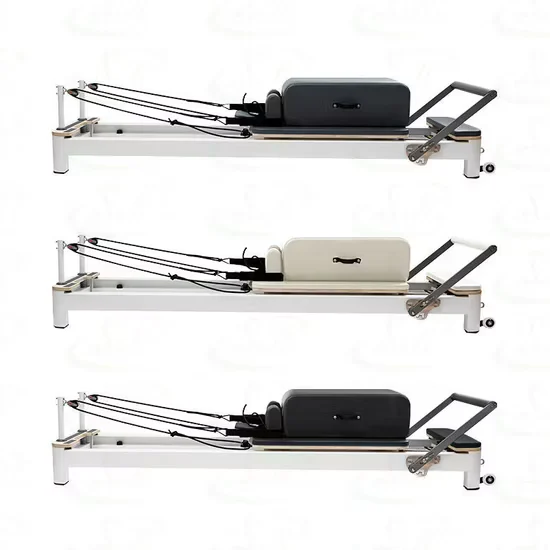
Commercial Aluminium Pilates Reformer, 2570×730mm Frame, 90kg Net Weight — aluminium extrusion construction eliminates corrosion risk in humid studio environments while maintaining torsional rigidity for rail tracking longevity; includes long box, jump board, and platform accessory integration. 3-year structural warranty with full OEM-ODM capability for custom branding and specification adjustments.
// Spec Highlights
• Direct from Manufacturer · No Middlemen · Worldwide Shipping
01
// Material
Imported Solid Wood
Premium hardwood frames sourced for density and visual warmth.
02
// Hardware
Medical-Grade Silent
Whisper-quiet pulleys and springs for clinical environments.
03
// Customization
Appearance OEM
Color, upholstery, and branding tailored to your studio.
04
// Service
Layout Design
Free venue planning for studios and rehab institutions.
Every component is selected for longevity, performance, and aesthetic harmony - from imported hardwood frames to silent medical-grade accessories.
// Features
Rust-Free Aluminium Rigidity — Mill-certified extrusions resist studio humidity without compromising the torsional stability needed for repeated spring-loaded movements.
| Parameter | Value |
|---|---|
| Product Type | Pilates Reformer |
| Frame Material | Aluminium |
| Product Dimensions | 2570 × 730 × 270 mm |
| Net Weight | 90 kg |
| Included Accessories | Long Box / Jump Board / Platform |
| Color Options | White (custom options available) |
| Logo Options | Customized |
| Target User | Adult, Unisex |
| Warranty | 3 Years |
| Facility Type | Typical Use |
|---|---|
| Commercial Pilates studio | High-frequency group and private session environments |
| Rehabilitation and physiotherapy clinic | Low-impact controlled movement programs |
| Boutique fitness facility | Premium equipment positioning for member retention |
| Home gym | Dedicated residential Pilates practice space |
Aluminium extrusion eliminates the corrosion pathway that causes thin-walled steel reformers to fail within their first year of commercial rotation.
Many studio operators specify "commercial grade" reformers without verifying the frame alloy or wall thickness. In humid environments — especially studios running back-to-back group sessions with minimal downtime between users — steel frames begin oxidizing at weld joints and rail contact points. The resulting surface pitting introduces friction into the carriage track, degrading the smooth resistance feel that clients associate with quality instruction. A commercial aluminium pilates reformer sidesteps this failure mode entirely because the material forms a self-protecting oxide layer rather than progressive rust [NEED_CITE: corrosion behavior of aluminium alloys in high-humidity indoor environments].
This reformer addresses the full sagittal and frontal plane spectrum required for classical and contemporary Pilates programming. The included long box enables seated and prone pulling movements, the jump board introduces controlled plyometric loading, and the platform extends the working surface for standing balance work. In a studio layout, these units pair with mat stations and cadillacs to create a complete apparatus zone. The 2570 mm length accommodates users across a broad height range without requiring carriage travel extensions. Facilities running high-density group formats benefit from the 90 kg net weight, which holds floor position during dynamic spring transitions without permanent anchoring. The commercial aluminium pilates reformer fits standard studio spacing when arranged in parallel rows with recommended lateral clearance.
A reformer in a busy studio endures eccentric loading patterns that differ fundamentally from static weight-bearing equipment. Every spring transition generates an impulse force through the carriage wheels and rail interface, concentrated at the contact points where directional changes occur. Over hundreds of daily cycles, these repeated micro-impacts test the aluminium extrusion’s torsional rigidity and the wheel bearing’s tolerance retention. Sweat and cleaning solution exposure adds a chemical dimension to the wear equation — components that survive mechanical fatigue can still degrade if their surface treatment fails against chlorinated disinfectants. Upholstery foam undergoes constant compression-release cycles, making density and recovery rate the primary determinants of visible surface lifespan [NEED_CITE: fatigue loading characteristics of spring-resistance exercise equipment].
The aluminium extrusion profile governs how much torsional deflection occurs when a user applies asymmetric force — for example, during single-leg work on the jump board or unilateral pulling from the long box. A thicker-walled profile resists this twisting, keeping the carriage track parallel and preventing the rail wear that develops when wheels run against a misaligned surface. The 90 kg net weight signals substantial material volume in the frame, contributing to both vibration damping during spring transitions and overall floor stability. Sealed bearing carriage wheels isolate internal lubrication from studio dust and cleaning residue, maintaining consistent roll resistance across thousands of sessions. The three-year structural warranty on this commercial aluminium pilates reformer reflects confidence in these load-path components rather than covering only cosmetic defects.
Reformers priced aggressively often achieve margins through thin-walled aluminium or unalloyed steel that flexes under off-center loading, creating a vague, unstable feel that advanced practitioners immediately detect. Non-sealed bushings in the carriage system develop lateral play within months of commercial use, requiring frequent wheel replacement or complete carriage rebuilds. Low-density upholstery foam compresses permanently under daily body-weight loading, forcing studios into a replacement cycle that disrupts scheduling and generates recurring material costs. Springs from unverified suppliers lose their calibrated resistance gradient unpredictably, making consistent class programming impossible. When hardware fasteners are non-standard sizes, replacement parts become unavailable once the original supplier discontinues the model [NEED_CITE: maintenance cost differentials between sealed bearing and bushing carriage systems].
Aluminium extrusion certification traceable to the mill confirms the alloy grade and wall thickness claimed in product literature, rather than relying on generic "aircraft aluminium" marketing language. Robotic MIG welding on aluminium jigs produces continuous weld beads at frame junctions — the stress concentration points where manual spot-welding leaves cold joints prone to crack propagation under cyclic loading. Every unit undergoes load testing before shipment, verifying carriage travel smoothness and spring attachment integrity under working conditions rather than sample-based batch approval. The 200μm industrial powder coating applied to steel components resists chipping at contact points where bare metal would otherwise oxidize. Floor planning support includes CAD layout files showing this reformer’s footprint with safe clearance zones, ensuring studios don’t discover unusable gaps after installation. OEM private label programs allow facilities to match equipment aesthetics to existing branding without compromising structural specifications.
Provide your studio floor dimensions and intended apparatus count to receive a scaled 2D-3D layout showing optimal reformer spacing with safe user clearance zones. Specify your expected daily session volume so the structural grade and spring configuration match your traffic pattern. Confirm the height range of your client population to verify that the carriage travel and rope length accommodate your user base. Indicate any custom requirements including frame color, logo placement, or upholstery material preferences for integration with existing studio aesthetics.
Q: How does an aluminium frame compare to steel for long-term studio ownership costs?
A: Aluminium eliminates rust-related rail degradation entirely, removing the sanding and refinishing cycles that steel frames require in humid studio environments. The material’s natural oxide layer self-repairs when scratched, maintaining corrosion resistance without ongoing coating maintenance. This translates to lower lifetime maintenance expenditure despite a higher initial equipment investment, particularly in facilities running high-volume group formats with frequent cleaning protocols.
Q: What should I verify about the rail and carriage system before purchasing?
A: Request documentation on rail straightness tolerance and carriage wheel material specification — sealed bearings outperform simple bushings in dust and moisture exposure common to studio environments. Ask whether the carriage track is integral to the aluminium extrusion or a separate attached component, as integrated tracks maintain alignment better under asymmetric loading. A factory visit or sample unit evaluation reveals tracking smoothness that specification sheets alone cannot communicate.
Q: How do I select spring resistance for mixed-level studio programming?
A: Studios serving beginners through advanced practitioners benefit from a graduated spring set offering distinct resistance levels rather than subtle increments. Confirm the spring supplier origin and fatigue cycle test data, as springs are the highest-wear component requiring predictable replacement intervals. Standard commercial configurations typically include multiple springs allowing instructors to scale resistance for rehabilitation clients and athletic populations using the same apparatus.
Q: What upholstery standards matter for commercial hygiene protocols?
A: High-traffic studios need vinyl rated for tear strength and chemical resistance to withstand daily cleaning with disinfectant solutions. Confirm that replacement upholstery pads are available as separate components with documented lead times, enabling rapid turnaround without taking the reformer out of service for extended periods. Foam density determines how quickly the padding compresses permanently under repeated body-weight loading during peak scheduling.
Premium aesthetics meet quiet operation for boutique studio environments.
Medical-grade silence and precision for sports & postpartum recovery.
Furniture-grade craftsmanship for premium residential installations.
Compact premium setups for one-on-one and small-group training.
Aesthetic Pilates integration for hybrid wellness studio programming.
Multi-unit deployment with instructor-grade reliability for certification programs.
Tell us about your project. Our team will respond within 24 hours with pricing, customization options, and shipping details.
// Sales Director
William
+86 132 2531 1800
// Export Manager
Bella
+86 198 5412 8032
william@bickfit.com