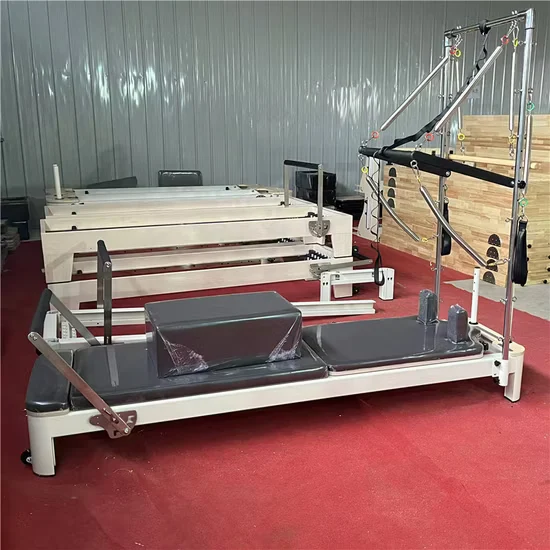
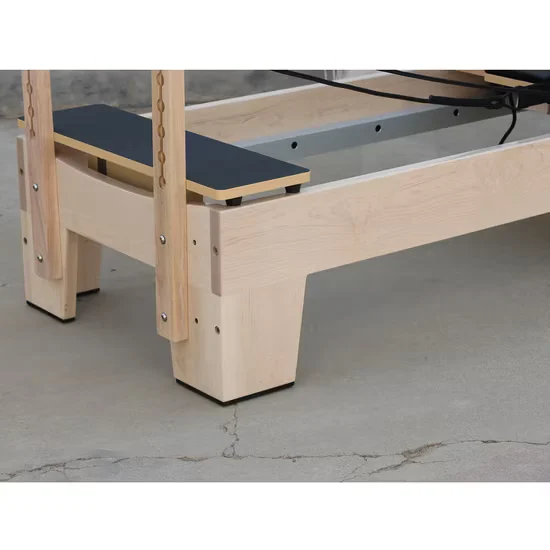
01 / Scenario
STUDIO
P
High-End Pilates Studios
Premium aesthetics meet quiet operation for boutique studio environments.

ISO
9001
CE
Certified
OEM
Available
10YR
Warranty
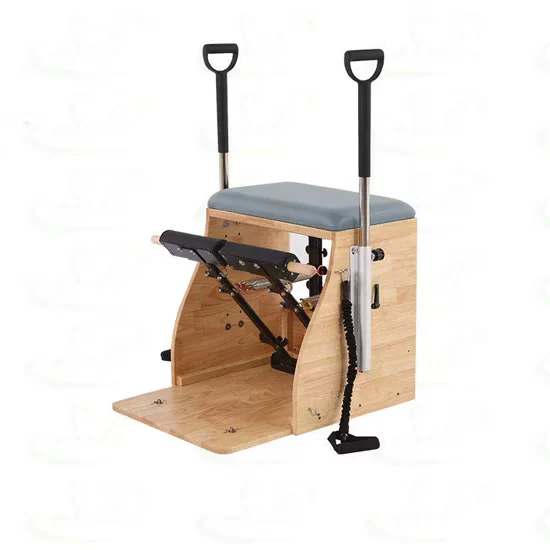
Professional Pilates Combo Chair, Solid Wood Frame, 800×620×1100mm — engineered with hardwood construction and an interchangeable accessory system featuring Long Box, Jump Board, and Platform for studio and rehabilitation applications. The 45kg net weight ensures stability during dynamic spring-loaded movements, while the solid wood joinery resists warping under repeated tension cycling. Each unit undergoes 32-point inspection and 100% load testing before shipment, backed by a 3-year warranty.
// Spec Highlights
• Direct from Manufacturer · No Middlemen · Worldwide Shipping
01
// Material
Imported Solid Wood
Premium hardwood frames sourced for density and visual warmth.
02
// Hardware
Medical-Grade Silent
Whisper-quiet pulleys and springs for clinical environments.
03
// Customization
Appearance OEM
Color, upholstery, and branding tailored to your studio.
04
// Service
Layout Design
Free venue planning for studios and rehab institutions.
Every component is selected for longevity, performance, and aesthetic harmony - from imported hardwood frames to silent medical-grade accessories.
// Features
Traced Solid Wood — Every board is hardwood, species-verified at intake, not veneer over particle core.
| Parameter | Value |
|---|---|
| Product Type | Pilates Combo Chair |
| Frame Material | Solid Wood |
| Finish | Solid Color |
| Product Dimensions | 800×620×1100mm |
| Net Weight | 45kgs |
| Accessory System | Long Box / Jump Board / Platform (interchangeable) |
| Customization | Available |
| Logo | Customized Is Allowed |
| Warranty | 3 Years |
| User Profile | Adult, Unisex |
| Facility Type | Typical Use |
|---|---|
| Pilates Studio | Group reformer-chair classes and private sessions with accessory rotation |
| Rehabilitation and Physiotherapy Center | Low-impact resisted movement for joint recovery and neuromuscular re-education |
| Boutique Fitness Facility | Functional movement circuits combining chair work with jump board plyometrics |
| Hotel Wellness Center | Compact footprint footprint allows placement in limited-space fitness suites |
Solid wood joinery holds under thousands of spring-tension cycles; composite cores do not.
A commercial Pilates combo chair sees repetitive pedal depression against spring resistance, sometimes hundreds of times per day in a busy studio. When the frame is particle board or MDF wrapped in thin veneer, the screw joints that anchor the pedal mechanism gradually loosen as the composite material crumbles around the fastener threads. We saw this firsthand when a batch of chairs with 14-gauge pedal mounts had to be recalled — the metal was fine, but the wood substrate failed at the gusset under cyclic spring loading. Buyers evaluating a fleet purchase should request the actual wood species and grade, not accept "wood" as a specification [NEED_CITE: structural performance of solid hardwood vs. engineered wood composites under cyclic loading].
The combo chair occupies a specific niche between the reformer and the Cadillac in a fully equipped Pilates environment. It targets spinal articulation, lower limb alignment, and upper body stabilization through a compact pedal-based resistance platform. In a studio running group classes, chairs pair naturally with reformers for circuit-style programming where members rotate between stations. The accessory system — Long Box for seated and supine work, Jump Board for controlled plyometric loading, Platform for standing balance challenges — extends the exercise library without requiring additional floor space. This configuration suits studios with moderate to high member throughput, where each station must justify its footprint across multiple class formats.
Every pedal press drives force through the spring anchor points and into the frame’s lower joinery. Over a typical studio schedule of eight or more classes daily, each commercial Pilates combo chair accumulates tens of thousands of load cycles annually. The critical stress points are the pedal pivot bushings, the spring attachment brackets, and the wood-to-metal fastener interfaces where the pedal mechanism bolts to the frame. Surface finish also matters: sweat, cleaning solutions, and bare-skin contact gradually degrade unprotected wood, particularly at grip points and foot contact zones. A properly sealed hardwood surface resists this chemical and mechanical wear, while unfinished or thinly coated boards absorb moisture and swell at the joints [NEED_CITE: wood surface degradation under repeated exposure to perspiration and cleaning agents].
Solid wood species and grade directly determine how the frame responds to years of spring-loaded use. Dense hardwoods with tight grain orientation resist warping and hold fastener threads securely, whereas softer species or boards with irregular grain patterns tend to loosen at the joints. The accessory interface — how the Long Box, Jump Board, and Platform mount, slide, and lock — depends on machining tolerance of the mating surfaces; even a slight mismatch introduces wobble that worsens with wear. Spring housing construction affects both the feel of resistance and the ease of replacement when springs fatigue. And the surface coating or sealant must withstand daily sweat exposure, chemical cleaning, and direct contact from bare feet and hands without breaking down or becoming slippery.
When manufacturers cut costs on a Pilates chair, the compromises hide inside the frame. Thin veneer over particle core looks acceptable in a showroom photograph but delaminates at the edges where pedal forces concentrate. Undersized spring brackets bend gradually, shifting the resistance angle and making exercises feel inconsistent across identical units. Non-standard hardware means replacement springs and bushings become difficult to source, effectively turning a repairable machine into disposable furniture. And thin surface finishes that fail within months expose raw wood to humidity and sweat, accelerating joint swelling and fastener corrosion [NEED_CITE: long-term cost implications of value-engineered fitness equipment in commercial environments].
Our manufacturing discipline extends beyond steel frames into every load-bearing product we build. The same traceability we apply to 11-gauge steel sourcing carries over to hardwood selection — species and grade are documented, not left to supplier discretion. Robotic welding consistency has its parallel in CNC-machined joinery tolerances that keep accessory interfaces tight across production runs. Every unit undergoes load testing before shipment, verifying that pedal mechanisms and spring anchors hold under sustained force. The 200μm powder coating standard translates to durable surface sealing on wood components, protecting against studio humidity and daily cleaning. Our 10-year frame warranty philosophy applies: structural components are built to outlast the warranty period by a wide margin.
Share your studio floor dimensions and current equipment list to receive a 2D or 3D layout showing optimal chair placement and accessory workflow. Specify your daily class volume so we can confirm the structural grade matches your throughput. Provide your target client profile — rehabilitation patients versus athletic populations — to determine the ideal spring resistance range and accessory mix. Let us know about branding requirements, including custom logo placement and color-matched upholstery, early in the process so production tooling can accommodate your specifications.
Q: How do I verify that a Pilates chair is genuine solid wood rather than veneer over composite?
A: Request a cross-section photograph of any cut edge or joinery point — composite cores show layered particle or fiber structure beneath the veneer, while solid wood displays continuous grain through the full thickness. You can also ask for the lumber supplier’s species certificate. Genuine hardwood is noticeably heavier than particle board at the same dimensions, and fastener holes in solid wood hold threads securely without crumbling.
Q: Which accessories should I order for a studio running group classes versus rehabilitation sessions?
A: Group class environments benefit from all three accessories — Long Box for seated series, Jump Board for controlled plyometric work, and Platform for standing balance drills — rotated throughout the weekly schedule. Rehabilitation clinics typically prioritize the Long Box for supported supine and seated exercises, adding the Platform as patients progress to weight-bearing balance work. Jump Boards are less common in clinical settings unless the facility handles athletic return-to-play protocols.
Q: How do spring resistance levels affect which exercises I can program on the combo chair?
A: Lighter springs allow controlled, slow-tempo movements suitable for rehabilitation and beginner clients learning movement patterns. Heavier springs provide the resistance needed for advanced strength work and athletic conditioning. Most studios stock a range and swap them based on class level. Confirm with the manufacturer that replacement springs in various resistance levels are available as standard catalog items rather than custom orders.
Q: What maintenance does a solid wood Pilates chair require in a humid studio environment?
A: Wipe down all wood contact surfaces after each class with a pH-neutral cleaner and dry cloth to prevent moisture absorption. Inspect sealant integrity at joints and high-wear zones quarterly; reapply recommended wood sealant if the surface shows dulling or roughness. Maintain studio humidity between forty and sixty percent when possible, as extreme swings cause wood to expand and contract, gradually loosening joinery over time.
Q: Can the chair be customized with our studio branding and color-matched to existing equipment?
A: Yes, logo placement and color customization are available during production. Provide vector artwork files and Pantone color references early in the ordering process so tooling and finish samples can be prepared before the full production run. Custom upholstery color matching is also possible — send a physical swatch or specify the exact material and color code for consistent results across your entire equipment fleet.
Premium aesthetics meet quiet operation for boutique studio environments.
Medical-grade silence and precision for sports & postpartum recovery.
Furniture-grade craftsmanship for premium residential installations.
Compact premium setups for one-on-one and small-group training.
Aesthetic Pilates integration for hybrid wellness studio programming.
Multi-unit deployment with instructor-grade reliability for certification programs.
Tell us about your project. Our team will respond within 24 hours with pricing, customization options, and shipping details.
// Sales Director
William
+86 132 2531 1800
// Export Manager
Bella
+86 198 5412 8032
william@bickfit.com