Split Shipment Modular Rig Multi-Region Wholesale Supplier
Splitting a modular rig order into multiple containers is not about saving freight—it is about matching HS codes, container geometry, and destination customs logic before the first crate is sealed.
The core of any split shipment policy for modular rigs lies in unifying HS code classification across all partial containers, optimizing cabinet types to maintain high load rates, and aligning every customs document to the exact same product description—otherwise, partial arrivals trigger "incomplete goods" rulings, duty reclassification, or outright rejection at the destination port.
I still remember a project in Riyadh where a full container of modular power racks arrived on schedule, but the accessory crates—J-cups, safety straps, lat pulldown attachments—were held up in a separate shipment that missed the vessel by a single day. The gym opening was days away, and Saudi customs would not release the main frames without the accessory paperwork matching the same commercial invoice batch. We ended up air-freighting replacement hardware from Dubai at several times the original sea freight cost. That single misalignment taught every buyer I now work with to treat split shipments as one coordinated customs event, not two separate orders. [NEED_CITE: WCO HS Convention general rules for incomplete or unfinished articles]
If you are sourcing a split shipment modular rig multi-region wholesale supplier, the first conversation should never be about price per unit—it should be about how the factory plans to divide the load, which HS codes each division falls under, and what happens at the destination port when container A arrives before container B.
What Is the Split Shipment Policy for Modular Rigs?
A split shipment policy for modular rigs is a pre-agreed framework that defines how a single large order is divided across multiple containers or multiple sailing dates, with each partial shipment carrying its own packing list, invoice, and bill of lading while remaining legally tied to one master purchase contract.
This is not the same as placing two separate orders. Under a true split shipment arrangement, the commercial invoice references a single PO number with line items distributed across named vessels or container numbers. [NEED_CITE: UCP 600 Article 31 rules on partial drawings or shipments] The reason this distinction matters is that many destination customs authorities—particularly in the Middle East and parts of Africa—treat unrelated shipments of the same product category as independent imports, each subject to its own duty assessment, inspection queue, and documentation review.
In practice, a typical split for a commercial gym build-out looks like this: the first container carries the upright frames, crossmembers, and main structural components of the modular rig; the second container carries the attachments, cable systems, weight storage horns, and hardware kits. The ratio usually settles around a majority share for the main structure and a smaller share for accessories, though the exact split depends on the rig configuration and the destination country’s tariff schedule.
A regional gym chain operator in the Gulf once asked us to deliver to three separate sites across two countries within a narrow window. Instead of shipping three partial containers at random, we mapped each site’s rig configuration, grouped identical upright sets into one container, and allocated all site-specific accessories into a second container labeled by destination branch. The result was clean customs clearance at each port because every container’s paperwork described a complete, self-contained functional unit rather than a random assortment of steel parts.
The risk of ignoring this structure is real. If the main frame container arrives but the accessory container is delayed, some customs jurisdictions will hold the main frames under a "goods not yet complete" classification, which can trigger higher duty rates or require a bond until the second shipment arrives. [NEED_CITE: GCC Common Customs Law treatment of incomplete industrial equipment]
How to Split Modular Rig Components Without Customs Issues?
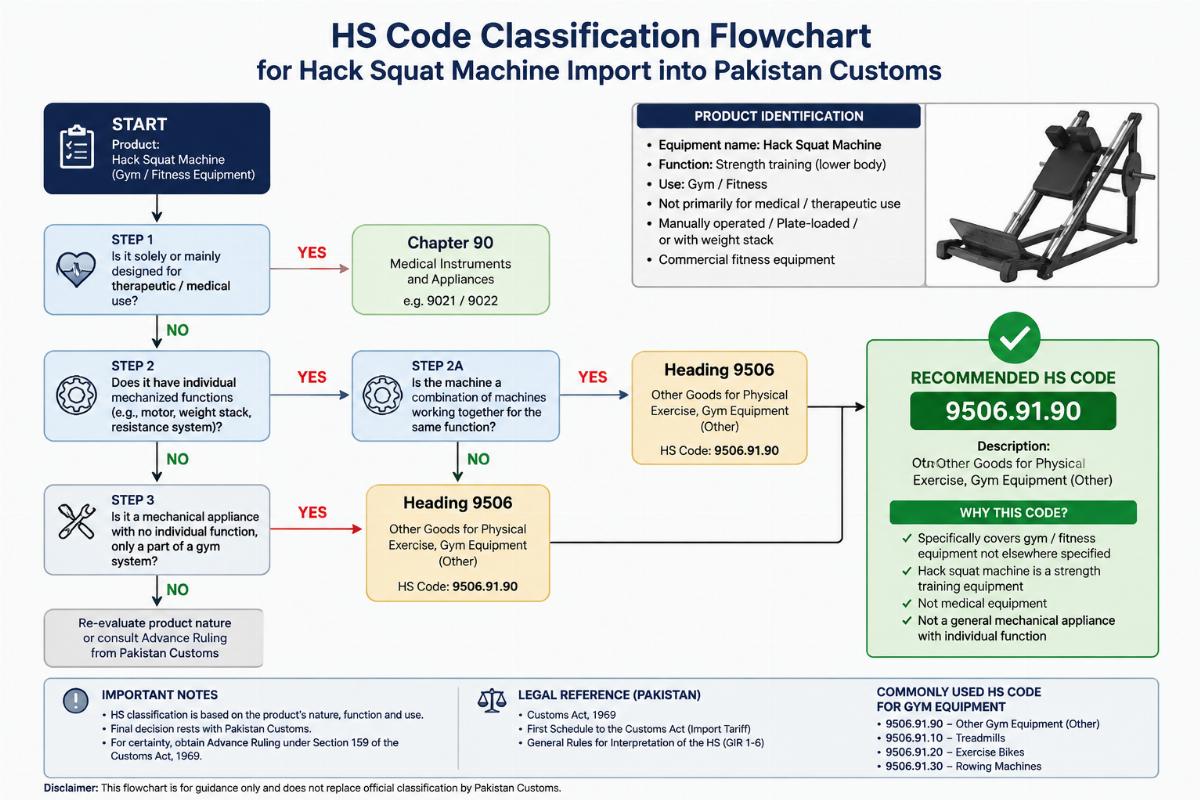
The only safe way to split a modular rig shipment is by HS code functional classification—main structural frames under one code, bolt-on accessories under another, and consumable hardware under a third if the destination tariff schedule justifies it.
Most buyers assume that because everything in the container is "gym equipment," customs will treat it as one category. This is incorrect. Under the WCO Harmonized System, a fully assembled power rack and a loose set of J-cups do not share the same classification in many national tariff books. [NEED_CITE: HS Chapter 95 explanatory notes on strength training apparatus vs parts and accessories] If you load both into one container without declaring them separately on the packing list, the customs broker at destination may classify the entire container under the higher-rate heading.
Here is how a proper split works at the component level:
- Main uprights and crossmembers are classified as the principal strength training apparatus. These are the heaviest, most voluminous items, and they carry the base HS code for the complete machine.
- Bolt-on attachments such as dip bars, landmine posts, monolift arms, and plate storage pegs are classified as parts or accessories. In some countries, these attract a lower duty rate; in others, they attract a higher one depending on whether the national tariff treats them as "integral" or "optional."
- Loose hardware kits—bolts, nuts, washers, anchoring sleeves—are often classified under general fastener headings rather than gym equipment headings. Mixing them into the main frame declaration can cause a customs officer to question the entire shipment’s classification.
A distributor in West Africa learned this the hard way when a mixed container of rigs and accessories was assessed under a single high-rate heading because the packing list did not separate the line items by function. The duty difference was substantial enough to erase the margin on the entire order. After that, every shipment we prepared for that buyer included three distinct line items on the commercial invoice, each with its own HS code, unit count, and net weight—even when all three traveled in the same container.
What Container Types Work Best for Partial Shipments?
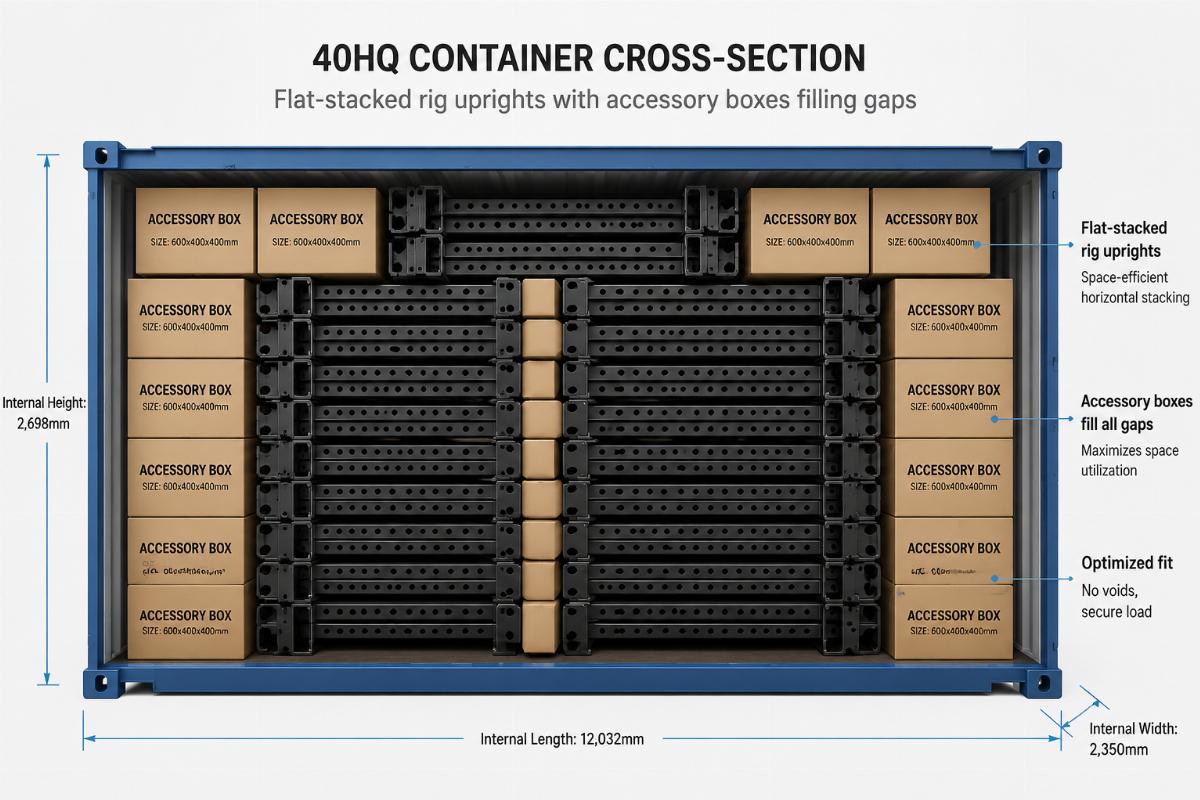
Choosing between a 20-foot and a 40-foot high-cube container for a split modular rig shipment depends entirely on the volumetric ratio of uprights to accessories, not on which container is cheaper per cubic meter.
Modular rig uprights are long, narrow, and stackable. Accessories are irregular, often boxed in smaller cartons, and leave awkward voids when loaded alone. If you put only uprights into a container, you will hit the weight limit long before you fill the volume. If you put only accessories, you will fill the volume long before you hit the weight limit. The art of the split is balancing both.
For a typical commercial modular rig order, the main structure shipment works best in a container that maximizes floor length for upright bundles, while the accessory shipment works best in a container where volume matters more than length. In many cases, this means the main structure goes into one container type and the accessories go into another—or, if the order is large enough, the main structure fills one container completely while the accessories share a container with flooring, dumbbells, or other gym items.
A hotel fitness center project in Latin America illustrates this well. The buyer needed modular rigs, rubber flooring, and a full set of adjustable dumbbells. Instead of shipping three partial containers, we loaded the rig uprights and crossmembers into one container at high volumetric efficiency, then packed the accessories, flooring rolls, and dumbbell sets into a second container where the irregular shapes filled the voids left by the rig’s boxy packaging. Both containers cleared customs cleanly because each was documented as a distinct functional shipment.
The loading calculation itself is straightforward but must be done before the order is confirmed, not after production finishes. The factory needs to know the exact dimensions of every packed component, the stacking constraints of the uprights, and the weight distribution limits of the chosen container type. [NEED_CITE: ISO 668 series container classification and dimensional specifications]
| Container Role | Typical Cargo Mix | Loading Priority | Documentation Approach |
|---|---|---|---|
| Main Structure Container | Uprights, crossmembers, base plates | Weight-limited, length-optimized | Single HS code for complete apparatus |
| Accessory Container | Attachments, cables, hardware kits | Volume-limited, shape-irregular | Separate HS codes by functional category |
| Mixed Gym Container | Accessories plus flooring, free weights | Volume-balanced across product types | Multiple line items with distinct HS codes |
How to Coordinate Multi-Region Delivery Timelines?
The biggest mistake in multi-region split shipments is not the split itself—it is the assumption that the first container to arrive can clear customs independently without the second container’s paperwork being ready and linked.
When a buyer in the Middle East orders modular rigs for three gym locations across two countries, the natural instinct is to ship each location’s equipment as it becomes ready. But if the main frames for Location A arrive at Jebel Ali while the accessories for Location A are still on the water, the frames may sit in the port yard accumulating demurrage charges until the accessories arrive and the full documentation set can be presented.
The coordination logic works like this:
- Map every destination point and its specific rig configuration before production begins.
- Group containers by destination, not by production completion date. If Location A needs both main frames and accessories, they should either travel in the same container or sail on the same vessel with linked bills of lading.
- Stagger sailing dates, not documentation dates. All commercial invoices, packing lists, and certificates of origin for a single destination should be prepared as a single batch, even if the containers sail weeks apart.
- Confirm with the destination broker whether partial clearance is permitted under local regulations. Some ports allow it; others require all containers under the same PO to arrive before any clearance begins.
A distributor operating across several East African ports restructured their ordering process after repeated demurrage costs. Instead of placing one large PO and letting the factory ship as items were ready, they issued separate POs per destination, each with its own delivery window and documentation package. The factory produced to a unified schedule but released containers in a sequence matched to each port’s arrival window. Demurrage charges dropped noticeably, and the broker at each port could process clearance without waiting for cross-referenced paperwork from another shipment.
What Documents Must Align Across Split Shipments?
Every document in a split modular rig shipment—commercial invoice, packing list, certificate of origin, bill of lading, and insurance certificate—must carry identical product descriptions, HS codes, and PO references across all partial containers, or the shipment will be treated as unrelated imports.
This is where most split shipments fail. The factory issues one invoice for the full order, then the logistics team generates separate packing lists for each container. If the packing list for container one describes "modular power rack main frames" and the packing list for container two describes "gym accessories," but the commercial invoice uses a single blanket description, the customs broker at destination has a mismatch to resolve. That mismatch can delay clearance by weeks.
The alignment checklist is non-negotiable:
- Product description wording must be identical across every document. If the invoice says "commercial modular strength rig upright assembly," the packing list and bill of lading must use the same phrase—not "power rack parts" or "gym frame components."
- HS codes must appear on the commercial invoice and be mirrored on the certificate of origin. Some destination countries require the HS code to appear on the bill of lading as well.
- PO number must be consistent. If the split shipment is under one PO, every document must reference that same PO. If the buyer has issued separate POs per container, the documents must clearly link each container to its specific PO while cross-referencing the master agreement.
- Net weight and gross weight must add up. The sum of all partial packing lists must equal the total stated on the master commercial invoice. Even small rounding discrepancies can trigger a customs query.
A buyer in Southeast Asia had a shipment held because the certificate of origin listed the full order weight while the bill of lading for the first container listed only that container’s weight—without any notation that it was a partial shipment. The customs officer assumed a documentation error and flagged the container for physical inspection. The delay cost the buyer storage fees and missed an opening promotion window.
Conclusion
A split shipment modular rig multi-region wholesale supplier earns its role not by cutting prices but by engineering the split at the intersection of HS classification, container geometry, and destination customs rules. Every partial container must carry documentation that speaks the same language as every other container in the order, and the sailing sequence must match the clearance logic of each port involved. Treat the split as one customs event divided across multiple boxes, and the cargo moves. Treat it as several unrelated shipments that happen to share a PO number, and the port yard becomes a storage facility.