Seated Leg Curl Belt Deck Bearing Replacement – OEM Supplier for Sale
Waiting for a belt to snap before ordering replacements is the single most expensive mistake gym operators make.
For high-traffic commercial gyms, seated leg curl belts should be inspected monthly and replaced every three to six months; deck and pivot bearings require monthly play-checks and proactive swap-outs before audible grinding begins. Mid-traffic hotel and apartment facilities can extend belt intervals to roughly eight to twelve months with quarterly bearing inspections. The real failure chain is not belt-then-bearing—it is belt wear causing off-axis loading that destroys bearings long before the belt itself snaps. [NEED_CITE: failure sequence analysis per ISO 15243 damage categories]
车间里焊过架子、拧过螺丝,后来跟着业务员跑单,才慢慢摸到外贸这扇门。干健身器材这些年,最怕客户半夜发视频过来——坐姿腿弯举的轴承碎了,皮带磨得只剩毛边,整台机器趴窝。有一回发往中东的货,客户那边找不到匹配的轴承,整批器械停摆两个月,最后我们连夜从佛山仓调件走空运才救回来。从那以后我就盯紧一件事:易损件的规格必须随货走,换件步骤得写成图,别让客户对着机器干瞪眼。
Let me walk you through exactly which parts fail, why they fail in that order, and how to build a spare-parts plan that keeps machines running instead of sitting in a maintenance queue.
What Components Need Regular Replacement on a Seated Leg Curl?
The seated leg curl concentrates wear on three specific points: the drive belt, the pivot deck bearings, and the cable-pulley bearings. Everything else on the machine—frame welds, weight stack guide rods, seat padding—lasts for years without intervention. These three components, however, absorb every repetition’s friction, tension fluctuation, and environmental exposure.
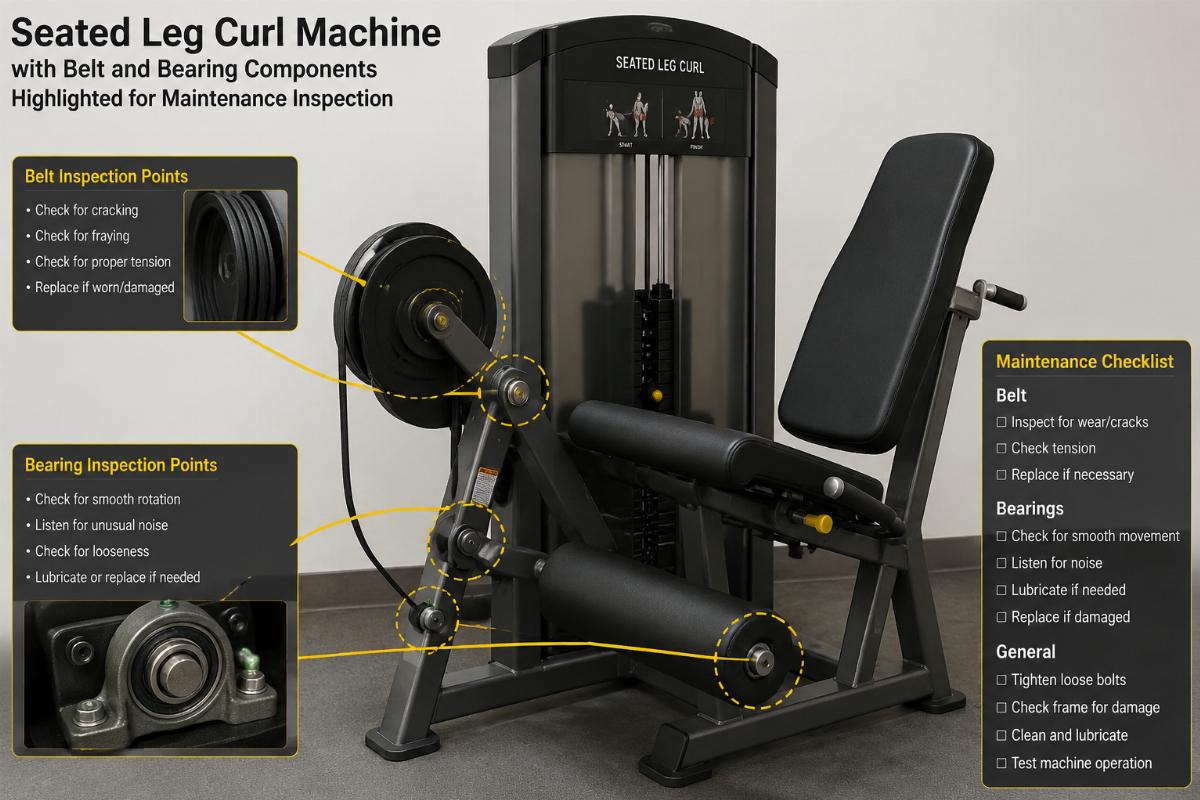
The drive belt transmits force from the weight stack to the lever arm. On a seated leg curl belt deck bearing replacement cycle, the belt is always the first item to show visible degradation. Edge fraying, longitudinal micro-cracks, and loss of tensile stiffness are the typical progression. [NEED_CITE: rubber-polymer belt degradation mechanisms under cyclic loading]
Pivot deck bearings sit at the main articulation point where the lever arm swings. They carry the full load of the stack plus dynamic shock from users who release weight abruptly. Unlike sealed industrial bearings, fitness bearings operate in an environment saturated with sweat aerosol, chalk dust, and humidity from nearby shower areas.
Cable-pulley bearings guide the steel cable through direction changes. They are smaller, spin faster per repetition, and are often overlooked until the cable starts jumping off its track. When a pulley bearing seizes, it slices through the cable sheath within a few hundred reps.

How Often Should You Replace the Belt and Bearings?
Replacement intervals must be tiered by daily usage volume, not by calendar alone. A belt that lasts twelve months in a low-traffic boutique studio will fail in under four months on a commercial gym floor running back-to-back peak-hour sessions.
| Usage Tier | Daily Reps (Approx.) | Belt Inspection | Belt Replacement | Bearing Check | Bearing Replacement |
|---|---|---|---|---|---|
| High-traffic commercial gym | Heavy continuous use | Monthly | Every few months | Monthly | Proactive semi-annual |
| Hotel or apartment fitness center | Moderate daily use | Quarterly | Roughly annual | Quarterly | Annual or as needed |
| Private studio or home gym | Light intermittent use | Semi-annual | Extended interval | Semi-annual | Multi-year service life |
[NEED_CITE: gym equipment maintenance interval recommendations per usage classification]
A Middle East distributor I worked with once ran a full container of strength machines into a chain of hotel gyms across the Gulf. They ordered zero spare belts or bearings, assuming warranty would cover any issues. Within months, two properties reported seized pivot bearings during peak summer humidity. The root cause was not the bearing itself—it was sweat corrosion accelerating pitting on races that had no protective seal upgrade for tropical coastal environments. Shipping individual replacement bearings from China in small quantities cost several times the value of the parts themselves, not counting guest complaints and machine downtime.
The lesson: belt and bearing replacement schedules are not optional maintenance suggestions. They are operational parameters that must be written into the facility’s preventive maintenance protocol before the machine is even unpacked.

What Are the Warning Signs Before Failure?
A seated leg curl never fails without announcing itself first—if you know what to listen for and feel for. The problem is that most gym floor staff treat unusual sounds as normal gym noise until something actually breaks.
Belt warnings come in three observable stages. First, a faint slapping sound during the eccentric phase indicates the belt surface is losing its grip texture. Second, visible edge分层—where the outer rubber cover begins separating from the tensile cord layer—means the belt has entered its final service window. Third, a noticeable dip in tension at the top of the movement, where the lever arm feels momentarily loose before catching, signals internal cord breakage. At this stage, the belt is a single heavy rep away from complete separation. [NEED_CITE: belt tension loss indicators in fitness equipment drive systems]
Bearing warnings are primarily auditory and tactile. A high-pitched metallic whine during slow reps indicates lubricant depletion inside the seal. A rhythmic clicking or grinding that accelerates with load means rolling elements are developing flat spots from brinelling. Axial play—where you can physically wiggle the lever arm side-to-side with the machine unloaded—is the terminal stage. By then, the bearing race is already scored, and replacement is urgent.
One often-missed sign is uneven cable wear. If the cable on your seated leg curl belt deck bearing replacement candidate shows asymmetric fraying, the pulley bearing behind it is running off-axis. Replacing the cable without replacing the bearing guarantees the new cable will wear out in a fraction of its expected life.

Step-by-Step Replacement Guide
A disciplined replacement sequence prevents collateral damage and ensures the machine returns to service with factory-spec alignment. Skipping steps—especially the tension calibration phase—is what causes new belts to fail prematurely and new bearings to develop noise within weeks.
Begin by disconnecting the machine from any electrical supply if it has electronic load sensors or console connections. Purely plate-loaded seated leg curls need no power disconnect, but verifying this prevents accidents in mixed-equipment facilities.
Remove the rear and side shrouds using the appropriate hex key. Most commercial machines use standard metric fasteners, but some older models have proprietary security bolts. Keep all fasteners organized by location—photographing the assembly before disassembly saves considerable reassembly time.
Mark the belt routing path with a grease pencil or masking tape before releasing tension. Belt direction matters: installing a belt reversed may seem to work initially but will accelerate wear on the non-drive side coating. [NEED_CITE: belt routing orientation standards in plate-loaded equipment]
Release the tensioner mechanism—typically a spring-loaded idler pulley or an adjustable eccentric bushing. Slide the old belt off and compare it against the replacement part. Width, tooth profile (if toothed), and overall loop length must match exactly. Even slight width mismatches cause tracking drift.
For bearing replacement, extract the old unit using a proper puller. Hammering bearings out distorts the housing bore and guarantees the new bearing will sit off-center. Press the new bearing in using a bearing driver sized to the outer race—never apply force through the inner race or rolling elements.
Reinstall the belt, restore tension to the manufacturer’s specified deflection range, and cycle the machine through full range of motion unloaded for several repetitions. Listen for rubbing, watch for belt tracking stability, and verify that the lever arm returns smoothly without binding.
A European fitness chain operator once had a technician skip the tension calibration step during a belt swap. The over-tightened belt loaded the pivot bearings with excessive radial force, and those new bearings developed audible grinding within weeks. The operator assumed the bearings were defective. In reality, the installation sequence had introduced the problem.

How to Build a Spare Parts Inventory?
The most cost-effective spare parts strategy is to secure critical wear components at the time of initial equipment purchase, not after the first failure occurs.
For a seated leg curl belt deck bearing replacement inventory, the minimum viable stock per machine includes one drive belt, one full pivot bearing set, and two pulley bearings. For facilities operating multiple identical units, bulk-packing these items at the time of order consolidation dramatically reduces per-unit logistics cost and eliminates the lead-time gap that turns a minor repair into extended machine downtime.
When sourcing from an OEM supplier, request that spare part specifications be documented and shipped alongside the main order. Bearing part numbers, seal types, and belt cross-section profiles should be listed on a dedicated spare-parts sheet. This documentation is what allows facility maintenance teams—or third-party service providers—to source exact replacements locally if needed, rather than depending exclusively on the original supplier for every future order.
A distributor in Southeast Asia learned this the hard way after purchasing a large batch of selectorized machines without requesting the spare-parts documentation package. When belts began wearing at one of their gym client sites, the local maintenance team could not identify the correct belt profile. They improvised with a generic substitute that ran for a short period before slipping under load. The resulting customer complaint traced back to a documentation gap that could have been closed at the original shipping stage.
Beyond belts and bearings, consider stocking cable assemblies, pulley wheels, and seat-adjustment pins. These items fail less frequently but are equally difficult to source urgently in many overseas markets. A consolidated spare-parts container addition—representing a small fraction of total order value—provides operational insurance that pays for itself the first time a machine is restored to service in hours rather than weeks.

Conclusion
Proactive seated leg curl belt deck bearing replacement is a scheduling discipline, not a reactive repair task. Tier your intervals by facility traffic volume, train floor staff to recognize early-stage warning signals, follow disciplined replacement sequences, and lock in your spare-parts supply at the point of initial equipment procurement. Machines that stay running generate revenue; machines that sit waiting for parts generate complaints.