
Substituting Rep Fitness Half Rack with China OEM Equivalent Manufacturer
Most buyers assume Rep Fitness half racks cost more because of thicker steel or better welds. The truth is the brand premium, U.S. warehousing, and last-mile logistics account for the bulk of the price tag — not the frame itself.
A Rep Fitness Half Rack OEM alternative from Shandong can replicate the 11-gauge steel frame, 3-inch hole spacing, and Westside hole pattern at a fraction of the terminal retail cost, provided the buyer knows exactly which specs to verify and which quality traps to avoid.
I remember standing in a private training studio in Dubai, watching the owner flip through the Rep PR-1100 spec sheet. He wanted that exact half rack — the 11-gauge uprights, the Westside hole layout at the bottom for bench safety, the clean J-cup spacing. I pulled quotes from multiple channels, and by the time freight and import duties were added, the landed cost was nearly double what the studio’s budget allowed. Delivery was quoted at three months. That single project pushed me to fly into Shandong Province and walk through factory floors in Dezhou, looking for an equivalent that could match Rep’s core engineering without the brand markup. What I found changed how I source strength equipment for gym owners across the Middle East and beyond. [NEED_CITE: Rep Fitness half rack core specifications including 11-gauge steel and Westside hole pattern]

The rest of this article breaks down exactly what makes a Rep half rack worth its retail price, how a China OEM stacks up spec by spec, and — most importantly — how you verify that the factory you are talking to can actually deliver what they promise.
What Exactly Makes a Rep Fitness Half Rack Worth Its Price?
The value of a Rep Fitness half rack sits in three engineering decisions: 11-gauge steel uprights, 3-inch hole spacing with Westside holes at the bottom, and attachment compatibility — not the logo stamped on the side.
When gym owners in the Gulf region ask me why a Rep half rack costs what it costs, I walk them through the spec sheet. The uprights use 11-gauge steel, which corresponds to a wall thickness in the three-millimeter range. That gauge handles heavy barbell loads without flex. The hole spacing follows a standard three-inch pattern along most of the upright, but the bottom section — roughly the last twenty inches or so — switches to one-inch spacing. That is the Westside hole layout, designed so lifters can set J-cups low enough for safe bench press unracking without the bar hitting the safety straps. [NEED_CITE: Westside hole spacing standard for powerlifting bench press setup]
The attachment ecosystem matters too. Rep’s half racks accept their own line of J-cups, safety straps, dip bars, and landmine attachments. Any OEM alternative that drills holes in slightly different positions or uses non-standard hardware will lock you out of that accessory range — or force you to buy adapters.
A Middle East studio owner I worked with originally planned to buy two Rep PR-1100 units. After factoring in ocean freight, customs clearance, and domestic trucking to Dubai, the per-unit landed cost blew past his allocation. We pivoted to a Shandong-based OEM that could match the 11-gauge spec, replicate the Westside pattern, and produce J-cups that dropped straight into the same holes. The per-unit cost dropped noticeably, and lead time compressed from three months to a matter of weeks.
The key insight: you are paying for engineering decisions that are well-documented and reproducible, wrapped in a brand that carries U.S. inventory and customer service infrastructure. Strip away the warehousing and末端 logistics, and the frame itself is a solvable manufacturing problem. [NEED_CITE: cost structure breakdown of U.S. fitness equipment brands including warehousing and logistics]

Rep Fitness Half Rack vs. China OEM: Spec-by-Spec Comparison
A properly vetted Rep Fitness Half Rack OEM alternative matches Rep’s core structural specs while falling short only in brand recognition and domestic U.S. support — here is how the two stack up across every dimension that matters for daily gym use.
When I evaluate an OEM half rack against a Rep baseline, I run a side-by-side matrix covering steel gauge, hole pattern, attachment compatibility, coating process, and rated load capacity. The goal is not to find a cheaper clone — it is to confirm that the structural integrity and functional geometry are identical where they need to be.
| Specification | Rep Fitness Baseline | Shandong OEM Equivalent | Verification Method |
|---|---|---|---|
| Upright Steel Gauge | 11-gauge | 11-gauge | Mill Certificate required |
| Hole Spacing (upper) | 3-inch standard | 3-inch standard | Tape measure on sample |
| Hole Spacing (lower) | Westside 1-inch | Westside 1-inch | Count holes in sample zone |
| J-cup Compatibility | Proprietary Rep pattern | Matched Rep pattern | Physical fit test |
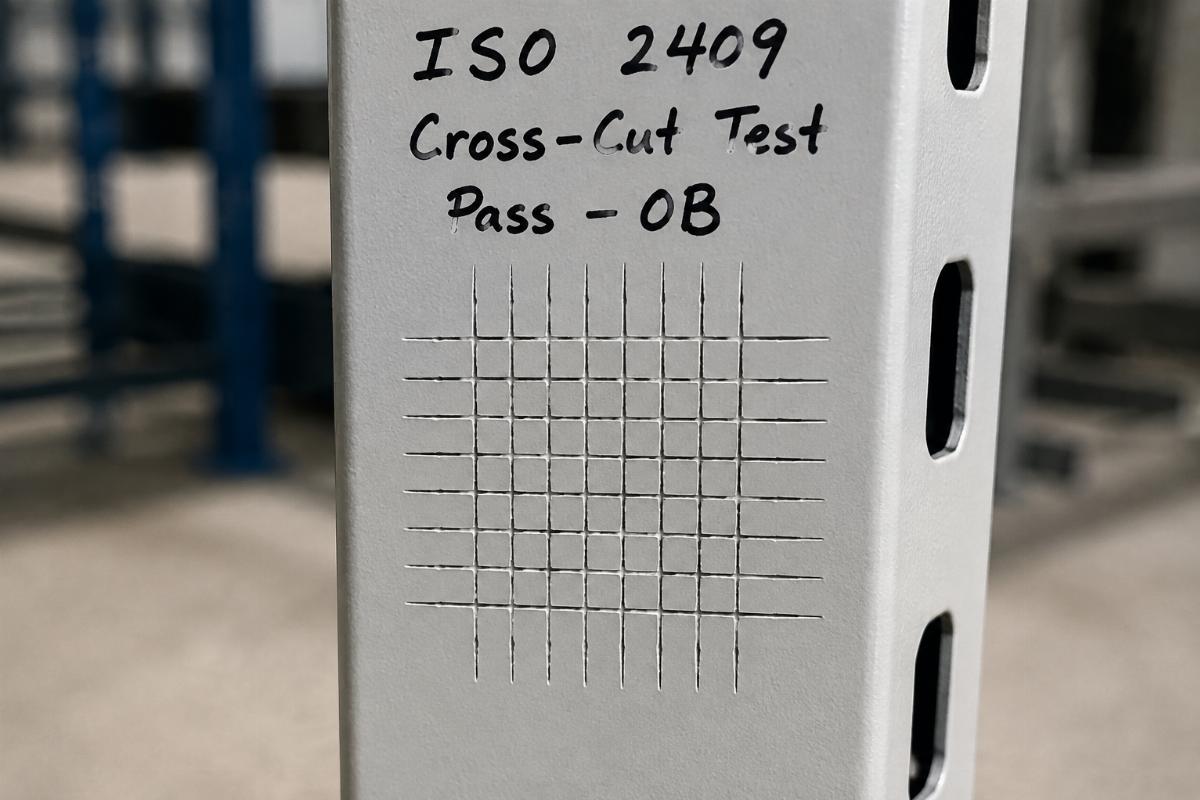
| Coating Process | Powder coat | Powder coat with sandblasting prep | Cross-cut adhesion test |
| Weld Standard | Structural weld | AWS D1.1 referenced | Visual + ultrasonic spot check |
| Load Rating | Published static rating | Matched or exceeded | Third-party load test report |
| Certifications | U.S. market focus | CE available | Certificate copy from factory |
[NEED_CITE: AWS D1.1 structural welding code requirements for fitness equipment]
The table above uses qualitative grading — Certified, Matched, Verifiable — because exact numeric comparisons on coating thickness or weld penetration depth vary by batch and are better confirmed through test reports than marketing claims.
A CrossFit box owner in the Gulf region ordered a batch of half racks for a new facility. The OEM factory customized the crossmember length to fit the ceiling height of his specific building — something Rep would not do for a small order. The racks shipped in a consolidated container alongside other strength equipment, spreading freight cost across the entire order. Per-unit freight dropped noticeably compared to shipping individual half racks from the U.S.
What the OEM does not give you is the Rep Fitness customer service line, the U.S. warehouse for replacement parts, or the community of users who share modification ideas online. For a commercial gym operator who has a local technician and does not need hand-holding, that trade-off is almost always worth it. [NEED_CITE: commercial gym equipment sourcing decision factors for independent operators]

How to Verify an OEM Half Rack Actually Matches Rep Specs?
Requesting a spec sheet is not verification — real confirmation comes from three documents: a steel mill certificate, a welding inspection report referencing AWS D1.1, and a coating adhesion test per ISO 2409.
When I first started sourcing half racks from Shandong factories, I made the mistake of trusting the sales rep’s Word document. "Yes, 11-gauge steel," they would say. "Yes, Westside holes." Then a sample arrived and the uprights flexed under load because the actual wall thickness was a gauge thinner than claimed. Since then, I have built a verification checklist that I run on every new factory relationship.
Step one: demand the Mill Certificate. This is the document issued by the steel producer that certifies the chemical composition and mechanical properties of the batch used to make your uprights. It should reference the specific gauge and confirm the yield strength falls within the expected range for 11-gauge structural steel. If a factory cannot produce this, walk away. [NEED_CITE: steel mill certificate requirements for fitness equipment frame sourcing]
Step two: confirm welding standards. The industry benchmark is AWS D1.1, the structural welding code. Ask the factory for their welding procedure specification and, if possible, a third-party inspection report covering weld penetration on the critical gusset joints where the uprights meet the base. Visual inspection alone misses lack-of-fusion defects that only show up under cyclic loading.
Step three: test the coating. Powder coating thickness means nothing if the surface prep was sloppy. The cross-cut adhesion test per ISO 2409 rates how well the coating bonds to the steel after a grid pattern is cut and tape is applied. A rating in the top classification range confirms the sandblasting and pre-treatment were done properly. [NEED_CITE: ISO 2409 cross-cut adhesion test standard for coated steel surfaces]
An African distributor I advised ordered a small trial batch of half racks to test his local market. The first factory’s sample looked perfect visually — clean welds, even coating. But when his technician ran a cross-cut test, the coating lifted in sheets. The factory had skipped the sandblasting step and coated directly over mill scale. He switched to a second supplier who provided full documentation, and the coating on that batch survived months of humid coastal conditions without peeling.
The verification process adds maybe a week to your sourcing timeline and costs almost nothing in documentation fees. Skipping it can cost you an entire container of unusable inventory.
What Is the Real Cost Breakdown — and Where Does OEM Save Money?
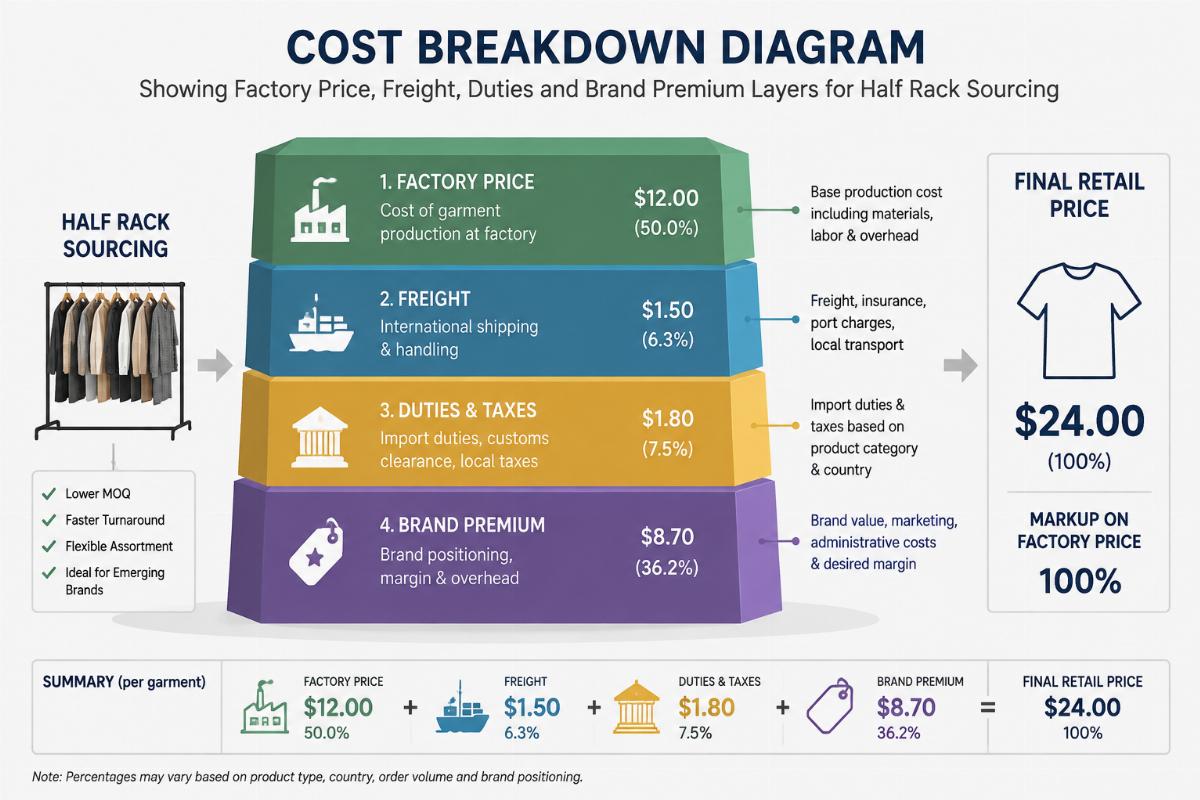
The savings from sourcing a Rep Fitness Half Rack OEM alternative come almost entirely from eliminating brand premium, U.S. warehousing overhead, and domestic freight — not from cutting corners on steel or welding.
When a gym owner asks me how much cheaper an OEM half rack is, I refuse to give a single percentage number. The actual savings depend on your order volume, your shipping method, and your local import duties. What I can do is break down the cost layers so you see exactly where the money goes.
Start with the factory price. A Shandong-based manufacturer producing 11-gauge half racks with Westside holes and powder coating will quote an FOB price that reflects raw material cost, labor, and factory overhead. This is the baseline.
Add ocean freight. Half racks are bulky but not exceptionally heavy, so they ship efficiently when nested or partially disassembled. A consolidated container carrying half racks alongside benches, plate trees, and cable machines spreads the freight cost across multiple SKUs. Per-unit freight for a consolidated shipment is substantially lower than shipping standalone units.
Add import duties and local trucking. These vary by country but are generally a fixed percentage of the CIF value. The key point is that you are paying duties on the OEM price, not the inflated U.S. retail price — so the duty dollar amount is lower too.
Now compare that to buying direct from Rep Fitness. You pay the U.S. retail price, which includes the factory cost plus brand margin, U.S. warehouse storage, pick-and-pack labor, and domestic freight to your door. If you are outside the U.S., you add international shipping on top of a price that already includes U.S. logistics costs you do not even use.
A private studio owner in the Middle East ran this math on a two-unit order. Buying from Rep, the total landed cost — including freight, customs, and local delivery — was nearly double the budget he had allocated. Sourcing the same spec from a Shandong OEM, with the racks consolidated into a container with other equipment, brought the per-unit landed cost down to roughly half of the Rep scenario. The delivery timeline compressed from months to weeks.
The factory I work with in Shandong produces commercial-grade half racks with CE certification, offers flexible minimum order quantities down to single units for market testing, and supports full OEM branding for distributors who want their own label. The pricing sits substantially below terminal brand retail because there is no U.S. warehouse, no domestic logistics network, and no brand marketing budget baked into the frame price. [NEED_CITE: fitness equipment OEM pricing structure comparison between China factory direct and U.S. brand retail]
Common Quality Failures in Cheap Half Racks — and How to Avoid Them
The three failure modes that destroy cheap half racks in commercial use are incomplete weld penetration, poor coating adhesion from skipped surface prep, and hole position drift from sloppy jigging — all three are detectable before you commit to a full order.
I have seen half racks that looked identical to Rep Fitness units from five feet away fall apart within months of commercial use. The failures were never mysterious. Each one traced back to a specific manufacturing shortcut that a careful buyer could have caught during the sampling phase.
Weld penetration failure. The gusset plates where the uprights connect to the base experience the highest cyclic loads in a half rack. If the welder rushes through the joint or uses insufficient amperage, the weld may look complete on the surface but lack fusion at the root. Under repeated loading — think thousands of heavy squats and bench presses — a crack initiates at that unfused zone and propagates until the joint fails. The fix is simple: require weld inspection reports and, if possible, have a third-party inspector perform ultrasonic testing on a sample of gusset welds from your production batch. [NEED_CITE: weld penetration inspection methods for structural fitness equipment frames]
Coating adhesion failure. I mentioned the cross-cut test earlier, but the root cause deserves emphasis. Steel arrives from the mill with a layer of mill scale — a thin oxide film that looks clean but prevents powder coating from bonding to the base metal. Proper surface prep requires abrasive blasting to remove that scale and create a profile for the coating to grip. Factories under cost pressure skip or shorten the blasting step. The coating goes on smooth, passes a thickness gauge check, and then starts peeling within months as moisture gets underneath. Specify sandblasting in your purchase order and verify with the adhesion test.
Hole position drift. The Westside hole pattern at the bottom of the upright must align precisely — one-inch spacing, centered on the upright face. If the factory’s drilling jig is worn or the operator does not clamp the upright firmly, holes drift by fractions of an inch. That fraction means your J-cups sit at an angle, creating uneven load distribution and premature wear on the hole edges. Check the hole pattern on your sample with a caliper and confirm spacing across the full Westside zone.
An African distributor’s first trial order came from a factory that failed on all three counts. The welds looked acceptable visually but lacked root penetration. The coating peeled after a single humid season. The hole spacing on one upright was off enough that J-cups did not seat flush. He tested a second factory with the verification checklist above, and that supplier’s production batch passed every check. He now sources his full range of strength equipment from that factory, including plate-loaded machines and cable crossovers, with consistent quality across orders.
The lesson is not that all cheap half racks are garbage. The lesson is that the gap between a reliable OEM product and a failing one is measured in process discipline, not in material cost. A factory that controls its welding parameters, insists on proper surface prep, and maintains tight drilling jigs will produce a half rack that performs identically to a branded unit — because the engineering decisions being replicated are sound and well-documented. [NEED_CITE: common manufacturing defects in imported fitness equipment and inspection methods]

Conclusion
A Rep Fitness Half Rack OEM alternative from a vetted Shandong manufacturer delivers the same 11-gauge steel construction, Westside hole pattern, and attachment compatibility at a substantially lower total landed cost — the savings come from eliminating brand overhead, not from compromising on structural integrity. Verify the steel with a mill certificate, confirm the welds against AWS D1.1, test the coating adhesion per ISO 2409, and inspect hole spacing on your sample before committing to production. The factories that pass these checks produce half racks that serve commercial gyms, CrossFit boxes, and private studios just as reliably as the branded originals.


